
 By

Recurly’s subscription data puts 66% of cancellations inside the first 12 months, and that single number should change how you plan everything else. Recurring revenue looks stable only if people stay, pay, and receive a box that earns money after every real cost is counted. Most first-time founders start with a niche, a logo, and a pile of inventory. Operators who survive start with proof.
Proof has a clear order. Validate demand with real payment before buying stock. Design a box you can pack the same way every cycle. Price it from contribution margin, build in pause and skip controls so unhappy subscribers have options besides canceling, then launch to a small cohort you can learn from before spending a dollar on acquisition.
Table of Contents
- Why Most Subscription Boxes Fail Early
- Validate Demand Before You Buy Inventory
- Source Products and Design a Repeatable Box
- Price Your Box Around Real Unit Economics
- Build Flexibility Into Your Subscription From Day One
- Launch Small and Measure What Actually Matters
- Tips for a Durable Box and Your Next Step
Why Most Subscription Boxes Fail Early
Recurring revenue is seductive because it feels automatic. You acquire a subscriber once, then charges repeat while you focus on finding the next customer. Packing day tells a different story. Products arrive late, shipping costs more than quoted, cards fail, and subscribers who loved box one decide box two was not worth it.
The early cancellation pattern is the core problem. As noted in the opening, a large share of subscribers leave in the first few months, which means you may never recover what you spent to acquire them. A box can show a profit on a simple product markup and still lose money once churn shortens the relationship. You don’t have a revenue problem at that point. You have a math problem that marketing can’t fix.

Retention decides whether acquisition was worth buying
Founders often treat churn as a later optimization, something to improve after launch. That timing is backwards. Subscription economics are highly sensitive to retention, so a small change in how long subscribers stay changes whether the whole offer works. You need at least three retention scenarios before launch, including a conservative case that assumes fast early exits.
The model also differs by box type. McKinsey research on subscription ecommerce consumers reports that replenishment subscriptions retain customers better than curation models, with approximately 45% of replenishment members remaining subscribed for at least a year. That doesn’t make curation a bad business. It means a surprise-based box carries more retention risk and needs stronger proof of repeat value.
Launch gate: Proceed only when projected lifetime contribution profit exceeds customer acquisition cost under your conservative churn case.
Branding can’t rescue a weak first box
A polished unboxing helps, but subscribers judge value against what they paid. If contents feel generic, poorly matched, or easy to buy elsewhere for less effort, attractive packaging only highlights the disappointment. The same applies to discounting. A cheap first shipment can fill your cohort with people who never intended to pay the normal price.
That’s why the sequence matters when you’re learning How to Start a Subscription Box Service that lasts. Prove demand, prove you can source and pack consistently, prove the margin, and give subscribers control before you scale. Skipping validation is the most common founder mistake because every later decision inherits that guesswork.
Validate Demand Before You Buy Inventory
Start with a narrow segment, not a broad niche with a catchy name. “Beauty lovers” tells you almost nothing about budget, frequency, or what would disappoint them. A specific segment has a recognizable problem, taste, or routine you can serve repeatedly. The narrower the segment, the easier it is to interview people, write a clear offer, and spot weak demand early.
If you need a refresher on the research discipline behind that work, our guide to researching a business before committing money covers the basics. Use it to structure questions before you talk to potential subscribers. Don’t use research as a way to collect compliments.
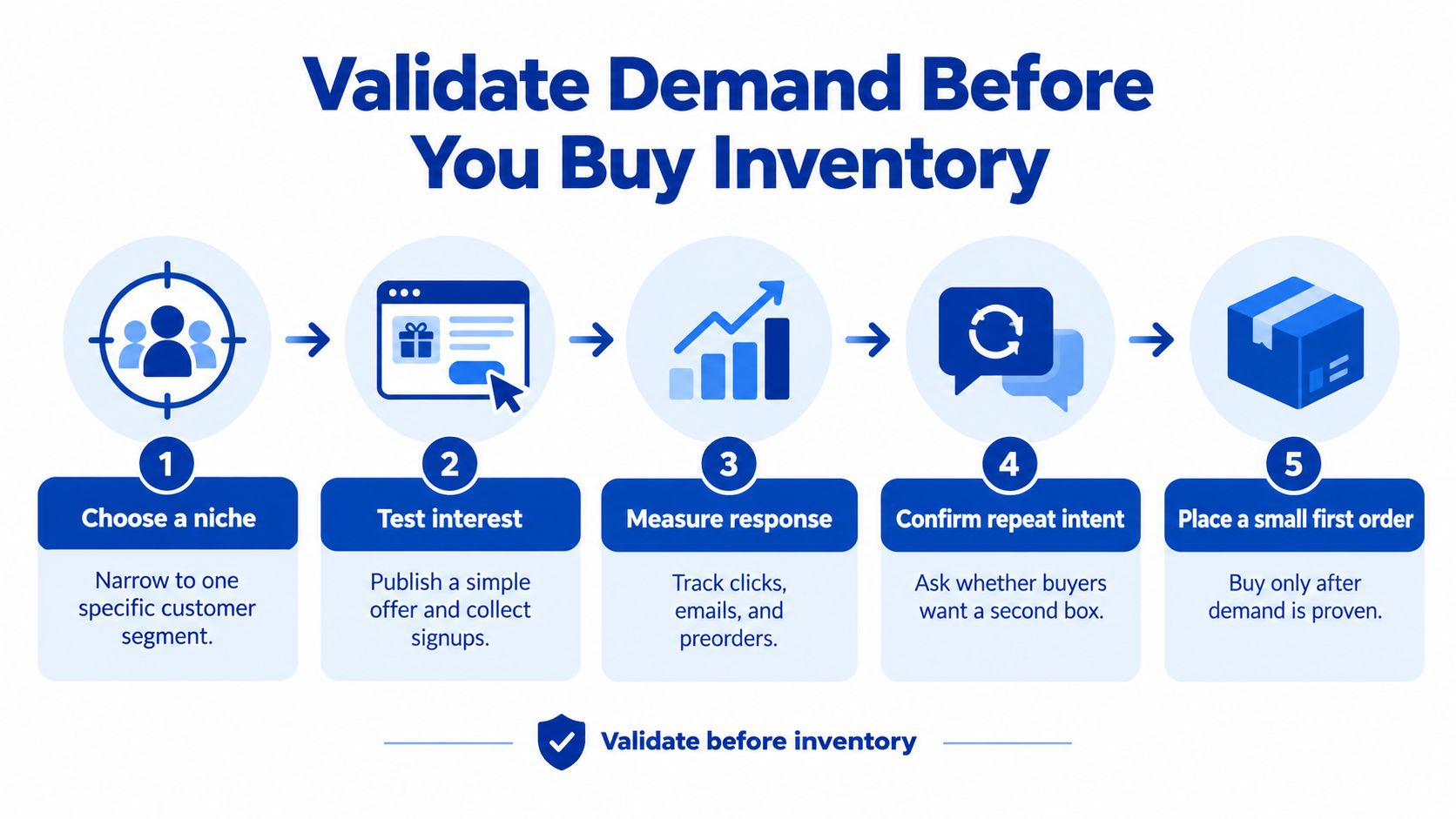
The five-step sequence below keeps you from buying inventory on enthusiasm alone.
Run interviews that surface payment intent
Structured interviews come first. Ask what people buy now, how often they run out or get bored, what they have cancelled before, and what made them stay with any subscription. Polite interest is not demand. Someone saying they’d “probably try it” has given you no usable evidence.
Listen for specific friction. Stockpiling, wrong shades, stale snacks, unused hobby supplies, and rigid delivery dates all point to the flexibility you’ll need later. Record objections in the customer’s own categories, then use them to shape the offer. You’re testing whether the problem repeats often enough to support a subscription.
Add friction with a landing page and paid presale
Next, publish a simple landing page that states who the box is for, what arrives, how often it ships, and what it costs. Collect signups, but treat email capture as a weak signal. The stronger test is a paid presale, even for a small founding cohort, because payment separates curiosity from commitment.
This video walkthrough helps you think through the practical setup before you test your own offer.
Measure conversion by cohort rather than relying on survey interest. Track which message, channel, and price produced buyers, and whether those buyers say they’d take a second box at the normal price. If you need packaging for a small test, compare UK short-run box printing costs before ordering a large print run you may redesign after feedback.
- Interviews: Test the problem, current spending, and past cancellation reasons.
- Landing page: Test whether a clear offer converts strangers into signups.
- Paid presale: Test whether people commit money before you buy stock.
Don’t proceed because feedback sounds warm. Proceed when presale buyers cover a believable first run and projected lifetime contribution beats acquisition cost under conservative churn. That gate feels strict. It’s cheaper than a storage unit full of unsold inventory.
Source Products and Design a Repeatable Box
Validation tells you someone wants the box. Operations decide whether you can deliver that promise every cycle without heroic last-minute shopping. Start with a limited SKU count. Fewer products means fewer suppliers to chase, fewer substitutions to explain, and a packing process a helper can learn quickly.
Supplier choice should follow the box’s job, not whoever offers the most novelty that week. If you’re new to supplier evaluation, our guide to sourcing raw materials for small-scale enterprises gives you a useful starting framework. The same discipline applies whether you’re buying finished goods, ingredients, or components.
Write a fixed box architecture
Your box architecture is the written spec every shipment follows. It keeps curation from becoming improvisation and gives suppliers a clear brief on size, quality, and timing. Without it, each month becomes a new product launch with new failure points.
- Dimensions and weight: Define maximum item size and total packed weight before you source.
- Substitutions: Decide in advance what can replace an item if a shipment falls short.
- Allergen disclosures: Required for food, beauty, and wellness products where ingredients matter.
- Quality checks: Note damage, leakage, expiry, scent, color, and labeling checks at intake.
- Assembly sequence: Set the order items go into the box so packing stays consistent.
- Cutoff dates: Lock order, payment, and address-change deadlines for each cycle.
Approach suppliers with volume tiers rather than a single order quantity. Ask how pricing, lead time, and minimums change as your cohort grows, and get substitution and shortage terms in writing. A supplier who’s flexible in a sales call but vague in writing will be vague again when you’re against a ship date.
Learn from adjacent subscription categories
Look outside your exact niche for operational warnings. Apparel, for example, adds sizing, taste, and return complexity that a simple replenishment box avoids, which is why reading subscription box advice for football shirt collectors can help you think through preference matching even if you never sell clothing. The lesson travels. The more personal the product, the more your box needs preference data and clear swap rules.
If you can’t write the packing sequence on one page, you’re not ready to scale the box.
Before launch, run a small packing pilot and record what happens. Time each pick, measure packing-material consumption, check dimensional weight, note damage, and watch for delivery exceptions. Those observations replace the optimistic estimates in your spreadsheet. They also reveal whether your box architecture works on a real table, with real products, under a real deadline.
Price Your Box Around Real Unit Economics
Price is not what competitors charge plus a hopeful markup. Price is what remains after the full cost of one shipped box is counted. Define contribution margin per shipment as subscription price minus product cost, packaging, pick and pack labor, shipping, payment fees, and expected refunds and failed-payment losses. If that number is weak, growth only multiplies the weakness.
Retention makes the pricing decision sharper. Recurly’s 2025 subscriber research on churn prevention found that 66% of cancellations occur within the first 12 months, while 89% of surveyed consumers considered good value for money a top subscription attribute; a separate 2025 Fuel Cycle survey of 672 consumers found cost was the leading cancellation reason at 37%, followed by insufficient perceived value at 23%. High price and weak value are not separate problems. Subscribers experience them as the same thing.
Build your worksheet line by line
Use the table below to build a worksheet before you set monthly, quarterly, or annual prices. If costing models are new to you, our overview of cost and costing models in companies will help you classify each expense correctly. For a broader margin review, a financial health check for ecommerce brands is a practical companion once your first numbers exist.
| Cost Component | What to Include |
|---|---|
| Product cost | Wholesale price, inbound freight, samples wasted in testing, shrinkage |
| Packaging | Outer box, filler, inserts, labels, tape, protective materials |
| Pick and pack labor | Your time or paid labor for assembly, quality checks, labeling |
| Shipping | Carrier charge at actual packed size and dimensional weight |
| Payment fees | Processing fees plus expected failed-payment losses |
| Refunds and replacements | Damaged goods, missing items, delivery exceptions, goodwill credits |
Test plan lengths without destroying box one
Monthly plans reduce commitment and usually make the first purchase easier. Quarterly and annual plans improve cash collection upfront, but they don’t fix a box subscribers don’t value. Test all three if your segment supports them, and model each under the same conservative churn case.
Avoid discounting so much that the first shipment is unprofitable. A low introductory price attracts deal seekers who may never accept the normal price, and it leaves no margin to absorb a damaged shipment or failed payment. The opposite error is stuffing an expensive surprise box with generic items to justify the ticket. Subscribers don’t renew based on claimed retail value. They renew when the box feels worth what left their bank account.
Pricing rule: If box one needs box four to become profitable, churn gets a vote on whether you ever reach box four.
Set price from the worksheet, then check it against perceived value in interviews and presale conversion. If buyers balk, don’t automatically cut price. Reduce product cost, simplify packaging, change frequency, narrow the segment, or improve the match between contents and need. Price is the outcome of those choices, not a substitute for making them.
Build Flexibility Into Your Subscription From Day One
Most launch guides treat retention as email copy and discount offers. Subscribers experience retention as control. They want to pause during travel, skip when shelves are full, change frequency when budgets tighten, and cancel without hunting for a hidden button. Build those controls before launch, then model what each one does to cash flow and inventory.
The evidence supports that contrarian approach. Mastercard and FT Strategies subscription economy research covering more than 10,000 consumers found that 31% frequently cancel and resubscribe, 57% of U.S. subscription businesses rank pausing among their three most effective retention tactics, and 74% of consumers are more likely to subscribe when cancellation is simple. Easy exit sounds risky. In practice, it lowers the fear of signing up.
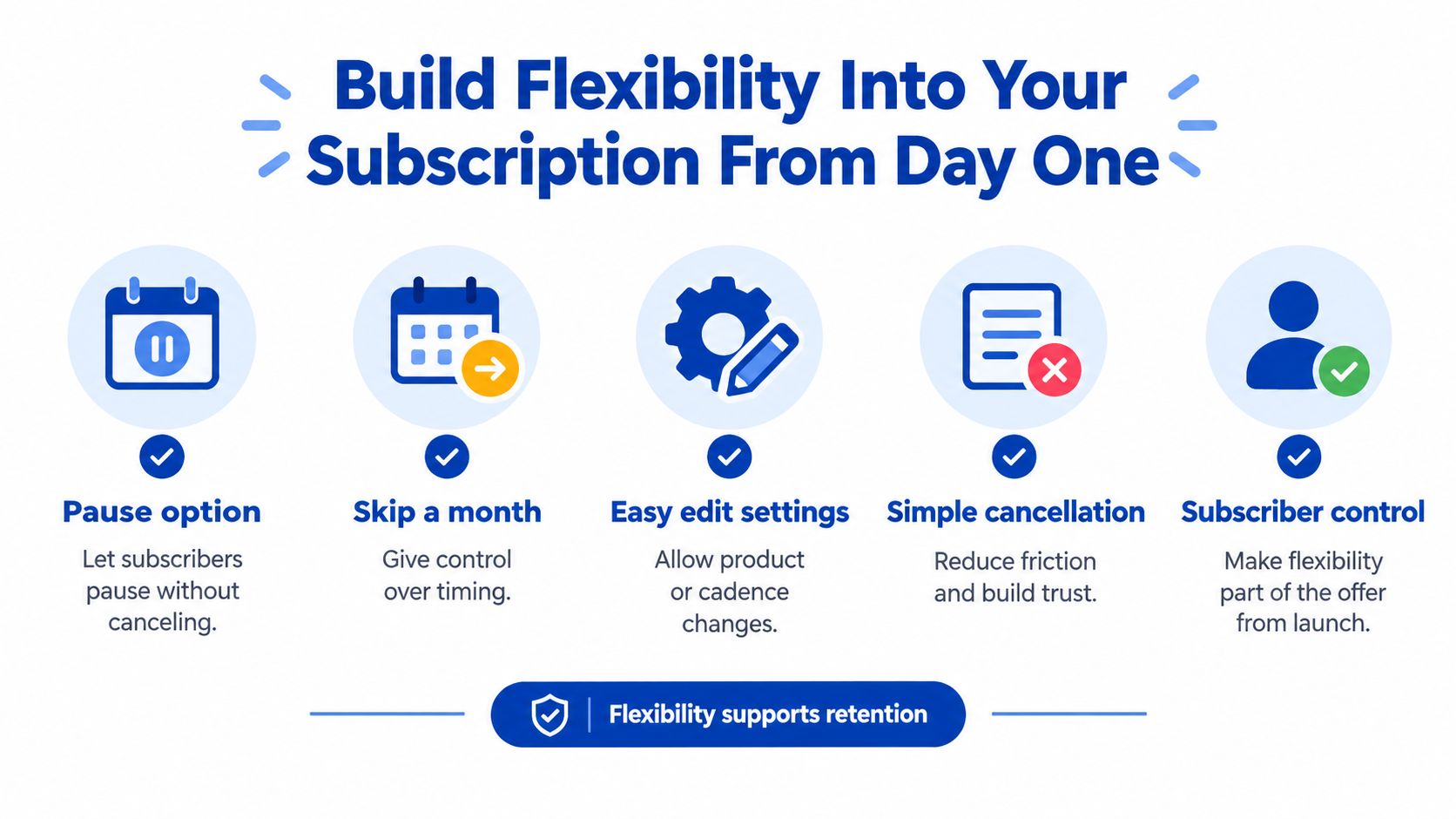
The checklist below shows the flexibility features to design before your first cohort arrives.
Decide what pause and skip do to inventory
A pause isn’t just a portal setting. It changes how many units you order, how much cash arrives that cycle, and whether you hold stock for someone who may return. For perishable or seasonal products, holding inventory can create waste. For replenishment staples, holding a small buffer may be reasonable.
- Pause: Define maximum pause length and what happens when it expires.
- Skip: Let subscribers miss one cycle without losing preferences or founding pricing.
- Frequency change: Move monthly buyers to a slower cadence before they cancel from stockpiling.
- Build your own box: Offer limited choices inside your box architecture so fulfillment stays manageable.
- Simple cancellation: Show the path clearly and ask one short reason question.
Forecast demand by cohort with these behaviors included. Active, paused, skipped, and cancelled subscribers should not be blended into one optimistic order quantity. Decide in advance when you’ll liquidate excess stock, bundle it as an add-on, or reserve it for reactivations.
Treat cancellation as a possible pause
Because many subscribers cancel and later resubscribe, your reactivation campaign should sound different from a win-back discount blast. Acknowledge the reason they left, tell them what changed, and make restarting easy at a frequency that fits their life now. Someone who left with a full bathroom shelf doesn’t need urgency. They need timing.
This matters most for beauty, food, hobby, and wellness boxes where products pile up, expire, or lose relevance when routines change. Rigid monthly delivery turns a temporary problem into a permanent cancellation. Flexibility protects lifetime value only if you’ve priced the pauses into your cash flow and ordering rules. Build the control panel and the financial model together.
Launch Small and Measure What Actually Matters
Launch is not a big reveal. It’s a controlled pilot with paying subscribers, a fixed ship date, and a short list of numbers you’ll review before spending more on acquisition. Keep the first cohort small enough that you can read every support message, inspect returns yourself, and fix packing errors without a public mess.
Sell the pilot as exactly what it is. Founding subscribers accept limited quantity and a feedback loop when you’re clear about timing and what may change. What they won’t accept is a missed ship date, surprise substitutions, or silence when a payment fails.
The image below captures the launch work, which is less about hype and more about reviewing cohort data with your team.

Measure the first to second box transition
The most useful early metric is first-to-second-box conversion. It tells you whether the first shipment created enough value for a repeat charge at the normal rhythm. Track it by acquisition source and offer, because discount buyers and full-price presale buyers behave differently.
- Contribution margin after delivery: Recalculate using actual packing time, shipping, damage, and replacements.
- Refund rate: Separate product dissatisfaction from delivery and billing problems.
- Failed payments: Count recovered and unrecovered failures as part of real churn.
- Renewal rate: Watch each cohort by cycle rather than celebrating total subscriber count.
- Cancellation reasons: Code responses consistently so patterns are visible over time.
During the pilot, record renewal behavior alongside operational exceptions. A late box may explain a cancellation that looks like a value problem in a survey. A damaged item may explain why an otherwise strong cohort weakens at box two. Connect the customer outcome to the operational cause before you redesign the offer.
Scale only when repeat economics hold
An acquisition spike is not durable revenue. If repeat economics fail under conservative churn, more paid traffic gives you more subscribers to lose and more inventory to fund. Scale acquisition only when contribution margin, renewal behavior, and failed-payment recovery hold together across the pilot cohort.
A smaller, tightly defined audience that renews is worth more than broad traffic that samples once and leaves.
That point matters in crowded categories where subscribers aren’t adding unlimited new spending. They’re replacing one box with another. Your advantage won’t come from shouting louder at launch. It will come from a specific promise, reliable delivery, and evidence that people stay past the fragile early cycles.
Tips for a Durable Box and Your Next Step
Durable boxes are run by habits, not launch energy. Rerun unit economics whenever product cost, packaging, shipping, or labor changes, even if the change looks small. Small leaks repeat every cycle. A box that’s slightly underpriced doesn’t fail once. It fails on every shipment.
Watch cohort curves instead of headline subscriber counts. A growing total can hide weakening renewal if acquisition keeps covering the losses. Review each cohort by cycle, plan type, pause behavior, and acquisition source. When box two or three softens, you want to know whether the cause was value, stockpiling, billing failure, or a fulfillment mistake.
Keep fulfillment boring until it is reliable
Don’t keep reinventing the box to chase novelty. Keep SKU count tight, follow your box architecture, and make packing repeatable before you add personalization or complex add-ons. Boring fulfillment gives you cleaner data. When subscribers complain, you’ll know the issue is product fit or value, not a different packing error every month.
Treat every cancellation response as product research. Short answers still have value when you code them consistently. Too much product points to frequency or skip design. Too expensive points to value or segment fit. Not for me points to curation, preference data, or an offer that promised the wrong thing.
- Rerun the worksheet: Update costs before each major order, not after margin disappears.
- Review cohorts monthly: Compare renewal and pause behavior across acquisition sources.
- Protect the spec: Change the box architecture deliberately, then retime packing and shipping.
- Read cancellations weekly: Turn repeated reasons into product, pricing, or frequency changes.
Keep building the wider business skill set
We publish practical business and ecommerce guidance for founders who are still building these skills. Our Making Money Insight category collects articles on income models and business operations, and we offer free best selling ebooks for readers who want longer resources. Our newsletter subscription is no spam, with notifications only about news and latest updates.
Your next step is specific and small. Pick one narrow segment this week, interview people in it, and run a paid presale test before ordering a single unit of inventory. If buyers won’t commit now, change the segment, offer, or price while the lesson is still cheap.
If you’re building a subscription box or another ecommerce income stream, visit Mega Income Stream for practical guides on business operations, pricing, and online income models that can support your next launch. Start with the validation and unit-economics work from this guide, then use our wider business resources to plan your next move before you spend on inventory or ads.
Generated with the Outrank tool










Comments