
 By

A boutique strategy firm may be the better fit for mid-market business growth when the work calls for specialized advice and close involvement from senior advisors. Privately held mid-market companies are characterized as having $5 million to $150 million in revenue, while boutique consulting firms typically have fewer than 1,000 employees. The choice between McKinsey and a boutique strategy firm depends on the decision at hand, the team doing the work, and the support needed to put recommendations into action.
A large firm can bring broad resources and global capacity, while a boutique may offer a focused team and direct access to its leaders. Both can help with strategy, but progress often depends on advisor fit and who owns execution. This comparison explains how the models differ in specialization, team structure, and implementation support, and when a large firm’s scale may matter more than a boutique’s closer engagement.
Key Takeaways
- Compare the people who will deliver the work, not just the firm names on the proposal.
- Define the business decision and intended outcome before choosing a consulting model.
- Assess how each advisor will support execution, track progress, and work with your team.
- Look for relevant industry or problem expertise that matches your company’s growth priorities.
- Match the firm’s capabilities to the work, from focused strategic decisions to broader transformation needs.
What is a boutique consulting firm?
A boutique consulting firm is a smaller, focused team, often led by operators with expertise in a specific industry or problem. Privately held mid-market companies are characterized as having $5 million to $150 million in revenue. For these businesses, choosing between McKinsey and a boutique strategy firm for growth depends on who leads the work and how advice connects to a decision. The consulting firm model matters less than the match between its expertise and the company’s needs.
To compare these consulting models, watch this overview:
Boutique Services for Mid-Market Businesses
Boutique consulting can support decisions such as pricing, organizational design, market entry, integration, and exit. Its defining feature is focus: the firm concentrates analysis on a specific business question rather than assembling broad capabilities across unrelated workstreams. A boutique may deliver a written product tied to a decision instead of a 60-slide deck. The specific business question should shape the work and its output.
Smaller teams can offer company leaders closer access to the advisor directing the engagement. In an operator-led model, the person who sells the work typically performs it, keeping context with the person responsible for recommendations. Boutique consulting firms typically have fewer than 1,000 employees, though size alone doesn’t establish fit. A mid-market growth mandate should match the team’s expertise to the decisions leaders need to make.
Defining the Work Before Comparing Firm Size
Start by defining the decision, the outcome the company needs, and what it can do next. A mid-market company considering a new market, for example, needs evidence about the opportunity and a clear basis for choosing. That mandate differs from coordinating a complex transformation across multiple workstreams. Define the decision before choosing a team structure.
Then clarify the expected deliverables, who will do the analysis, and which tasks will stay with company staff. Identify the engagement lead, the team’s relevant experience and availability, and how recommendations will be tested against company assumptions. This makes comparing McKinsey and boutique firms for mid-market growth practical: fit depends on the decision, team capacity, and implementation needs.
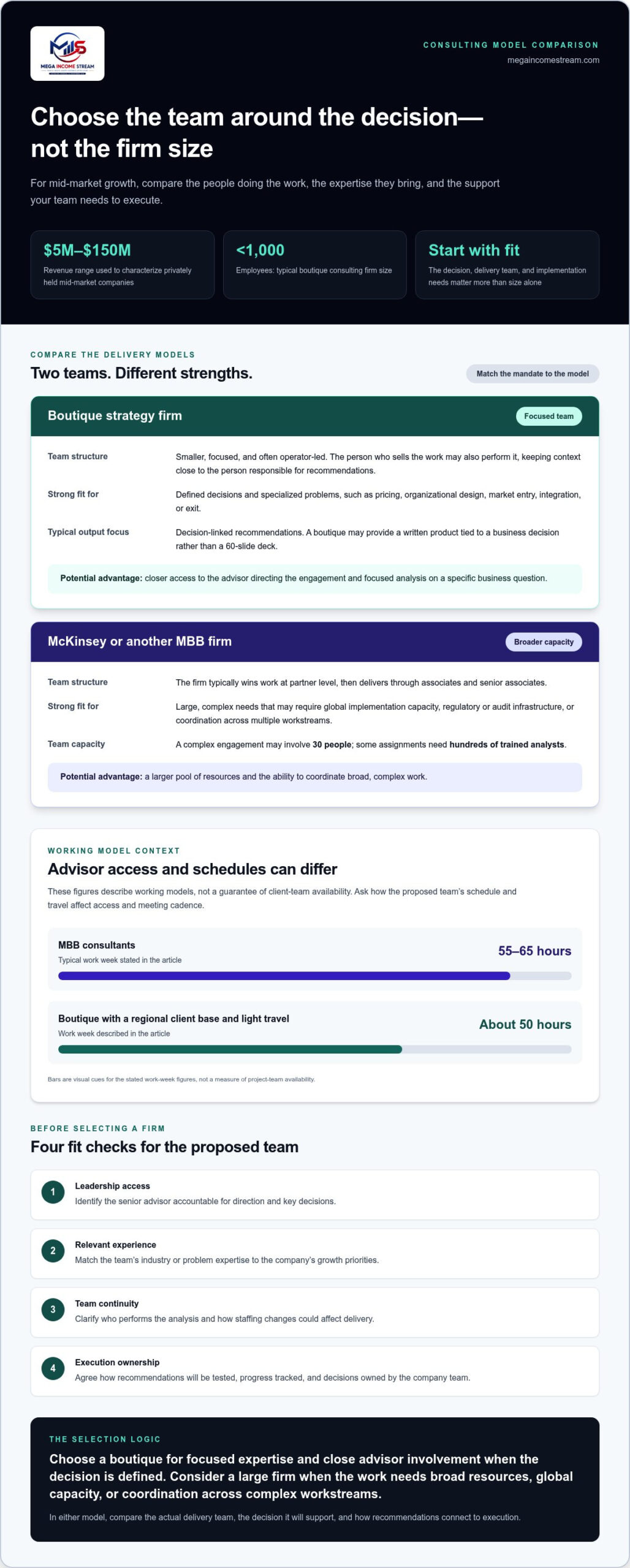
McKinsey and other MBB firms can suit large enterprises, including Fortune 500 companies, when work requires global implementation capacity, regulatory or audit infrastructure, or a large team. A complex engagement may involve 30 people; some assignments need hundreds of trained analysts. Large firms typically win business at partner level, then deliver through associates and senior associates.
| Option | Team model | Best-fit work | Deliverable focus |
|---|---|---|---|
| Boutique consulting firm | Smaller, focused, often operator-led | Defined decisions and specialized problems | Decision-linked recommendations |
| McKinsey or another MBB firm | Partner-led sale, associate delivery | Large, complex, multi-workstream needs | Broad analysis and coordinated capacity |
Choose based on the decision, team capacity, and implementation needs, not firm size alone.
Matching an advisor to the work ahead
Match the advisor to the decisions, working relationship, and capacity your company needs. A mid-market leadership team should assess sector experience, senior access, and who is responsible for recommendations. A broad network can help when an assignment requires varied expertise; a specialist may fit better when the problem calls for deeper knowledge of one business area. For mid-market business growth, begin the McKinsey-versus-boutique strategy firm comparison with the work, not the brand.
Culture matters because consulting requires employees to share information, challenge assumptions, and make decisions with advisors. A private business may prefer working closely with a small team, while a company coordinating multiple departments may need a larger structure. Ask who leads the analysis, how the team will work with staff, and how leaders will make decisions as findings emerge. These details shape the project’s day-to-day experience.
Working hours and travel also affect advisor fit. MBB consultants typically work 55 to 65 hours per week. A boutique firm with a regional client base and light travel can offer a work week of about 50 hours. Those working models can influence meeting schedules and access to advisors. Ask how the proposed team’s travel and availability fit your company’s operating rhythm.
Vacation figures provide context about firm employment, not a promise about client-team availability. Bain gave its 2025 MBA class 25 paid vacation days. McKinsey gave its 2025 MBA class 19 paid days off, while BCG gave its 2025 MBA class 15 paid days off. For the McKinsey-versus-boutique strategy firm choice for mid-market growth, focus on the actual project team and its coverage plan.
- Leadership access: Identify the senior advisor accountable for direction and key decisions.
- Sector experience: Match prior work to the company’s industry and growth challenge.
- Team continuity: Clarify who performs analysis and how staffing changes affect delivery.
- Working model: Align meeting cadence, travel, and staff responsibilities before kickoff.
Choose the advisor whose experience and availability match the work, then agree on progress tracking and decision ownership. To translate growth priorities into practical business strategies, business strategy guidance can help frame the next steps.
Boutique firm advantages in strategy execution
A boutique can connect senior advice to implementation through focused leadership and a defined scope. That matters when a mid-market company needs recommendations its team can act on, not strategy work detached from operating decisions. At kickoff, set the outcome, assign internal owners, and agree how progress will be reviewed. A pricing decision, for example, needs both an analysis of options and a clear owner to put the selected approach into practice.
Ongoing senior involvement can make the work more continuous. Gelbard says he is actively involved in each engagement he takes on, rather than acting only as an occasional reviewer. By contrast, a large-firm partner may manage ten other client relationships during an engagement. The practical question is not firm size alone: does the person shaping recommendations stay connected as company leaders test and apply them?
Commercial structure can also shape the work. Boutique advisors who charge retainers or project fees may have an incentive to reach the right answer efficiently. That does not mean every project is fee-based or guarantee a faster result. It does make it important to clarify scope, milestones, decision rights, and what counts as a completed deliverable before work begins. Clear boundaries keep the focus on the outcome, not activity without a defined business need.
- Set the outcome: State the business decision and what a useful recommendation must enable.
- Assign owners: Name company staff responsible for decisions and implementation tasks.
- Track progress: Agree on review points and how leaders will resolve open decisions.
- Protect continuity: Identify the senior lead and how the team will communicate changes.
These steps help compare consulting firms on execution, not presentation alone. Evaluate each proposal for scope, leadership access, your team’s capacity, and implementation ownership. A boutique’s specialization and close engagement can help when a defined strategic choice needs direct follow-through. A larger firm may fit better when the work calls for broad coordination or capacity across multiple workstreams.
Before kickoff, put the work plan into operational terms: list decisions, responsible owners, evidence needed, and how recommendations will be tested with staff. Then establish how changes in priorities will affect scope and responsibilities. For a practical way to structure strategy execution planning, connect the recommendations to accountable owners and measurable business actions.
Boutique firm specialization
A boutique’s specialization is useful when the company’s challenge matches the advisor’s demonstrated expertise. Boutiques often focus on a particular industry, function, or type of problem. That focus can shape the questions asked, the evidence analyzed, and the recommendations made. For example, a firm specializing in pricing can examine customer segments and offer design instead of treating pricing as one item in a broad corporate review.
Specialization matters most when context changes the answer. A market-entry plan for a software company involves different customers, channels, and operating constraints than one for a manufacturer. A boutique with relevant sector experience may bring that context to the engagement quickly. A global firm can be a stronger fit when the work requires expertise across regions or coordinated implementation capacity.
Check whether the advisor’s past work matches your company’s stage and scale, not just its industry. A founder-led business and a mature private company may face different growth bottlenecks in the same sector. Ask for examples of comparable strategic problems, the advisor’s role, and the decisions those engagements supported. Then assess how closely those examples match your priorities.
Specific outcomes can help assess fit, but interpret them in context. In a survey of pharma business-development executives, 78% reported superior outcomes from boutique advisory firms on licensing transactions. That finding relates to pharma licensing, not every advisory assignment. It suggests a useful evaluation question: does the firm’s specialization align closely with the work being commissioned?
Use a focused evaluation process before choosing a boutique consulting firm:
- Stage and scale: Compare the advisor’s experience with businesses facing similar growth conditions.
- Sector depth: Ask how industry knowledge changes the analysis or recommendation.
- Relevant references: Request callable references tied to comparable work.
- Pricing alignment: Match the proposed commercial structure to the engagement’s scope and outcome.
- Professional judgment: Assess how the advisor handles assumptions, trade-offs, and evidence.
A competitive advantage can come from insight that leads to a decision, not simply an industry label. In an initial conversation, describe the growth constraint and ask how the advisor would investigate it. A strong response should connect the proposed analysis to specific choices, such as prioritizing customer groups or testing a new channel, rather than jumping to a generic playbook.
Finally, distinguish specialist depth from global reach. For a defined sector problem, relevant advisory experience and access to the lead expert may matter most. For work spanning markets, functions, or implementation teams, broader infrastructure may be more important. Choose the engagement model by comparing the work required with the expertise and capacity the proposed team can provide.
What services do boutique strategy consulting firms offer mid-market businesses?
Boutique strategy consulting can cover focused work across strategy, operations, technology, and digital transformation. The right scope depends on the business decision, the expertise needed, and the company’s ability to act on recommendations. For example, a growth strategy mandate might assess customer segments, channel priorities, and operating constraints, then outline choices for leadership.
In operations, an engagement could map a slow handoff between sales and delivery, identify the source of delays, and recommend a revised workflow. Technology work may assess how current systems support a business process. Digital transformation might connect a strategic goal to changes in tools, processes, or team responsibilities. These are distinct scopes, so define the problem before combining them.
A boutique firm may focus on one service area or combine related capabilities. That focus can give a mid-market company targeted analysis without turning a defined problem into a broad transformation program. A wider mandate may require several specialists, coordinated workstreams, and stronger internal project ownership. Match the scope to the decision rather than assuming every growth challenge needs the same consulting package.
Use these steps to turn a broad growth concern into a workable mandate:
- Name the decision: State what leadership must choose, such as which customer segment to prioritize.
- Set the boundary: Specify which functions, markets, or processes belong in the analysis.
- Define the output: Identify the decisions or actions the recommendations should enable.
- Assign internal owners: Name the staff who will provide information and lead implementation.
This sequence helps separate strategic analysis from execution support. If a company needs to choose a market, the work may focus on customer demand, competitive position, and entry options. If it has already chosen a market, the mandate may instead address the operating changes needed to serve it. Keeping these questions separate makes progress easier to measure and responsibilities clearer.
For a broader transformation, Tier 2 consulting firms offer services across strategy, operations, technology, and digital transformation. Boutique consulting firms may provide a narrower specialist fit, while a larger platform can coordinate a wider scope. Compare proposals by asking which expertise each workstream requires, who will lead it, and how recommendations connect to company decisions.
Turn a growth priority into a defined scope and an actionable plan with practical business strategy guidance.
Mega Income Stream: Business Strategies
Mega Income Stream helps business leaders turn growth priorities into practical strategies and revenue opportunities. If your next step is to turn a consulting recommendation into a focused plan, its Business Strategies and Consulting Business offerings can help structure the work. Making Money Insights can also support decisions about developing sustainable income streams and identifying market opportunities. Use these offerings to move from strategic choices to actions your team can own, rather than another set of broad ideas. Make the next move concrete: define the growth objective, identify the decision blocking progress, and outline the outcome you want to pursue. To discuss your business strategy needs, contact Mega Income Stream or visit megaincomestream.com.
Turn the Firm Choice Into Forward Motion
Choosing between McKinsey and a boutique strategy firm for mid-market business growth matters only if the decision leads to action. Set the next phase around a clear operating priority: identify the choice leadership must make, assign an internal owner, and define how the team will put the decision into practice. This keeps the consulting engagement tied to the company’s actual growth agenda.
Use the same discipline after the advisor’s work ends. Translate recommendations into decisions, owners, and review points your team can manage. If you need help shaping that next move, connect with Mega Income Stream about your business priorities. A focused plan gives leaders a practical starting point and helps keep growth work moving with purpose.
FAQs
What Is the Day-to-Day Work Like at Each?
Day-to-day routines depend on the assignment and team design. On a boutique project, the lead advisor may work directly with executives during analysis and decision sessions. A large-firm team may divide research, modeling, and presentation tasks among several roles. For a practical comparison, ask each proposed team to describe a typical project week, including when your staff contribute and who presents findings.
How Should You Choose Between MBB and a Boutique?
Choose by identifying what the engagement must deliver and the capabilities needed to deliver it. A company preparing a board-level decision may value a recognized firm’s credibility. A company seeking focused expertise may prioritize a specialist’s relevant experience and access. Compare proposed team members, availability, working methods, and implementation responsibilities, then select the model that fits the decision and the organization’s ability to act.
Cost: How Much Are Clients Actually Saving?
There’s no universal saving to calculate without comparing equivalent scopes. Review what each proposal includes: research, leadership workshops, analysis, recommendations, and support after presentation. Check whether one option includes extra workstreams the company doesn’t need. Compare the total expected effort and deliverables with the decision’s value to the business. This makes the commercial comparison more useful than comparing headline fees alone.
Principal-Led Delivery: Who Is Really Doing Your Project?
Look beyond the senior name on a proposal and map responsibility for each work product. Ask who gathers evidence, builds analyses, challenges assumptions, and presents recommendations. Clarify who can make scope decisions and resolve disagreements during the engagement. A responsibility map helps executives understand the principal’s direct involvement and where company staff need to contribute, without relying on titles alone.
How do McKinsey and boutique strategy firms compare on growth strategy outcomes?
Outcomes depend on whether the analysis fits the company’s market and leaders use it to make decisions. For example, a growth plan should link its assumptions about customer demand to choices about products, channels, or investment priorities. Track the decisions made and the operating indicators leadership chooses to assess progress. This offers a practical way to evaluate the strategy’s usefulness without assuming either firm type guarantees results.
What do boutique strategy consultants charge for mid-market projects?
Project fees vary with scope, required expertise, deliverables, and advisor involvement. Instead of relying on a broad benchmark, compare proposals line by line. Confirm whether each covers discovery, analysis, leadership discussions, final recommendations, and follow-through. Distinguish a narrow diagnostic from a broader strategy mandate. These details explain why proposals differ and whether each addresses the business decision at hand.
How do McKinsey and boutique firms differ in team size and senior partner involvement?
Team size and senior involvement depend on the proposed engagement, so review the named roles rather than assuming a standard setup. Ask how many people will attend core working sessions, who reviews the analysis, and how often senior leaders participate. Establish how the team will handle a personnel change. These details show whether the delivery model gives executives the right access while meeting the project’s workload.
Which types of mid-market growth challenges are best suited to McKinsey versus a boutique firm?
A boutique may suit a company testing a specific growth lever, such as reshaping its product mix around customer feedback. McKinsey may suit a decision requiring broad coordination across business units or regions. To distinguish between the cases, list the affected teams, markets, and decisions, then identify where specialized insight or coordination matters most. This turns a broad growth challenge into a clearer assessment of the capabilities required.








Comments