
 By

A practical way to start an AI automation agency is to focus on a specific business outcome and make delivery repeatable. The first decision isn’t which AI tool to use. It’s which business process needs a better system and how you’ll demonstrate the value of your service.
That focus shapes your offer, sales conversations, and operating model. A clear outcome helps potential clients understand what they’re buying, while a defined scope makes delivery easier to plan. Pricing should reflect the work involved and whether the engagement ends at implementation or includes ongoing support.
This guide covers the choices that turn automation skills into a business: finding a niche you can reach, selecting tools that fit client workflows, setting project or recurring prices, and planning delivery around your schedule. You’ll also learn to frame your service around results, not technology alone. Use these steps to create a focused plan, test it in real client conversations, and refine your model as you learn which problems you can solve consistently.
Key Takeaways
- Choose a reachable niche with repetitive processes and a clear business problem to solve.
- Build a lean tool stack around the client workflow, then document how data moves from input to outcome.
- Separate implementation fees from ongoing support, and base pricing on scope, complexity, and measurable value.
- Keep a side-business schedule focused on delivery and client acquisition so you can build without disrupting other work.
- Package your service around a specific result, then use early projects to refine the offer before scaling it.
How to Start an AI Agency?
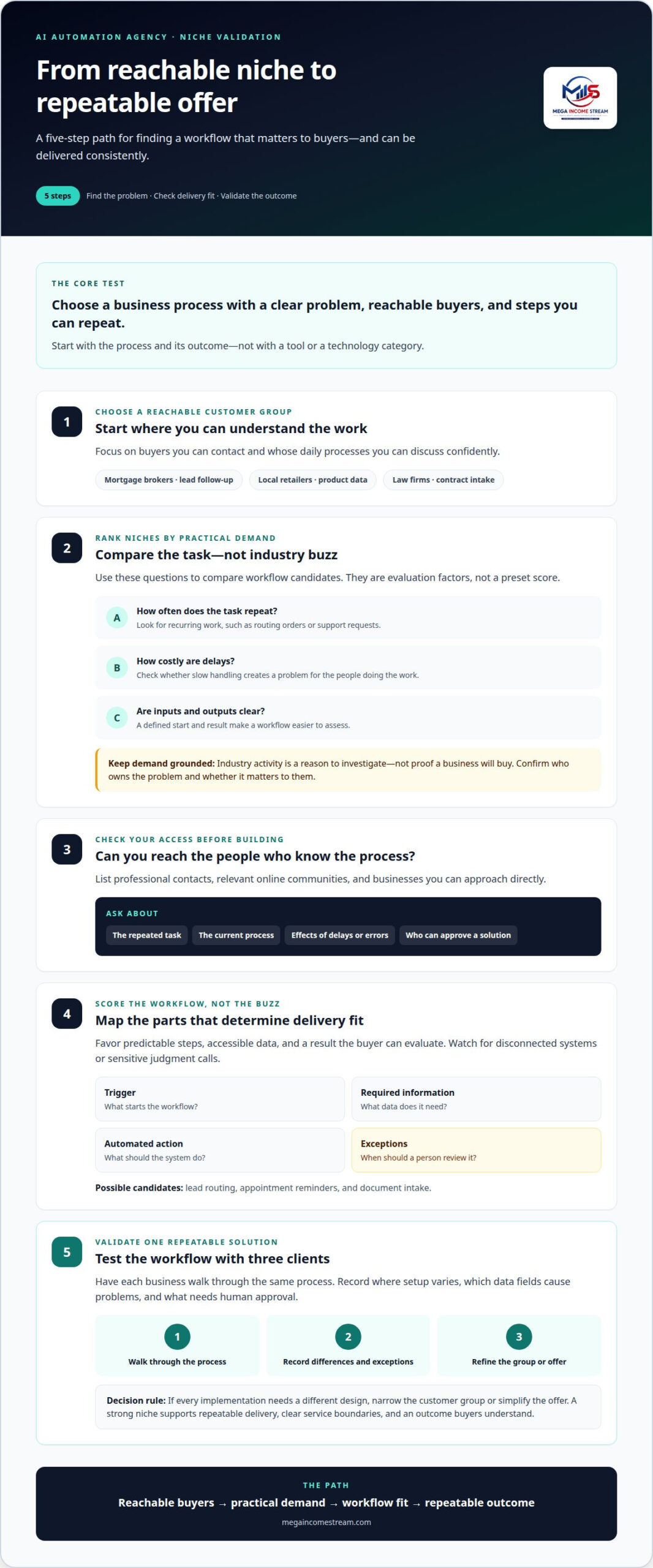
- Choose a reachable customer group. To start an AI automation agency, focus on buyers you can understand and contact, such as mortgage brokers, local retailers, or law firms. A niche is useful when businesses share workflows, software, and purchasing needs. Mortgage brokers may spend time following up with leads, while retailers may manage repetitive product data. Choose a group whose daily processes you can discuss confidently, not just a technology category.
- Rank niches by practical demand. Compare how often a task repeats, how costly delays are, and whether the workflow has clear inputs and outputs. An e-commerce company, for example, may need to route orders or support requests, while a legal office may want to organize contract intake. Treat industry activity as a reason to investigate, not proof that a business will buy. Confirm that someone owns the problem and that it matters to the people doing the work.
- Check your access before building. A promising market is hard to serve if you can’t reach decision-makers or understand their workflows. List professional contacts, relevant online communities, and businesses you can approach directly. Ask about a repeated task, the current process, and the effects of delays or errors. For example, discuss how incoming inquiries get routed to the right salesperson. These conversations can reveal whether the problem matters to buyers and who can approve a solution.
- Score the workflow, not the buzz. Favor processes with predictable steps, accessible data, and results a buyer can evaluate. Lead routing, appointment reminders, and document intake are possible candidates. Avoid starting with workflows that depend on disconnected systems or sensitive judgment calls. Map each candidate’s trigger, required information, automated action, and exceptions that need human review. This breakdown reveals delivery complexity and helps you distinguish a workable first service from an ambitious, poorly scoped build.
- Validate one repeatable solution. If you’re deciding how to start an AI automation agency, test the workflow with three clients before selling the same outcome more broadly. Record where setup varies, which data fields cause problems, and what needs human approval. Ask each business to walk through the same process, then note differences in systems or rules. If every implementation needs a different design, narrow the customer group or simplify the offer. A strong niche supports repeatable delivery, clear service boundaries, and an outcome buyers understand.
So, What Exactly is an AI automation Agency?
An AI automation agency builds and maintains workflows that connect business software with AI tasks. To demonstrate a solution, map the current process, build a working version, and show it handling a representative example. Measure ROI by comparing the baseline effort and operating costs with the workflow’s results. Maintain the system by reviewing errors, outputs, and integration changes.
- Map the process before selecting tools. Document the trigger, input data, decisions, output, and exceptions. For example, a lead workflow might capture an inquiry, summarize it, and send it to the right sales queue. Mark where a person must review or approve the result. This map sets system boundaries and helps the client see which steps will change.
- Choose tools that fit the client’s stack. Make.com and Zapier can connect business applications through no-code workflows. Compare their integrations, branching logic, data handling, and handoff requirements with the process map. Add an AI model only for a defined language task, such as classification or summarization. Avoid tools that don’t support a specific workflow step.
- Build a controlled prototype. Test each workflow stage with sample or client-approved data before connecting live systems. Set clear instructions, expected output formats, and fallback actions for missing information. For example, send an uncertain lead category to a human queue instead of automatically updating a customer record. Record test cases and outcomes so the demonstration shows repeatable behavior.
- Demonstrate the workflow from start to finish. Show the current task, then the automated version with the same representative input. Include the trigger, data moving through connected tools, the AI-generated result, and any human approval. Show a successful case and an exception. Explain what the workflow handles, what remains with staff, and how the result fits the client’s existing process.
- Track ROI and maintain the system. Agree on a baseline, such as staff time spent, processing errors, or response delays. Compare the same measure after launch, accounting for operating and maintenance costs. Review logs for failed connections, unexpected outputs, and pending approvals. When a form, CRM field, or process rule changes, update the integration and retest affected steps.
- Document ownership and operating limits. Provide a workflow diagram, connected-tool list, prompt versions, exception rules, and escalation path. Specify which tasks run automatically and which require staff approval. In a document intake process, for example, the system might extract fields while a person reviews uncertain entries. Clear documentation helps the client operate the workflow and gives future updates a reliable starting point.
Project fees, retainers, and hourly pricing
Choose a pricing model that reflects the work, delivery risk, and ongoing responsibility. Define the scope and payment trigger before presenting a proposal.
-
Compare Agency Pricing Models
Match the model to the service. Use a project fee for a defined build, an hourly rate for open-ended troubleshooting, and a retainer for planned maintenance. A workflow with a fixed trigger, output, and handoff, for example, suits project pricing. Avoid hourly billing when the client expects a predictable deliverable, or a retainer without clearly defined monthly work.
-
Set Project and Retainer Pricing
Estimate delivery effort before setting the fee. Include discovery, development, testing, documentation, client feedback, and deployment. A project estimated at three days can stretch across two weeks because of delays, data preparation, and feedback loops. For retainers, specify included monitoring, updates, and support boundaries. Keep new integrations or major workflow changes outside the maintenance scope unless agreed separately.
- Build a repeatable estimate. Break each project into tasks, then estimate the effort and uncertainty involved. A lead-routing automation, for example, may need form mapping, CRM field configuration, test submissions, and exception handling. Identify dependencies before quoting. Missing access or inconsistent records can increase delivery effort, so state your assumptions and define how scope changes affect the project.
- Set payment milestones around delivery. Tie invoices to observable stages, such as approval of the workflow map, completion of a test environment, and final handoff. This makes progress easier to track than billing for vague activity. Define client responsibilities, including system access and timely feedback. A delayed approval shouldn’t silently extend the delivery window or expand the work included.
- Protect the value of your time. Calculate an internal effective hourly rate for every fixed-fee project, even if clients see an outcome-based fee. Include revisions, meetings, testing, and support in the calculation. If repeated builds take longer than planned, adjust the scope, improve templates, or revise future estimates. Don’t let a low initial quote become the default for increasingly complex deployments.
- Account for international revenue friction. With cross-border clients, track the invoice currency, payment platform fees, and exchange-rate movement between invoicing and withdrawal. Local inflation can also change revenue’s purchasing power over time. Record the gross amount and the amount received in your operating currency, then review both when assessing project profitability. Keep currency assumptions clear in proposals.
- Review the model after each engagement. Compare estimated effort with actual delivery time, then note scope changes and support requests. If a client repeatedly needs new features, separate those builds from routine maintenance. If a stable workflow needs occasional monitoring, a retainer may fit better than repeated hourly invoices. Use these records to refine proposals and keep recurring work clearly bounded.
Starting an agency as a permanent side business
Build around fixed work blocks, a focused offer, and a delivery process that fits your existing schedule. Common risks include overbuilding before validating demand, underestimating client delays, and promising automation without clear human review.
-
Identify Business Automation Needs
Look for tasks that consume time outside your working hours. Ask business owners how staff handle repeated handoffs, data entry, or follow-up. Record the trigger, people involved, systems used, and points where work stalls. A useful candidate has a clear owner and an observable process. Don’t automate a task simply because it uses AI. First identify the operational problem that needs solving.
-
Find High-Value Business Problems
Prioritize problems with visible operational consequences. Compare delays, repeated manual work, missed handoffs, and preventable errors. A slow inquiry-routing process, for example, may affect sales follow-up, while inconsistent report preparation may consume staff time. Ask who owns the problem and how they would recognize improvement. Avoid workflows without a consistent process or with unclear decisions, since outcomes are harder to demonstrate.
-
Choose an Agency Business Model
Pick a model that fits the hours you can reliably commit. A project-based model suits defined implementations; ongoing maintenance can create recurring work after delivery. A focused consulting model can help businesses identify automation opportunities before building. Keep the offer narrow enough to deliver alongside a job. As an illustrative capacity framework, you could start with 1-2 clients during months 1-3, then assess whether 3-5 clients during months 4-6 is manageable based on project scope and available hours.
-
Estimate Startup Costs
Build a startup budget around the expenses your operating model requires. In the United States, costs depend on software subscriptions, computing needs, business administration, and how you reach prospects. A lean setup can limit spending to essential tools and basic sales materials; larger builds may need paid platforms or specialist support. Separate recurring expenses from one-time purchases, and don’t add tools before a client workflow requires them.
- Protect a consistent work block. You could use a 90-minute daily block as an illustrative schedule for focused agency work, with separate time for prospecting, delivery, and documentation. Adjust the block to fit your availability and workload. Set a weekly output, such as completing a prototype or following up with prospects. Keep client calls within defined availability windows. This structure can reduce context switching and make delivery capacity visible before accepting additional projects.
- Set a measured transition threshold. Track agency revenue alongside salary and household expenses before considering a full-time move. As an illustrative framework, you might compare agency revenue with 75-100% of salary over three consecutive months, while also assessing recurring revenue and workload stability. Another planning example is to save 3-6 months of living expenses beforehand. These figures are not universal benchmarks; evaluate them against your expenses, obligations, and income volatility. Review workload stability, not just one strong project month.
Defining an outcome-focused service offer
- Start with one buyer and one measurable result. A mortgage broker may need faster lead follow-up, while a law firm may want to reduce manual contract work. Choose one workflow with a clear starting point and outcome. Avoid presenting a broad menu of AI tools. Buyers can evaluate a specific operational change more easily than an abstract promise to “use AI.”
- Describe the current process before proposing automation. Record who handles each step, which systems they use, and where delays occur. In this mortgage-broker example, setup is estimated at about two weeks, with a projected saving of 8-10 hours a week on manual outreach. These are example estimates, not typical results; validate them against the client’s workflow and baseline. Define what the system handles and which exceptions remain with staff.
- Translate saved effort into business value. A law firm workflow that saves 20 hours of senior partner time per month at $400 per hour represents $8,000 in monthly savings. Treat that calculation as a way to frame potential value, not as a guaranteed result. Confirm the baseline task and the value assigned to each saved hour before making a claim.
- Set a baseline and success measure. Choose a metric the client can track, such as staff hours spent on a workflow, response time, or incomplete records. Define how to measure it before deployment. For example, compare weekly manual outreach hours before and after a mortgage lead follow-up system is introduced. Keep the process and reporting period consistent.
- Package the deliverable and boundaries. State the workflow included, systems connected, testing process, handoff materials, and human review points. Separate the initial build from future changes, such as adding a new CRM or lead source. A precise scope helps prevent a simple follow-up automation from expanding into a full sales operations rebuild.
- Use a pilot to test the offer. A defined pilot can focus on one workflow, one team, and one success measure. The research example proposes a $500 pilot and a refund if it fails to save the client 5 hours in the first week. Treat these figures as proposed terms, not evidence of typical results. Define the measurement method, client responsibilities, and limits before including the offer.
- Refine the offer from delivery evidence. Compare the agreed metric with actual results, then document setup steps, exceptions, and client feedback. If a workflow repeatedly needs manual correction, narrow the promise or improve the process before selling it again. For a practical framework to shape the commercial side of your offer, explore business strategy guidance.
Mega Income Stream
Mega Income Stream helps entrepreneurs shape an AI automation concept into a practical business model. Its Business Strategies, Making Money Insights, and Consulting Business help readers refine a niche, assess an offer, or plan a sustainable revenue workflow.
Turn to Mega Income Stream when you have a workflow idea but need a clearer path from delivery to recurring income. Strategic guidance can help connect your target customer, measurable outcome, and operating model, without treating AI tools as the business itself.
Contact Mega Income Stream to discuss the business strategy behind your AI automation agency.
Turn Your First Offer Into a Stronger Business
A durable approach to how to start an AI automation agency is to treat every engagement as a source of operational insight. Notice which client problems fit your strengths, which workflows create avoidable complexity, and which outcomes your delivery process can support consistently. These patterns help sharpen your positioning and show where to focus next.
Growth doesn’t require adding every new AI tool or serving every industry. It comes from deliberate choices about the work you accept, the systems you maintain, and the value your agency delivers. Mega Income Stream’s Business Strategies, Making Money Insights, and Consulting Business can help you assess those commercial decisions and plan your next move.
Contact Mega Income Stream to discuss your agency and the business strategy behind its next stage. Keep testing, keep learning, and build at a pace your operations can sustain.
Frequently Asked Questions
How do I find “leads” without spending money on ads?
Use targeted outreach, professional communities, and introductions from your existing network. Identify businesses with a visible workflow problem, then send a concise message describing one relevant improvement. As one illustrative outreach plan, you could send 10 to 15 targeted LinkedIn messages per day and publish three niche-focused posts per week for 90 days. This is a planning example, not a verified market benchmark. Track replies and booked conversations, then adjust your message based on which problem earns responses.
How do I handle client data privacy?
Limit data access to what the workflow needs, and use client-approved accounts and permissions. Before building, map what information enters each tool, where it goes, and who can view it. Don’t copy sensitive records into demos or prompts without approval. Document data retention, human review, and access removal when work ends. These practices reduce unnecessary exposure but don’t replace client-specific privacy or security requirements.
Which Industries Are Worth Digging Into?
Explore industries with repeated processes and clear operational bottlenecks, such as e-commerce, legal services, healthcare, financial services, and logistics. Treat activity in an industry as a reason to investigate workflows, not proof that a specific business is ready to buy. Look for reachable decision-makers and processes you can understand before choosing a market.
What services can an AI automation agency offer to small businesses?
An agency can automate routine steps such as sorting incoming inquiries, drafting appointment reminders, extracting fields from invoices, or routing support requests. A small property management firm, for example, could route maintenance requests by issue type and property. Define what the system does, what staff must approve, and how exceptions are handled. Keep the offer focused on a practical workflow rather than access to AI tools alone.
How do you choose a profitable AI automation agency niche?
Choose a niche where businesses share a costly or time-consuming workflow and you can reach the people who own it. Interview prospective buyers about their current tools, process delays, and measures of success. Then test whether the same core solution could work for several similar organizations. A niche is stronger when the problem repeats, the outcome is measurable, and delivery doesn’t require rebuilding the system for every client.
What skills and tools do you need to start an AI automation agency?
Build skills in process mapping, workflow logic, prompt design, testing, documentation, and client communication. No-code platforms such as Make.com and Zapier can connect business applications, while an AI model can summarize or classify text. Learn to manage permissions, errors, and human approvals, too. A working demo should show the input, each automated step, and the result, including what happens when information is incomplete.
How do you find and acquire clients for an AI automation agency?
Start with a focused prospect list, then reach out with a tailored observation about one business process. A short screen recording can show the current task and a possible automated version. Follow up with useful context rather than generic pitches. LinkedIn outreach, niche-specific posts, and warm introductions can help build a steady pipeline. Track outreach, replies, discovery calls, and proposals to see where prospects stop progressing.
How should an AI automation agency price projects and monthly retainers?
Use project pricing for a defined build, monthly retainers for agreed maintenance, and hourly billing for unpredictable support. As illustrative estimates rather than verified market rates, setup projects might range from $1,500-$5,000 per project and maintenance retainers from $500-$2,000 per month. Actual prices vary by scope and market. Estimate discovery, testing, implementation, handoff, and support before setting terms, then define exclusions clearly.











Comments