
 By

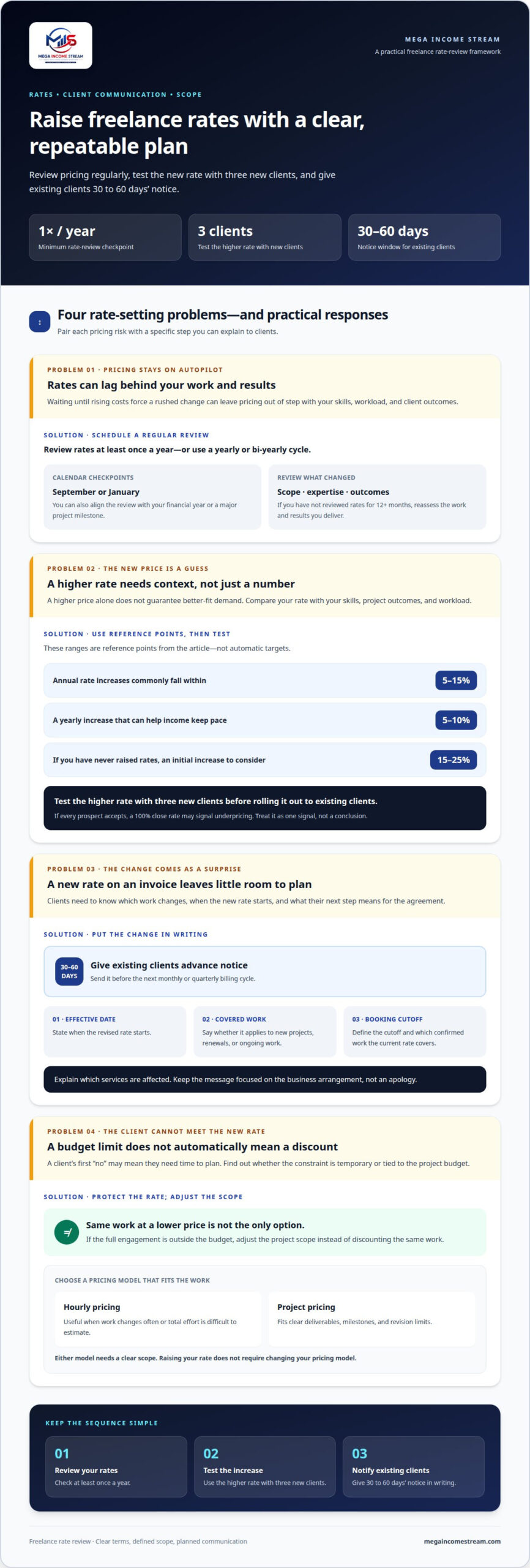
Review your rates at least once a year, test a higher rate with three new clients, and give existing clients 30 to 60 days’ notice before the increase takes effect. That sequence gives you a practical way to learn how to raise freelance rates without losing clients while protecting the value of your work.
It’s reasonable to worry that raising your freelance rates could push reliable clients away. But keeping the same price indefinitely can leave your income out of step with the value, skills, and results you bring to a project. A clear notice and a rate supported by specific work make the change easier to understand, even when a client needs to discuss the budget.
This guide explains when to review your rates, how to communicate a change, and how to respond to pushback without discounting your work. You’ll also learn how to test a new rate with new clients and adjust project scope when a client can’t afford the full engagement. The aim is a repeatable process, not a risky, one-off price jump.
Key Takeaways
- Set a regular rate-review checkpoint, such as once a year, so pricing changes become part of your business cycle.
- Test a higher rate with three new clients before rolling it out to existing clients.
- Give existing clients 30 to 60 days’ notice and explain what has changed in your work or results.
- If a client can’t meet the new rate, adjust the project scope instead of discounting the same work.
- Assess whether a client relationship still makes business sense when they decline the increase.
1. Can raising my rates help me get better clients?
Yes, a well-timed rate increase can help position your work for clients who value its results. If every prospect accepts, a 100% close rate may signal underpricing, not ideal positioning. Treat that as one signal, then compare rates with skills, project outcomes, and workload. A higher price alone won’t create better-fit demand, but pricing that reflects your contribution can filter out clients focused only on the lowest quote. A practical approach to how to raise freelance rates without losing clients starts with matching price to the work delivered.
Set a regular review checkpoint instead of waiting for rising costs to force a rushed change. Review rates at least once a year, or use a yearly or bi-yearly cycle. September and January can serve as calendar checkpoints. You can also align a review with your financial year or a major project-completion milestone. For international work, consider how local inflation affects operating costs; the U.S. Bureau of Labor Statistics’ consumer price data is one reference for tracking price changes in the United States.
Use each review to check whether your workload and results still match your pricing. If you haven’t reviewed rates for 12+ months, assess whether your scope, expertise, or client outcomes have changed. Freelancers who have charged the same rates for over a year may have reason to increase them. Annual increases commonly fall between 5-15%; a 5-10% increase each year can help keep income from falling behind. If you’ve never raised rates, an initial increase of 15-25% may be worth considering. These ranges are reference points, not automatic targets.
International freelancers should also account for platform fees and exchange-rate volatility. A platform fee reduces the amount retained from a client payment, while currency movements can change its value in local currency. The Federal Reserve’s foreign exchange data can help track currency movements. Review these factors alongside project costs before setting rates for cross-border work.
Keep hourly pricing when the work changes often or the total effort is difficult to estimate. Choose project pricing when deliverables, milestones, and revision limits are clear. Ongoing troubleshooting may suit hourly billing, while a defined website audit may suit a fixed project fee. Either model needs a clear scope. You don’t have to change your pricing model to raise your rate.
Choose the increase date around a contract renewal, new project, or completed delivery. Send clients the details in writing, including the new rate and effective date. Give existing clients 30 to 60 days’ notice, and send notice before the next monthly or quarterly billing cycle. A scheduled review and direct communication make the change easier to plan for, an important part of deciding how to raise freelance rates without losing clients.
2. Giving clients advance notice
Give clients clear notice instead of letting a higher rate appear unexpectedly on an invoice. Send existing clients the change directly, explain which services it affects, and state the effective date. Keep the message focused on the business arrangement, not an apology. Clients should be able to see the new rate, when it begins, and which upcoming work it covers.
Allow existing clients 30 to 60 days’ notice before the increase takes effect. That window gives them time to plan upcoming work or discuss a different scope. For clients billed monthly or quarterly, send the notice before the next billing cycle. Avoid sending it at 11:00 on a Saturday night; choose a normal working time when the client can read and respond.
Should freelancers raise rates for existing clients or only new clients? In general, review rates for both groups rather than leaving existing clients on outdated pricing indefinitely. A loyalty discount can keep a valued client’s rate below your rate for new clients while still raising it above your previous rate.
Tailor the notice to the relationship. For a monthly client, name the next billing period affected; for a project client, say whether the change applies to new work or a renewal. If your agreement has a review date, use it to explain the updated terms. Put the details in writing after any conversation so both sides have the same effective date and scope.
Occasional clients still deserve a courtesy message when they request work once or twice a year. Send a brief update before preparing a new estimate, not after they approve the work. This gives them the current pricing before they commit. Keep it concise: say your rates have changed, identify the applicable rate, and invite them to share the project requirements.
You can also give clients the option to book upcoming work at the current rate before the increase begins. Set a clear cutoff date and define what the booking covers, such as a confirmed project or agreed deliverables. Don’t leave the offer open-ended. A defined window helps clients decide while protecting your schedule from speculative reservations.
Before sending each notice, confirm these details:
- Effective date: State when the revised rate starts.
- Covered work: Identify whether it applies to new projects, renewals, or ongoing work.
- Booking option: Explain the cutoff for reserving work at the current rate.
3. What if a client says no to my rate increase?
Respond with evidence, then decide whether the relationship still works within the client’s budget. A client’s first “no” may mean they need time to plan, not that they reject your work. Ask what constraint is behind the response. Distinguish a temporary budget limit from an unwillingness to pay for the value and scope you provide.
Explain the change through specific client value, not a general claim that your costs have increased. Point to relevant results, expanded skills, improved processes, or new services you’ve delivered since the last pricing review. For example, describe how a refined reporting process gives the client clearer performance data, if that’s work you actually provide. Keep the explanation tied to their project and don’t promise future results.
To negotiate a freelance rate increase with long-term clients, connect the revised rate to documented work and outcomes, then invite a practical discussion. Offer choices that protect your rate, such as keeping the full scope at the new price or reducing deliverables to fit the client’s budget.
Use the response to assess whether the client is a good fit. If they repeatedly reject the new rate, expect the same scope at the old price, or dismiss the value delivered, continuing may leave less room for better-fit work. Consider the project’s workload, reliability, payment pattern, and portfolio value before deciding. If the client can’t accept the updated terms, close the engagement professionally and agree on a clear endpoint for current work.
A concise email keeps the conversation focused. Here is a sample message using specific example details:
Subject: Updated rate for weekly social media management
Hi Sarah,
From October 1st, my rate for weekly social media management will be $75 per hour. This reflects the advanced analytics reporting and graphic design templates implemented for your campaigns. I value our work together and can discuss either continuing with the current scope at the updated rate or adjusting deliverables to fit your budget. Please let me know which option suits your upcoming work.
Best,
Alex
For future agreements, state the review process clearly instead of negotiating from scratch each year. A sample clause can propose a 5% rate increase on each contract anniversary. Treat that wording as a proposed term to discuss and include in the agreement, rather than assuming it changes an existing contract automatically.
Before finalizing a decision, write down the client’s response, the agreed scope, and the rate that applies to future work. If they accept, update the project terms in writing. If they request a lower budget, adjust deliverables rather than quietly reducing your rate for unchanged work. If you can’t agree on workable terms, set a professional transition plan and reserve capacity for clients whose budgets match your services.
4. Adjusting project scope instead of discounting
If a client can’t afford your updated rate, reduce the deliverables, not the value of unchanged work. A lower fee for the same workload cuts your effective earnings and sets an unclear pricing precedent. Instead, identify which parts of the project contribute most to the client’s main goal. Keep those deliverables, then remove or defer work that can wait.
Start by breaking the proposal into clear components. A content project might include research, drafting, editing, revisions, and performance reporting. A design project might include discovery, concepts, final files, and implementation support. List each item separately, then identify what the client needs now. This turns a vague budget objection into a specific scope discussion.
Protect the work that determines quality or makes the deliverable usable. For a website redesign, that could mean retaining core page layouts while postponing extra landing pages. For a marketing audit, keep the analysis and recommendations but defer a follow-up workshop. The client gets a smaller engagement, and the remaining work still has a clear purpose.
- Keep core outputs: Preserve the deliverables tied directly to the client’s stated goal.
- Remove optional work: Separate add-ons, extra formats, or secondary research from the essential scope.
- Defer later tasks: Move non-urgent deliverables into a future project instead of compressing them.
- Set firm boundaries: Define included revisions, meetings, turnaround, and support in the revised proposal.
Then present choices, not an open-ended discount. For example: “The full package includes research, copy, and editing. To fit this budget, we can keep research and copy, then leave editing for a later phase.” This makes it clear exactly what changes. It also lets the client compare the full engagement with a smaller option based on deliverables, rather than asking you to do the same work for less.
Write the revised scope into the proposal before work begins. Name each included deliverable, the items removed, the approval points, and how you’ll handle additional requests. If the client adds a new page after approving a smaller website project, treat it as new scope and provide an updated estimate. Clear boundaries prevent small additions from quietly restoring the original workload.
Don’t reduce the fee by squeezing the same tasks into a shorter schedule. That can lead to rushed decisions, more rework, and unclear expectations. If the client rejects every smaller option, their budget may not cover the project’s essential requirements. Explain which outcomes you can deliver within the agreed scope, then let the client choose whether to proceed, defer, or pause.
5. Building confidence before raising rates with existing clients
Build confidence by testing your proposed rate with three new clients before changing terms with established ones. Treat each conversation as a small market test, not a verdict on your entire business. Record the proposed rate, the client’s response, and any concerns about scope. If prospects accept, you gain evidence that your pricing can work for new projects. If they hesitate, note the reason before changing your rate.
Use the same offer when testing your rate. If one prospect receives a smaller scope and another receives a broader package, their responses won’t be directly comparable. Keep the deliverables, timeline, and payment structure consistent. When a prospect declines, ask which factor affected the decision: the rate, project scope, or timing. That distinction helps separate pricing resistance from a poor-fit project.
Track more than acceptance. For each prospect, note whether they understood the value, requested different deliverables, or negotiated the terms. A yes with a sharply reduced scope may not mean the same thing as a yes to the full proposal. A no based on timing also differs from a direct objection to the rate. Use these observations to refine your explanation and offer, not to lower your price automatically.
Then prepare a brief record for each existing client. Include completed deliverables, expanded responsibilities, useful feedback, and outcomes you can accurately describe. For example, if you added reporting to a recurring marketing project, record when that work began and how it changed the engagement. Keep claims specific and verifiable. A clear record helps anchor a pricing conversation in the actual work, rather than anxiety about the client’s reaction.
Before contacting long-term clients, rehearse the update aloud. State the new rate, effective date, and concrete change in your work. Practice answering “Why now?” with a short explanation tied to skills, results, or project requirements. Avoid overexplaining; too much justification can make a standard business decision sound negotiable. Keep your notes nearby, then follow the same communication process for each client.
Use a simple decision log after every conversation: proposed rate, response, reason given, and next step. Compare that record with your three new-client tests before adjusting your approach. Confidence comes from a repeatable process and evidence, not from assuming every client will respond alike. To strengthen your rate-testing strategy, turn those observations into a consistent pricing review process.
Mega Income Stream
Mega Income Stream helps freelancers turn rate decisions into a clearer business strategy. Its Business Strategies, Making Money Insights, and Consulting Business support practical thinking about pricing, client fit, and sustainable revenue. Turn to this guidance when you’ve reviewed your rates, tested a higher price, and need to connect those decisions to broader business goals. The focus stays on actionable choices: how your offer is positioned, which project terms protect your time, and how pricing supports a more stable income workflow. If you want to discuss your freelance pricing strategy, contact Mega Income Stream.
Make pricing part of your operating system
The next step in learning how to raise freelance rates without losing clients is to make pricing a repeatable business decision, not a reaction to one difficult project. Treat your rate policy as part of your service design: it should reflect the work you take on, the outcomes you can support, and the boundaries that protect delivery quality.
Keep a simple record of pricing decisions alongside your project notes. Track which offers attract suitable work, where clients request changes, and which projects remain sustainable to deliver. Over time, these patterns can guide clearer packages, stronger positioning, and more deliberate client selection. The aim isn’t to win every negotiation. It’s to build a freelance business where the work and revenue support each other.
If you want help turning those decisions into a stronger business strategy, contact Mega Income Stream today. Use the next rate review as a chance to shape a more sustainable path forward, one clear decision at a time.
Frequently Asked Questions
How often should I raise my freelance rates?
Review your rates at least once a year, then adjust when your workload, skills, or services change. A review doesn’t require an automatic increase; it gives you a regular opportunity to compare your pricing with the work you deliver. Use it to check project profitability, client mix, and changes in your responsibilities. A predictable review cycle also makes pricing easier to plan than waiting for a difficult negotiation.
Can raising my rates help me get better clients?
It can help position your services for clients who value your outcomes, but price alone won’t establish fit. A 100% close rate on proposals may indicate undercharging. Review that signal alongside the type of projects you win, how clients respond to your recommendations, and whether your scope stays controlled. Clear positioning and relevant proof of your work help prospects understand what a higher rate represents before they compare proposals.
How do I know if I’m charging enough?
Compare your revenue with the time and work required to deliver each project. Review a year’s worth of records, including invoices, project notes, expenses, and unpaid administrative work. Look for recurring projects that take more time than expected or include tasks outside the original scope. Also assess how consistently prospects accept your proposals. Together, these records show whether your pricing supports the workload and business model you want.
What if a client says no to my rate increase?
Ask what’s behind the refusal, then decide whether a smaller scope can meet the client’s budget. If they want the original deliverables at the old rate, don’t treat that as an agreed compromise. Consider whether the project remains worthwhile given its workload, payment reliability, and strategic value. If you can’t agree on workable terms, explain the transition clearly and complete existing commitments according to the agreed terms.
How much should freelancers raise their rates each year?
Annual freelance rate increases commonly fall between 5-15%, while a 5-10% increase each year is one approach to keeping income from falling behind. These figures are reference points, not a required formula. Consider how your scope, skills, demand, and operating costs have changed since your last review. If you haven’t raised rates before, assess the adjustment separately rather than assuming a routine annual increase fits.
How to calculate a new freelance rate based on expenses, taxes, and desired income
Start with your desired business income, then account for operating expenses, a tax reserve, and savings or reinvestment needs. For international projects, also factor in platform fees, local inflation, and exchange-rate changes, which can affect your net income or costs. Divide the total by the hours you realistically expect to bill, not every working hour. Tax treatment varies by situation, so use general estimates for planning rather than treating this as tax advice.
How much notice should freelancers give clients before a rate increase?
Give existing clients 30 to 60 days’ notice before the new rate begins. Choose the timing around the client’s billing cycle or the next project decision, so they can plan rather than discover the change after work starts. State the effective date and which work it covers in writing. For a client who requests work occasionally, share current pricing before preparing a new estimate or confirming the project.
How do I tell existing clients about a freelance rate increase? Is there an email template?
Send a direct email that names the updated rate, start date, and affected work. Keep the explanation brief and specific to your client relationship. For example: “Hi [Name], from 2026, my rate for [service] will be [rate]. This reflects [specific change in scope, skills, or service]. The updated rate applies to [upcoming work]. Please let me know if you’d like to discuss the project plan. Best, [Name].”











Comments