
 By

Affiliate links are trackable links that connect a reader’s click or purchase to a publisher, and effective affiliate link placement strategies put them where they help readers take a relevant next step. The best placement isn’t simply the most visible one. It matches the recommendation to the content and the reader’s intent.
Too many links can disrupt a page, while too few may make useful recommendations hard to find. Make each link clear, relevant, and easy to act on without crowding out the information readers came for.
This guide explains how affiliate links work, where to disclose affiliate relationships, and how to choose channels such as articles, email, video, and social profiles. You’ll also learn how to test placements, assess link density, and use clicks and conversions to refine your approach. Build a placement system around reader value, then improve it using evidence from your own content.
Key Takeaways
- Use comparison tables and clickable product images to make relevant recommendations easier to act on.
- Make affiliate relationships clear so readers can recognize when links may earn you a commission.
- Choose channels and content formats that fit the recommendation, from tutorials and email to video and social profiles.
- Test one placement change at a time and compare link clicks over a meaningful period before deciding what works better.
- Prioritize reader relevance over link volume, then refine placement and density using performance data.
1. What Are Affiliate Links?
Affiliate links are trackable links that connect a publisher’s recommendation to a reader’s click or later action. An affiliate program uses link data to attribute eligible activity to the publisher. For example, a tutorial about project planning might link to a tool it explains. The link should support the recommendation, not interrupt it.
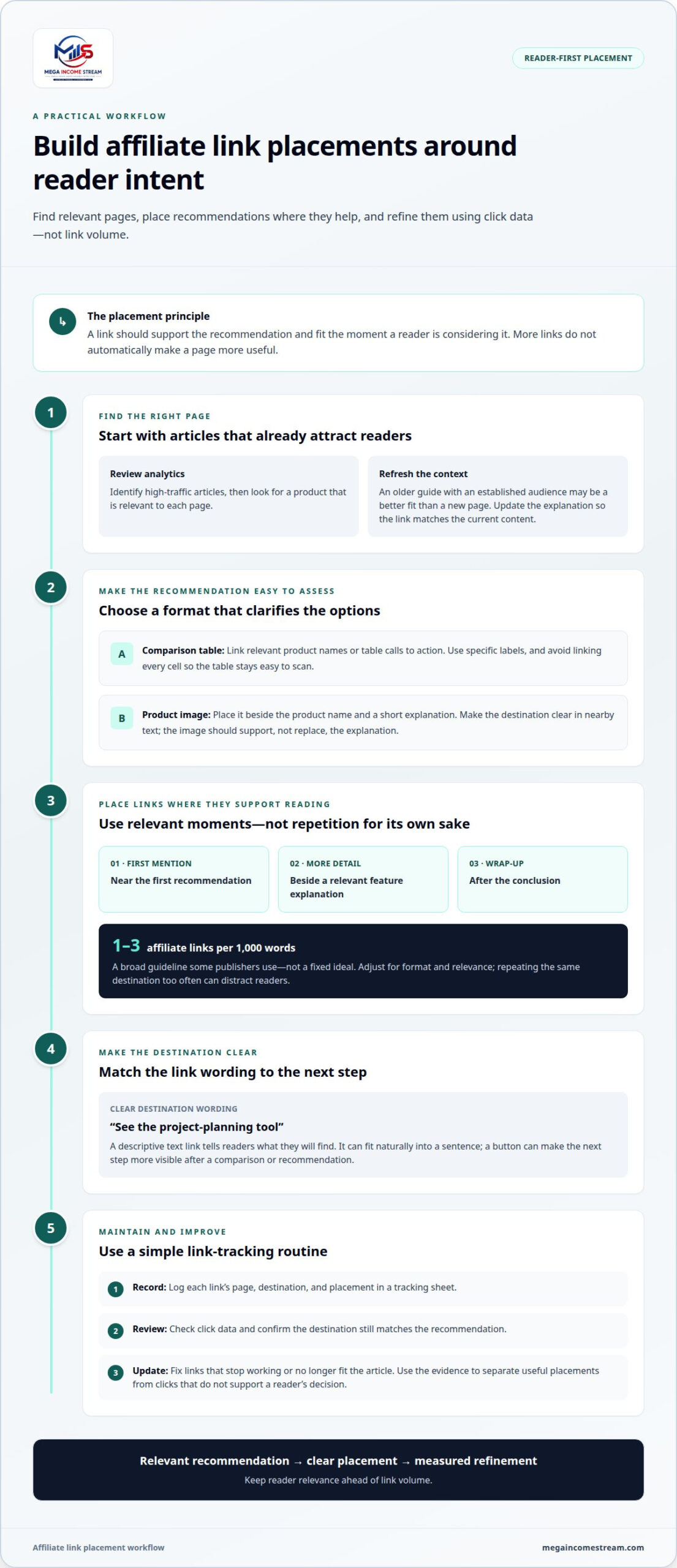
Comparison tables help readers evaluate options side by side. Link each relevant product name or table call to action to its destination, and keep labels specific. A table comparing project-planning tools, for example, could link each tool’s name to its product page. Avoid linking every cell, since a crowded table is harder to scan.
Clickable product images give readers another route to a recommendation. Place an image beside the product name and a short explanation, then make its destination clear in nearby text. For example, a tutorial showing a microphone setup could make the pictured microphone clickable while also including a descriptive text link. The image should help explain the recommendation, not replace it.
Start with pages that already attract visitors. Review website analytics, identify high-traffic articles, and match each page with a relevant product. An older guide that still draws readers may be a better place for a useful recommendation than a new page without an established audience. Update the surrounding explanation so the link fits the page’s current content.
Multiple links can serve different reading moments. A product review might include a link near the first recommendation, another beside a detailed feature explanation, and a final link after the conclusion. There’s no fixed ideal number for every page. As a broad guideline, some publishers use one to three affiliate links per 1,000 words, adjusting for format and relevance. Repeating the same destination too often can distract from the advice.
Text links and buttons suit different actions. A descriptive text link fits naturally into a sentence explaining a product’s use. A button can make the next step more visible after a comparison or recommendation. For example, “See the project-planning tool” makes a text link’s destination clearer than “click here.” Keep button wording direct and consistent with the page.
Manage active links as part of content maintenance. Record each link’s page, destination, and placement in a tracking sheet. Review click data and confirm the destination still matches the recommendation. If a link stops working or the article changes, update it promptly. This process helps distinguish useful placements from links that generate clicks without supporting a reader’s decision.
2. Affiliate disclosure and transparency
Disclose affiliate relationships clearly so readers can recognize when a recommendation may generate a commission. In the United States, the Federal Trade Commission (FTC) says affiliate relationships should be disclosed clearly to audiences. Its social media disclosure guidance offers a relevant reference for creators promoting products. A disclosure gives readers context before they use a recommendation to make a decision.
Excessive or misleading placement can make a page feel designed for clicks rather than useful information. If a recommendation’s commercial connection is hidden, readers may misunderstand why it appears or lose trust in the surrounding content. For example, presenting a paid recommendation as an independent comparison can obscure the publisher’s incentive and make the evaluation harder to interpret.
Place the disclosure where readers encounter the recommendation. On a product review, put a short disclosure near the beginning, before the first affiliate link. On a comparison page, include it before the table, not only after product links. Readers arriving directly on a page should still see the relevant context before assessing its recommendations.
Use plain language. A concise statement can explain that the publisher may earn a commission if readers buy through affiliate links. Avoid vague phrases that leave the relationship unclear, such as “partner content,” without further explanation. The FTC’s endorsement guidance provides additional context for understanding how endorsements and disclosures relate.
Keep the disclosure close to the content it describes. A general site notice may not be visible to someone arriving directly at a tutorial or product review. Add a clear statement to that page, then repeat it when a separate format needs its own context. For example, a downloadable guide should include its disclosure alongside the recommendations.
Choose wording and placement that fit the channel. In an email promoting a software tutorial, put the disclosure near the recommendation, not in an unrelated footer. In a video, explain the relationship where viewers can connect it to the products discussed. A social post should keep its disclosure alongside the affiliate recommendation.
Make the disclosure readable on mobile and desktop. Use ordinary text, visible contrast, and direct wording rather than burying the statement in a dense paragraph. Check a review page on a phone: if a reader sees a product link before the disclosure, move the disclosure higher. This helps readers understand the connection before acting.
Review each disclosure when editing a page or changing its recommendations. Confirm that the statement still describes the relationship and appears before the relevant link. If a tutorial gains a new affiliate recommendation, update the disclosure at the same time. Treat transparency as part of publishing, not as a separate notice readers must search for.
3. Affiliate marketing channels and content formats
Choose a channel based on where readers already seek help. A tutorial can connect a problem to a useful product, while a comparison article helps readers weigh alternatives. A newsletter can share a focused recommendation with subscribers. Match the affiliate marketing format to the reader’s task, then place the link beside the explanation that makes it relevant.
In-context links work best when the surrounding sentence explains the next step. In a tutorial about setting up a home office, a link to an ergonomic keyboard could follow the section on typing comfort. The reader sees why the product fits before deciding whether to click. Use descriptive anchor text to signal the link’s destination instead of relying on a generic phrase.
Build a contextual cluster around one clear recommendation. A review might pair an explanatory text link with a comparison-table entry and a relevant product image. Each element should point to the same product and support the same decision. Don’t stack them together. Spread them across the sections where readers learn about the product, compare features, and consider their next action.
Sticky elements need a clear role. A fixed mobile bar can keep a primary recommendation visible as readers scroll, but it shouldn’t cover text or compete with the article. For example, a cooking tutorial might use a compact link to a featured kitchen tool. Check the page on a phone and desktop, then remove the element if it obstructs instructions or distracts from the content.
Different formats create different reader expectations. A social media post usually has one primary affiliate link, while a YouTube description can list tools mentioned in the video with a brief reason for each. A profile link can lead to a recommended-tools page. An email signature can point to a resource relevant to the message, rather than inserting a product pitch into every email.
Use content intent to interpret conversion rates. A product comparison attracts readers evaluating choices; an introductory tutorial may attract readers still learning the basics. Those audiences may click for different reasons. Compare performance within similar formats, and note whether readers reached the recommendation. A click alone doesn’t show whether the surrounding content answered their question.
Keep each channel’s destination consistent with its promise. If a post describes a beginner’s guide, link to a page that helps beginners, not an unrelated product roundup. This alignment strengthens information scent: readers can infer what a link offers from its wording and context. Review the path from post to destination, and adjust it if the promise and landing content don’t match.
4. Testing link placements with A/B tests
A/B tests show whether a placement change affects clicks and conversions. Compare two versions of the same page, changing only the affiliate link’s position. For example, place a text link near a product explanation in one version, then after the explanation in the other. Keep the audience, offer, and surrounding copy consistent so placement remains the main difference.
Set a clear measurement goal before changing the page. Track link clicks to see whether readers notice the recommendation. Then review conversions or earnings to assess whether those clicks lead to meaningful outcomes. A version that attracts more clicks may still bring less value if readers don’t complete the action. Use analytics to follow the path from page visit to affiliate result.
Choose a page with steady traffic and a relevant recommendation, such as a product tutorial already attracting visitors. Record its current click activity before the test. Then publish the two placement versions and collect data over a defined period. For example, you could run a test for 2–4 weeks, then review whether the results are clear enough to guide a decision. A short test can reflect a temporary traffic shift instead of a consistent response from the audience.
Test positions that reflect real reading behavior. Compare a link near the first product explanation with one beside a later feature discussion. Keep the anchor text and destination unchanged. If you also change a button, rewrite the link, or edit the article, you won’t know which adjustment affected performance. Isolate placement, then log when the test starts and which version readers see.
Use a simple analytics record for each test. Include the page, placement description, test dates, clicks, and resulting affiliate activity. For example, note whether a link appeared within a tutorial paragraph or beside a product comparison. If your affiliate dashboard reports purchases or sign-ups, compare those outcomes with the page’s click data. This connects reader actions to business results.
Interpret results in context. A comparison page may attract readers ready to evaluate options, while an introductory guide may serve people still learning. Compare similar pages or audience segments rather than treating every visit as equivalent. Check whether mobile and desktop visitors respond differently, since a link beside a wide table may be harder to find on a phone.
After the test, keep the placement that better serves readers and performance goals. Document what changed and what the analytics showed. If the outcome is unclear, refine the test rather than changing several page elements at once. A repeatable testing record helps publishers build on previous findings and avoid relying on a single page’s unusual traffic pattern.
5. Strategic affiliate link placement and link density
Placement can improve click-through rates when a relevant recommendation appears at the moment readers need it. Put a link beside the explanation or comparison that supports the next step. This helps readers understand what the link offers, while clear, descriptive wording sets expectations before the click. Conversions depend on more than visibility: relevance and a useful destination matter too.
Visibility still shapes the opportunity. Nielsen Norman Group research found that visitors spend approximately 57% of page-viewing time above the fold. That makes early placement worth testing, but it doesn’t mean every recommendation belongs in the opening paragraph. A practical starting point is one relevant affiliate link within the first 300 words, after readers have received useful context.
Match link density to the content’s job. There’s no fixed ideal number of affiliate links for every page. As an illustrative suggestion, you could test 1–3 links per 1,000 words, but format and reader intent should shape the final count. Tutorial or educational content may need only 1–3 links per article. A product review could use 5–8 links to its reviewed product when each supports a distinct point; these counts are examples, not evidence-based guidelines.
Comparison pages need a different structure. Limit repeated links to 2–3 per product, so each option remains easy to assess. In a long roundup, give each product one clear affiliate link, with a second link only when the list’s length makes another useful placement. Repeating a destination without adding context creates clutter, not stronger recommendations.
Use scroll depth to understand where intent develops. No verified source is provided for the claim that readers who scroll past 50% of a page’s content are 4–5 times more likely to click affiliate links. Instead, track scroll depth and link clicks on your own pages. Use the results to test placements near detailed explanations, where readers can evaluate the relevant feature.
Descriptive anchors and mobile-friendly calls to action also reduce friction. Name the product or action in the link text, then make buttons easy to use on small screens. Keep the wording specific, such as “Compare writing tools,” rather than “Click here.” Each element should clarify the next step.
Use affiliate link placement strategies to prioritize reader benefit, then compare clicks and conversions by page and position. If a page has several links, track each placement separately where possible. A useful recommendation creates a clear path from information to action; extra links without a distinct purpose only compete for attention. Review each page’s intent, add links where they answer a need, and remove redundant ones.
Mega Income Stream: Business Strategies
Mega Income Stream helps entrepreneurs turn individual marketing decisions into practical business strategies. If you’ve identified promising placements but need a clearer plan to prioritize tests, evaluate results, and connect affiliate content to broader revenue goals, this is a natural next step.
Use this guide to pinpoint the decision you need to make, such as which pages to optimize or how to assess link performance. Mega Income Stream’s Business Strategies, Making Money Insights, and Consulting Business can help you approach those decisions with a structured growth perspective.
Contact Mega Income Stream for support shaping your next business strategy.
Build Your Next Optimization Cycle
Turn your affiliate content into a managed portfolio, not a collection of isolated links. Start by choosing a business objective for the next publishing cycle, such as improving product guidance or aligning recommendations with a specific audience need. Then document the reasoning behind each change. That record helps distinguish a deliberate strategy from a series of disconnected edits.
Use affiliate link placement strategies as part of a wider revenue plan. Ask whether each recommendation fits the reader journey, supports the content’s purpose, and contributes to a sustainable income workflow. If the answers are unclear, revisit the page’s role before adding more promotional elements.
Mega Income Stream can help entrepreneurs connect practical business decisions with growth goals. If you’re ready to shape your next steps, contact Mega Income Stream today.
Build deliberately, learn from each decision, and keep improving the system behind your content.
Frequently Asked Questions
What Are Affiliate Links?
An affiliate link is a referral URL associated with a publisher’s account in an affiliate program. The program uses its tracking data to connect eligible activity with that referral. Before publishing, confirm that the link belongs to the intended program and points to the correct destination. For example, a link for a specific product variation shouldn’t send readers to an unrelated category page.
Where should affiliate links be placed in blog posts and articles?
Map links to the reader’s decision path. A beginner’s guide may explain terms, while a troubleshooting article may serve readers ready to choose a solution. Review the page’s search intent and section order, then place recommendations where they answer the question at hand. After editing, test each destination and check that the linked page fulfills the promise made by its surrounding text.
What are the best affiliate link placement strategies for product reviews and comparisons?
Build reviews around evaluation criteria readers can verify, such as compatibility, setup requirements, or intended use. For comparisons, apply the same criteria to every option and distinguish documented features from personal experience. A spreadsheet can track each product, evidence supporting its recommendation, and destination URL. This makes later updates more consistent when product details or the article’s scope change.
How many affiliate links should a page include?
Use an editorial audit instead of a universal quota. List each destination on the page, note which reader need it serves, and flag repeated links that add no new decision point. A link supporting a separate feature explanation may earn its place; a duplicate beside unchanged copy may not. Revisit the audit when the article’s recommendations, structure, or intended audience changes.
Do affiliate links perform better above the fold or within content?
The stronger position depends on reader intent and page layout. Compare placements for similar traffic sources and device types, since a desktop layout may expose a link that mobile readers encounter later. Keep the destination and offer consistent during the comparison. Then assess engagement and downstream actions, rather than treating visibility alone as evidence that a position serves the page better.
How should affiliate links be placed in email newsletters and social media posts?
Match the destination to the promise made in the message. If an email shares a checklist, link to the resource or product that supports it, not an unrelated offer. In social posts, confirm that the destination works within the platform’s link flow and remains understandable when shared. Use separate tracking labels for distinct campaigns when the affiliate program supports them.
What affiliate link disclosure rules apply in the United States under FTC guidelines?
FTC guidance says affiliate relationships should be disclosed clearly to audiences. Make the commercial connection understandable in the content where the recommendation appears, and consider how the disclosure displays across formats such as mobile posts, email, and video. This FAQ provides general information, not legal advice. Publishers with questions about how disclosure rules apply to their specific activities can consult qualified legal counsel.
How do affiliate link placement strategies differ by website type and audience?
Start with the site’s main reader task. A recipe publisher may organize recommendations around ingredients or equipment, while a technical documentation site may connect them to setup needs. Audience familiarity also shapes the context required: experienced readers may need specifications, while newcomers may need basic comparisons. Use page analytics and reader feedback to identify unanswered questions, then align recommendations with those needs.











Comments