
 By

A freelance copywriter already keeps a folder of prompts that turn messy client briefs into usable outlines. One weekend she strips the private client details, adds a few before-and-after samples, exports a PDF, and lists the pack on her own site. By the next Friday a stranger has paid for it. The file didn't need reprinting, shipping, or another weekend of work.
That sale is the true promise behind the best digital products to sell, and also the trap. The trendiest format is rarely the right one. A product earns its keep when it matches a skill you already use, an audience you can reach without buying ads, and a build you can finish before the idea goes cold.
I judge every idea below on three questions, not on hype.
- Build time: How many hours sit between a blank file and a listing someone can buy.
- Buyer fit: Who has a painful, repeating job and will pay to skip it.
- Resale: Whether the same file can sell again next month without a rewrite.
The products also stack. A short guide can feed an email list. That list can pre-sell a course. A template inside the course can become its own download. You don't have to pick a random winner. You pick a first product you can ship, then let the next one grow out of questions buyers already ask.
An eBook is a focused document, usually a PDF or EPUB, that solves one job a buyer would otherwise figure out alone. A freelance writer can turn a pricing method she already uses into a 40-page guide and sell it from her own site. A consultant can give away a short cash-flow primer, collect emails, and sell the paid workbook to the people who finish it. Authors who also want a storefront often pair a direct download with Amazon Kindle Direct Publishing.
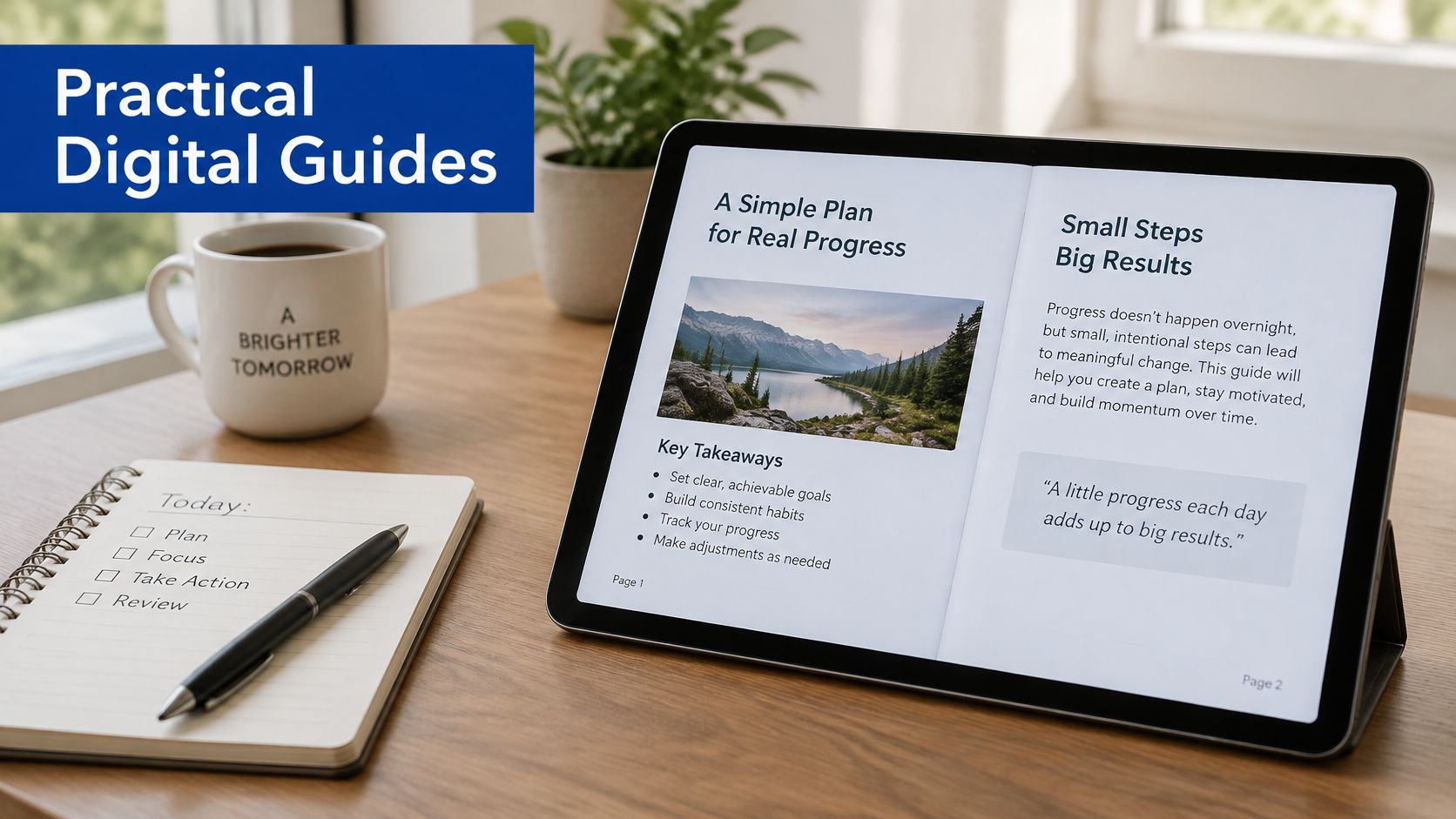
Build time is usually one to three focused weekends if you already know the topic. Writing from scratch, with research you don't have, stretches into a month and still may not sell. Buyers are people who want a result they can name, such as a proposal price, a launch checklist, or a first client script. Resale is strong. After the file is done, each sale costs almost nothing to deliver. What doesn't resell cleanly is a guide stuffed with platform screenshots and tax figures that go stale.
Practical rule: Promise one measurable result in the title, then spend the pages on steps, examples, and a template. Theory without a worksheet is a blog post.
Price it in the low to mid range and test two prices before you lock one in. Offer a sample chapter so the download also grows the list that will later buy a course or a template pack. Update the file about once a year. A dusty 2022 screenshot is how a good guide starts earning refunds.
Before writing the whole guide, sketch the buyer's starting point and the finished result. A pricing guide for freelance writers, for example, could include a rate calculator, three annotated quotes, and a script for explaining a higher fee. That is more useful than 40 pages of general advice about confidence. Give the sample chapter to a few potential readers and ask where they got stuck. Their answers tell you what needs an example, not just another paragraph.
Make the delivery easy to use. Include a clickable contents page, editable worksheets where relevant, and a note stating when the guide was last checked. If buyers repeatedly ask for help applying one chapter, that is a promising topic for a workshop or template, not necessarily a reason to double the eBook's length.
For example, a freelance designer could package a short guide to scoping brand projects with an editable discovery questionnaire and a sample project brief. A buyer leaves with documents they can use on their next client call, rather than a collection of design tips.
Table of Contents
- 2. Online Courses
- 3. Notion, Spreadsheet, and Productivity Templates
- 4. Printables and Planners
- 5. Stock Photos, Graphics, and Design Assets
- 6. Lightroom Presets and Photo Editing Assets
- 7. WordPress Themes, Plugins, and Website Templates
- 8. AI Prompt Packs and Prompt Libraries
- 9. Business Document Templates and SOP Packs
- 10. AI Chatbot, Automation Workflows, and Licensed Business Bots
- How the 10 Digital Products Compare on Effort, Revenue Model, and Buyer Fit
- Pick One Product and Ship It This Month
2. Online Courses
A course is a sequence that leads to a finished skill, not a pile of videos. Buyers pay for the path and the proof they did the work. You can sell it once, as a cohort with a start date, or as a membership. Freelancers often teach pricing or client acquisition on Teachable or Thinkific. The heavier the promise, the more you should pre-sell to a small group before you record everything.

The DataIntelo report valued the global online-course-platform market at $24.6 billion in 2025, with skill-development courses at $9.48 billion, or 38.5% of that market. Size doesn't mean a general "learn business" course will sell. A 2024 study of 275 university students found overall online-learning satisfaction above a moderate level, and tied satisfaction to motivation, learner interaction, teaching ability, platform design, and learning resources.
What actually gets finished
Completion measured against every person who ever enrolled is a misleading score. Dropout stays common, so I design for the people who meant to finish.
- Short modules: One outcome per lesson, not a 40-minute lecture.
- Proof of work: A worksheet, a project, and a pass mark you can point to.
- A person in the loop: Cohort feedback raises the price and cuts the "I bought it and never opened it" refund.
Build time is the highest on this list, often several weeks once you count recording, editing, and the project. Buyers want a portfolio piece, an operating procedure, or a workflow they can use at work on Monday. Resale works for a self-paced course. A live cohort does not. It needs you every round. Ship a free mini-course first. The people who finish it are the only audience worth recording the full version for.
For example, a bookkeeping course for new freelancers could start with sorting one month of transactions, move to a reusable spreadsheet, and end with a monthly review routine. Each lesson produces part of the finished system. That is easier to evaluate than a course promising to teach everything about money. Run the first version live with a small group, note every point where learners need clarification, and record the stable lessons afterward. Keep feedback sessions as a separate offer if students value your time more than extra videos.
A second example is a short course for virtual assistants who need to set up a client's inbox. Lessons could cover labeling rules, a reply library, and an escalation checklist. The final assignment is a working inbox system the learner can demonstrate, not a quiz about email etiquette.
3. Notion, Spreadsheet, and Productivity Templates
Say a designer spends Sunday night rebuilding the same client tracker in a blank sheet. A template removes that Sunday. Notion workspaces, Google Sheets budgets, and Excel trackers sell because the buyer duplicates them and starts the same day. The value is the structure and the formulas, not the branding.
Thomas Frank built a known catalog of Notion systems for students and personal productivity. Freelancers sell onboarding and invoice trackers on Etsy and Gumroad. Personal-finance creators sell dashboards that already have the categories, the charts, and a sample month filled in.
Build time is often a single weekend if the sheet is one you already run your own work on. A pretty template you have never used takes longer and breaks on the first odd input. Buyers are operators with a repeating task, invoicing, a content calendar, a pipeline, not people browsing for inspiration. Resale is excellent until the host app changes a feature and your instructions lie.
I ship two versions. A light file at a low price proves the workflow. A full file, with extra views and a five-minute setup video, carries the margin. Keep a short changelog. When you later teach the same workflow, the template becomes the worksheet inside the course instead of a separate invention.
Consider a client pipeline sheet. The basic version might track contact, stage, next action, and follow-up date. The full version could add a dashboard and a sample pipeline so buyers see how to use it before entering their own leads. Test both with an empty account, not just your carefully filled-in working copy. Check what happens when a buyer deletes a row, changes a category, or opens the file on a phone. A plain setup guide and clearly marked example data prevent many support requests.
For a different buyer, a tutor could sell a lesson-planning spreadsheet with student goals, session notes, and an automatic next-session checklist. Include one fictional student record so buyers can see the workflow, then make it easy to clear the example before entering real information.
4. Printables and Planners
Printables are files meant for a home printer. Weekly planners, budget trackers, habit charts, and worksheets. The buyer downloads, prints, and writes on paper. Undated planners are the workhorse on Etsy because they don't expire on January 1. Seasonal bundles, holidays and back-to-school, spike and then go quiet. Editable Canva files sit in between. The buyer tweaks colors, then prints.
Paid demand is broader than courses, and more uneven. Whop's roundup of 2025 digital-content figures notes that 68% of internet users aged 16 and older paid for digital content monthly, while streaming led at 32% and e-learning and digital movies were each 11%. A planner for one kind of buyer can be an easier first sale than a course. The same roundup cites a Goldman Sachs estimate of roughly $250 billion for the creator economy in 2024, with a projection of $480 billion by 2027, which is more competition for generic creator products, not a reason to copy them.
A one-time printable with a paid yearly refresh is often easier to validate than a subscription nobody trusts yet.
Build time can be a few evenings in Canva if you already have a visual system. Buyers are specific. Freelancers, students, new parents. "Planner for everyone" is how listings drown. Resale is high, and so is copying, so your mockups and a clear personal-use versus commercial-use license do more than a low price. Bundles raise the order. Keyword-rich titles still matter on Etsy and on Pinterest, where the search is the storefront.
A student exam planner, for instance, could pair a term overview with weekly revision sheets and a one-page checklist for each subject. Show a filled-in example next to the blank pages so buyers understand the intended routine. Export and print a test copy in black and white as well as color. Check margins, writing space, and whether small text stays readable on an ordinary home printer. Offer common page sizes only if you have actually checked the layouts in each size.
A meal-planning printable for a household of two could bundle a weekly menu, a shopping list sorted by store section, and a leftovers tracker. A filled-in week shows how the pages work together. That is a more specific purchase than a generic sheet labeled "meal planner."
5. Stock Photos, Graphics, and Design Assets
Stock is a portfolio business, not a single hero file. You upload photographs, icons, vectors, or mockups. The marketplace takes the payment and the license, and you earn when someone downloads. Adobe Stock and Shutterstock do this for photos. Creative Market fits icon sets. Envato Elements fits social templates and mockups that marketers reuse across clients.

Build time for one accepted photo is short. Build time for an income is long, because one file rarely pays rent. You need a stream of accepted work and keywords that match how buyers search. Buyers are marketers, bloggers, and small studios who would rather license a scene than book a shoot. Resale is the model. The same asset can pay again for years. The trade-off is that you don't control the price, and popular scenes are crowded.
I would rather shoot a narrow niche, shop interiors for a trade, clinic reception desks, small-warehouse packing tables, than another generic laptop-on-a-desk. Release every recognizable person and property. Fill in the metadata. Read each site's exclusivity rules before you upload the same file everywhere. Then watch which keywords download, and shoot more of that, not more of what you wish people wanted.
Plan a shoot as a set, not a single frame. A small bakery might need a wide counter scene for a website banner, a close-up of packaging for a product page, and a vertical crop for social posts. Leave uncluttered space where a buyer might place text. For graphics, the same principle means delivering a coordinated set with consistent file names and a short note on what buyers may edit. Keep a record of releases, upload dates, and accepted assets so you can tell whether a niche is producing downloads rather than just filling a folder.
A designer could take the same niche approach with a coordinated set of bakery icons: menu labels, packaging symbols, and social post graphics delivered in editable formats. Show the set in a sample menu so buyers can picture its use, and state the permitted uses in the license.
6. Lightroom Presets and Photo Editing Assets
A preset is a saved recipe. One click in Adobe Lightroom, Lightroom Mobile, Photoshop, or Capture One applies a look the buyer doesn't want to rebuild on every frame. Wedding photographers sell packs from their own sites because couples' galleries need to match. Travel shooters sell mobile packs to people who edit on a phone. Video editors buy LUT packs for the same reason, a consistent grade without a color course.
This product fails when the preset only looks good on the three photos in the sales gallery. Show the same pack on hard sun, open shade, and indoor tungsten. If it falls apart, say so on the page, or fix it before you sell it.
Build time is short once your own editing is consistent, often a day to export, name, and write install steps for each app version. Buyers are creators who already shoot and hate the editing bottleneck. They are not beginners who need you to explain exposure. Resale is close to perfect. The files are tiny and the delivery is automatic. What costs you later is support from people on the wrong software version, which is why the install note earns its place.
Name packs by job or mood, "film wedding," "bright airbnb," not "Pack 3." A free five-preset starter grows the list. The paid pack, and later a short course on shooting for that look, sells to people who already trust the color.
Build the sales page around the photos buyers actually edit. A real-estate photographer might show the same preset on a bright living room, a dim hallway, and a room with mixed lighting, with exposure adjustments disclosed. Package compatible files, import instructions, and a short troubleshooting note. State which software you tested and when. If a buyer needs to adjust white balance on every image, explain that openly: a preset is a starting point for a consistent edit, not a repair tool for every lighting problem.
For example, a food photographer could build a pack for cafe interiors and show it on a window-lit table, an overhead menu shot, and a warm evening scene. Label the starting lighting for each before-and-after so buyers know where the look is likely to work and where it needs adjustment.
7. WordPress Themes, Plugins, and Website Templates
A theme controls how a WordPress site looks. A plugin adds one job, forms, booking, checkout, membership. Both are old markets, which is a compliment. Buyers already know how to purchase them. Developers sell themes on ThemeForest. Plugin authors often ship a free version and charge for the features a business needs. Agencies sell a narrow template, a restaurant, a solo lawyer, a studio schedule, instead of another all-purpose blog theme.
Build time is measured in weeks, not weekends, if you follow WordPress coding standards and test on common hosts. A pretty demo that breaks on a cheap shared server creates a support job you didn't price. Buyers are site owners and freelancers who want the feature without hiring you for the whole build. Resale is real, but it is not "build once and walk away." Core, PHP, and page-builder updates will break something.
Documentation is the product. A clear setup guide cuts tickets more than another skin. License tiers matter. One site for a freelancer, several sites for an agency. I would not start with a general theme. Start with booking for consultants, document the happy path, and offer a paid setup only after the self-serve version has reviews. The free tier is how strangers find you. The paid tier is how the time pays back.
For example, a plugin for independent tutors could let visitors request a lesson time in the free version, then add availability rules and reminder emails in the paid version. Before selling it, test a complete booking on a fresh WordPress install and document what happens if an email fails to send.
8. AI Prompt Packs and Prompt Libraries
The weekend story at the top is this product. A prompt pack is a set of tested instructions for a repeating job, client briefs, product descriptions, email angles, spreadsheet cleanup. Buyers are not paying for the model. They already have that. They pay to skip the hour of bad outputs.
The Stack Overflow 2025 Developer Survey, with more than 49,000 responses from 177 countries, found that 84% of developers use or plan to use AI tools, up from 76% in 2024, and that 47.1% use them daily. Positive sentiment still fell to about 60%, and only 31% said they were using AI agents. That gap is the product. Sell tested prompts, output examples, and a way to check the result. Don't sell a dump of clever lines.
- Test in public conditions: Run every prompt more than once and keep the failures out of the file.
- Group by task: "Proposal follow-up," not "for Model X," unless you also name the model you tested.
- Show the work: A before-and-after is worth more than a claim that the prompt is powerful.
Build time is a weekend if the prompts are already in your daily work. Buyers are practitioners who use the tools and don't trust them. Resale is good for a quarter, then weaker, because models change. Plan a paid update. Pair the prompts with the steps around them, where the output goes, what a human still checks, and you can later fold that same pack into a course module without starting over.
A property manager, for instance, might package prompts that turn approved maintenance notes into tenant updates. Include a sample input, a sample draft, and a checklist for verifying dates, repair status, and private details before sending. The review step is part of what the buyer is purchasing.
9. Business Document Templates and SOP Packs
Most small teams don't lack opinions about how work should happen. They lack a file someone else can follow on a Tuesday when the founder is out. Proposal shells, invoice sets, onboarding packets, and standard operating procedures fix that. Consultants sell proposal-and-invoice packs. Operations people sell SOP libraries for remote teams. Freelancers sell the contract set they wish they'd had for web design or copywriting.
These are not legal advice. Say that on the sales page, and tell the buyer to have a local professional read anything that creates a binding promise. A template that pretends to be a lawyer is how you buy a support nightmare.
Build time is moderate. A clean pack for one function, hiring, sales, or finance, can be a week if you are adapting documents you already use. Writing fake policies for an industry you don't know is how the file gets returned. Buyers are owners and freelancers who feel operational drag, not readers collecting PDFs. Resale is strong because the next buyer has the same blank page.
Ship editable Word or Google Docs files plus a one-page implementation note. What to rename, what to delete, what to send first. The same pack is also the cleanest bridge to paid consulting. People who buy the hiring kit and get stuck are telling you the next offer. Don't pitch that on day one. Let the template prove you understand the work.
A small agency's client-handoff pack could include an asset inventory, access-transfer checklist, final-deliverables email, and an internal sign-off sheet. Show which document the team completes first and which goes to the client. That sequence makes the pack usable without a call to explain it.
10. AI Chatbot, Automation Workflows, and Licensed Business Bots
This is the product I would not sell as a vague "AI employee." Sell one workflow with a result you can describe. A lead-capture bot for a local service business. A Make or Zapier bundle that tags orders and alerts a person. An n8n flow that books appointments and writes the summary into a sheet. Agencies license the setup. Specialists sell the self-serve file and, separately, a paid install.
The OECD's 2025 report on generative AI and SME workforces found that 54.1% of surveyed small and medium-sized enterprises using generative AI named copyright, legal, or regulatory issues as a barrier, and 52% were concerned about information submitted to models. A kit that ignores that will create refunds. Document what the human still reviews, what must never be pasted into a model, and what the buyer is allowed to modify or resell.
A workflow only feels simple after you write down the accounts it needs.
Build time is days for a narrow, tested flow and longer once you add error handling. Buyers are owners without a developer who still have a task with a measurable before and after, missed leads, slow replies, double-booked calls. Resale of the template is good. Resale of your time is not, unless you priced a setup package on purpose. Connected apps change, so retest on a schedule and put the test date on the download page.
For example, a local cleaning company could use a licensed workflow that captures a quote request, checks whether the service area matches, and sends the details to a human for pricing. The download should identify the required accounts, show a test request from start to finish, and explain what happens if a connection stops working. It should not promise an instant quote if a person still sets the price.
How the 10 Digital Products Compare on Effort, Revenue Model, and Buyer Fit
| Item | Main Format | Creation Effort | Recurring Revenue Potential | Best For | Sample Buyer |
|---|---|---|---|---|---|
| eBooks and Digital Guides | PDF, EPUB, or MOBI guide | Low to moderate | Moderate through ongoing sales and upsells | Teaching a focused skill or solving a specific problem | A freelance writer who needs a repeatable way to quote projects |
| Online Courses | Video lessons, written materials, quizzes, and community | High | High through memberships or recurring cohorts | Teaching a structured skill or transformation | A new virtual assistant learning to set up client inboxes |
| Notion, Spreadsheet, and Productivity Templates | Notion workspaces, spreadsheets, and setup guides | Low to moderate | Moderate through repeat sales and bundles | Streamlining recurring workflows | A tutor tracking student goals and lesson plans |
| Printables and Planners | Downloadable PDF or PNG files | Low | Moderate through evergreen and seasonal sales | Organization-focused audiences and printable tools | A student organizing revision before exams |
| Stock Photos, Graphics, and Design Assets | Licensed photos, illustrations, vectors, and templates | Moderate to high | Moderate through repeated downloads and royalties | Photographers and designers building a portfolio | A bakery owner who needs coordinated icons for menus and posts |
| Lightroom Presets and Photo Editing Assets | Preset packs, profiles, and LUT files | Low to moderate | Moderate through repeat sales and bundles | Photographers and creators seeking consistent editing styles | A food photographer editing a series of cafe images |
| WordPress Themes, Plugins, and Website Templates | Installable themes, plugins, and website templates | High | High through subscriptions and support renewals | Developers serving WordPress site owners | An independent tutor who needs lesson-booking requests on a website |
| AI Prompt Packs and Prompt Libraries | Prompt documents, spreadsheets, or text libraries | Low | Low to moderate through repeat sales and updates | Freelancers and businesses seeking faster AI workflows | A property manager drafting updates from approved maintenance notes |
| Business Document Templates and SOP Packs | Editable documents, checklists, and guides | Moderate | Moderate through repeat sales and consulting upsells | Small businesses and freelancers needing operational documents | A small agency standardizing client handoffs |
| AI Chatbot, Automation Workflows, and Licensed Business Bots | Chatbot configurations, automation workflows, and setup guides | High | High through recurring licenses and support | Businesses seeking to automate specific tasks | A cleaning company routing quote requests to its pricing team |
Pick One Product and Ship It This Month
Stop comparing all ten. Match one product to a skill you already perform for pay or for yourself, an audience you can reach without a new channel, and a build you can finish in the next 30 days. If you can't name the buyer in one sentence, you don't have a product yet. You have a format.
Use the calendar as the filter. Under about 15 hours, start with a printable, a preset pack, a prompt library drawn from work you already do, or a single spreadsheet you have battle-tested. Between two and four weekends, an eBook or a business-document pack is realistic, especially if a free chapter or a free template starts the email list. A full course, a WordPress plugin, or a licensed bot only belongs on this month's list if the outline, the code, or the workflow already exists. Recording from a blank page is next month's project, after strangers have paid for the smaller version.
Price it before you polish it. Look at what that buyer already pays for a similar file, then sit in the middle until you have reviews. Very cheap signals "unfinished" to a buyer who can't hold the product. Very expensive, with no sample and no setup note, creates the refund. Put the license in plain language. Personal use, client use, or the right to resell. For anything touching contracts or model outputs, say what you are not. You are not their lawyer, and you are not promising a model will behave the same way in six months.
Publish in one place you control and, if the product fits, one marketplace that already has shoppers. Your site is where the email address lives. Etsy, Gumroad, a theme market, or a course platform is where strangers browse. Turn on delivery the same day. A checkout that emails a link is the whole operation. Then collect ten pieces of feedback before you build a second product. The questions people ask are the next SKU. The questions nobody asks are the features you should delete.
Sequence beats variety. A sample chapter feeds the list. The list pre-sells the course. The course includes the template. The template's support questions become the SOP pack or the setup call. That is a shop. Ten unrelated files launched in a burst is a clearance table.
Our Earn Living Online section walks through starting an online income model in more than one format, and our free best-selling ebooks are there when you want a longer read on pricing and packaging before you record anything. Ship the small file this month. Let the second product wait until a paying buyer has told you what was missing.
Mega Income Stream publishes practical guides on earning online, including digital products, freelancing, and business operations, plus free best-selling ebooks you can read before you pick a format. If you're choosing a first product and want a wider look at pricing, funnels, and income models, visit Mega Income Stream and start with the Earn Living Online section.










Comments