
 By

For most LLCs, cash accounting records income when payment arrives and expenses when paid, while accrual accounting records income when earned and expenses when incurred. The right choice in accrual vs. cash accounting for an LLC depends on its tax classification, gross receipts, and whether specific IRS rules apply.
Cash accounting can make cash flow easier to track because the records follow payments. Accrual accounting shows income and expenses in the periods they relate to, but it may require reporting income before a customer pays. That difference can affect both bookkeeping and the timing of taxable income.
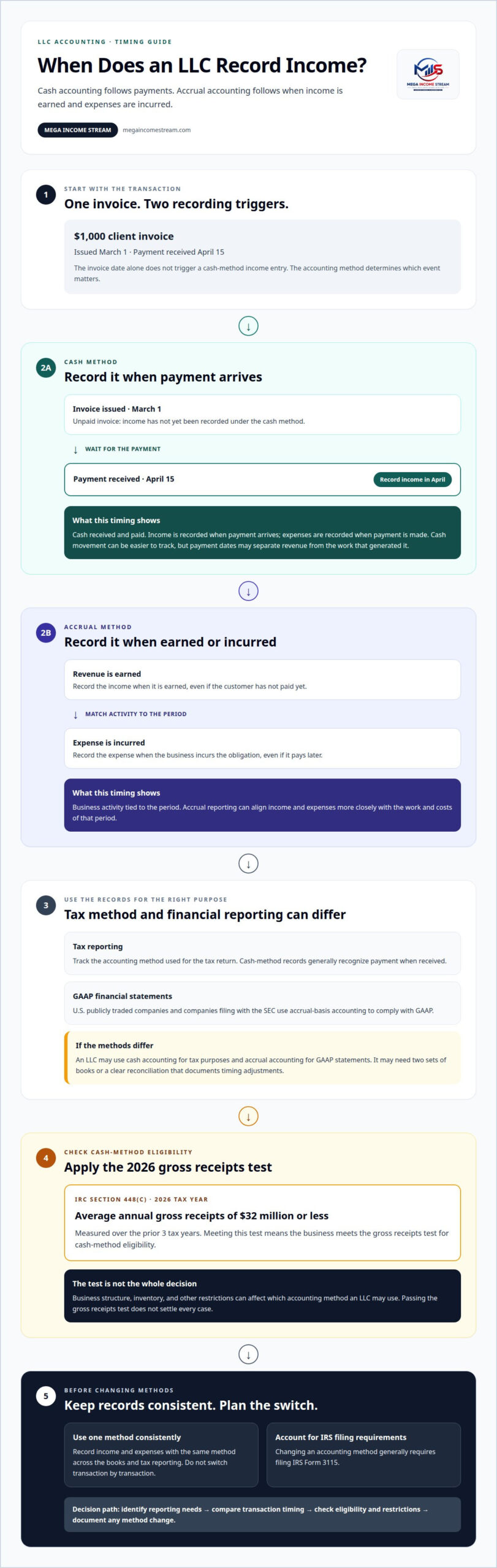
For the 2026 tax year, a business meets the IRC Section 448(c) gross receipts test for cash-method eligibility if its average annual gross receipts over the prior three tax years are $32 million or less, according to the Internal Revenue Service. Passing that test does not settle every case: business structure, inventory, and other restrictions can affect the method an LLC may use.
This guide explains how each method works, how it affects tax timing, and which businesses may be required to use accrual accounting. It also offers a practical way to weigh reporting needs against cash-flow visibility.
- Compare timing: Assess how each method affects cash visibility, profit reporting, and taxable income timing.
- Match revenue and costs: Use accrual reporting to evaluate performance by period.
- Assess eligibility: Consider gross receipts, business structure, and inventory when evaluating cash-method use.
- Plan method changes: Account for formal IRS filing requirements before switching methods.
- Check reporting rules: Identify when business requirements make accrual accounting necessary.
What is cash-basis accounting?
Cash-basis accounting records business income when payment arrives and expenses when payment leaves the account. Because bookkeeping follows transactions that affect available funds, an unpaid invoice does not yet appear as received income. A bill enters the records when the business pays it. This approach makes cash movement easier to track, but payment dates can separate revenue from the work that generated it.
Consider a $1,000 client invoice issued on March 1 and paid on April 15. Under the cash method, the business records the income in April, when it receives payment. If a business invoices a client in October and receives payment in January, the income generally falls into the following tax year under cash-basis accounting. The invoice date alone does not trigger the cash-method entry.
Accrual accounting uses a different trigger. It records revenue when the business earns it and expenses when it incurs them, rather than waiting for cash to change hands. If work is complete and the client owes payment, the business records the earned revenue even if the invoice remains unpaid. Similarly, an expense enters the records when the business incurs the obligation, even if it pays later. This timing can align income and expenses more closely with the work and costs of a period.
| Accounting method | Income recorded | Expenses recorded | What the timing shows |
|---|---|---|---|
| Cash | When payment is received | When payment is made | Cash received and paid |
| Accrual | When revenue is earned | When expenses are incurred | Business activity tied to the period |
Use the table to see which timing better fits the business’s reporting needs, then consider applicable tax rules before choosing a method. For example, an LLC with unpaid invoices may report income in a different period under accrual accounting than under cash accounting. That distinction matters for internal performance tracking and tax purposes. Financial reports prepared under generally accepted accounting principles may also use accrual treatment, so reporting needs can shape the bookkeeping process.
Consistency matters after a method is selected. Record income and expenses using the same method across the books and tax reporting, rather than switching transaction by transaction to create a preferred result. Changing an accounting method generally requires filing IRS Form 3115, according to the Internal Revenue Service. The form is therefore a key consideration before moving from cash to accrual or making another method change. The decision is not simply about which entry is easier; it affects when transactions appear and how the books communicate business activity.
GAAP and accrual accounting
For U.S. public-company reporting, accrual accounting is standard. U.S. publicly traded companies and companies filing with the Securities and Exchange Commission use accrual-basis accounting to comply with generally accepted accounting principles, or GAAP. GAAP financial statements record business activity by period rather than showing only cash received and paid. This structure helps readers assess revenue, expenses, assets, and obligations across reporting periods.
An LLC’s tax method and financial-reporting method can serve different purposes. A business may use the cash method for tax purposes while preparing GAAP financial statements on an accrual basis. It may then need two sets of books or a clear reconciliation between its tax records and financial statements. Records should show which method produced each reported figure, so invoices and bills do not shift between systems without documentation.
For example, an LLC completes a client project in December but receives payment in January. Its accrual-based GAAP records can recognize earned revenue in December, while its cash-method tax records generally recognize the payment when received. The two sets of records answer different questions: one presents business activity for financial reporting, and the other follows the tax accounting method. A reconciliation documents why the same transaction appears in different periods.
Inventory is another point to consider. For inventory, keep records that connect the cost of goods with the items sold rather than treating every purchase as an immediate expense. An LLC that buys products for resale therefore needs records of purchases, units held, sales, and related costs. Those details help financial statements connect product revenue with the inventory costs associated with those sales.
Use a consistent close process for GAAP records. At each reporting close, separate earned revenue from cash collections, identify expenses incurred but unpaid, and reconcile inventory records with sales. Then document adjustments between financial statements and tax records. For example, a December invoice collected in January may require a period adjustment in the financial statements, while the tax records follow the LLC’s chosen method.
- Financial reporting: Apply accrual accounting when preparing GAAP statements.
- Tax reporting: Track the method used for the tax return separately.
- Reconciliation: Record adjustments that explain timing differences.
- Inventory: Connect product costs with the inventory and sales records.
This distinction matters when an LLC grows or prepares statements for lenders, investors, or other readers. First decide whether the records support tax reporting, GAAP financial reporting, or both. Then map each transaction to the relevant ledger and preserve the reconciliation. This keeps annual results understandable without treating the tax year and financial-reporting period as interchangeable.
Accrual-basis accounting advantages and disadvantages
Accrual accounting can give an LLC a clearer view of profitability by matching revenue with the expenses that generated it. A project completed in December and its related subcontractor expense can appear in the same reporting period, even if payment happens later. This helps owners assess whether a project was profitable instead of comparing unrelated cash movements. Lenders and investors usually want accrual-basis financial statements, so accrual records can also support external reviews.
The trade-off is that reported income may not yet be in the bank. An LLC can owe tax on revenue earned during a period before the customer pays. To manage the gap, monitor unpaid invoices alongside cash balances, upcoming bills, and expected collections. Accrual reports show business activity, but they do not replace a cash forecast.
- Profit analysis: Match revenue and related expenses to assess results for a project or period.
- Financing records: Prepare accrual statements when lenders or investors require that reporting basis.
- Collection risk: Track earned revenue separately from amounts actually collected.
- Bookkeeping workload: Maintain unpaid invoices, incurred expenses, and period-end adjustments.
Accrual treatment can also affect tax timing. If accrued income tends to be lower than accrued expenses, an LLC may have a lower tax liability using accrual accounting than using the cash method. The comparison depends on when the business earns revenue and incurs costs, not simply on when money changes hands. For example, expenses incurred before year-end may be recorded in that period even if a customer pays later. The timing difference can change taxable income between methods.
Cash accounting has a different advantage: its records follow receipts and payments. That can make available cash easier to track and reduce the need to record unpaid invoices and bills. However, cash reports can distort a period’s operating results. A large payment received after a project ends may appear in a later period, while expenses paid early may appear before the revenue they support. As a result, the totals may not show how profitable the underlying work was.
Neither method is best in every situation. A service LLC with delayed customer payments may value accrual reporting for project profitability, while a business focused on near-term liquidity may find cash records easier to manage. As average annual gross receipts and operations change, revisit whether the method still supports tax reporting, cash-flow planning, and financing needs. Keep records consistent and account for applicable rules before changing methods.
Tax timing and IRS gross-receipts rules
Federal eligibility for the cash method depends on gross receipts, business structure, and other restrictions. State tax rules can differ, so federal eligibility alone does not determine which method is accepted for a state return.
Federal Cash-Basis Accounting Choice
An LLC can choose cash-basis accounting for federal taxes when it qualifies under the applicable rules. For the 2026 tax year, a business meets the IRC Section 448(c) gross receipts test for cash-method eligibility if its average annual gross receipts over the prior three tax years are $32 million or less, according to the Internal Revenue Service.
The IRC Section 448(c) gross receipts test threshold increased from $31 million in 2025 and $30 million in 2024, according to the Internal Revenue Service. The test is not the only factor: business structure and other tax restrictions can limit eligibility even when receipts fall below the threshold.
Certain S corporations, partnerships without C corporation partners, farming businesses, and personal service corporations may qualify for cash accounting under exceptions. Tax shelters, including syndicates, cannot use the cash method, regardless of gross receipts. Businesses under common ownership generally combine gross receipts when applying the test.
Tax and Bookkeeping Risks
Cash accounting generally reports income when received and expenses when paid. That timing can make cash records easier to track, but an unpaid invoice may not yet appear as income. Accrual accounting records earned revenue and incurred expenses, making business activity clearer but potentially reporting income before collection.
The methods can also shift deductions between tax years. For U.S. tax purposes, certain year-end bonuses paid within the first 2½ months of the following tax year may be deductible under the accrual method, according to the Internal Revenue Service. Inventory and business structure can also affect which method is available, so bookkeeping convenience alone does not settle eligibility.
For an LLC with material inventory, review the gross-receipts rules before choosing a method. A business that exceeds the applicable threshold and carries inventory as a material income-producing factor may have to use accrual accounting under the rules described here. This affects inventory records, expense timing, and tax reporting.
To assess the test, calculate gross receipts across the prior three tax years, combine receipts where common ownership applies, and identify the LLC’s tax structure. Then account for inventory and any relevant exception. Review state returns separately under the state’s accounting-method rules, because federal treatment does not settle the state question.
Businesses required to use accrual accounting
An LLC’s name does not determine its federal accounting method. Business structure, gross receipts, inventory, and tax-shelter status can affect whether cash accounting is allowed. The practical takeaway is to identify the rules that apply before treating cash reporting as an available option.
Tax shelters cannot use the cash method. U.S. tax shelters, including syndicates, are ineligible regardless of gross receipts. A low-receipt LLC does not qualify for cash treatment merely because it operates on a small scale if it falls into this category. Its accounting method must follow the restriction that applies to its tax status.
Some corporations and partnerships face a gross-receipts restriction. For the 2026 tax year, the Internal Revenue Service’s Section 448(c) test uses average annual gross receipts over the prior three tax years, with a $32 million eligibility threshold. A C corporation, or a partnership with a C-corporation partner, exceeding the applicable threshold generally cannot use the cash method under the rules described here. An LLC taxed as a partnership must therefore account for its tax classification and partners, not just its state-law form.
Inventory can change the accounting requirement. A business that carries inventory as a material income-producing factor and exceeds the gross-receipts threshold may have to use accrual accounting. This matters to an LLC selling products: its records must track purchases, inventory on hand, sales, and cost of goods sold. A service LLC without material inventory may face a different analysis, but other eligibility restrictions still apply.
There is an important distinction between tax accounting and financial reporting. U.S. publicly traded companies and companies filing with the Securities and Exchange Commission use accrual-basis accounting to comply with generally accepted accounting principles. That reporting requirement does not, by itself, mean every LLC must use accrual accounting for federal taxes. An LLC can have separate financial-reporting and tax-method considerations.
To determine whether accrual treatment is required, work through these checks:
- Tax status: Identify whether the business is a corporation, partnership, or tax shelter.
- Ownership: Determine whether a partnership has a C-corporation partner.
- Receipts: Apply the relevant gross-receipts test, including aggregation where common ownership rules apply.
- Inventory: Assess whether inventory is a material income-producing factor.
- Reporting purpose: Separate federal tax accounting from GAAP financial reporting.
These checks distinguish an optional method from one restricted by tax rules. For an LLC with product sales, complex ownership, or changing receipts, a business strategy review can map the relevant rules to its reporting workflow before it adopts or changes a method.
Mega Income Stream
Mega Income Stream helps entrepreneurs connect accounting decisions with practical business strategies and revenue planning. If your LLC is weighing cash-flow visibility against accrual-based performance reporting, its Consulting Business can help map the trade-offs to your operating model and growth priorities. Making Money Insights can also support broader decisions about income workflows and sustainable revenue streams. These services focus on business strategy, not personalized tax or legal advice. Contact Mega Income Stream to discuss how accounting choices fit your business plans.
Put Your Accounting Decision Into Practice
Turn your accounting choice into a repeatable operating process. Document who handles bookkeeping, how transactions move from invoices and receipts into the records, and when management reviews them. A clear workflow makes the choice between accrual vs. cash accounting for an LLC easier to maintain as the business adds customers, products, or revenue streams.
Set a review point around meaningful business changes, such as introducing inventory, changing ownership, or preparing financial reports for a new audience. At each review, record what changed and whether the current process still supports day-to-day decisions. Keep tax reporting decisions separate from broader growth planning, and involve qualified tax professionals in tax-specific decisions.
When you want to connect accounting choices with your next business priorities, contact Mega Income Stream. Use the conversation to clarify the operational questions your records need to answer and define a practical next step. Document each review’s changes and whether you kept or updated the process.
Frequently Asked Questions
What is the accrual method of accounting?
The accrual method records transactions based on when revenue is earned or an expense is incurred. For example, an LLC that completes a design project but has not collected payment records the earned revenue in the project period. It also records a supplier bill when it incurs the cost. This helps managers assess project performance using related revenue and expenses rather than payment dates alone.
Which method do most small businesses use?
Cash accounting is a common choice for small businesses because it follows bank activity and can be simpler to maintain. It may suit an LLC with uncomplicated operations and few unpaid invoices. Businesses that need period-based profitability reports, seek financing, or manage inventory may find accrual records more useful. No single method fits every small business, and eligibility rules can limit the choice.
Can I switch from cash to accrual (or back)?
Yes, but changing an accounting method generally requires filing IRS Form 3115, according to the Internal Revenue Service. Treat the switch as a formal accounting change, not a bookkeeping setting adjustment. Before changing methods, identify the current method, the proposed method, and the transactions whose timing will shift. That review helps keep tax records and financial reporting aligned through the transition.
How do the methods differ?
Cash records follow receipts and payments, while accrual records follow earned revenue and incurred obligations. As a result, the same transaction can appear in different reporting periods. For example, a customer payment received after a project ends may appear later in cash records, while accrual records associate earned revenue with the work period. Track unpaid invoices and bills separately so cash balances do not obscure outstanding obligations.
Which Method Should You Choose?
Choosing between accrual vs. cash accounting for an LLC starts with eligibility, then turns to reporting needs. Consider whether the business holds inventory, has unpaid invoices or bills, needs period-based profitability reports, or prioritizes cash visibility. Cash records can simplify transaction tracking; accrual records can align revenue and costs by period. The chosen method must also meet applicable tax and financial-reporting requirements.
Which method gives a more accurate picture of profitability?
Accrual accounting generally gives a clearer picture of profitability for a reporting period because it matches revenue with the expenses that generated it. For example, a service project’s revenue and related contractor costs can appear together even if payment dates differ. Cash records still help monitor liquidity, but payment timing can make a period look unusually strong or weak compared with the work performed.
What is the difference between cash and accrual accounting for an LLC?
The difference is when transactions enter the LLC’s records: cash accounting follows payments, while accrual accounting follows earned revenue and incurred expenses. The LLC label alone does not determine which method applies. Federal tax classification, ownership, receipts, and inventory can affect eligibility. The chosen method also shapes how managers interpret unpaid customer balances, upcoming bills, and financial results for a period.
What IRS rules limit cash accounting for LLCs, including gross receipts thresholds?
For the 2026 tax year, a business meets the IRC Section 448(c) gross receipts test for cash-method eligibility if its average annual gross receipts over the prior three tax years are $32 million or less, according to the Internal Revenue Service. Business structure and other restrictions also matter. Tax shelters can’t use the cash method, and inventory can affect whether accrual accounting is required.











Comments