
 By

A laptop bought in March. A spare room that's 60 percent office and 40 percent guest bed. A design subscription that renews on the same card you use for groceries.
By filing season, that pile of transactions has become the question every freelancer asks: what can I really deduct?
The honest answer is that freelance tax deductions aren't a hunt for hidden write-offs. Each one is a decision with three separate consequences: how much tax it might save, how much cash it costs now, and what proof you'd need if anyone asked. Most guides cover the first and skip the other two, which is why people overpay in April and overspend in December.
This U.S.-focused guide walks through common deductions, worked examples, and the records behind each claim. Use the figures as planning examples, not as a substitute for calculating your own return. If you work under another tax system, the business-purpose questions still help, but the rates and eligibility rules may differ.
Table of Contents
- Common Freelance Tax Deductions and What Each Requires
- How Deductions Lower the Tax You Actually Pay
- Home Office and Vehicle Deductions Compared
- Eligibility Tests That Decide Whether an Expense Counts
- Recordkeeping Habits and Costly Mistakes
- Cash Flow and Estimated Tax Timing for Deductions
- Set Up Your Deduction System This Month
Common Freelance Tax Deductions and What Each Requires
Most claims begin with one idea: an ordinary and necessary cost of running your business. That broad test isn't a promise that every useful purchase is fully deductible. You also need to know whether the expense is personal in part, whether it buys an asset that lasts beyond the year, and whether a category-specific limit applies.
Say you're a freelance designer. You buy a $1,400 laptop, pay $55 a month for design software, and work from a spare room. The laptop is 90 percent client work and 10 percent streaming, so its business-use cost is $1,260 before deciding how to recover that cost for tax purposes. The software is entirely for client work, so the year's $660 in subscription payments is a straightforward business expense. The spare room doubles as a guest bedroom, so its shared use generally defeats the home-office exclusive-use test. Three costs, three different outcomes.
The scale of these expenses isn't marginal. For tax year 2022, the IRS reported approximately 33.1 million sole-proprietorship returns, with roughly $2.084 trillion in business deductions reported across them (IRS Statistics of Income tables). Deductions are part of how self-employed profit is calculated, not a bonus added after the return is finished.
Start with recurring operating costs, then review larger purchases separately. For instance, a $30 monthly scheduling tool used only for client bookings produces $360 of annual business expense. A $120 monthly internet bill used about 60 percent for work suggests a $72 monthly business share, or $864 for a full year, if you can explain how you reached that estimate. The calculation is simple; the business-use evidence is what makes it credible.
A useful first pass is to sort transactions into business-only, mixed-use, and personal. Business-only might include a domain used for your portfolio. Mixed-use might include a phone used for client calls and family messages. Personal might include a television subscription you sometimes watch while working. That sorting step prevents the payment method from driving the tax decision.
Consider a freelance editor who pays $240 for an annual proofreading tool in January but starts using it for client projects in April. The invoice establishes the cost; her work history helps explain why the tool belongs to the business. If the same subscription also serves personal writing, she should identify and support the business portion rather than assume every charge on her work card is deductible.
Start with equipment, because it's bought first and misclassified most
IRS guidance on managing gig-work taxes
Equipment expected to last more than a year may need to be capitalized and depreciated rather than treated like an ordinary monthly subscription. Section 179 and bonus depreciation can accelerate a qualifying deduction. For qualified property acquired and placed in service after January 19, 2025, the restored 100 percent bonus-depreciation rule may apply, subject to the property's eligibility and other restrictions (IRS Schedule C instructions). Simply ordering a laptop in December isn't enough: document when it was ready and available for business use.
Don't treat every device as automatically eligible for the same accelerated deduction. Mixed-use assets require a documented business percentage; vehicles and other listed property can face additional rules, including a more-than-50-percent business-use test for Section 179. Consider a camera bought for $2,000 and used 75 percent on paid shoots. Its starting business-use amount is $1,500, not $2,000. Your next question is whether that $1,500 is deducted immediately under an available rule or recovered over time. Keep the receipt, the date you began using it for work, and a reasonable account of the 75 percent split.
Timing matters as much as the invoice. If a monitor arrives on December 29 but stays boxed until you set up your workspace in January, save evidence of when you actually put it into business service. If an existing personal laptop becomes your work laptop later, record when business use began and review the applicable basis rules rather than treating its original purchase price as an automatic new business expense.
Also distinguish a repair from an improvement or a new asset. Paying to replace a worn cable is a different question from buying a new editing workstation. Keep an asset list even if an item qualifies for immediate expensing, because you may need its treatment and business-use history when you sell it, replace it, or change how you use it.
Run the table below against your receipts. Each row names the main test, the evidence, and the mistake to avoid.
| Expense | Deductible when | Records to keep | Watch for |
|---|---|---|---|
| Computer, phone or camera | Used for client work; longer-lived items may be depreciated or qualify for accelerated expensing | Receipt, placed-in-service date, business-use percentage | A mixed-use device is not automatically 100 percent business |
| Software and subscriptions | Used to deliver work or run the business | Invoices and billing statements | A personal entertainment subscription does not become business software because it shares a card |
| Internet and phone | To the extent used for business | Bills and a documented usage estimate | Claiming the whole household bill despite substantial personal use |
| Home office | Qualifying space used exclusively and regularly for business | Floor measurements, bills, and evidence of dedicated use | A guest bedroom or shared living area usually fails the exclusive-use test |
| Vehicle and travel | Qualifying business trips and travel | Trip log, receipts, and business purpose | Ordinary commuting and undocumented personal miles |
| Professional services | Fees tied to operating the business | Invoices and engagement letters | Personal legal or tax work bundled with business services |
| Advertising and website | Business marketing, hosting, domain, or portfolio costs | Invoices and ad platform statements | Personal content mixed with client marketing |
| Business insurance | Coverage for business liability or property | Policies and premium statements | Health insurance follows a different deduction path |
| Education and memberships | Costs that maintain or improve skills in your current work, when applicable | Receipts, course details, and business purpose | Training that qualifies you for a new trade or business |
| Bank and payment fees | Charges incurred to collect business income or operate accounts | Statements showing gross sales and fees | Recording only a net platform payout and losing track of fees |
| Supplies and small tools | Materials used in client work | Itemized receipts | Personal purchases mixed into the same shopping trip |
For example, if a platform reports a $1,000 client payment but deposits $970 after a $30 processing fee, record the $1,000 of gross business income and the $30 business fee rather than treating $970 as the whole transaction. Where a receipt includes both printer paper and household supplies, highlight the business line items instead of claiming the entire purchase.
You can use the same approach for a $75 monthly phone plan. If a review of calls and usage supports 40 percent business use, the estimated business portion is $30 per month, or $360 for twelve months. Record how you arrived at 40 percent and revisit it if your work pattern changes. An estimate is easier to defend when it reflects actual use rather than a percentage copied across unrelated bills.
Write the business-use percentage next to anything that isn't entirely for work. That single habit turns a receipt pile into a claim you can explain.
How Deductions Lower the Tax You Actually Pay
A deduction reduces income subject to tax; it isn't a refund of what you spent. A $1,000 laptop doesn't send $1,000 back to your account. If its full business cost is deductible this year, it lowers the relevant tax base by $1,000, and the actual saving depends on your taxes and other deductions.
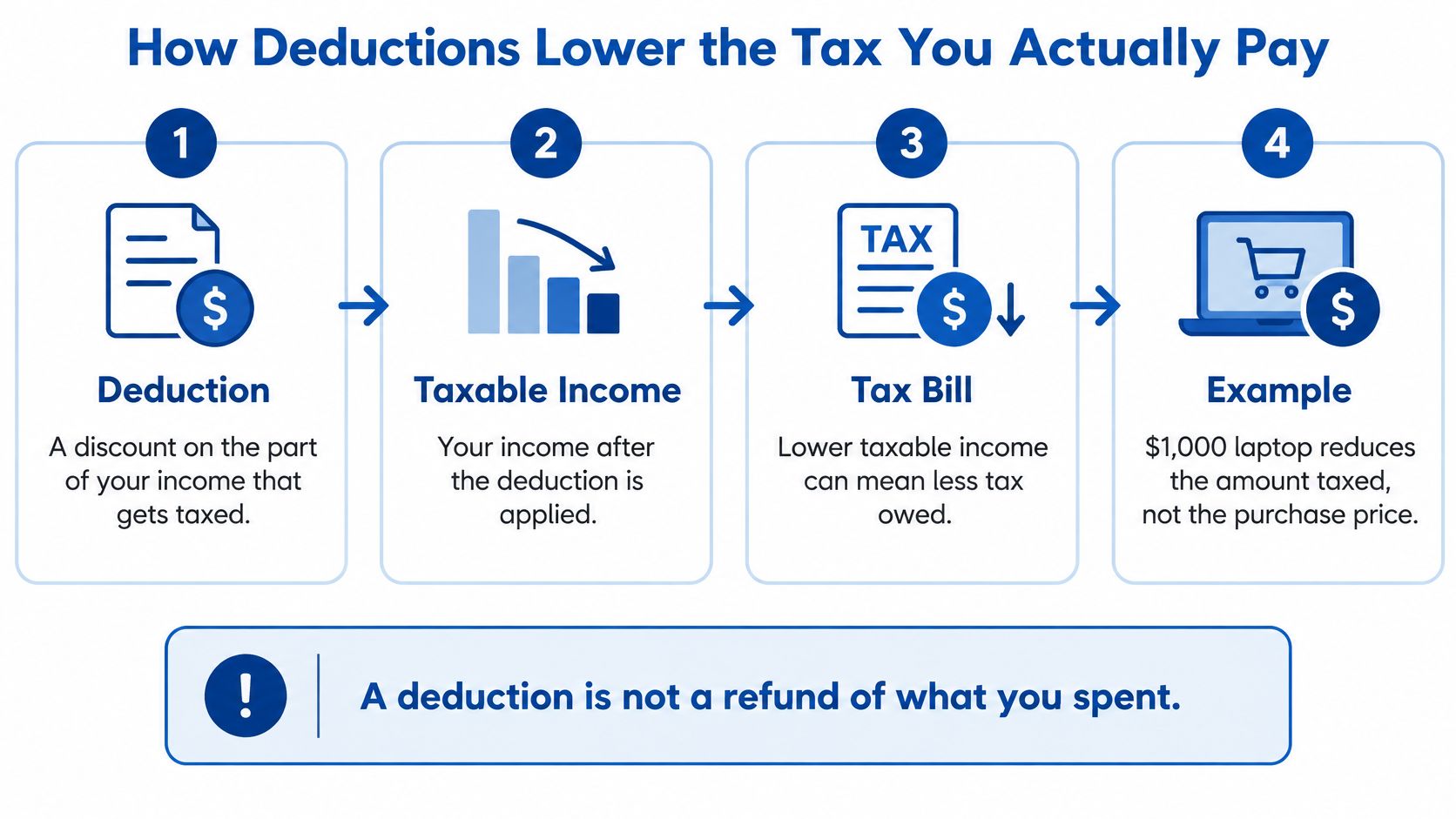
Suppose annual gross receipts are $60,000 and deductible Schedule C business expenses are $12,000. Net Schedule C profit is $48,000. Those business costs reduce gross receipts before you calculate tax on the resulting profit (IRS Publication 334). A separate question is how much less tax you owe than if you had earned the same receipts without those costs.
That distinction matters when you evaluate a purchase. If an extra $600 subscription does nothing useful for the business, its deduction does not erase the $600 charge. If it saves enough administrative time to let you complete another paid assignment, its business value may outweigh its after-tax cost. Tax treatment is one input to the decision, not the business case itself.
Here is a simplified marginal example for an additional $1,000 of eligible Schedule C expense, assuming the expense is fully deductible this year, a 22 percent marginal federal income-tax rate, and self-employment earnings below the Social Security wage base:
- Self-employment tax: Approximately 92.35 percent of the $1,000 profit reduction, or $923.50, leaves the self-employment-tax base. At 15.3 percent, that is about $141 less self-employment tax.
- Income tax: The $1,000 also reduces business profit, but the deduction for one-half of self-employment tax becomes about $71 smaller. Ignoring other interactions, income-taxable income falls by roughly $929, creating about $204 of income-tax savings at 22 percent.
- Combined illustrative saving: Around $345, leaving about $655 of the $1,000 cost after this simplified federal tax effect.
Applying that marginal example to all $12,000 of expenses would suggest a saving near $4,140, but a real return may cross tax brackets or interact with the qualified business income deduction, credits, state taxes, and other limits. The comparison is useful for planning, not a guarantee of what a particular receipt will save.
For a smaller decision, imagine a $200 business-only course that qualifies as a current-year Schedule C expense. Using the same illustrative marginal assumptions, its tax effect would be roughly one-fifth of the $1,000 example, not $200 back. If the course improves your work, the remaining after-tax cost could still be worthwhile. If you bought it solely for a write-off, you have paid for something you didn't need.
The IRS generally requires self-employed people with $400 or more in net earnings from self-employment to file Schedule SE, subject to the applicable rules (IRS self-employment tax guidance). Once Social Security earnings reach the annual wage base, the marginal self-employment-tax effect changes. And a deduction taken outside Schedule C can affect income tax without reducing Schedule C profit in the same way.
Practical rule: compare the after-tax cost of a purchase with the business benefit it produces. If you don't need a $1,000 item, spending $1,000 to save a few hundred dollars in tax still leaves you with less cash.
The other half of the equation is proof. A $1,000 deduction that cannot be supported may turn into tax, interest, and a difficult conversation later.
Home Office and Vehicle Deductions Compared
These deductions both involve a choice between a standardized calculation and an actual-expense calculation, but eligibility comes first. Choosing the method with the larger number cannot fix a space used personally or a trip that wasn't for business.
A home office generally must be used exclusively and regularly for business and meet an additional qualifying-use test, such as being your principal place of business or a place where you normally meet clients in the course of work (IRS Publication 587). A dedicated room can qualify even if your work also takes you to client sites. A desk in the family living room generally cannot qualify merely because you answer emails there. There are specific exceptions to the exclusive-use rule, so unusual situations merit a review.
Exclusive use describes what happens in the claimed area, not whether the room has a door. A dedicated corner of a larger room may warrant review if its boundaries and use are clear; a spare bedroom that occasionally hosts overnight guests usually presents a different problem. Photograph the setup and keep a basic floor sketch. Neither replaces the use test, but both help document the space you actually claimed.

Under the simplified home-office method, the calculation is generally $5 per square foot, up to 300 square feet, for a maximum $1,500 deduction (IRS simplified home-office guidance). A qualifying 180-square-foot office produces $900 before the applicable income limitation. Measure the actual qualifying space; don't count the hallway just because you pass through it on your way to the desk.
The actual-expense method uses the qualifying business percentage of eligible indirect home costs, plus any separately allowable direct expenses. Suppose a dedicated 150-square-foot room sits inside a 1,200-square-foot rented home. Its area is 12.5 percent of the home. Annual rent of $14,400 would produce a $1,800 business-use share of rent alone, before considering other eligible costs or the business-income limitation. Compare that with $750 under the simplified method for 150 square feet. Actual expenses may win numerically, but you need the bills and a defensible measurement.
For a closer comparison, suppose another qualifying 150-square-foot office has a $600 simplified calculation gap in favor of actual expenses after rent and other eligible costs are tallied. Check whether the extra deduction is worth the additional recordkeeping, especially if you own the home and depreciation is involved. Compare allowable amounts, not merely the total of every housing payment.
The income limit also differs in an important way: an allowable actual-expense home-office amount limited by business income may generally carry forward, while the simplified method does not create a carryover of unused home-office expenses (IRS simplified home-office guidance). Depreciation under the actual method can also matter when you sell your home. Run both methods before deciding.
Vehicle calculations require a trip log even if you choose a standardized rate. Under the 2026 standard mileage method, the IRS set the business rate at 72.5 cents per mile for January through June and 76 cents per mile for July through December (IRS standard mileage rates). For example, 1,000 qualifying business miles in the first half and 1,000 in the second half would produce $1,485 under those rates, before any separately allowable items. Don't apply one half-year rate to every trip.
A calendar entry saying "client meeting" does not establish how far you drove or whether you added a personal stop. Log the date, destination, purpose, and distance for each business trip. If you drive from a client meeting to the grocery store, distinguish the business portion from the personal errand instead of recording the full outing as client travel.
Under actual vehicle expenses, track both total annual miles and business miles to calculate the business percentage of eligible operating costs and any allowable depreciation. If a vehicle travels 12,000 total miles, including 3,000 business miles, the business-use share is 25 percent. If eligible annual operating costs were $4,000, that percentage would yield $1,000 before considering depreciation and other rules. The mileage-method example and the actual-expense example are alternatives, not deductions you add together.
Watch the video walkthrough before choosing a method, since the choice can affect future years.
| Method | How the amount is figured | Records you need | Best when | Limit to know |
|---|---|---|---|---|
| Simplified home office | $5 per square foot, up to 300 square feet, maximum $1,500 | Floor-area measurement and proof of qualifying use | Smaller dedicated office or modest eligible housing costs | Limited by business income; no carryover of unused simplified expenses |
| Actual-expense home office | Eligible direct costs and the business-use percentage of eligible indirect home costs | Housing bills, floor measurements, and use records | High housing costs or larger qualifying space | More records; depreciation can affect a later home sale |
| Standard mileage vehicle | Business miles multiplied by the rate for when the miles were driven | Dated trip log with destination, purpose, and miles | Substantial business driving with relatively modest operating costs | Eligibility and first-year choice matter; depreciation is built into the rate |
| Actual vehicle expenses | Business-use percentage of eligible vehicle costs, subject to applicable rules | Expense receipts, business trip log, and total annual mileage | High operating costs or an appropriate depreciation calculation | Mixed use, vehicle limits, and future method choices need attention |
For an owned vehicle, you generally must choose standard mileage in the first year it is available for business use if you want the option to use that method later. You may be able to switch from standard mileage to actual expenses in a later year, but depreciation rules then apply. For a leased vehicle, choosing standard mileage generally commits you to that method for the lease period, including renewals (IRS Publication 463). Compare the available choices when the vehicle first enters business service, not just at filing time.
Eligibility Tests That Decide Whether an Expense Counts
Three questions settle many borderline cases:
- Is the expense ordinary and necessary for your work? A videographer's camera stabilizer may be ordinary for client shoots. A purchase that only supports a personal hobby has a different purpose.
- Does it connect to operating or earning income from your current business? Identify the project, client, marketing activity, or skill it supports.
- Can you separate business use from personal use? If you cannot support a full-business claim, calculate a reasonable business share or leave the personal part out.
Ask a fourth question before filing: Does a special rule change the amount or where it is deducted? An eligible business meal, a long-lived asset, and a qualifying self-employed health insurance premium do not necessarily follow the same calculation or appear in the same place on a return. Passing the broad business-purpose test is the beginning of the review.
Those questions apply even if you paid with a business card. A freelance writer who buys a $300 course on editing techniques for current assignments can document the course description and the assignments it helps with. A course that qualifies that same writer for an entirely new profession needs a different analysis. Likewise, a client lunch isn't fully deductible merely because you discussed work: business meals have their own substantiation and limitation rules (IRS Publication 463).
For a meal, record who attended and what business was discussed while the details are fresh. For education, save the syllabus or course page along with the receipt. For an advertising charge, retain the campaign report or the page being promoted. Those supporting details answer a different question from the credit-card statement, which generally shows only that money changed hands.
The UK system illustrates the broader business-purpose distinction without substituting for U.S. rules. HM Revenue & Customs identifies certain professional journals and memberships and business-only professional fees as allowable costs for self-employed people (GOV.UK guidance on expenses if you're self-employed). The lesson for a U.S. freelancer is to identify what was purchased for the business and exclude private consumption, while applying U.S. tax law to the return.
Consider a freelance photographer who buys a $2,400 lens and estimates 80 percent client use and 20 percent personal use. The business-use cost is $1,920, before deciding whether to depreciate or expense the asset under an applicable rule. She keeps the receipt, date placed in service, and a short note explaining the split based on her shoots. Claiming the whole $2,400 would ignore the known personal portion.
Now consider a designer who pays $900 for a conference. If the sessions directly maintain skills used for existing client services, the registration may have a business purpose. Travel, lodging, and meals still need separate review, and a vacation added to the trip does not make the personal days deductible. Keep the conference agenda and a breakdown of what each charge covered.
Mixed-purpose travel makes the distinction concrete. Suppose the designer attends business sessions for two days, then stays another two days to sightsee. The conference agenda and travel itinerary help separate the business activities from the personal extension. Do not assign every hotel night or meal to the business merely because the trip began with a conference.
The business-versus-hobby question also matters when income is sporadic. Client contracts, invoices, consistent efforts to earn a profit, and businesslike records can help show that an activity is being carried on as a business. No single bank account or business plan automatically decides the issue. Similarly, a loss from a genuine business does not automatically offset unlimited other income; other loss rules may restrict the result.
Write a one-line business purpose for substantial or unusual expenses in the same record as the amount. Months later, the reason for the purchase matters more than the store name.
Recordkeeping Habits and Costly Mistakes
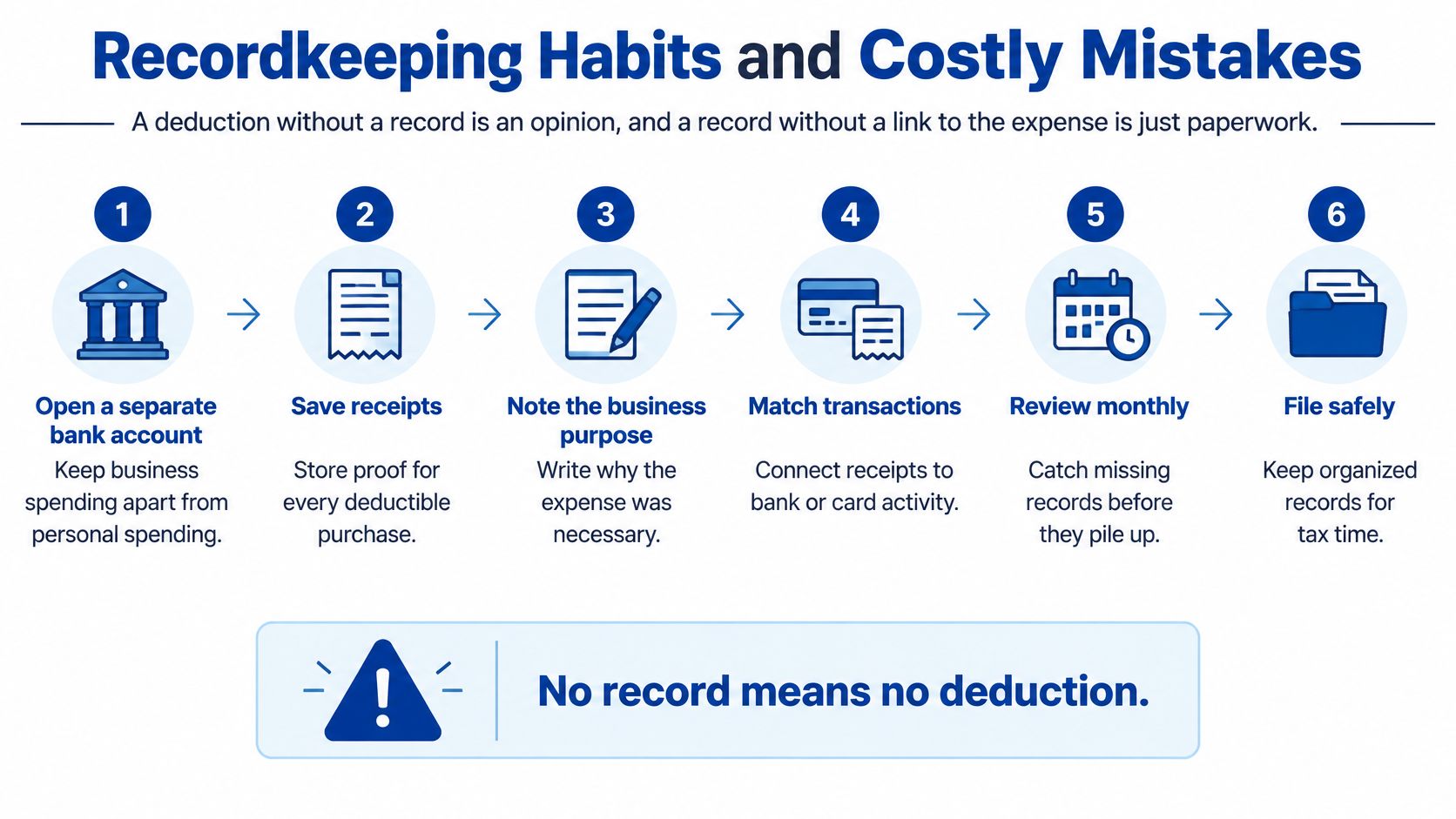
A deduction without a record is difficult to defend. A receipt without a business connection is incomplete. Build a system that preserves the amount, date, payee, purpose, and any mixed-use calculation while the details are still fresh.
The goal is not to produce the most complicated spreadsheet. It is to answer two questions quickly: What happened? and Why did the business pay for it? A folder of screenshots with no transaction names may preserve charges but still leave you reconstructing context a year later. A short note attached to each unusual purchase is often more useful than a long explanation written at filing time.
The monthly routine
- Use a separate account and card for business activity where practical. The separation makes reviews easier, but a business card does not turn a personal purchase into a deduction. If you accidentally pay for groceries with it, label the transaction personal.
- Capture itemized receipts as purchases happen. A card statement shows payment, but often not what was bought. Save the itemized receipt and name the file so you can find it later.
- Categorize each transaction and add its business purpose. A note such as "design subscription, client brochure work, March" is more useful than "software." Include a business-use percentage when appropriate.
- Log vehicle trips at the time of travel. Record date, start and destination, business purpose, and miles. A trip from your home office to a client site can raise different questions from a drive to a regular workplace; note the facts rather than labeling every car trip "business."
- Reconcile invoices, platform reports, tips, refunds, and deposits. If a platform pays out net of fees, reconcile the gross amount, the fee, and the deposit. An information return can help you check income, but it does not define all the income you must report.
- Maintain an asset list. For each laptop, camera, or vehicle, keep cost, placed-in-service date, business-use percentage, and the depreciation or expensing treatment used on the return.
Make this a 20-minute monthly close. For example, at the end of March, match the design software's three charges to invoices, verify the laptop receipt and business-use note, and total the mileage log for that month. At year end, you have twelve small reconciliations instead of one search through hundreds of transactions.
A simple file name such as 2026-03-18_camera-battery_85_business.pdf can identify the date, item, amount, and purpose at a glance. Store the matching card transaction and receipt in one searchable system. If you use a bookkeeping app, export or back up the underlying records instead of assuming you will always have access to the account.
Two common errors deserve an extra check. First, a single percentage applied to every household bill may not reflect how you actually use the phone, internet, and workspace. Second, reimbursed client costs can be recorded incorrectly if you don't review how the client payment and your expense were handled. Keep the invoice and receipt together so the accounting treatment is consistent.
For instance, if you buy $80 of project materials and bill the client for them, retain the supplier receipt and the client invoice. Your books should show how both sides were treated; the word "reimbursement" on an invoice does not by itself establish the correct reporting. The same discipline helps with refunds and chargebacks, where the bank deposit alone may not tell the whole story.
How long to keep what
For many federal tax records, a practical baseline is at least three years after filing the return, but some circumstances require longer retention. The IRS generally advises keeping property records until the period of limitations expires for the year you dispose of the property (IRS recordkeeping guidance). If you've wondered how long you have to keep bank records for tax purposes, match the retention period to what the statements support rather than discarding everything on one fixed date.
The practical distinction is between records tied to one return and records that may matter to future returns. A receipt for routine supplies may support one year's expense. A laptop invoice can also support later depreciation, a change in business use, or a sale. If you amend a return or face a special limitations period, reassess the retention date instead of applying the three-year baseline automatically.
| Record | What it proves | How long to keep it |
|---|---|---|
| Invoices and client payment records | Income, timing, and any later adjustments | Generally at least three years after filing; longer when a special rule applies |
| Platform statements and 1099 forms | Amounts reported by payers and payment processors | Keep with the return they support for the applicable period |
| Itemized receipts and bank statements | Purchase, payment, and business connection | Keep with the return they support for the applicable period |
| Mileage log | Dates, business purposes, and distances | Keep with the return claiming the trips for the applicable period |
| Home-office measurements and bills | Qualifying area and eligible housing costs | Keep with the return; preserve measurements while the same setup remains relevant |
| Asset purchase and disposition records | Cost basis, business use, depreciation, and sale | Until the asset is disposed of, plus the period applicable to that disposition return |
For example, if you bought a camera in 2026 and sold it several years later, don't delete its original invoice just because the 2026 return is old. You may still need its cost and depreciation history to calculate the later sale correctly. Keep secure backups as well as files you can actually search.
If you rearrange your home office or change vehicles midyear, preserve the old measurements or mileage records alongside the new ones. A year-end photo of the current arrangement cannot necessarily establish what your workspace looked like six months earlier.
Cash Flow and Estimated Tax Timing for Deductions
Maximizing deductions isn't automatically the best financial move. A deduction lowers some future tax liability; it doesn't return the cash you spent or make an unnecessary purchase worthwhile.
Picture a freelancer who closes a strong December and considers buying a $3,000 laptop before year end. If she needs it for committed client work, can pay for it, and can substantiate a qualifying deduction, buying now may make sense. If the current laptop works and the only goal is a write-off, the new one drains $3,000 before her next estimated payment. Even an illustrative $1,000 tax saving would still leave approximately $2,000 of after-tax cost. Depending on the facts, lower reported business profit may also affect a lender's assessment of her income.

A smaller example makes the same point. A $50 monthly app that saves two billable hours may be worth keeping even if it saves little tax. A $500 annual membership you never use isn't a bargain simply because it qualifies as a business expense. Ask what the spending does for the business before calculating the tax effect.
Try a three-part purchase check: Do I need it now? Can I pay for it without using my tax reserve? What records will support the claim? An item can pass the tax test and fail the cash-flow test. Conversely, a necessary purchase might be worthwhile even when its deduction is delayed or limited.
Why estimated payments change the decision
Freelance income often arrives without withholding, so many self-employed people pay estimated income and self-employment tax during the year rather than waiting until filing season (IRS Topic 554 on self-employment tax). Your payment schedule and required amount depend on your circumstances; use the applicable estimated-tax instructions or a tax professional to calculate them.
Suppose you receive $8,000 from clients in one month, set aside $2,000 for taxes, and plan a $2,500 equipment purchase. Paying for the equipment out of the remaining $6,000 leaves $3,500 for operating costs and living expenses. Paying for it out of the tax reserve may leave you short when an estimated payment is due, even though the purchase ultimately reduces taxable profit. The tax benefit and the payment deadline occur on different timelines.
That difference grows when income is uneven. A freelancer who earns most of her revenue from two large projects may need more cash available between payments than a freelancer with steady monthly retainers. Review upcoming rent, software renewals, subcontractor payments, and estimated tax before making an optional year-end purchase.
Quarterly reviews should reconcile changes in income and expenses. A client refund issued in a later quarter needs an accurate entry linked to the original transaction; its treatment depends on how you originally reported the payment. A surprise platform bonus increases income even if it wasn't in your original estimate. Reviewing both before the next payment helps you avoid treating last quarter's forecast as a permanent number.
Not every tax break reduces the same tax base. Qualifying self-employed health insurance premiums are generally handled separately from ordinary Schedule C operating expenses, subject to applicable limits. A temporary qualified-tips deduction may reduce income tax for eligible taxpayers, but does not eliminate self-employment tax on the tips (IRS self-employment tax guidance). Tips must meet eligibility and income rules, so creators juggling client fees, platform income, and tips should not apply one rate to everything. This guide to filing taxes as an influencer explores those mixed income streams.
Decision rule: buy when the item solves a real business need and enough cash remains after funding your tax reserve. Defer when the deduction is the only reason to spend.
These are U.S. examples. If you file elsewhere or across jurisdictions, check the rules and payment schedule that apply to you before copying the calculations.
Set Up Your Deduction System This Month
You don't need a perfect accounting system to improve your next return. Set up a repeatable process before your next estimated payment:
- Choose a reserve percentage based on your situation. Discuss the number with a professional, especially if you also have a job, a spouse's income, or state tax obligations. Then move that share of each client payment into a separate savings account.
- Calendar estimated payment dates and a quarterly review. At each review, compare income collected, expenses recorded, and payments already made. If you invoice internationally, our USD vs. Local Currency Freelance Earnings Estimator shows what a payment is worth before you set an amount aside.
- Create three folders: receipts, mileage, and assets. Put an itemized purchase receipt in the first, trip records in the second, and laptop or camera purchase and depreciation details in the third. A folder naming rule you follow is better than an elaborate one you abandon.
- Audit one recent month as a trial run. Check whether a mixed-use subscription has a documented percentage, whether gross platform income reconciles to deposits, and whether your home-office space genuinely meets the use test.
- Book a professional review before filing if you claim a home office, vehicle expenses, substantial equipment, or bonus depreciation. Those decisions can affect future years. This guide on how to hire a tax professional covers questions to ask.
Turn that checklist into a small trial. Pick one month and record gross client payments, fees, deposits, business-only costs, mixed-use costs, and assets separately. If those totals reconcile and each unusual charge has a short purpose note, you have a workable foundation. Fix missing receipts and mileage entries now, while you may still remember the transaction, rather than waiting until the return is due.
For example, start with this month's card statement and identify five expenses you can explain in one sentence each. Save their receipts and note any personal portion. Repeat next month. By filing season, the work is mostly a review of decisions you already documented.
One rule survives every threshold change and new depreciation window: claim an expense only when its business connection, calculation, and records hold up. Everything else is a guess with a number attached.
Mega Income Stream publishes practical, plain-language guides on freelance income, pricing and the money decisions that sit behind both. If this walk-through changed how you think about deductions, our freelance rate and tax coverage will help you connect the write-off side of the ledger to the pricing side. Start at Mega Income Stream and build the system before the next payment lands.










Comments