
 By

The cost of a business growth consultant versus a full-time hire depends on the work: a consultant can address a defined growth problem, while an employee provides ongoing ownership. Comparing fees alone misses the trade-offs. Factor in the employee’s additional costs, onboarding time, and how much work the business needs each week.
It’s reasonable to hesitate before adding a permanent salary or paying for outside advice. A consultant may be premature if the problem isn’t clear, the team can handle the work, or there’s no capacity to implement recommendations. For a focused project, engagements can last from a few weeks to 6-12 months, depending on scope.
This guide explains common consulting fee structures and engagement lengths, when a consultant may not be the right fit, and how to compare fees with the full cost of a hire. You’ll also get a practical way to weigh short-term expertise against long-term ownership, so your next growth investment matches your business’s needs.
Key Takeaways
- Match the engagement to a defined growth problem; ongoing work that needs consistent ownership may call for a full-time hire.
- Compare a consultant’s fee with the employee’s total employment cost, not salary alone.
- Choose a pricing structure that fits the scope, delivery timeline, and level of specialist input required.
- Set a measurable business outcome before work starts so you can assess whether the investment is creating value.
- Use the decision guide to weigh workload, implementation capacity, and near-term business needs before committing.
When is hiring a business consultant premature or simply wrong?
A consultant is often the better fit for a one-time intervention, not a permanent leadership gap. A founder bottleneck, stalled launch, or broken sales process can have a defined endpoint. A founder-bottleneck engagement is described as lasting 8 to 12 weeks. That temporary window can focus on solving the constraint and transferring practical skills to the team.
Hiring becomes premature when the business hasn’t isolated the problem or assigned anyone to implement recommendations. For example, a consultant can map a sales handoff, but the team still needs an owner to use the new process. A 4-8 week assessment phase can identify priorities before implementation. If leaders cannot commit time during that phase, the assessment may produce a plan without operational change.
Use the next 12 months to distinguish a temporary project from sustainable hiring needs. If a business needs expertise for a launch, process redesign, or market assessment, a consultant can supply focused leadership without creating a permanent role. If the work recurs every week and requires internal decisions, team coordination, and ongoing maintenance, hiring may build stronger ownership. The decision turns on recurring workload, not job-title prestige.
Pricing structure also signals what the engagement is built around. Time-based billing charges for hours or days, so a changing scope can raise the total fee. Value-based pricing ties the fee to an agreed outcome, such as a market-entry plan or redesigned workflow. That model still needs clear boundaries. Define the deliverable, acceptance criteria, decision owner, and exclusions before work begins.
Consultants and business coaches address different needs. A consultant typically diagnoses a strategic or operational issue and provides recommendations, implementation support, or a defined deliverable. A coach focuses on a leader’s decisions, habits, and accountability. For example, a consultant might redesign a lead-qualification process, while a coach helps a founder establish a consistent decision-making routine. Choose according to the work product you need.
A consultant may not be the right choice when the business needs daily execution rather than targeted expertise. If no one internally owns the project, even a detailed plan can stall. Assign a manager to coordinate decisions, share data, and track implementation milestones. Without that counterpart, a short engagement may end before new systems become part of routine operations.
Before hiring, define the bottleneck in one sentence and identify who owns it. Then specify a measurable output, such as a documented process, launch plan, or revised reporting workflow. Match the engagement to that output. If the need continues after delivery, reassess whether the recurring responsibilities justify a permanent role.
How much does it cost to hire a business consulting firm?
Hourly fees, fixed project fees, and retainers suit different kinds of consulting work. Compare the cost of a defined scope, not a rate in isolation.
Hourly consulting rates vary by specialty. Small-business strategy consultants charge USD 80 to USD 300 per hour. Marketing consultants charge USD 50 to USD 150 per hour, while operations consultants charge USD 80 to USD 250 per hour. These ranges are distinct benchmarks, not a single average for every business growth consultant. The relevant rate depends on the expertise required and the work included.
For a quick estimate, multiply the hourly rate by expected hours. At USD 80 per hour, 10 hours would cost USD 800; at USD 300 per hour, the same time would cost USD 3,000. This calculation estimates fees only. It doesn’t show whether the assignment includes analysis, recommendations, or implementation support, so match hours to deliverables before comparing proposals.
Hourly Consulting Rates
Hourly billing can suit a short advisory task or flexible discovery because payment follows time spent. The drawback is that the final cost rises if the scope expands or decisions stall. A written estimate of hours and outputs helps you track the engagement. For example, specify whether a review covers one sales process or several business functions.
Hourly and Project Cost Comparisons
Hourly work provides flexibility; project pricing sets a fee for defined work. Business process optimization may cost USD 10,000 to USD 30,000. Strategy formulation with market research may cost USD 10,000 to USD 20,000. These are examples of project scopes, not direct equivalents to an hourly engagement. Compare the included work before choosing a billing structure.
An hourly agreement can be hard to forecast when discovery changes the assignment. A project fee provides a clearer budget when deliverables are stable, but scope changes may require renegotiation. Compare what each proposal includes, such as research, meetings, revisions, and execution support. A lower starting fee may not mean a lower total cost if important work falls outside the scope.
Factors Affecting Consultant Pricing
Specialty, experience, scope, and company size affect the effort and expertise required. A focused review for one decision-maker differs from work that coordinates several departments. More stakeholders can add discovery, communication, and approval steps. The consulting model matters too: hourly billing follows time, a project fee covers a defined output, and a retainer supports recurring work.
Before comparing costs, document the business problem, expected deliverable, and internal owner. Then ask how the proposed scope addresses those needs and which tasks remain internal. This prevents an hourly estimate from being mistaken for a complete project price. It also makes proposals easier to compare based on equivalent work, not headline rates.
A useful budget review separates professional fees from the value of the work. Record the scope, billing model, expected hours or project phases, and implementation responsibilities. Then compare that total with the cost of assigning the same work internally. This grounds the fee comparison in capacity and delivery needs, without assuming any billing model guarantees a business result.
Project-based consulting fees
A project fee covers a defined scope, while an employee brings ongoing costs. Compare deliverables, implementation needs, and the employee’s full cost before estimating the break-even point.
Project pricing varies with the work. A business process optimization project may cost $10,000 to $30,000. Strategy formulation with market research may cost $10,000 to $20,000. Organization-structure development and implementation may cost $5,000 to $20,000. These examples show why industries and project scopes shouldn’t be treated as interchangeable.
Compare each project against an employee’s complete employment cost, not salary alone. Taxes and full benefits can add 45% to 55% of salary. For example, a $180,000 salary can become a $300,000 total investment after additional employment costs. The employee may deliver ongoing capacity, while a project fee pays for an agreed scope and timeframe.
Estimate ROI by comparing the project’s cost with its measurable bottom-line improvement, then dividing net gain by cost. Break-even occurs when cumulative benefits equal the consultant’s investment or the employee’s full cost over the same period. Include implementation expenses and lost output during hiring or onboarding to make the comparison useful.
Project Fees Versus Monthly Consultant Fees
A fixed project fee suits a defined output, such as a process redesign with agreed deliverables. A monthly retainer supports recurring advice or work across multiple priorities. Small-business consulting retainers can range from about USD 2,000 for a few monthly interactions to USD 20,000 or more. Define the monthly scope, meeting cadence, and cancellation terms before comparing it with a one-time project.
Duration changes the comparison. Consulting engagements can run from a few weeks to 6-12 months, depending on the project. A short assignment may avoid paying for unused capacity after delivery. A longer engagement can support implementation, but recurring tasks may signal a continuing internal role. Map the work month by month before treating a fee as a one-off investment.
Compare the Investment Against Expected Revenue
Use the same baseline for both options. Record current revenue, direct costs, and the operational issue being addressed. Estimate the improvement attributable to the work, then subtract the full consulting or employment cost. Separate recurring revenue gains from one-time savings, since they affect the break-even timeline differently.
For a practical review, set three measures before work starts:
- Baseline: Record the current revenue or cost metric and its measurement period.
- Deliverable: Tie the consultant’s work to a defined output and responsible owner.
- Break-even: Track cumulative benefits against total costs until they reach parity.
This method grounds the decision in business outcomes rather than job titles or fee structures alone.
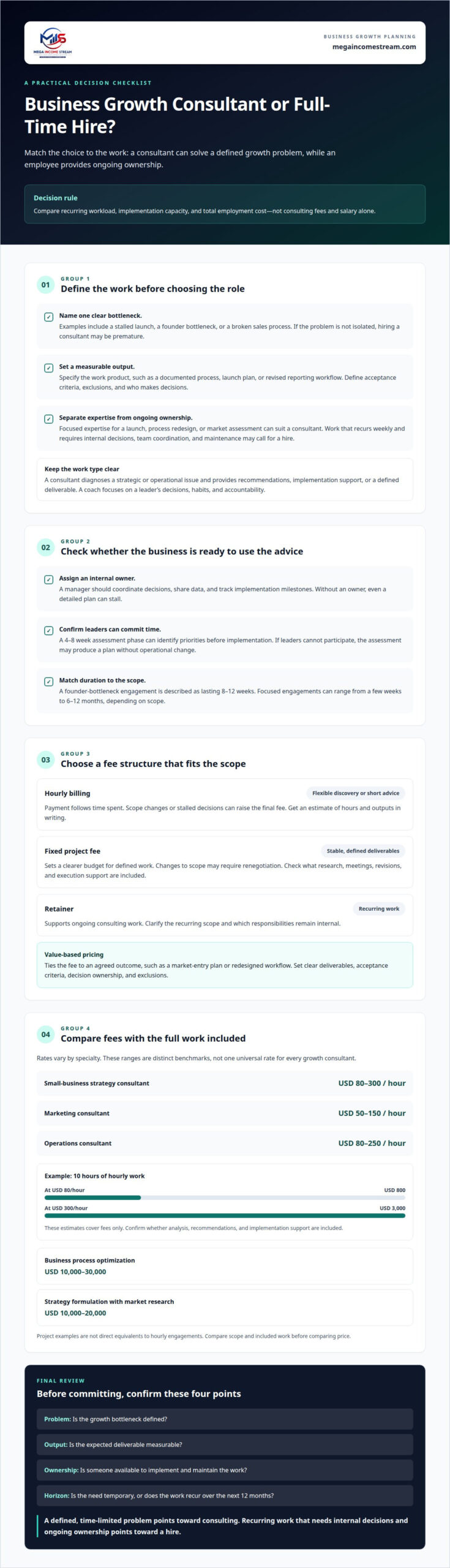
Choosing between a consultant and a full-time hire
Choose based on the work’s duration, ownership needs, and available internal capacity. The business growth consultant cost vs full time hire comparison is most useful when both options are measured against the same outcome.
Consultant Cost-Effectiveness
A consultant can fit a defined problem that calls for specialist expertise or a fast turnaround. The engagement can focus on diagnosis, recommendations, or a specific deliverable. That differs from hiring someone to own growth work continuously. A consultant may also provide flexibility to scale support up or down as priorities change.
Use a clear scope to keep the engagement focused. Define the business problem, expected output, and decision-maker. Then identify who internally will apply the recommendations. Without an owner, even strong analysis can go unused. Include implementation capacity in the comparison, not just the consultant’s fee.
Full-Time Hire Considerations
A full-time growth specialist can suit recurring work that needs consistent attention within the company. An employee can build, improve, and maintain systems over time, develop company-specific knowledge, and share it with colleagues. Those advantages differ from the focused expertise and temporary support a consultant provides.
Consider whether the role requires a full 40 hours per week and whether that workload is likely to continue. Review the business outlook over the next 6 to 12 months. Ongoing execution, coordination, and accountability can support a permanent role; a short-term initiative may not. Include the employee’s total employment cost when estimating the commitment.
| Evaluation criterion | Consultant | Full-time hire |
|---|---|---|
| Work pattern | Defined project or specialist intervention | Recurring responsibilities and ongoing ownership |
| Expertise | Focused skills for a specific business need | Skills that develop within the company |
| Flexibility | Support can scale with project needs | Stable capacity for continuing work |
| Knowledge | Advice and experience brought to the engagement | Internal learning and team knowledge sharing |
To decide, list the tasks expected after the initial growth problem is addressed. Separate work that ends with a deliverable from work requiring ongoing ownership. Then identify who will handle each continuing task. This clarifies whether the company needs temporary expertise, internal capacity, or both in sequence.
The business growth consultant cost vs full time hire decision should also account for access to leadership. A consultant can advise on a defined challenge, but company leaders still set priorities and approve changes. A full-time specialist can coordinate recurring work, but still needs clear authority and resources. Match the role to the decisions and deliverables it must own.
Use the same target, timeline, and ownership expectations to compare options. If the need is finite and clearly scoped, temporary expertise may fit better. If the work remains central to operations, an internal role may support more consistent execution. Base the choice on business requirements, not assumptions about either arrangement.
What is the average hourly and project cost of a business growth consultant in the US?
Consultant costs depend on whether the engagement uses hourly billing, a fixed project fee, or a monthly retainer. These models price different things: time, defined deliverables, or continuing access. Compare scope and expected outputs before treating a rate as a useful benchmark.
Hourly billing suits focused advice when the work may change during discovery. The total depends on hours used, the consultant’s specialty, and the amount of execution included. A strategy consultant may focus on direction and priorities; a marketing consultant may analyze acquisition or conversion; an operations consultant may examine workflows and handoffs. Rates for different expertise are not interchangeable.
A project fee instead covers a defined scope, such as market research, process optimization, or organization design. The fee depends on complexity, stakeholders, research requirements, and implementation support. A project involving project-management software is one example of a scoped assignment. Clarify whether the deliverable includes recommendations only or also implementation, training, and revisions.
Retainers provide recurring access across a defined period. Small-business consulting retainers can range from about USD 2,000 for a few monthly interactions to USD 20,000 or more. The broad range reflects differences in interaction frequency and scope. A few advisory sessions require less capacity than ongoing strategic support and implementation coordination.
Engagement length changes the total commitment. Business consulting can last from a few weeks to 6-12 months, depending on the project. A 4-8 week assessment phase may come before implementation. Calculate the full engagement cost by adding each phase, rather than comparing only an initial assessment or monthly installment.
Use this sequence to assess a proposal:
- Set the scope: Name the business problem, deliverable, and work excluded from the agreement.
- Choose the model: Match hourly billing to flexible advice, project fees to a fixed output, or a retainer to recurring work.
- Map delivery: Identify milestones, internal decision-makers, and implementation responsibilities.
- Calculate total spend: Include all phases, ongoing support, and any separately scoped implementation work.
Compare the same work with an employee’s full cost and expected ownership. A consultant’s project fee can cover concentrated expertise, while a hire can build and maintain internal capability. Make the comparison using equivalent outputs and the same timeframe, not a single hourly figure against an annual salary.
Use a business growth cost model to connect scope, billing structure, delivery phases, and expected business outcomes.
Rates vary by consulting model: hourly billing depends on time, specialty, and execution; project fees depend on scope and complexity; retainers reflect the frequency and breadth of ongoing support. Strategy, marketing, and operations expertise are not directly interchangeable. The section provides no basis for comparing rates by US city.
Mega Income Stream
Mega Income Stream helps entrepreneurs assess growth priorities through Business Strategies, Making Money Insights, and Consulting Business. Use this guidance when your cost comparison points to a defined business problem but the next step needs structure. The focus is on connecting growth goals with practical decisions, including the expertise your business needs and how to apply it.
For example, a founder weighing project support against ongoing hiring can clarify the outcome, responsibilities, and implementation plan before committing. That makes the decision easier to connect to revenue priorities and internal capacity, rather than choosing by fee alone. If you’d like to discuss your growth decision, contact Mega Income Stream.
Turn the Cost Comparison Into a Clear Next Step
Turn your decision into a focused operating plan. Before committing, write down the growth outcome the business needs, who will own execution, and how progress will be reviewed. This makes comparing a business growth consultant’s cost with a full-time hire a practical resource decision, not an abstract debate about job titles.
Align the next step with your business’s priorities. If the main challenge is choosing a growth direction or taking a more deliberate approach to revenue, strategic input can clarify where to focus. If the business needs ongoing internal ownership, define the responsibilities that role must carry. Keep the decision tied to the work and the outcome you need.
Mega Income Stream offers Business Strategies, Making Money Insights, and Consulting Business to support entrepreneurs working through growth decisions. Contact Mega Income Stream to discuss your next step. A clear plan can turn a difficult choice into a manageable action.
Frequently Asked Questions
And finally, what should you expect to pay for a seasoned, successful consultant?
There isn’t one standard fee for experience or a “successful” track record. In the US, business consulting firms may charge $150 to $500 or more per hour; small-business strategy consultants commonly fall within $80 to $300 per hour. Small-business retainers can range from about USD 2,000 monthly to USD 20,000 or more. The engagement’s scope and billing model shape the total, so compare defined deliverables, not reputation alone.
Is consulting right for your business?
Consulting can suit a business with a specific growth obstacle but without the expertise to diagnose or solve it internally. For example, a company preparing to enter a new market may need research and a launch plan before building a permanent team. Consulting is less suitable if leaders cannot make decisions or assign an internal owner. Recommendations require implementation capacity to lead to operational change.
What is the revenue plateau trigger for hiring a consultant?
A plateau is a signal to investigate, not an automatic hiring threshold. The market estimates that a revenue plateau can represent $50K to $200K per month in unrealized growth, and two consecutive quarters of stalled revenue can precede a six-quarter decline. First identify whether the constraint involves demand, pricing, conversion, or delivery. A consultant becomes relevant when a defined expertise gap blocks action on that constraint.
What is the average salary and total employer cost of a full-time growth consultant in the US?
A specific national average for the job title “growth consultant” isn’t provided here. A related benchmark estimates senior-level marketing professional pay at $124,850 USD/year and an all-in annual employee cost of $248,352 USD/year. Treat these as different reference measures, not a precise salary quote for every growth role. Duties, seniority, benefits, and the company’s compensation structure affect the actual employment budget.
How do consultant fees compare with full-time hire costs, including benefits, payroll taxes, and recruiting?
A consultant fee usually purchases defined expertise for a set scope or period. A full-time hire adds salary plus employment costs; in the United States, actual employee cost averages 25% to 40% more than agreed salary. Benefits and employer payroll taxes contribute to that difference, while recruiting adds another hiring expense. Compare both options over the same timeframe and include implementation, onboarding, and continuing work.
When should a company hire a full-time growth specialist instead of a consultant?
Hire a full-time specialist when growth work is continuous and needs daily ownership within the company. An ongoing role might manage experiments, coordinate sales and marketing, and maintain reporting after each campaign. A consultant is better suited to a time-bound need for specialist expertise. The key question is whether the workload and accountability continue after a defined project ends.
How do business growth consultant rates vary by US city, industry, and consulting model?
By specialty, small-business strategy consultants charge USD 80-300 per hour, marketing consultants USD 50-150, and operations consultants USD 80-250; hourly billing follows time, project fees cover defined deliverables, and retainers support recurring work.
What are typical contract terms, minimum engagements, and cancellation rules for growth consultants?
Engagements may last a few weeks to 6-12 months, and an assessment phase may run 4-8 weeks. Set the scope, deliverables, acceptance criteria, decision owner, and exclusions in advance; define a retainer’s scope and meeting cadence, and make it easy to cancel without notice.











Comments