
 By
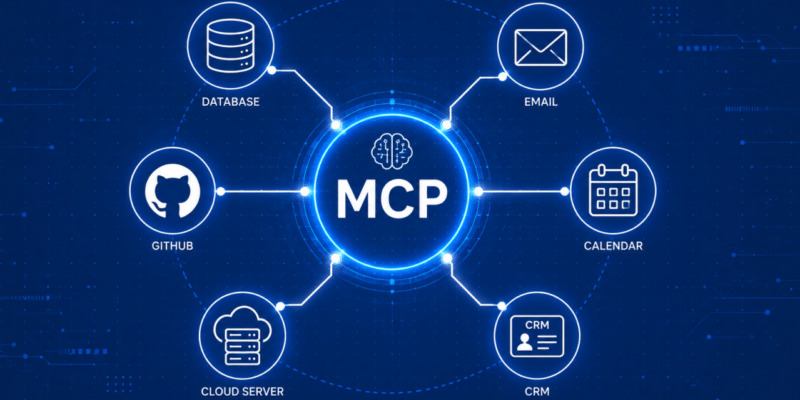
Connecting databases directly to LLMs for custom enterprise solutions.
Can Model Context Protocol help you build a knowledge-based mega income stream? Yes. MCP can connect an AI application to approved documents, databases, and business tools, helping you deliver services such as research briefs, internal knowledge assistants, and specialist support.
Where does the money come from? Customers pay for useful results: faster answers, less repetitive research, better access to expertise, and reliable ongoing support. MCP provides part of the connection layer. Your knowledge, service design, and ability to solve a worthwhile problem create the commercial value.
That distinction matters. Connecting an assistant to documents is a technical achievement. Turning those connections into a service people keep paying for requires a clear customer need.
What Is Model Context Protocol?
Model Context Protocol is an open standard for connecting AI applications to external information and capabilities. Anthropic introduced it publicly on November 25, 2024.
Think about an AI assistant helping a consultancy prepare a client briefing. The information might sit across research folders, project records, and an internal database. MCP gives compatible applications and servers a shared way to communicate.
The official documentation distinguishes three participants:
- Host: The AI application coordinating the experience.
- Client: The component connecting the host to an MCP server.
- Server: The program exposing information or capabilities.
A server may run locally or remotely. However, connecting it does not automatically give an assistant access to everything in a company. Available information depends on the integration, permissions, and application.
How Does MCP Turn Business Knowledge Into a Service?
MCP can make approved knowledge easier to retrieve and use within an AI workflow. Imagine a training business with years of course materials, instructor notes, and frequently asked questions. Customers struggle to find relevant explanations, while instructors repeatedly answer similar questions.
A knowledge assistant could help learners locate approved material and receive explanations linked to the underlying sources. The business could sell that experience alongside its training subscription.
MCP servers can expose different building blocks:
| Building block | What it provides | Possible business use |
|---|---|---|
| Resources | Context such as documents or records | Retrieve an approved training handbook |
| Tools | Functions that retrieve information or perform actions | Search a knowledge collection |
| Prompts | Reusable interaction templates | Structure a consistent research briefing |
These are protocol features, rather than ready-made products. Their availability depends on what the server implements and the application supports.
Your service must still decide which information matters, how to evaluate answers, and when a person should intervene.
What Does Research Say About the Opportunity?
Research supports the potential value of AI assistance, but it does not establish a standard income level for MCP businesses.
The November 2023 version of the NBER working paper Generative AI at Work studied 5,179 customer support agents. It reported an average 14% increase in issues resolved per hour, with larger gains among novice and lower-skilled workers.
That research examined a particular AI support system. It was not an MCP study, and its results should not become a guaranteed productivity claim for your product.
Its practical relevance is narrower: making useful expertise available during work can have measurable value.
For your business, the question becomes: Can this specific service improve this customer’s workflow enough to justify its cost?
Answer that through a pilot, rather than borrowing another organization’s results.
Which Knowledge-Based Services Could You Sell?
Start with a recurring information problem in a field you understand. The following are potential service concepts, not documented customer outcomes.
| Service | Potential customer | Deliverable |
|---|---|---|
| Internal knowledge assistant | Consultancy or agency | Answers grounded in approved procedures |
| Research briefing service | Specialist business team | Reviewed summaries with source references |
| Training companion | Professional education provider | Explanations drawn from licensed materials |
| Product knowledge assistant | Manufacturer or distributor | Searchable specifications and support guidance |
| Proposal research support | Business development team | Relevant approved case studies and service details |
For example, a UK consultancy might need faster access to previous project lessons. A Canadian distributor might need help finding product specifications across hundreds of manuals.
The strongest starting point is usually a narrow, repeated task with an identifiable budget owner. “Find the correct approved procedure” is easier to evaluate than “answer every business question.”
How Should You Choose a Profitable Niche?
Choose a niche where information is valuable, difficult to navigate, and needed repeatedly. Before building, speak with prospective customers and ask:
- Which questions repeatedly interrupt experienced staff?
- Where do employees currently find answers?
- How long does the task take?
- What happens when the answer is wrong?
- Who maintains the source material?
- Who would approve payment for an improvement?
Look for a combination of frequent use and manageable complexity. A small, well-maintained collection of technical manuals may offer a better first project than an enormous archive containing conflicting instructions.
Read Also: Sustainable Income Streams for Businesses: A 2026 Guide
Also check whether you have permission to use the information commercially. Paying for a publication does not necessarily grant permission to redistribute its contents through a customer-facing assistant.
What Does a Practical MCP Knowledge System Need?
A practical system needs an AI application, suitable connections, searchable information, and controls around access and output. A useful starting design includes:
- An MCP-compatible host that supports the capabilities you need.
- A server or connector for the approved information source.
- A retrieval service that locates relevant passages.
- Source metadata such as document title, version, and update date.
- An evaluation process for checking answer quality.
- Monitoring for failures, costs, and usage.
MCP standardizes communication; it does not prescribe how the application manages context or uses its language model.
You may use retrieval-augmented generation, often called RAG, behind a search tool. RAG retrieves relevant material for an answer; MCP can expose that retrieval capability to a compatible application. They serve different purposes and can work together.
For a first pilot, connect one approved collection and support one clearly defined task.
How Do You Prepare Knowledge Customers Can Trust?
Organize the information before asking AI to explain it. An assistant cannot reliably resolve every contradiction in a poorly maintained archive. If two handbooks provide different procedures, someone must establish which one is authoritative.
Prepare the collection by:
- Removing obsolete duplicates.
- Identifying the current approved versions.
- Assigning an owner to each subject.
- Recording review dates.
- Separating general material from restricted information.
- Preserving references to original documents.
Design answers to show their supporting sources. Where evidence is missing or conflicting, the assistant should explain the gap and route the question appropriately.
That gives customers something more useful than a fluent response: an answer they can check.
How Can You Protect Client Information?
Enforce permissions in the server and underlying data systems. A prompt telling the model to “respect confidentiality” is insufficient. For a service handling several clients, make sure each request is restricted to the correct organization and user permissions. Test attempts to retrieve another client’s documents.
MCP’s security guidance addresses risks including token misuse, compromised local servers, and excessive permissions. These controls require deliberate implementation.
Also treat retrieved documents as untrusted input. A document containing instructions to reveal secrets should remain source material, rather than becoming an instruction the assistant follows. Google’s MCP security guidance explicitly recommends treating external data as untrusted.
Begin with read-only capabilities where practical. Introduce actions such as sending messages or changing records only when they serve a clear customer need and have suitable authorization and review.
How Much Could a Knowledge Service Earn?
Revenue depends on customer demand, service scope, pricing, delivery costs, and retention. There is no dependable universal “MCP income” benchmark.
Consider this hypothetical monthly model:
| Item | Assumption | Amount |
|---|---|---|
| Subscription revenue | Five clients paying $1,000 | $5,000 |
| Model, hosting, and retrieval costs | Combined monthly usage | $650 |
| Support and knowledge maintenance | 30 hours valued at $40 | $1,200 |
| Other operating costs | Allocated expenses | $350 |
| Remainder before tax and other unlisted costs | Revenue minus listed costs | $2,800 |
These are planning assumptions, not market rates or promised results. The example shows why revenue alone is misleading. A service collecting $5,000 can require substantial support, review, and maintenance.
Track setup fees separately from recurring subscriptions. Setup work may include information cleanup, integration, access configuration, and staff training.
Price the ongoing service around an agreed scope, with clear usage limits and charges for additional work.
Which Metrics Show Whether the Service Works?
Measure business outcomes alongside technical performance.
| Metric | What it helps you understand |
|---|---|
| Task completion time | Whether users finish work faster |
| Source-supported answer accuracy | Whether answers match approved evidence |
| Escalation rate | Which questions still require experts |
| Active usage | Whether customers repeatedly use the service |
| Cost per completed task | Whether delivery remains economical |
| Renewal rate | Whether customers see continuing value |
Create a baseline before deployment. If a task previously took 12 minutes and takes eight during a comparable pilot, the observed reduction is approximately 33%.
Check that the completed work remains accurate. Faster incorrect answers do not represent a successful service. Use realistic questions, ambiguous requests, missing information, and permission tests in your evaluation.
How Should You Launch Your First Offer?
Launch with a paid, tightly scoped pilot and a clear definition of success. A practical sequence is:
- Choose one buyer and task. Identify who experiences the problem and who controls the budget.
- Agree on source material. Confirm access, ownership, and approved usage.
- Build a small demonstration. Show relevant answers with checkable references.
- Run a controlled pilot. Measure accuracy, task time, usage, and support effort.
- Review the economics. Compare customer value with your full delivery cost.
- Offer ongoing service. Include maintenance, monitoring, and defined support.
Keep the initial sales message concrete: “Help staff find approved product guidance faster” is easier to assess than “Transform your business with MCP.”
Expand after the first workflow performs reliably.
Final Thoughts
MCP can support a knowledge-based mega income stream by making valuable information accessible through compatible AI applications. Its commercial potential comes from the service built around those connections.
Start with a recurring problem, authoritative sources, and measurable outcomes. Then price the work to cover integration, maintenance, review, and support.
A sustainable business grows when customers trust the answers, use the service regularly, and see enough value to renew.
FAQs
1. Do I need coding skills to build an MCP knowledge business?
Not always for an initial demonstration. Existing integrations may cover your requirements. Custom retrieval, permissions, hosting, and production support often require development expertise.
2. Does connecting documents through MCP train the AI model?
No. Providing information through MCP does not itself retrain model weights. Storage, retention, and training policies depend on the AI provider, application, configuration, and agreements.
3. Can I sell access to someone else’s research through an assistant?
Only where your rights and agreements permit that use. Check licensing and confidentiality terms before including third-party or client-owned material in a commercial service.
4. Is an MCP knowledge service passive income?
Usually, it requires ongoing work. Documents change, integrations fail, customers need support, and answer quality needs monitoring. Recurring revenue is possible, but maintenance should be included in the business model.
Source: yougov.com, machinelearningmastery.com









Comments