
 By

What if the best way to strengthen revenue isn’t adding more income streams, but choosing one that fits the business you’ve already built? Sustainable income streams for businesses can reduce dependence on a single customer, offer, or sales channel. But a popular idea can still become a costly distraction if it doesn’t match your customers or capabilities.
It makes sense to look for new revenue when one source carries too much weight. The challenge is finding an opportunity that adds resilience without draining cash, stretching your team, or pulling focus from your core model. More revenue sources aren’t automatically more security. Strategic fit matters.
This guide explains what makes an income stream commercially sustainable and how to compare options using customer demand, margins, operational capacity, and fit with your wider growth strategy. You’ll also see how transactional, recurring, usage-based, and licensing models differ, and how to test a promising offer through a paid pilot or minimum viable offering before scaling. The goal is a measured decision: build on existing customer relationships or delivery capabilities, validate willingness to pay, then invest according to the results.
Key Takeaways
- Sustainable income streams for businesses combine real customer demand, healthy economics, and operations the team can support over time.
- Compare transactional, recurring, usage-based, and licensing models by how they capture value, not by how popular they seem.
- Assess each opportunity for customer overlap, demand evidence, margin potential, revenue concentration, and operating effort.
- Use a staged test to validate an idea before committing significant cash or team capacity to scaling it.
- Prioritize the revenue opportunity that aligns with your existing capabilities and growth priorities, rather than simply adding more offers.
What Makes an Income Stream Sustainable for a Business?
A sustainable income stream does more than bring in repeat payments. It serves an ongoing customer need, generates enough margin to support delivery, fits the business’s operating capacity, and can adapt as customers and markets change. Put simply: Sustainable business income is revenue a company can work to maintain because customer value, delivery costs, and operating demands remain aligned over time.
That distinction matters. Revenue can recur on a billing schedule and still be fragile if customers stop seeing value, costs rise faster than income, or delivery depends on a platform the business can’t control. Evaluating sustainable income streams for businesses means looking beyond payment frequency to the health of the system that produces the income.
Sustainable revenue versus passive income
“Passive” describes the level of day-to-day involvement, not the durability of revenue. A subscription may renew automatically, but customers still expect reliable service, useful updates, and responsive support. A digital course may continue selling after it’s created, yet still need maintenance and promotion to stay relevant. Less routine work doesn’t mean no ongoing investment.
Consider a bookkeeping firm that offers monthly financial reporting. The recurring fee creates a predictable billing pattern, but the firm must still deliver accurate reports and keep client information current. Whether this model works depends on the firm’s customers, expertise, and capacity. The point isn’t to copy a particular model. It’s to connect income to value the business can keep delivering.
The four tests of a durable income stream
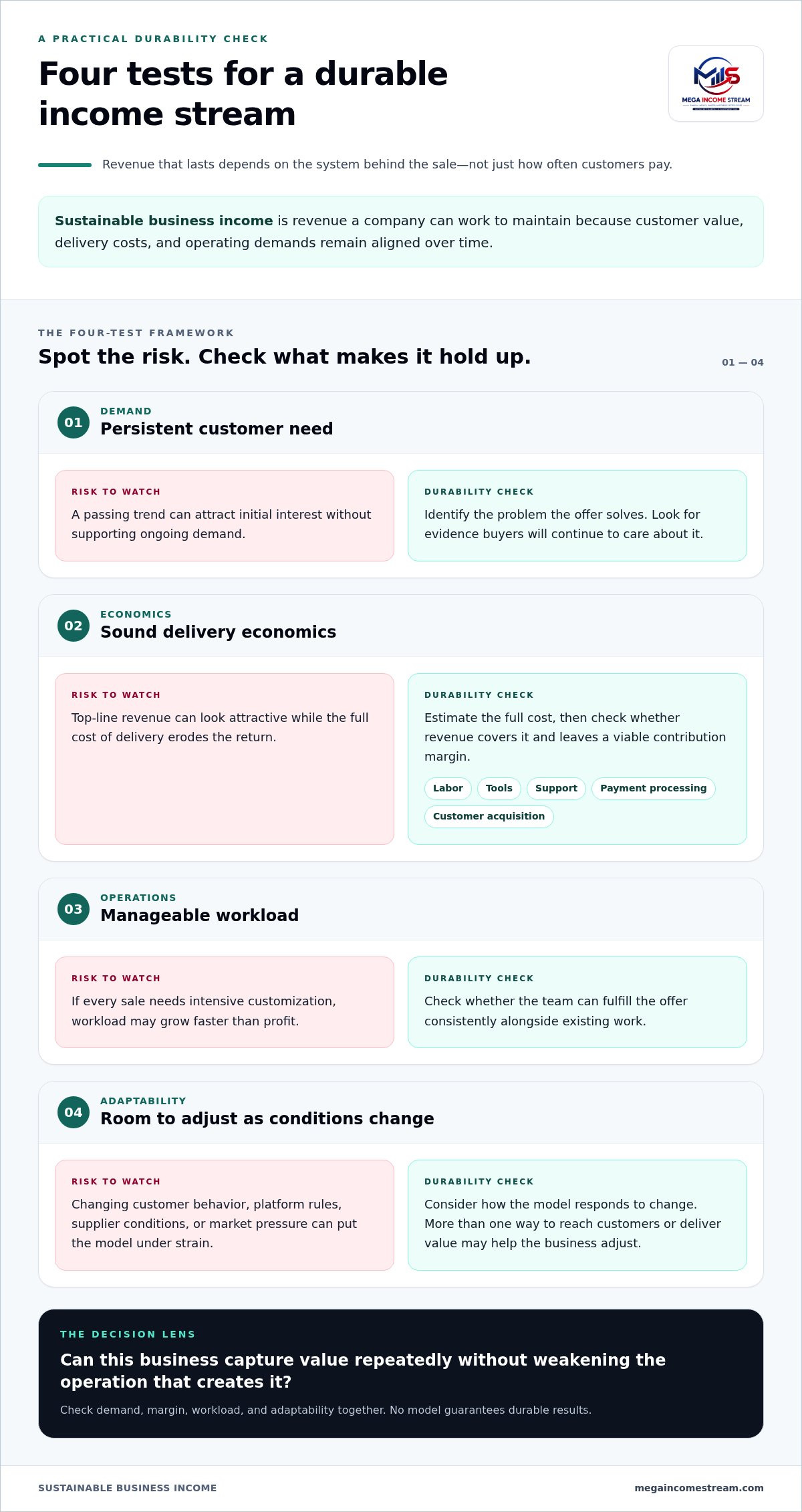
Use four practical tests to assess whether a revenue opportunity can hold up beyond its first sales:
- Persistent customer need: Identify the problem the offer solves and look for evidence that buyers will continue to care about it. A passing trend may attract initial interest without supporting ongoing demand.
- Sound economics: Estimate the full cost of delivery, including labor, tools, support, payment processing, and customer acquisition. Revenue needs to cover these costs and leave a viable contribution margin, not just look attractive at the top line.
- Manageable operations: Check whether the team can fulfill the offer consistently alongside existing work. If each sale requires intensive customization, growth may increase workload faster than profit.
- Adaptability: Consider how the model would respond to changing customer behavior, platform rules, supplier conditions, or market pressure. A business with more than one way to reach customers or deliver value may be better positioned to adjust.
These tests turn the broader framework for revenue models into a business-design question: can this company capture value repeatedly without weakening the operation that creates it? No model guarantees durable results, but checking demand, margin, workload, and adaptability helps separate a promising opportunity from recurring revenue that may not last.
How Business Income Streams Work: Four Revenue Model Patterns
A revenue model describes how a business captures value, not which business idea it should copy. Ask how customers pay in relation to the value they receive: once, over time, as they use something, or for access to an asset or marketplace. A company may combine patterns when they serve the same customer need and fit its delivery system. A business model innovation framework can help leaders consider how to change the way value is created and captured, rather than simply adding unrelated offers.
Recurring revenue is earned through ongoing access or service, transactional revenue with each purchase, and asset-based revenue by monetizing rights or resources the business controls. The mechanics shape cash flow, delivery commitments, and exposure to customer churn, so the right pattern depends on the business model and its capabilities.
Recurring and access-based revenue
Subscriptions, memberships, retainers, and service agreements charge customers on a recurring basis for continued access or support. A design firm, for example, might provide a client with ongoing access to a defined amount of creative support under a retainer. Predictable billing can support planning, but it also creates a standing obligation: customers need to keep receiving value to justify renewing.
That value may come from consistent service, updated resources, dependable access, or results that remain relevant. Retention requires more than an automatic charge. The business must manage delivery quality, customer support, renewal decisions, and service capacity as its subscriber base changes.
Transactional, usage-based, and asset-based revenue
Transactional revenue arrives when a customer makes a purchase, such as ordering a product or buying a defined, productized service. Each sale can be easier to scope, but future revenue depends on new or repeat purchases rather than a continuing contract. Usage-based models charge as customers consume more, linking revenue to activity while making demand less predictable from period to period.
Licensing and other asset-based models generate income from rights, intellectual property, equipment, or distribution access the business controls. For instance, a company might license a training framework for another organization to use. This can extend the value of an existing asset, but ownership rights, maintenance, fulfillment, and distribution still need attention. “Repeat payment” and “repeat value” aren’t the same thing.
Some businesses combine these mechanics around one customer relationship: a defined setup purchase, an ongoing service agreement, and a usage component as demand grows. A combination makes sense only if each part is clear to customers and practical to deliver. Use business strategy consulting to connect revenue-model choices with growth priorities and the capabilities already in place.
How to Compare Income Streams for Strategic Fit and Resilience
Adding another revenue stream can reduce reliance on one offer, but it can also create new costs, processes, and points of failure. A second offer sold through the same dominant platform, for example, may diversify what customers buy without reducing exposure to that platform. The goal isn’t to maximize the number of streams. It’s to find an opportunity that improves the business’s overall risk and return profile without adding more operational drag than the team can absorb.
Compare each candidate against the same criteria. Use qualitative ratings rather than false precision, and write down the assumptions behind each rating. A compact scorecard might look like this:
Customer overlap: Low, medium, or high. How closely does the offer fit the needs of current customers?
Demand evidence: Weak, mixed, or strong. Is interest based on buyer behavior, conversations, or actual commitments, rather than internal enthusiasm?
Margin potential: Low, medium, or high. What remains after acquisition, delivery, support, and maintenance requirements?
Concentration impact: Increases, holds, or reduces exposure to a particular customer, channel, supplier, partner, or market.
Operating effort: Light, manageable, or heavy. What new skills, systems, leadership time, and ongoing work will the stream require?
These ratings aren’t universal benchmarks. They make trade-offs visible and help identify where an attractive-looking idea relies on an untested assumption. A medium margin rating, for instance, might assume that fulfillment can use existing staff and tools. If that assumption proves wrong, update the comparison.
Assess customer fit, demand, and economics
Start with the customer relationship. Do existing buyers have a related need, and what evidence supports it? Repeat requests or paid commitments offer a stronger signal than a broad expression of interest. Then map expected revenue against the full cost of reaching and serving those buyers, including acquisition, delivery, support, and maintenance. Estimate contribution margin after variable costs, and mark uncertain inputs for testing rather than treating them as facts.
Balance resilience against operational complexity
Look for shared capabilities. An existing audience, delivery process, expertise, or customer-support system can make an aligned stream easier to run. Then identify what the new offer adds. An offer that depends on one marketplace may replace customer concentration with channel concentration. Reliance on a single supplier or commercial partner can create similar exposure. Account for leadership attention and team capacity, since a stream that distracts from the core may weaken the business it was meant to protect.
Finally, compare the opportunity with the current revenue mix. Ask what failure it helps the business withstand, what new dependency it creates, and what work must continue to keep it viable. That wider view helps distinguish genuine diversification from a reshuffling of risk, and gives the testing process a clear set of assumptions to validate.
How to Test a Sustainable Income Stream Before Scaling
A promising idea is a hypothesis, not proof of demand. Before investing in infrastructure, custom development, or dedicated hires, design a small test that can show whether customers will pay and whether the business can deliver profitably. For sustainable income streams for businesses, validation should protect cash and team capacity while producing evidence strong enough to guide the next investment.
Set a review date and decide in advance what results would justify scaling, revising, or stopping. Base the thresholds on your company’s economics, available runway, and strategic priorities, not a benchmark copied without context.
Design a low-commitment market test
Write down the target customer, the problem, the offer, the channel, and the assumptions that must hold true. Choose a test suited to the model: customer interviews can expose unmet needs, preorders can test willingness to pay, and a paid pilot can reveal delivery demands. Keep the scope intentionally limited, and record what evidence would change your decision.
- Define the hypothesis. State who will buy, what value they expect, and why this offer fits the business.
- Test demand. Seek behavior that signals commitment, such as a purchase, preorder, or agreement to a paid pilot. Interest alone is weaker evidence.
- Model delivery. Estimate the labor, tools, support, acquisition effort, and ongoing maintenance needed to fulfill the offer. Check whether the test itself fits available cash and team capacity.
For recurring offers, account for the gap between receiving cash and completing the promised service. Advance payments can help cash flow, but they may also fund future delivery obligations, so they aren’t all immediately available for expansion.
Measure performance and decide what happens next
Track results against the assumptions you wrote down. Gross sales matter, but they don’t show whether the stream can cover its costs or repeat reliably. Include one-off setup work in the analysis, then distinguish it from the ongoing effort required to serve each customer.
- Demand: Who showed real buying intent, and through which channel?
- Conversion and repeat behavior: Did prospects buy, and did customers return or continue?
- Delivery effort: How much time and support did fulfillment require?
- Contribution: What remained after variable acquisition and delivery costs?
Use the findings to make a deliberate call. Scale when demand, contribution, and delivery capacity meet the thresholds set for your business. Revise when the signal is promising but a specific assumption, such as pricing, scope, or channel, fell short. Stop when evidence doesn’t support the investment or the offer pulls resources from higher-priority work. A structured strategy review can help turn test results into a practical growth roadmap. Explore business strategy consulting.
Build Sustainable Business Income with a Strategy, Not More Ideas
A longer list of offers can look like progress, but every new stream competes for attention, resources, and customer trust. A stronger move is to prioritize an opportunity that reinforces the business or deliberately extends what it can already deliver. Sustainable income streams for businesses aren’t defined by how many there are; their value comes from how well they support customer needs, financial objectives, and the company’s ability to execute.
That means looking beyond an idea in isolation. A new revenue option might sound attractive, yet be a poor fit if it serves a different audience, demands capabilities the company hasn’t built, or distracts from a higher-priority growth bottleneck. Strategic fit turns diversification into a deliberate business decision rather than a collection of side projects.
Connect revenue opportunities to the business model
A focused strategy review connects three elements: what customers need, what the business can reliably deliver, and what its financial priorities require. For example, a company seeking more predictable cash flow might examine ongoing services for current customers, while one constrained by delivery capacity might first look for ways to make existing work more repeatable. Neither path is universal. The right direction depends on the organization’s customers, capabilities, and objectives.
Ask whether a potential stream builds on an existing customer relationship, makes better use of delivery infrastructure, or creates a necessary new capability. If it extends the current model, define how it complements the core offer. If it moves into new territory, be clear about the additional investment and management attention it will require. A sound strategy makes those trade-offs explicit before the business commits.
Turn analysis into a focused growth roadmap
An opportunity scorecard and market-test results become useful when they lead to decisions. Advisory work can connect those findings to the wider business: identify where growth is constrained, compare opportunities with available capabilities, and prioritize the next move. A tailored roadmap can clarify what to pursue, what to refine, and what to set aside, with practical milestones that keep execution aligned with the company’s priorities.
Mega Income Stream’s business strategy consulting and advisory focuses on growth, revenue optimization, and identifying income opportunities. The aim is to make the next decision more deliberate, not to prescribe a universal formula. A company may need to strengthen its core offer before diversifying; another may have a clear opportunity to serve existing customers in a new way. The strategy should reflect the business in front of you.
If you’re ready to connect revenue opportunities with your capabilities and growth priorities, explore business strategy advisory and map a focused path forward.
Make Your Next Revenue Move Deliberate
The next step isn’t to chase every promising idea. Choose one opportunity worth investigating, decide what evidence would strengthen or weaken the case, and make room to learn before committing more resources. That discipline helps make sustainable income streams for businesses a long-term growth decision rather than a reaction to short-term pressure.
A focused outside perspective can help clarify where growth is getting stuck and which opportunities merit attention. Mega Income Stream offers strategic advisory, customized roadmaps, and practical frameworks to help businesses assess revenue opportunities and make informed diversification decisions.
Explore strategic guidance for sustainable business growth and take the next step with a clearer view of where your business can go. Build deliberately, learn from the evidence, and keep moving toward growth that fits.
Frequently Asked Questions
Is passive income truly passive for a business?
Business income rarely requires no ongoing attention. A subscription may involve service reviews, a digital product may need updates, and an asset can require maintenance or replacement. To assess how passive a stream really is, list the recurring tasks, who owns them, and what happens if that person or system is unavailable. The useful measure is ongoing effort and capital compared with the value returned, not whether work disappears entirely.
How many income streams should a small business have?
There’s no ideal number that applies to every small business. Choose revenue sources based on their contribution after costs and the attention required to maintain them. For example, a business could review each stream quarterly and track its revenue, direct expenses, and staff time separately. If an offer repeatedly consumes resources without advancing financial or customer priorities, improving or retiring it may be wiser than adding another stream.
Can a B2B business create recurring revenue without a subscription?
Yes. A B2B company can earn repeat revenue through retainers, service agreements, licensing arrangements, or customers who reorder regularly without being locked into a subscription. The distinction is whether payment is contractually scheduled or depends on a new purchase. For instance, a buyer may reorder supplies as needed, while a service agreement sets out an ongoing relationship. Make the scope and renewal expectations clear so the payment structure matches the value delivered.
How can seasonality affect a business income stream?
Seasonality can make revenue and cash availability uneven, even if sales perform well across the full cycle. Compare results across equivalent periods, such as this spring with last spring, rather than drawing conclusions from a single month. A business might also forecast expected receipts alongside payroll, supplier payments, and other obligations during slower periods. An off-season offer could help, but assess whether its demand and delivery costs make it a practical fit.
How should a business account for the initial investment in a new income stream?
Track launch spending and setup effort separately from the costs of serving customers over time. Include internal hours, equipment use, onboarding work, and any initial development, even if no new cash payment is required for staff time. Record the assumptions behind expected demand and set a review point before testing begins. Early sales don’t prove the stream can recover its investment; consult an accounting professional for treatment suited to your business and jurisdiction.
Can one product or service support multiple income streams?
Yes, if each format serves a clear buying need and doesn’t confuse the value of the core offer. A company might provide the same expertise through a tailored engagement for one customer and a standardized resource for another. Before launching both, define the audience, scope, support requirements, and customer outcome for each. Shared knowledge can reduce duplicated effort, but separate demand evidence helps reveal whether each format deserves continued investment.









Comments