
 By

The average affiliate conversion rate by industry is not one universal target. The right benchmark depends on what counts as a conversion and how affiliate traffic is measured. A click that leads to a purchase is not directly comparable with one that leads to a signup or another tracked action. Comparing different outcomes can make a campaign look stronger or weaker than it is.
If you already use conversion rates to assess affiliate performance, you know the percentage alone does not explain what is driving results. Industry averages provide context, but can hide how results are distributed. A few unusually high values can pull up the mean, while the median shows the midpoint and the mode identifies the most frequent value.
This article explains how affiliate conversion rates vary across industries and how to interpret averages alongside other statistical measures. You’ll see why measurement choices matter, what a benchmark can and cannot tell you, and how to use comparisons to assess your affiliate strategy more clearly.
Key Takeaways
- Compare affiliate conversion rates only when the tracked action and measurement method match; otherwise, the benchmark can distort performance.
- Use the mean, median, and mode together to see how unusually high or low results affect an average.
- Industry comparisons need context: purchase decisions and conversion paths differ across finance, retail, travel, and software.
- Separate traffic quality and funnel factors from the industry label when diagnosing a campaign’s results.
- Use benchmarks as a starting point for evaluating your strategy, not as a standalone verdict on performance.
Central tendency
Central tendency summarizes a group of results with a mean, median, or mode, but none automatically represents a typical affiliate outcome. The average affiliate conversion rate by industry is useful only when the underlying conversions use comparable definitions and populations.
Average Rates Across Industries
An industry average condenses multiple affiliate conversion rates into one figure, helping publishers compare their results with a wider group. But unusually high or low values can shift the mean, so treat it as a reference point, not a target.
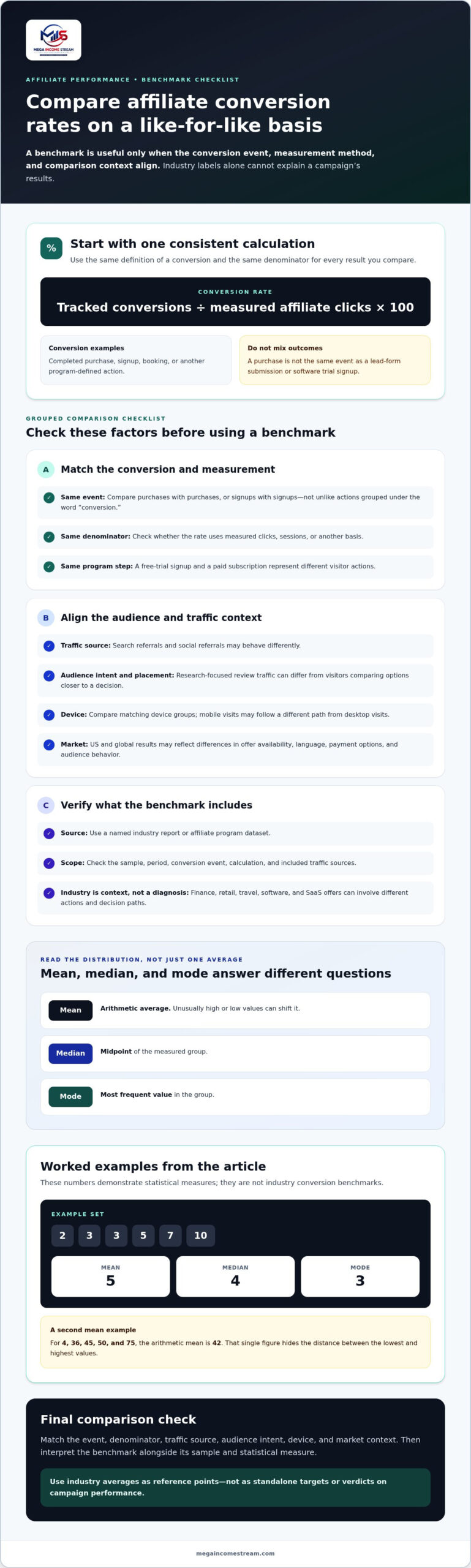
Consider the values 4, 36, 45, 50, and 75: their arithmetic mean is 42. That single figure hides the distance between the lowest and highest values. For another set, 2, 3, 3, 5, 7, and 10, the mean is 5, while the median is 4 and the mode is 3. These examples demonstrate statistical measures, not industry conversion benchmarks.
Rates by Industry Category
Industry categories group programs with similar offers, such as finance and insurance, ecommerce and retail, travel, software, and SaaS. The category helps frame comparisons, but cannot explain a campaign’s results by itself. A policy application, product purchase, booking, and software signup are different actions with different decision paths.
Offer type, audience intent, and purchase value all shape the conversion process. A reader comparing software plans may need more time to decide than someone buying a familiar retail item. Commission models can influence which offers affiliates promote, but do not establish a typical conversion rate. Compare similar actions and traffic conditions before drawing conclusions.
US and Global Benchmarks
A US benchmark describes results from a US audience and program context. A global benchmark combines markets that may differ in offer availability, language, payment options, and audience behavior. Direct comparisons are unreliable unless the measurement and audience mix align.
Traffic source and device also affect how a rate should be interpreted. Search traffic with purchase intent may behave differently from social referrals, while mobile visits may follow a different path from desktop visits. Segment reports by source and device, then compare matching groups instead of blending them into one headline figure.
Calculate conversion rate by dividing tracked conversions by measured affiliate clicks, then multiplying by 100 to express the result as a percentage. A conversion could mean a completed purchase, signup, booking, or another program-defined action; use the same event definition across every comparison. For example, don’t compare purchase conversions with lead-form submissions as if they were identical.
Reliable benchmarks come from a named industry report or affiliate program dataset that explains its sample, period, conversion event, and calculation. Check those definitions before applying a figure to your campaign. The mean, median, and mode answer different questions: the mean gives the arithmetic average, the median marks the midpoint, and the mode identifies the most frequent value.
For the set 2, 3, 3, 5, 7, and 10, the arithmetic mean is 5 and the mode is 3; neither alone captures every pattern in the distribution.
What is the average affiliate conversion rate across industries?
There is no single conversion rate that represents every affiliate industry. The average affiliate conversion rate by industry depends on the action tracked, the audience, and the funnel. A retail purchase, an insurance lead, and a software trial are different outcomes. Combining them can blur meaningful differences between campaigns.
Why One Cross-Industry Average Can Mislead
An average only compares results fairly when the underlying measurements share a definition. For example, a retailer may count completed purchases while an insurance program counts submitted leads. Treating these outcomes as equivalent creates a broad figure, but does not show how either campaign performs against comparable partners.
Even programs in the same category can differ. One software company may track a free-trial signup, while another tracks a paid subscription. Both may call the event a conversion, but the visitor has taken a different step. Before using a benchmark, identify the exact event and check whether the source measures clicks, sessions, or another denominator.
How to Read a Published Industry Average
Start with the report’s scope. Check which industry it covers, which conversion event it counts, and which traffic sources it includes. A figure based on product orders is not a direct comparison for a lead-generation campaign. The same applies when a report groups partner referrals with other acquisition channels.
Then assess how the average was calculated. A mean combines observations into one arithmetic result, but a few unusually high performers can influence it. A median describes the midpoint of the measured group. If a report provides only one summary, do not assume it represents every participating affiliate or program.
Build a Useful Comparison for Your Campaign
Make a like-for-like comparison. Match the tracked action, traffic source, audience intent, and device before interpreting a difference. For example, compare search referrals that lead to completed purchases with similar purchase-focused traffic, rather than with software trial signups. This makes the comparison more useful for diagnosing the funnel.
Next, separate the stages that lead to the counted event. A review page may attract readers researching options, while a product comparison page may serve visitors closer to choosing. If those placements send different audiences, their conversion rates can diverge even when the offer stays the same. Review the placement context alongside the headline rate.
Use an industry average as context, not a verdict on campaign quality. Pair it with consistent reporting from your own program, then investigate where the audience exits or continues. This turns a broad benchmark into a practical question: which part of this affiliate funnel differs from a comparable one?
What is the affiliate conversion rate for finance and insurance?
Finance and insurance affiliate conversion rates depend on the action a program counts, such as a quote request, completed application, or sale. These outcomes involve different steps, so one rate cannot represent every campaign. A publisher comparing insurance leads with completed financial product sales needs separate benchmarks for each event.
Why the Tracked Action Changes the Rate
A quote request is an early funnel action; purchasing or activating a product requires additional steps. For example, an insurance visitor might submit contact details before receiving a quote, while another program counts only a completed policy purchase. These events measure different levels of commitment, so their rates answer different performance questions.
Finance offers also vary in how much explanation a visitor needs before acting. A page about a familiar service may move readers toward an application, while a page comparing loan features may serve visitors still weighing options. Match the benchmark to the specific product and conversion event instead of treating all finance referrals as one group.
What Shapes Finance and Insurance Results
Audience intent matters because a visitor seeking a quote has a different task from someone reading a general guide. A comparison article can attract researchers, while a product-specific page may reach readers closer to applying. This distinction affects how the same offer performs across placements.
Offer structure also changes the path. An insurance lead form asks for information; a completed application may require more decisions. For a financial product, eligibility details, application steps, and offer clarity can influence whether a reader continues. Track each stage separately to locate friction.
- Traffic source: Compare search referrals with social referrals separately, since the visitor’s reason for clicking may differ.
- Device: Review mobile and desktop journeys independently, especially where forms or application steps shape completion.
- Placement: Distinguish a product comparison page from a broad educational article when assessing intent.
How to Use a Finance Benchmark
First, identify whether the reported finance conversion means a lead, application, approval, or completed sale. Then check that the benchmark covers a similar product and audience. An insurance lead-generation campaign should not be judged against a completed-sale benchmark for another financial offer.
Next, use your own reporting to compare equivalent placements and traffic segments. If quote requests come in but completed purchases do not, examine the transition between those events. If one source produces fewer qualified inquiries, compare its audience intent and page context before changing the offer. This ties the benchmark to a decision you can act on.
What is the affiliate conversion rate for ecommerce and retail?
Ecommerce and retail affiliate rates depend on the purchase event and shopping journey, not on one universal industry figure. A completed order differs from a product-page visit or an email signup. For example, an affiliate promoting running shoes should compare purchase conversions with similar retail purchases, not newsletter registrations.
What Changes a Retail Conversion
A shopper’s intent varies by page and product. Someone reading a detailed comparison of two coffee machines may be closer to choosing than someone browsing a general gift guide. The same retail offer can therefore produce different outcomes across placements, even when the affiliate link leads to the same store.
Product price and the level of consideration shape the journey, but do not create a reliable rate on their own. A shopper buying a familiar household item may decide quickly. Someone comparing a laptop may first review specifications, alternatives, and return terms. Measure the event that matters to the program, then interpret it alongside the product and page context.
Where Shoppers Drop Out
Retail conversions often depend on steps after the affiliate click. A visitor may reach a product page, add an item to a cart, then leave before completing checkout. Another may choose a different size or color, or find that the item cannot be delivered to their location. These actions affect completed orders without changing the affiliate’s content.
Separate the journey into useful stages in your reporting. Track product-page visits, cart activity, and completed orders when those events are available. If visitors reach the product page but do not buy, investigate the transition from product selection to checkout. If few click through, review the article’s relevance and recommendation placement.
Compare Retail Campaigns Fairly
Match comparisons by product type, audience, and traffic source. A review of kitchen appliances serves a different decision from a seasonal clothing roundup. Search visitors looking for a specific item also bring different intent from social readers discovering a product through a post.
Device context matters too. A mobile visitor may browse a product on the move, while a desktop visitor may compare options across several tabs. Compare mobile and desktop performance separately, then check whether the landing page and checkout support the same purchase path.
Use an ecommerce benchmark only when its conversion event and sample resemble your campaign. A completed-order rate cannot directly evaluate a campaign measured by add-to-cart actions. Record the offer, placement, source, device, and counted event alongside each comparison. This helps identify whether a gap relates to audience intent, product fit, or a step in the shopping journey.
What are affiliate conversion rates for travel, software, and SaaS
Travel, software, and SaaS affiliate conversion rates depend on the action tracked and the visitor’s decision path. A completed hotel booking, a software trial activation, and a paid subscription measure different outcomes. Compare each campaign using its program’s defined event, then consider content placement and visitor intent. A destination guide and a hotel comparison page, for example, serve travelers at different stages.
Travel Affiliate Conversions
A travel referral can lead to a flight booking, hotel reservation, rental car booking, or another travel purchase. Each action involves a distinct choice. Someone reading a destination guide may still be deciding where to go, while someone comparing hotels in a selected city may be closer to booking. Treat these placements as separate traffic contexts.
Booking journeys include choices such as dates, room type, and location. A visitor might click an affiliate link, compare properties, and leave before completing a reservation. To understand the outcome, review the landing page, offer relevance, and where the visitor exits. A hotel listing click alone does not show whether a booking was completed.
Define the travel conversion precisely. A completed hotel booking differs from a property-listing click, lead, or itinerary request. Keep the tracked event consistent when comparing campaigns. Also distinguish destination-search referrals from broad social referrals, since visitors may arrive with different plans and levels of purchase intent.
Software and SaaS Affiliate Conversions
Software programs may track a download, account creation, trial activation, or paid subscription. These actions occur at different stages. For example, creating a project-management account does not mean the visitor has purchased a subscription. Keep each event separate in reports so an early signup is not mistaken for paid revenue.
Product complexity shapes how visitors evaluate an offer. A concise feature comparison may answer questions about a simple tool, while a business platform may require readers to assess integrations, team needs, and workflows. A tutorial showing how a design application handles a specific task can serve a different audience from a broad software roundup.
Subscription programs may track initial signups, paid conversions, and renewals separately. Compare each event with the matching action in another campaign. Do not treat a free account as a paid customer, or a renewal as a new signup. Clear event labels make campaign reports useful for diagnosing where visitors progress or stop.
How to Compare These Categories
For travel, software, and SaaS, record the offer, page type, referral source, device, and conversion event. A hotel comparison page, software tutorial, and SaaS pricing explainer address different visitor needs. Segmenting campaigns helps show whether outcomes relate to intent, content fit, or the action being counted.
When reviewing a published benchmark, examine its sample and event definition. A travel report measuring bookings cannot be directly compared with software data counting trial activations. Match the reporting criteria first, then use the benchmark to frame campaign analysis and identify which part of the visitor journey needs attention.
Mega Income Stream: Business Strategies
Mega Income Stream helps readers turn affiliate performance questions into practical business decisions. If you have compared benchmarks but still need to decide which offers or channels fit your revenue strategy, its Business Strategies and Making Money Insights can help frame the next steps. The Consulting Business is relevant when you need a more structured review of growth opportunities and income workflows.
Bring a clear question to that work, such as whether to refine an existing affiliate funnel or build a strategy around another niche. Keep the conversion event, audience, and traffic source in view so decisions rest on comparable performance data.
Visit megaincomestream.com to explore the business strategies and insights.
Turn Your Benchmark Into a Better Growth Decision
Use your understanding of the average affiliate conversion rate by industry to shape a broader operating plan. Decide which audience you want to serve, what recurring problem your content writing and SEO skills will solve, and how affiliate offers fit that value proposition. This shifts the focus from isolated referrals to building a clear, sustainable business model.
If you’re ready to develop that plan, Mega Income Stream offers Business Strategies, Making Money Insights, and a Consulting Business to support strategic planning around income opportunities. Define the business question you want to solve, then bring that focus to your next planning conversation.
Contact Mega Income Stream to discuss your next strategic step. Keep building with purpose.
Frequently Asked Questions
What are typical affiliate conversion rates by industry or niche?
Use the affiliate program’s reporting to establish a working baseline for your niche. Review how it attributes delayed purchases, handles duplicate transactions, and treats cancelled orders. Then compare your results across consistent reporting periods and placements. For example, if a product review and a buying guide send referrals to the same offer, track them separately to see which page contributes more completed actions.
What are reliable sources and recent benchmarks for affiliate conversion rates?
Use a named industry report or affiliate program dataset that explains its sample, period, conversion event, and calculation. Compare similar actions, audiences, and traffic conditions; the mean, median, and mode provide different views of the results.
How do affiliate conversion rates vary by traffic source and device?
Conversion rates can differ by traffic source and device. Search traffic may behave differently from social referrals, and mobile visits may follow a different path from desktop visits. Segment results by source and device, then compare matching groups.











Comments