
 By

The U.S. Census Bureau counted 30,427,808 nonemployer establishments in 2023, one-person businesses with no paid employees that together collected nearly $1.8 trillion in receipts, about 6.4% of U.S. gross domestic product (Census Bureau, 2023 Nonemployer Statistics). The count rose from 29,811,495 in 2022, and these operations grew at an average of 2.7% a year from 2012 through 2023, against 1.1% for businesses with employees.
That figure reframes the whole question. None of those operations needed paid employees, which means earning outside a paycheck can require less infrastructure than many assume. It also says nothing about what the owners kept, because receipts are gross revenue before fees, expenses and tax. The gap between the two is where side income often fails, and it's the measure this guide uses to judge every route.
You don't need to become a business owner to benefit from the same thinking. Whether you're taking a tutoring booking, delivering an order or selling a used chair, ask three questions: How soon will I be paid? How much will I spend to get paid? How many hours will the entire transaction take? A route becomes easier to evaluate when you answer those before committing to it.
For example, a $75 editing assignment might sound better than a $45 tutoring session. But if the assignment takes three hours, another hour of client messages and two weeks to collect, while the session takes an hour plus 30 minutes of preparation and pays promptly, the comparison changes. The best route is not necessarily the one with the biggest advertised payment. It is the one that works with your cash needs, available hours and tolerance for uncertainty.
Table of Contents
- Extra Income Routes Compared at a Glance
- How to Assess Your Skills and Available Hours
- How to Pick a Route That Fits Your Life
- Launch Your First Route in 30 Days and Avoid Costly Mistakes
- Realistic Income and Time Expectations by Stage
- Confirm Your First Route This Week
Extra Income Routes Compared at a Glance
Read the table as a shortlist, not a ranking. Each row answers the two questions that decide whether a route is available to you this month rather than next quarter: what you spend before anyone pays you, and how long the gap runs between starting and the first cleared payment.
Extra income routes by upfront cost and time to first payment
| Route | Upfront cost | Time to first payment | Skill level | Best for |
|---|---|---|---|---|
| Freelance writing or editing | $0-50 | 2-6 weeks | Moderate | People with strong writing or editing skills |
| Online tutoring | $0-100 | 1-3 weeks | Subject knowledge | Teachers, students and certified experts |
| Reselling used goods | $50-300 | 1-4 weeks | Low | Shoppers with a good eye for underpriced items |
| Gig driving or delivery | Vehicle and fuel costs | About 1 week | Low | Flexible drivers with a reliable car |
| Virtual assistance | $0-50 | 2-4 weeks | Moderate | Organized people with admin or scheduling skills |
| AI-assisted service for a niche | $20-100 per month for tools | 3-8 weeks | Moderate to high | People with industry knowledge who can check quality |
These are planning ranges, not promises. The starting point matters: someone with an existing tutoring referral may book a paid session much faster than someone creating a profile from scratch. A freelancer with samples but no prospects still needs time for outreach, agreement and payment. For gig work, check onboarding requirements and payout terms before treating a quick start as cash you can use this week.
The table also leaves out how much unpaid work happens between jobs. A writer may spend evenings pitching before winning a $200 assignment. A tutor might get one referral and keep the same student for several weeks. A reseller has to photograph, list and answer messages for items that may never sell. When comparing routes, estimate both the first transaction and what it would take to repeat it.
When cash is tight, time to first payment can matter more than the advertised rate. A route promising an impressive hourly figure means little if the first payment lands in seven weeks and you've spent $200 on training in the meantime. Compare the date money arrives against the date your next bill is due. If you need $150 soon, selling an item you already own might be a better short-term move than building a freelance profile, even if freelancing offers greater long-term potential.
Costs are planning estimates that shift with your city and the calendar. A reseller with dense estate sales nearby spends less on stock than one driving forty minutes each way to source. Tutoring demand can bunch around exam terms, so a January start may look different from a July start. Before choosing a row, write down the costs specific to your version of it: fuel, supplies, platform charges, software, payment processing and any insurance you may need.
One useful comparison is cash tied up per attempt. If you already own an item, listing it may cost time but require little new spending. Buying ten items to resell ties up money until they move, and some may not. A service can be cheaper to start, yet you may wait longer to find a buyer. If your budget is $75, do not use the entire amount on stock or subscriptions before learning whether anyone wants the offer.
The only rate that matters: what you keep, divided by every hour the work touches, including the unpaid ones spent bidding, invoicing and chasing payment.
One skill can sit in two rows, and that's not duplication. Writing appears as freelance editing and as an AI-assisted service for a niche: same underlying ability, different buyer and different defense against competition. A strong editor could proofread general blog posts, or specialize in checking technical drafts against a client's source material. The latter asks for more judgment, but also more responsibility for accuracy.
The AI row is the one people misjudge. The 2026 Future Workforce Index reports that freelancers doing AI-related work on Upwork earned 34% more per hour than freelancers not incorporating AI, while generative-AI and creative-production contract starts grew 90% as per-contract earnings fell 13% (The Future Workforce Index 2026). Those figures don't establish what a new seller will earn. They do point to a useful distinction: producing a quick draft is easier to compete on than checking whether it is accurate, appropriate and ready for a particular buyer to use.
Suppose you know the terminology used by local home-service businesses. A generic offer to produce AI-written posts tells buyers little. A narrower offer to turn a company's approved service notes into clearly edited customer FAQs defines the input, output and review responsibility. You would still need to verify every claim and get client approval, but the buyer can see what the service actually solves.
A route that pays within a week can still eat your evenings. Delivery needs a car, fuel and a check that your insurance covers the work you intend to do; reselling needs regular sourcing and a place to store stock. Fast payment and low effort are different things, and only one of them shows up in the table. Likewise, tutoring can have low startup costs but require scheduled sessions, preparation and sometimes a parent or student who changes plans at short notice.
If a row you circled depends on building an audience first, read up on how social media influencers actually make money before you count sponsorship income. Ad revenue, affiliate links and paid partnerships involve more work than a post alone suggests. An audience-dependent plan belongs on a different timeline from a service you can offer to one buyer today.
Circle two or three rows that match your skills and your budget. Beside each, note one likely customer, one upfront expense and one way to reach a buyer this week. Add a likely obstacle, such as travel, fixed appointment times or slow payment. If you can't name a buyer or a first action, the route needs more definition before it needs money.
How to Assess Your Skills and Available Hours
Write the answers down. A list in your head inflates the hours you have and hides the skills you've stopped noticing because they come easily to you. The goal is not to find your most impressive talent. It's to identify an outcome someone needs that you can deliver reliably within the time you actually control.
Here's the same checklist in one view, so you can tick through it before you commit anything to paper.
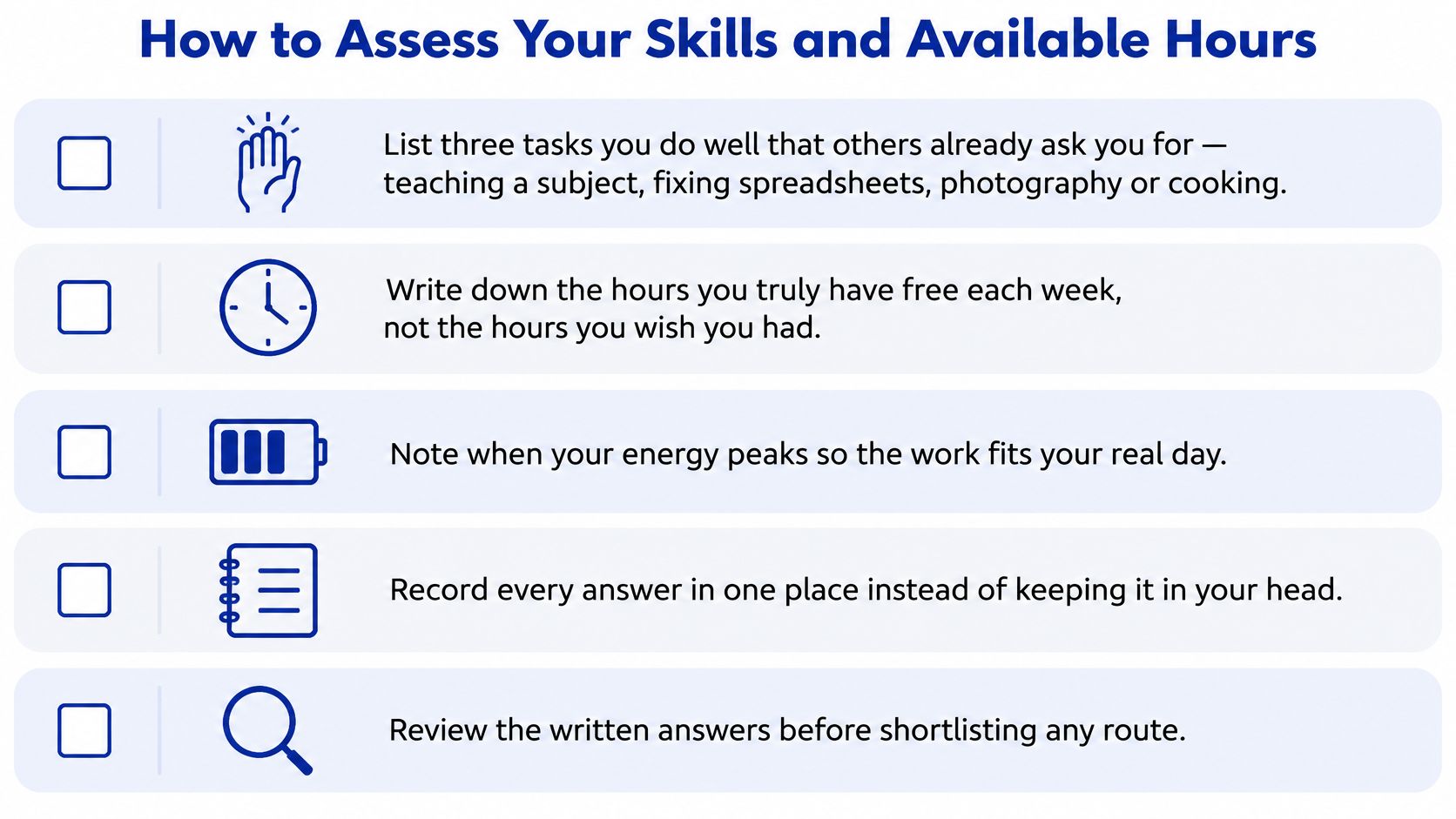
Answer Six Questions in Writing
- List three tasks you already get asked to do. Teaching a subject, fixing a spreadsheet, photographing a product or cooking for a group all count. Look beyond favors from friends: what problem does a coworker regularly bring to you? Other people asking is useful market research because it shows someone wanted the outcome before money was mentioned. It doesn't prove they'll pay, but it gives you a place to start. Describe each task as a result: "turn a messy spreadsheet into a usable report" is easier to test than "good with spreadsheets."
- Mark the ones someone would pay for today. Not after a course, not after a certificate. For each task, name a plausible buyer and a deliverable. "I organize files" becomes "I can clean up a small business's shared folder and hand over a naming system." If the honest answer is "nobody yet," keep the skill on your learning list rather than building your first income plan around it. Check whether the buyer has a reason to act now, such as a recurring task or a deadline.
- Count the hours you have free. Subtract work, commuting, sleep, caring duties and the rest you take in practice. Then reduce the remaining time to a conservative working estimate, perhaps roughly two thirds, because weekday evenings get interrupted and Saturday mornings disappear. If your calendar shows nine open hours but only six reliably survive, plan a six-hour test. Include time for finding customers and completing admin, not just delivering the paid work.
- Separate predictable hours from shifting ones. A standing Tuesday evening and a random Sunday afternoon support different routes. Predictable blocks suit tutoring and scheduled calls; fragmented blocks suit listing items or answering messages. Also note when buyers need you. Three free weekday mornings won't help much with an offer that requires live evening sessions. If your schedule changes weekly, decide how much notice you can realistically give a customer.
- Inventory your assets and licences. A laptop, a car, a sewing machine, a professional licence or a room you can teach in may open routes. Then check what each route actually requires. Owning a car doesn't settle the questions of fuel, wear, insurance and availability; holding a professional licence doesn't automatically permit outside work under your employer's rules. Write down what you would have to buy or verify before the first job.
- Finish this sentence. "I can offer [skill] to [type of customer] for [hours] a week." Add a tangible outcome if you can: "I can edit two short newsletters for local nonprofits in four evening hours a week." If the sentence won't complete cleanly, the skill list is still too vague to price or pitch. Make it small enough that you could deliver the first version without rearranging your whole life.
A nurse who writes well and has five free evening hours a week might test patient-education handouts and clinic website copy for small practices, delivered in two evening blocks. The offer still needs boundaries: what subject matter is covered, who approves medical claims, and whether the nurse's employer permits the work. Someone with a car and free Saturday mornings has a different test: try one delivery shift and log actual net pay per hour before committing to more.
Consider a second example: an office worker can format spreadsheets and has two unpredictable hours most weekdays. Live tutoring is a poor fit despite their ability to explain formulas. A small, clearly scoped spreadsheet-cleanup service could fit better if customers can send files securely and accept a two-day turnaround. The offer should specify whether it includes correcting formulas, reorganizing tabs or simply formatting, because those tasks take different amounts of time.
A skill inventory also helps you avoid paying to learn something you can already sell. An organized office worker may not think of calendar cleanup as a marketable service because it feels routine. But if they can describe the result, such as reducing scheduling back-and-forth for a small team, they have a testable offer. They should find out whether buyers want it before buying a virtual-assistance course.
Check your limits as carefully as your strengths. A skill you use at work may involve confidential data, employer-owned templates or regulated advice. Do not assume that experience gives you permission to reuse workplace material or serve the same clients independently. Create your own examples, confirm any relevant restrictions and narrow your offer to work you can actually perform outside your job.
Rank what's left by how many people need it and how fast you can deliver it. A skill in demand that takes you three weeks to produce may lose to a less exciting one you can turn around in two days.
At the end of the exercise, keep a short list of two skills, two customer types and your realistic weekly hours. For each pairing, write one sentence describing the first paid job. That gives you enough information to compare routes without turning self-assessment into another month of preparation.
How to Pick a Route That Fits Your Life
Scoring beats intuition here, because it's easy to pick the route that sounds most interesting rather than the one your week can hold.

Take each route you circled and score it 1 to 5 on six things: skill match, cash needed upfront, schedule fit, income predictability, room to grow, and whether your employer's policy allows outside work. A 5 means a strong fit; a 1 means a serious obstacle. Check the employer-policy question before doing the rest of the arithmetic, because a conflict discovered in month three can wipe out the value of the side income. If a policy is unclear, resolve that uncertainty before accepting work.
Give each score a short reason. "Schedule fit: 2, because I can only commit to one evening every other week" tells you more than a total of 21 points. For affordability, compare the estimated cost with money you can safely spend, not your credit limit. For predictability, ask whether the route can produce repeat bookings or whether you must win every sale from scratch.
Any route scoring 2 or lower on schedule fit or upfront affordability drops off the list, however well it scores elsewhere. Those are hard constraints. The remaining scores are preferences you can trade. Don't let a high total hide one impossible condition: a tutoring plan can't work if you have no dependable session time, even if you have excellent subject knowledge. Treat an unresolved employer restriction as a reason to pause that route rather than awarding it a convenient middle score.
For example, suppose two routes both score well for skill match. Tutoring needs no meaningful inventory but requires two fixed evenings; reselling takes more cash up front but fits scattered weekend hours. If your evenings change every week, reselling may be the better experiment. If you have no spare money for stock but a reliable Wednesday slot, tutoring may win. A scorecard makes that trade-off visible without pretending it can predict earnings.
You can also compare the worst ordinary week, not just the ideal one. Suppose you have six side-work hours when nothing else goes wrong, but only three during a busy work week. Can the route pause, or will a client still expect delivery? Reselling items you already own may tolerate a missed week; a standing tutoring appointment may not. The ability to say no or reschedule is part of schedule fit.
Participation in this kind of work is already mainstream. The Federal Reserve's 2024 household economic well-being survey found that 13% of U.S. adults earned money by selling things through gig or resale channels, while 9% earned money from short-term tasks such as giving rides, delivering takeout or doing odd jobs (Federal Reserve, 2025 Economic Well-Being of U.S. Households). The two groups overlap, so don't read them as a single total. Widespread participation tells you that these are viable categories to investigate, not that every participant earns enough to make a given route worthwhile.
The same survey carries a warning about choosing on vibes. Among people who did gig work, 55% agreed it provided flexibility, but only 35% said it provided work-life balance. Flexibility is control over when you work. Balance is whether the work stops. If a route requires you to be available whenever a client messages, ask whether you can set response hours before you take the first booking.
A bookkeeper who wants to try delivery, for example, should notice that her weekday evenings are already committed to family and delivery may compete with that time. Reselling might score higher on her schedule even if it scores lower on speed, because she can photograph items on Saturday mornings and pause during a busy month. She would still need to test whether sourcing and storage make the numbers work.
Room to grow favors routes where the work leaves something behind: a client list, a portfolio or a repeatable service. Growth doesn't have to mean building a large business. It might mean getting the same tutoring student each week rather than finding a new one every time. If you want to explore a route that could eventually depend less on booked hours, spend an evening on how to monetize a website before you commit to something purely transactional. A website generally needs its own development and audience-building time, so don't substitute hoped-for future revenue for a near-term cash plan.
Then name one primary route and one backup. Choose the backup so it needs different equipment or a different time slot. Delivery and reselling both fail if your only free window is Saturday and it disappears; tutoring on a weekday evening could provide a more independent fallback. Write down the reason each route won or lost, so you can revisit the decision using evidence rather than memory.
A practical final check is to describe the first seven days of each route. If your primary plan requires a portfolio, identify which sample you will make. If the backup requires a car, check whether you can actually use it during your free hours. A route that wins on paper but has no feasible first-week action is not yet a plan.
Launch Your First Route in 30 Days and Avoid Costly Mistakes
A month won't replace your income. It can tell you whether anyone will pay for what you're offering, which is the question to answer before spending heavily. Define success in observable terms: a paid booking, a completed sale or a serious buyer agreeing to specific terms. Likes, views and encouraging comments aren't substitutes for those signals.
Set two limits before you begin: a maximum amount you can spend and a maximum number of hours you can devote each week. A $50 test that produces no sale is easier to learn from than a $500 setup purchase that leaves you short of cash. Record your assumptions too. If you expect the first job to take four hours, writing that down lets you compare the estimate with what actually happened.
The month fits into six moves, and new sellers often stall when they skip the second one and go straight to advertising.
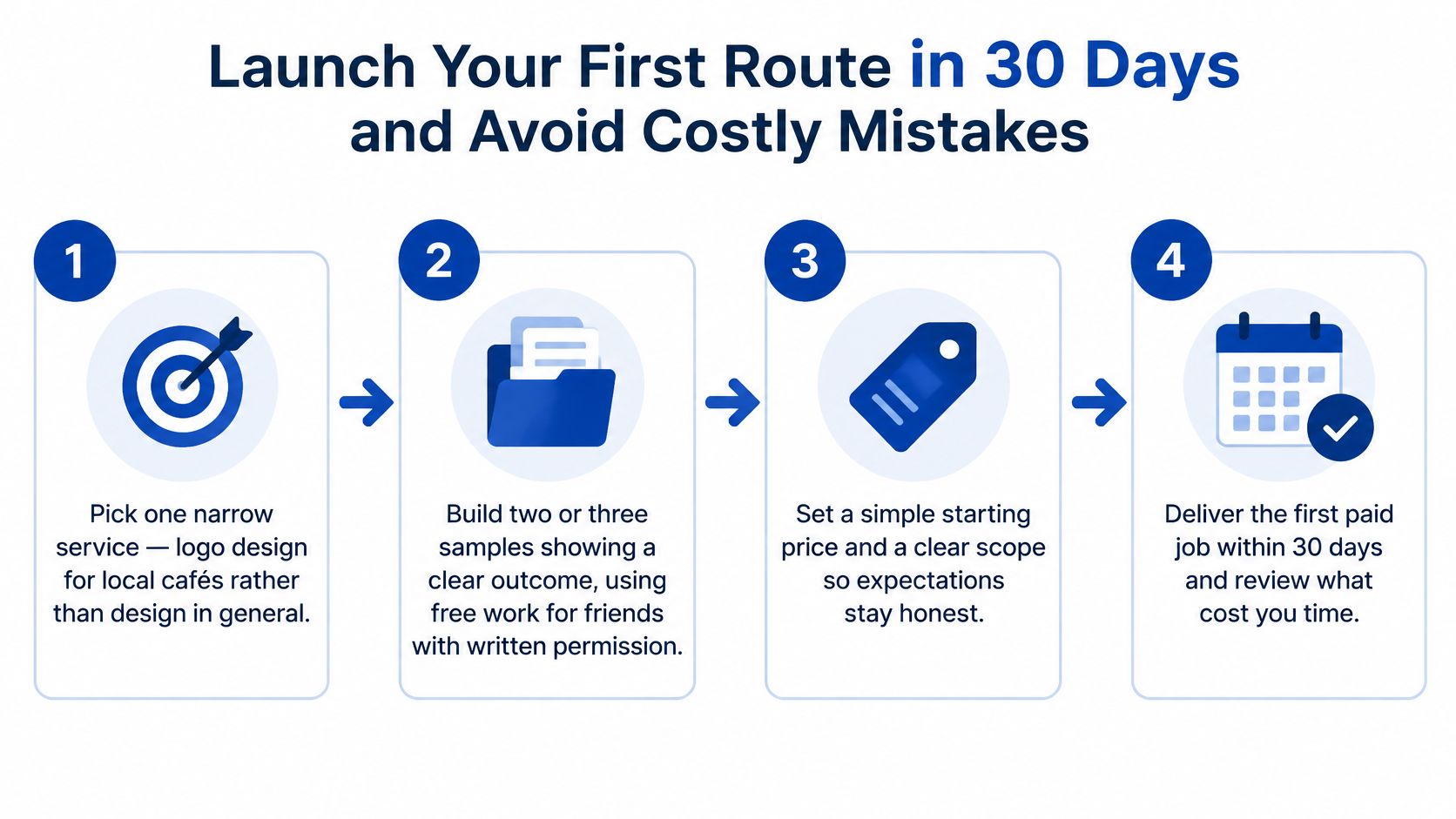
The Six Steps in Order
- Narrow the service to one outcome. "Menus and signage for independent cafés" is an offer; "design" is a field. Specify the deliverable and buyer so prospects can decide quickly whether it's relevant. For instance, "I will format a one-page seasonal menu from your supplied text" is easier to quote than "I help with creative work." Name what the buyer supplies, what you deliver and when the job is finished.
- Build two or three samples that prove the outcome. Free work for friends can help, as long as you get written permission to publish it. You can also make a clearly labeled demonstration sample that isn't presented as client work. Show the result at the size and style a buyer would receive, and explain what you did without claiming results you haven't measured. Two relevant examples often tell a buyer more than a large, unrelated portfolio.
- Set a target rate from the bottom up. Add your expected expenses, tax set-aside and the unpaid sales time that never appears on an invoice, then calculate the hourly equivalent you need. If a job takes three hours to complete and another hour to discuss, revise and invoice, pricing only the three production hours understates the work by a quarter. Pricing from a competitor's advert imports their cost base into your business. For an initial quote, estimate the full job and set a clear scope so you can compare the quote with the actual hours afterward.
- Reach qualified prospects through at least three channels in week two. Former colleagues, a local business directory, a niche job board or a trade association newsletter can all supply leads. Tailor the message to the buyer's likely problem rather than sending the same broad pitch to everyone. Record how many relevant conversations each channel produces; one channel alone tells you little about whether the offer or the channel is failing. Respect each channel's rules and avoid treating a list of names as permission to send indiscriminate messages.
- Put the scope in writing before work starts. State deliverables, revision rounds, milestones, payment dates and who owns the files afterward. If a café orders a menu, specify whether changing prices after approval is included. A short written agreement turns an awkward future conversation into a decision both sides already made. Confirm who can approve the work, especially when more than one person at the customer's organization may comment.
- Track collected money and hours from project one. A spreadsheet with date, client, hours, invoiced, fees and received is enough. Include time spent finding the customer and making revisions. Invoices are hopes; bank deposits are data. Tracking from the first job prevents you from confusing a busy calendar with a profitable route. Add a brief note about where the lead came from, so you can see which outreach produced actual paid work.
Here is how that sequence might look for a spreadsheet-cleanup offer. You define the job as reorganizing an existing workbook of up to five tabs, build a before-and-after sample using your own fictional data, estimate two hours of work plus one hour of communication, and contact people who manage recurring reports. Before starting, you agree on which formulas you will check and whether a second revision is included. When the client pays, you log every hour rather than only the time spent editing cells. The example does not prove demand, but it gives you a test you can run and assess.
What the Month Looks Like
Week one: choose the narrow offer, produce the samples and write down your cost and time assumptions. For a service, draft one short pitch that names the buyer's problem and what you'll deliver. Keep setup lean: a sample and a way to receive inquiries matter more than a logo. Before spending anything, list the tasks you can complete with tools you already own.
Week two: set an initial price and begin outreach through the channels you've chosen. Aim for conversations that can tell you why a buyer does or doesn't want the offer. If people understand the offer but object to its scope, adjust the package; if they don't understand it, rewrite the pitch before lowering the rate. Log responses by channel rather than relying on whichever reply felt most encouraging.
Week three: follow up where appropriate, send proposals and refine your estimate of how long fulfillment takes. A prospect asking for work outside your original offer isn't necessarily a bad lead, but quote the added work separately instead of treating it as free validation. If a buyer goes quiet, note where the conversation stopped and move on rather than spending the whole week waiting for a reply.
Week four: agree on scope, deliver the first job if you've secured one, and review the results on day 30. If no one has paid, record what happened: no inquiries, inquiries with no calls, calls with no agreement or agreements that stalled on payment. Each outcome points to a different next step. No inquiries might mean your channel or message needs work; interested buyers who reject the price may need a clearer package, a different buyer or a revised quote.
For reselling, use equivalent steps: choose one category you understand, list a manageable batch of items, photograph everything against the same background, and price from completed sales rather than asking prices. Start with items you already own if possible, since that lets you test the listing workflow without tying up cash in inventory. Track the purchase price when applicable, packaging, shipping, fees and time from sourcing to dispatch. Record items that do not sell too; ignoring unsold stock makes the route look more successful than it is.
For tutoring, pick one exam or subject level, run a limited number of trial sessions, and set a rate before you start accepting ongoing bookings. A trial should have a clear purpose: identify the student's level, teach one topic and show the family what future sessions would cover. Decide whether preparation time and cancellations are accounted for in your terms. A repeat booking is more informative than praise alone, because it shows a family is willing to commit time and money again.
The same sequence runs in this walkthrough if you'd rather watch it first.
The Mistakes That Eat Your Margin
Counting invoices as income. Platform fees and card charges may come out later, and an unpaid invoice isn't available cash. A $300 invoice isn't necessarily $300 you can spend. Keep side-income transactions easy to identify and log what actually arrives, along with the costs attached to earning it. When budgeting, use cleared payments rather than proposals, promises or outstanding bills.
Underpricing revisions. Define included rounds and state the price for additional changes before work begins. If a buyer asks for a third round of "one small change," decide whether it falls inside the agreed scope rather than letting the request silently lower your effective rate. A revision round can mean one consolidated set of feedback, not unlimited messages over several weeks.
Skipping the written scope. Even a brief agreement can identify the deliverable, deadline, price, revision limit and payment date. Without it, a client and seller may genuinely remember different promises. Put important changes in writing as the project evolves. For a digital deliverable, also agree on the file formats the customer will receive.
Depending on one client. If one customer provides all your extra income, losing them cuts it to zero. Keep some prospecting time in your schedule even when you are busy delivering. Diversifying matters most after you've proven that the first client type is worth serving. You do not need several clients immediately, but you should know what you would do if your first regular customer paused work.
Buying tools before a buyer exists. A $400 software subscription is a large test expense if you haven't sold the service. Start with tools you already have where practical. Buy a paid tool when a specific job requires it and the expected earnings justify the cost, rather than assuming the purchase will create demand. Include recurring subscriptions in your monthly costs even during weeks when no jobs arrive.
Ignoring the cost of chasing payment. Late payment creates unpaid admin and can upset your cash plan. Agree on payment dates up front; for service projects, consider whether an appropriate deposit or milestone payment makes sense. Check any terms you use against the rules that apply where you work. A customer who requests substantial work before agreeing to payment terms is asking you to take on extra risk.
Leaving returns, travel or preparation out of the estimate. A reseller can make an apparently good sale and still lose money after a return and shipping costs. A tutor can quote an attractive session rate but spend an extra hour preparing each lesson. Log the whole job, not just the paid interaction. Even if a cost seems small on one sale, repeated packaging purchases or short drives can change the monthly result.
Confusing interest with a sale. A prospect asking questions may never book. A marketplace user saving an item may never buy it. Treat those responses as clues about your offer, not money you can count on. The stronger signal is a customer who agrees to specific terms and follows through.
If your route involves reselling, sourcing is the whole game, and estate clearances can be a source of resale stock. Turning that stock into cash is its own skill, and this downsizing sale guide for executors covers how to sell items online, including listing and pricing steps a reseller can examine for their own workflow. Check condition, permissions and total costs before assuming a low purchase price means a good margin.
The Numbers That Decide Whether You Continue
Contracting isn't a fringe activity. U.S. labor data reported by the Bureau of Labor Statistics counted 11.9 million independent contractors in their main job, 7.4% of employment, and the operational risk for this kind of work is income that moves month to month. StartFleet's freelance statistics report that 58% of self-employed adults experienced month-to-month income variation in 2025. These figures don't describe the prospects for any one side project, but they are a reason to avoid building fixed personal expenses around a best-case month.
For a service, track three numbers separately: collected revenue, total work-related expenses and total hours. Divide the difference between the first two by the third for an effective pre-tax hourly rate. Also track how much revenue depends on your largest client. A high rate from one short project is encouraging, but it isn't proof that you can repeat the result.
Add two useful diagnostic numbers: how many relevant prospects you contacted and how many paid jobs resulted. If you contacted 15 plausible buyers and had no conversations, test the targeting or opening message before rewriting the entire service. If several buyers asked for a quote but none accepted, inspect your scope, price and how well the offer matches their needs. Small samples cannot establish a reliable conversion rate, but they can show where a process is getting stuck.
Product routes carry the same lesson in slower motion. U.S. Small Business Administration data on employer establishments born between 1994 and 2022 puts average survival at 67.7% after two years, 49.2% after five, 33.9% after ten and 25.5% after fifteen (SBA, FAQs About Small Business). Those are benchmarks for businesses with employees, not odds on your side-income idea, but they explain why staged validation beats a big opening purchase.
For a productized side business, the arithmetic is required monthly orders = fixed monthly costs divided by contribution margin per order, where margin is price minus payment fees, fulfillment, returns allowance and variable marketing. If fixed costs are $120 a month and you keep $12 per order before those fixed costs, you need 10 orders just to cover them. That doesn't yet pay you for sourcing, packing or customer service. Use your own figures in the formula before buying a large batch of stock.
Run a second calculation for time. If packing, messages and dispatch take 20 minutes per order, ten orders require more than three hours of direct work even before sourcing or marketing. If you only have four hours a week, ask whether the workload still fits when returns or customer questions arrive. Breaking even on cash while exhausting your available hours is not a useful outcome.
A useful decision rule ties it together. Continue a service when its realized hourly rate, after expenses and unpaid marketing time, beats your target rate across three consecutive projects. If it doesn't, inspect the cause before quitting or adding hours. A slow first job may reflect a learning curve; repeated low-margin jobs may mean the price, buyer or scope needs to change. If freelancing is the route you've picked, this guide to how to start freelancing fills in the client-acquisition side.
Realistic Income and Time Expectations by Stage
Gross monthly income is the wrong number to plan around. Reported average side-hustle earnings sit near $885 a month, yet the median lands at $200 to $400 and 58.6% of side hustlers earn less than $250 monthly (GovFacts, the side hustle economy). Budget on the average and you're planning for a month many earners never see. The stages below are illustrative planning ranges, not guaranteed earnings or a prediction of when you'll reach them.
Illustrative earnings ranges and what to measure at each stage
| Stage | Timing | Illustrative monthly net before tax | What to measure |
|---|---|---|---|
| Test | Months 1-2 | $0-200 | Whether anyone pays and hours spent per sale |
| Early | Months 3-6 | $200-400 | Repeat customers and net hourly pay |
| Stable | Months 7-12 | $400-800 | Income volatility and share of income from one client |
| Scaled | Year 2 onward | $800-1,600 | Whether margin holds as volume grows |
Here, net before tax means collected revenue minus business-related costs, not take-home pay after tax. Results vary widely by route, available hours, location and buyer demand; you may spend longer in a stage, skip one or decide that a smaller, steadier amount fits your life better. A person with four reliable hours a week should not treat the same monthly target as someone with fifteen.
In the test stage, the question is whether a buyer pays, since your own enthusiasm doesn't count. A $40 tutoring session can provide useful evidence if you know how much preparation and travel it took. One lucky sale, however, doesn't establish regular demand. Record what produced it so you can attempt the same process again. If you earn nothing in the first month, distinguish between a route nobody wanted and a route you barely had time to test.
In the early stage, look for repeat customers and a rate that survives the full workload. A second sale suggests the outcome may be valuable beyond your opening pitch. If repeat work arrives but every job overruns, adjust scope or price before taking on more customers. For instance, an editor who repeatedly spends an extra hour untangling unclear source material could ask clients to supply a brief in advance or quote that work separately.
At the stable stage, measure concentration and volatility. If one client produces three quarters of your income, that income can disappear with one decision outside your control. Track a few months of collected payments, not just your strongest month, before deciding how much of the money can safely support recurring bills. It can help to compare your best month, worst month and typical month rather than using the best one as your budget.
At the scaled stage, more sales should not automatically mean more hours at a worse rate. A reseller might ship more orders but spend longer handling returns; a service provider might add clients but lose evenings to coordination. Compare the effective hourly rate and your available personal time with what they were at the stable stage. Growth that breaks either one may not be an improvement. A narrower, higher-margin offer may fit better than taking every available job.
A buffer can help absorb uneven months, but its size should follow your circumstances. One month of your target side income can be a useful initial savings goal if you rely on that money for a recurring expense. If the side income is optional, you may instead keep a smaller amount to cover inventory, refunds or delayed payments. Neither choice turns variable income into a salary.
Work Out What You Actually Keep
Take a $300 project. Subtract a $30 platform fee and $25 in supplies, and $245 remains. Now count the hours: 10 hours of delivery plus 4 hours of unpaid admin, proposals and messages. That works out to $245 across 14 hours, about $17.50 per hour before tax. The $300 invoice was the sale price, not your effective pay.
Now change one assumption. If the client needs three more hours of revisions at no added charge, the same $245 is spread across 17 hours, or about $14.41 per hour before tax. If you had a minimum acceptable rate of $18, that project would miss it even though the headline price stayed the same. This is why revision limits and time logs belong in the plan, not as an afterthought.
Try the calculation again across several jobs rather than judging one in isolation. If a first project pays poorly because you made reusable templates, the second and third projects may improve. If every project requires fresh unpaid outreach and extensive revisions, the low rate may be built into the offer. Keep the numerator and denominator consistent: count collected revenue and related expenses for the same period as the hours you include.
Apply the same calculation to a physical product. If you sell an item for $60 after buying it for $20, don't stop at a $40 apparent profit. Deduct selling fees, packing materials, shipping you pay for and the cost of getting the item. Then count sourcing, photography, listing, messages and dispatch. A product can have a positive cash margin but still pay poorly for your time.
For a concrete illustration, suppose that $60 sale also costs $7 in fees, $4 in packaging and $9 in shipping you cover. After the $20 purchase, $20 remains before tax. If sourcing, listing and shipping the item take two hours altogether, that is $10 per hour before tax, even though the difference between buying and selling prices was $40. A return could reduce it further.
If the number disappoints, adding hours is often the weakest fix. Raise the price, cut revision rounds, switch to a cheaper channel or find a different buyer first. Survey work and microtasks still have a place when you need a small amount of cash rather than a business, and this guide to how to earn money from surveys shows what to expect. Emergency cash and a route worth building are different things; treat them differently.
Set the stop-loss before you need it: three consecutive projects below your minimum rate, or no repeat customer by month six, means pause, diagnose the problem and consider the backup.
Confirm Your First Route This Week
Commit to a 14-day test of your primary route with a fixed weekly cap. Six hours may be manageable alongside a job, but use the number your own calendar supports. Cap it now, while you're still objective, because an open-ended trial can become a second job before you know whether it pays.
Make the test concrete. For a service, write the offer, prepare a sample and contact a small number of relevant prospects. For tutoring, define the subject and available session slots, then seek a first booking. For reselling, list items you already own and record the full cost and time of each sale. Set a spending cap as well as a time cap so the test can't quietly grow into an inventory or subscription commitment.
Here is a simple version you can copy into your notes:
- Primary route: The specific service, subject or item category you will test.
- Buyer and offer: Who might pay, what they will receive and the price or pricing method.
- Limits: The maximum amount you will spend and the hours you can reliably use each week.
- First action: One prospect to contact, one listing to publish or one trial slot to offer.
- Review date: Day 14 for an initial signal, followed by day 30 if the test warrants it.
Write the go or no-go rule before you start. A paid job at an acceptable effective rate is a strong signal to continue. A confirmed buyer who has agreed to a price and date may justify finishing the 30-day test even if payment has not cleared by day 14. If neither appears, look at where the process stalled before deciding whether to change the offer or switch to the backup. Don't add hours merely to avoid making that decision.
For example, a tutor might decide to continue if one family books a paid session and asks about another, then review the effective hourly rate once preparation is included. A reseller might continue if several existing items sell at a worthwhile margin, but hold off on buying inventory until the numbers from those sales are clear. The decision rule should match the route, not someone else's success story.
Before you fix a rate, check it against local prices and your own costs, so the number means something in the money you spend. If clients pay in a currency other than US dollars, our USD vs. Local Currency Freelance Earnings Estimator shows what your rate is worth after conversion, which can help you assess whether an attractive headline number still works for you.
Put the go or no-go date on the calendar and note the three figures you'll review: money collected, money spent and hours worked. Then do one thing today: send one offer, post one listing or book one tutoring trial. The point isn't to guess the perfect route. It's to gather enough evidence to make a better next decision.
Mega Income Stream covers this ground in depth, with guides in its Earn Living Online section on freelancing, pricing, survey work, digital products and other ways to build income alongside a job. If you're weighing routes or setting your first rate, start with the Mega Income Stream library and pick the one article that matches the route you've chosen.









Comments