
 By

Two invoices cleared this month. One client is thirty days late. There's a proposal due Friday for a project type you haven't priced before, and the number you type into that quote decides how the next six weeks feel.
Most freelancers answer that question by looking sideways at what someone else charges. A marketplace listing, a friend's day rate, a competitor's page. It feels like research. It's usually a guess with a source code attached.
A freelance pricing calculator works the other direction. It starts from the income you need to live on, adds every cost you carry, and divides by the hours you can bill. The output is a floor. Everything else, benchmarks, positioning, discounts, is a check against that floor rather than a replacement for it.
This guide builds that floor from your own numbers, then tests it against a quieter calendar, a fixed-fee project, and a brief that contains more than one service. The aim isn't to find the one perfect rate. It's to know what a quote has to earn before you decide whether a particular opportunity is worth taking.
Table of Contents
- The Formula Behind a Freelance Pricing Calculator
- How Billable Hours Decide Your Rate
- Taxes, Expenses and Reserves That Raise Your Floor
- How to Run Your Numbers Through a Calculator
- Checking Your Rate Against Market Benchmarks
- Choosing Between Hourly, Project and Retainer Pricing
- Pricing Briefs That Combine Several Services
- Common Mistakes That Quietly Underprice Your Work
- Confirm Your Starting Rate Before Your Next Quote
The Formula Behind a Freelance Pricing Calculator
Hourly floor = (target profit + business expenses + tax reserve + benefits reserve) ÷ billable hours
That line is the whole engine. Every input is something you either know or can estimate from your own records. Nothing depends on what the freelancer down the street charges. Set the number before the first proposal goes out, because an unprofitable project is an expensive way to learn what the formula would have told you for free.
The formula runs backwards from a rate card. A rate card starts with a price and hopes the income follows. This starts with the income you need and produces the price that delivers it.
For a quick first pass, imagine your annual requirement is $96,000 after adding your target income, expenses and reserves. If you expect 1,200 billable hours, your floor is $80 per hour. A $2,000 project needs to fit within 25 hours to meet that floor. If the work will take 35 hours, the attractive-looking fee works out to about $57.14 per hour. That comparison is useful even when you never show a client an hourly rate.
Start From Profit, Not Revenue
Target profit is what's left after the business pays its costs. Here, think of it as the amount you want available for yourself before the separate tax and benefits reserves in the formula. If you want $80,000 available, the calculation has to produce that amount after software, insurance and equipment, while also funding tax and a retirement contribution. Revenue is a bigger, softer number that feels like progress and funds nothing specific.
Suppose you invoice $100,000 in a year and spend $18,000 on running the business. The difference is $82,000 before the tax and benefits reserves in this model. If you entered $100,000 as your personal income target, then added the $18,000 again, you'd be working from the wrong starting point. Keep each line distinct: what you want available, what the business spends, and what you set aside.
The divisor carries the same weight as the total. Count only the hours a client pays for. The pitching, admin and quiet weeks that fill the rest of your calendar have to be recovered inside that same rate, so an optimistic hours estimate lowers the floor below what the business needs.
Every Reserve Moves the Rate
Take a freelancer targeting $80,000 in income before their separately budgeted tax reserve, across 1,200 billable hours. The first pass gives $66.67 an hour. Watch what each additional line does to the running total.
| Line item | Amount | Running total | Per billable hour |
|---|---|---|---|
| Target income before separate reserves | $80,000 | $80,000 | $66.67 |
| Business expenses (software, insurance, equipment) | $12,000 | $92,000 | $76.67 |
| Self-employment tax reserve (illustrative U.S. estimate) | $11,300 | $103,300 | $86.08 |
| Retirement and benefits reserve (example assumption) | $8,000 | $111,300 | $92.75 |
The $12,000 of software, insurance and equipment leaves the business whether or not you budget for it. The $11,300 tax line is an illustrative reserve, not a completed U.S. tax calculation. Actual self-employment and income taxes depend on taxable profit, other income, deductions, filing status and applicable thresholds. If your goal is a specific amount after all tax, work backwards with a tax professional or a calculator designed for your circumstances rather than treating this example reserve as exact.
The $8,000 benefits reserve represents costs such as retirement contributions and health cover that you would otherwise need to fund yourself. Replace it with your own target. For example, if you need $12,000 rather than $8,000, the annual requirement rises by $4,000 and the floor at 1,200 billable hours rises by $3.33 per hour.
If running totals feel unfamiliar, the logic is the same as any product-level break-even model, and this break-even formula walkthrough applies it to a single unit cost. Your billable hour is the unit.
Substitute your own income target, annual costs, reserves and billable hours, and the output becomes a planning floor. Hold every quote against it. Pricing below the floor means funding the client's project out of your other earnings or reserves, which can be a deliberate choice for a strategic account and a quiet leak everywhere else.
How Billable Hours Decide Your Rate
2,080 hours is a payroll number. It's 40 hours a week for 52 weeks, and it assumes every one of those hours earns money. Yours don't.
The unpaid work is not an accident of a badly run week. It's structural:
- Vacation and public holidays. You fund them yourself, so they have to sit inside the rate.
- Sick leave. Allow for days when you cannot work or need to care for someone else.
- Marketing and pitching. Proposals, discovery calls, follow-ups and portfolio upkeep.
- Invoicing and bookkeeping. Chasing payment counts as work and earns nothing.
- Training. Whatever keeps your skill sellable.
- Business development. The partnerships and referrals that produce next quarter's work.
Utilization is billable hours divided by total working hours. A plan of 1,200 billable hours is roughly 58% of 2,080. That's one planning scenario for a solo operator who handles their own sales and admin, not a utilization target everyone can reach.
Try a calendar-based version instead of starting with 2,080. If you plan to work 46 weeks at 35 hours a week, you have 1,610 working hours. At 65% billable utilization, that's about 1,047 hours you can invoice. Using 1,200 without explaining where the extra 153 billable hours will come from makes the resulting floor too low.
What Optimism Costs
Keep the annual requirement at $111,300 from the worked example and change only the hours.
| Billable hours per year | Share of 2,080 hours | Hourly floor | Change vs 1,200 hours |
|---|---|---|---|
| 1,000 | 48% | $111.30 | +20% |
| 1,200 | 58% | $92.75 | baseline |
| 1,248 | 60% | $89.18 | -4% |
| 1,400 | 67% | $79.50 | -14% |
At 1,000 hours the floor is $111.30 an hour. At 1,200 it's $92.75. At 1,248 hours, a 60% utilization assumption, it drops to $89.18, and at 1,400 it lands at $79.50. Same annual requirement, but a materially different rate depending on how honestly you forecast the calendar.
The difference also shows up in an individual proposal. A freelancer pricing from a 1,400-hour forecast might quote a 20-hour task at $1,590 using the $79.50 floor. If their actual annual workload turns out closer to 1,000 billable hours, that same 20-hour task would need $2,226 at the $111.30 floor. The shortfall isn't visible until they add up a year of projects.
The same effect appears in reverse in compensation targets. At 1,000 billable hours, a $60,000 compensation goal alone implies $60 per billable hour before a single overhead line, as the 2025 benchmark compilation from Working Figures notes. That compilation also reports U.S. median employee wages of $30.27 an hour for graphic designers and $65.38 for software developers, a spread of $35.11, or about 116%, while noting that those figures exclude the self-employed. Employee pay tells you the opportunity cost of going independent. It doesn't quote the job.
Practical rule: when two billable-hour estimates are plausible, test the lower one. If the higher estimate depends on every prospect signing and every week staying full, it is a stretch scenario, not a safe floor.
Run the One-Month Test
Log every working hour for four weeks in a spreadsheet. Mark each line as billable or not billable, and don't tidy the result. Multiply the weekly billable hours by the weeks you expect to work in a year, not 52.
For example, four weeks with 78 billable hours gives you 19.5 billable hours per week. At 46 working weeks, the simple projection is 897 billable hours. Check whether that month was unusually busy or quiet before committing to the number. If one big client accounted for half the logged hours and their contract ends soon, run a second scenario without them.
Track quoted hours against actual hours at the same time. If you repeatedly estimate 10 hours for a deliverable that takes 14, your utilization estimate alone won't save the quote. You need to correct both the annual hours forecast and the hours inside your project fees.
Taxes, Expenses and Reserves That Raise Your Floor
A usable floor has three jobs: pay the work, fund the business, and leave enough behind for tax and benefits. Miss one and the hourly figure is only a gross wage with nicer formatting.
Separate costs by their behavior. A fixed annual insurance premium can be entered directly. A payment-processing fee changes with revenue and may need to be added to individual quotes. A laptop replacement comes every few years, but the rate still has to fund it gradually. Treating all three as whatever you happened to pay last month will distort the result.
The Cost Lines to Enter From Your Statements
Use last year's actual outflows as your starting point, then adjust for known changes and divide the annual total by the billable hours you already chose. If you're new to freelancing, use written quotes, current subscription prices and a conservative equipment budget instead of pretending you have a year's statements.
- Software and subscriptions. Every monthly tool the work depends on, from design suites to scheduling.
- Equipment and depreciation. Laptop, monitor, peripherals, camera, desk. Budget for replacement cycles as well as the first purchase.
- Professional insurance. Liability or indemnity cover, priced annually and easy to forget.
- Accounting and tax preparation. What you pay someone to file the return you'd rather not file alone.
- Workspace, internet and phone. Rent, power and connectivity for the desk you work from.
- Training and conferences. The courses and events that keep your rate justifiable.
- Marketing and portfolio costs. Domain, hosting, paid listings, portfolio photography.
- Payment and platform fees. The percentage a marketplace or card processor takes before your money arrives.
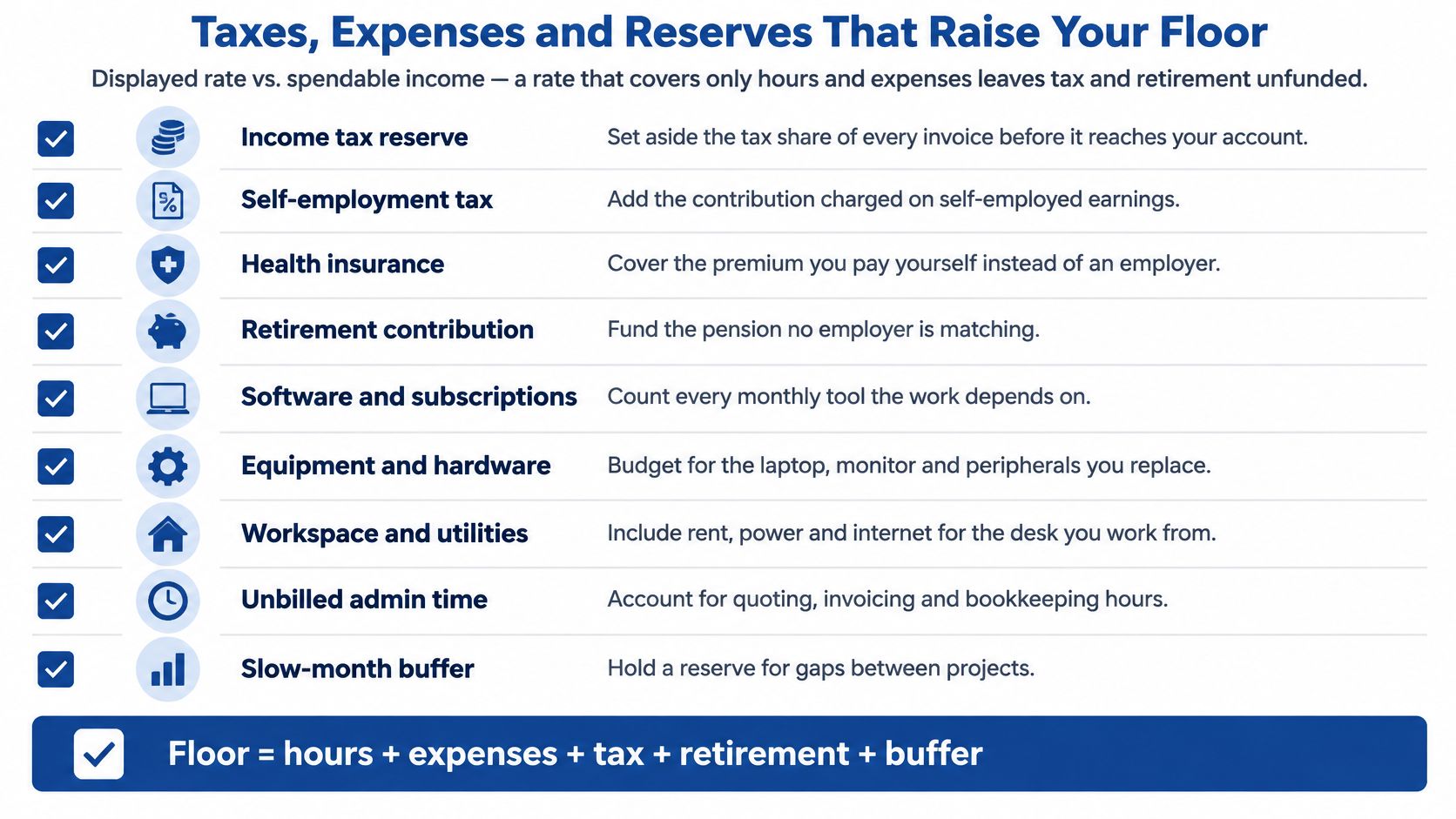
Here's how small lines accumulate. A $40 monthly subscription costs $480 a year. A $2,400 laptop replaced every three years adds an $800 annual planning allowance. Together they add $1,280, or about $1.07 to a floor built on 1,200 billable hours. Neither looks large in isolation; both need funding.
That last line changes quotes, not just bookkeeping. If a payment platform keeps 5% and you need $1,000 to reach your account, quoting $1,000 leaves you with $950. Before other transaction-specific charges, you'd need to quote about $1,052.63 to net $1,000 after that percentage fee. Don't also include the same fee at its full estimated value in annual expenses unless you're intentionally accounting for separate transactions. Avoid counting a cost twice.
The Self-Employment Tax Rule in the U.S.
The Internal Revenue Service describes a 15.3% self-employment tax rate, split into 12.4% Social Security and 2.9% Medicare, generally calculated on 92.35% of net self-employment earnings. The Social Security part is subject to an annual wage base, and additional Medicare tax may apply above filing-status thresholds. Check the applicable year's figures before using them in a forecast.
The trap is placement. Self-employment tax is computed on earnings, not simply added as a fixed percentage of each invoice. Income tax is separate again. If the worked example's $80,000 is an amount you want to keep after taxes, a reserve estimated from that same $80,000 does not by itself solve the after-tax calculation. You need to estimate the taxable profit required to produce your desired after-tax amount, then use that profit figure in your pricing model.
For planning, you might keep a reserve line in the calculator and update it against your accountant's estimate or prior returns. For tax payments, use the calculation that applies to your circumstances. The hourly floor is a business planning tool, not a tax return.
Outside the U.S., swap in the local self-employment or social contribution rules and test the result against your actual records. If you book income when you invoice rather than when cash lands, this accrual versus cash method comparison explains why the reserve and the bank balance can disagree in the same month.
Treat reserves as part of the rate, then decide how to hold the cash when payments arrive. A separate tax account can keep a large client payment from looking fully spendable. Re-total the cost lines at least once a year, and sooner if your business structure, income or expenses change.
How to Run Your Numbers Through a Calculator
The order of the inputs matters less than where each number comes from. Here's the sequence that produces a usable planning floor, with the slip that ruins each step.
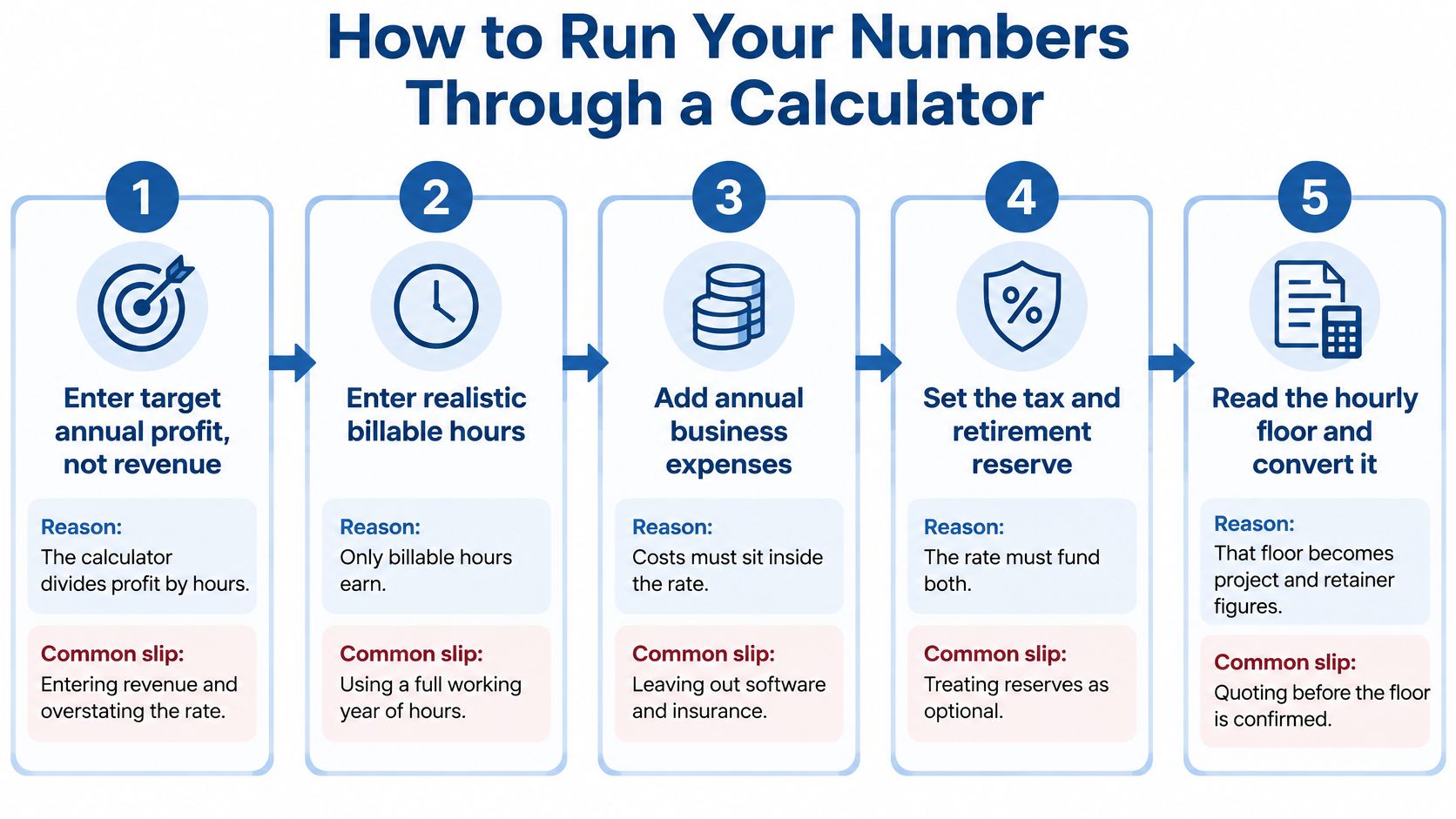
- Enter your annual income target, not gross revenue. Decide whether the target is before or after tax, and keep that definition consistent. The slip is calling an after-tax goal pre-tax income without adjusting the reserve.
- Enter billable hours from your utilization estimate. Not 2,080, not your best month. The slip is copying a full-time employment year into a freelance calculation.
- Enter annual business expenses from your records. Total the categories and adjust for known changes. The slip is leaving out insurance and accounting because they're paid once a year.
- Set the tax reserve for your country and business structure. Keep the output labelled as an estimate. The slip is using one percentage for both self-employment and income tax without checking either.
- Enter a benefits reserve. Retirement, health cover and paid leave belong in the planning model if you need to fund them yourself. The slip is assuming a future pension funds itself.
- Read the hourly floor and compare it with your current quotes. Divide recent fixed project fees by the hours they actually took. The slip is comparing your floor only with the rate on your website.
- Check payment risk. Consider deposits, milestones and late-payment terms before adding an arbitrary surcharge. The slip is assuming invoiced money is available on the day the work ends.
- Convert the floor into every currency you're paid in. Compare today's exchange rate with a less favorable scenario, and account for fees before deciding whether the quote works. For cross-border projects, our USD vs. Local Currency Freelance Earnings Estimator at Mega Income Stream is another way to examine the amount received after conversion and related costs.
- Run conservative, expected and strong scenarios. Change billable hours first, since a small reduction can move the rate sharply. Check separately whether your cash reserve could cover a slow period.
- Save the output with the date and every assumption. You'll rerun it when a tool subscription rises, a client leaves or your availability changes.
For a quick scenario check, put $111,300 in the annual requirement field. Try 1,000, 1,200 and 1,400 billable hours. The corresponding floors are $111.30, $92.75 and $79.50. If your current $90 hourly quote works only in the strongest scenario, it isn't a reliable starting rate for the year.
The saved record matters more than the first result. A floor without its assumptions is a number you'll second-guess the moment a client pushes back.
Checking Your Rate Against Market Benchmarks
A benchmark answers one question. Is my floor plausible for the work I do and the clients I serve? It can't tell you what to charge, because it knows nothing about your costs, your hours or your pension.
Compare like with like before treating a published figure as a signal. A U.S. employee wage, an international freelancer survey, a UK day rate and a marketplace listing describe different populations. Note whether a number is an average or a median, whether it reflects an asking rate or a paid contract, and which currency and date apply.
What the Published Numbers Measure
Location alone moves the reference point enormously. The Payoneer regional survey of more than 2,000 freelancers in 122 countries put the global average at $23 an hour, with North America at $56 and Central America at $18. A freelancer selling to North American clients is looking at a regional figure roughly 2.4 times the global figure. That still doesn't establish what any one specialty or contract should cost.
| Source | Figure | Who was measured | Limitation for your calculator |
|---|---|---|---|
| Payoneer global study | $21 average hourly rate, up from $19 two years earlier | 7,000 freelancers in more than 150 countries | Global average mixes all skills and regions |
| Payoneer regional survey | $23 global average; $56 North America, $27 Western Europe, $24 South America, $23 Central and Eastern Europe, $22 Africa, $20 Asia, $18 Central America | More than 2,000 freelancers in 122 countries | Regional averages, not skill-specific |
| BLS median employee wages (via 2025 compilation) | $30.27 graphic designers, $36.98 writers, $37.46 editors, $44.54 web developers, $65.38 software developers | U.S. employees | Excludes the self-employed, so a reference for opportunity cost only |
| HeyOrca survey, May 2024 | $49.50 under one year; $46.71 for 1 to 3 years; $57.84 for 4 to 6 years; $92.23 for 7 or more years | More than 100 agency and freelance social-media professionals | One niche and dated, but it shows variation by experience |
| YunoJuno 2025 report | Average hourly rate 49 pounds; average day rate 390 pounds, up 3% | More than 261,000 freelance contracts | UK-centred contract data, not split by skill |
| AIR 2025 freelance-rate research | No single headline rate; project and hourly payments converted into comparable hourly rates | 280 valid freelancer responses | Small sample, and the conversions are estimates |
| 2025 Freelancer Study | 100 euros average hourly rate | 3,571 freelancers and independent professionals | Survey average, not split by skill |
| 2026 Freelancer Compass survey | 103 euros average hourly rate, down 1 euro | 5,412 freelancers, self-employed professionals and sole proprietors | Average across all specialisms |
Our freelance rate guide carries Upwork marketplace benchmarks that work as an additional reference, including virtual assistants at $20 to $35 an hour, writers at $30 to $40, digital marketers at $35 to $50, graphic designers at $40 to $45, web developers at $50 to $60 and data analysts at $55 to $65. Treat any marketplace range as context for a comparable service, not proof that your own floor must fall inside it.
The Decision Rule for a Gap
If your floor sits above the typical range for your skill and region, first check the inputs. Did you underestimate billable hours because of a temporary slow month, or are you carrying a cost that belongs to another business activity? If the calculation holds, you have two honest options. Justify the gap through specialisation, demonstrable results or a client niche that pays for outcomes, or change your costs, service mix or positioning.
Say a generalist's calculated floor is $90 an hour, while the marketplace listings they see commonly show $50 to $60. Matching those listings would not make the missing $30 disappear. They might narrow the service to higher-value work, offer a defined outcome rather than hourly support, or build a steadier pipeline that supports more billable hours. Each option needs testing; none guarantees that every buyer will accept $90.
If your floor sits below the typical range, don't take it as an instruction to quote the minimum. Check billable hours and expenses, then look at what clients pay for similar work. A $55 floor in a market where your specific projects regularly support higher fees leaves room for a stronger quote and a buffer against overruns.
Record the date, sample size and geography of every benchmark you use. Averages move. A rate card screenshot from two years ago is a historical document, not a current quote.
Choosing Between Hourly, Project and Retainer Pricing
Is the client buying your time, a defined result, or guaranteed capacity? Answer that before you quote, because the three models carry different risk.

Each model converts the same floor differently. An hourly quote should start at or above the floor. A fixed fee needs to cover expected hours and an allowance for defined scope uncertainty. A retainer needs to cover the work you expect to do and any capacity you agree to keep available. The floor is your internal check, not necessarily the price the client sees.
Hourly billing suits discovery work when neither side can reasonably define the full scope. A fixed fee suits a repeatable deliverable with a written acceptance point. A retainer suits ongoing work, but only if the agreement explains what happens when the client uses fewer or more hours than expected.
Converting a Floor Into a Quote
At a $60 floor, a website estimated at 20 hours becomes $1,200 before any buffer, and $1,380 with a 15% scope allowance. A retainer covering 30 expected hours plus 5 hours of reserved capacity becomes $2,100 a month. Those figures are minimum planning examples, not a requirement to sell either service at cost.
| Pricing model | Best when | Income predictability | Main risk |
|---|---|---|---|
| Hourly rate | Scope is unclear or the work is exploratory | Low to medium, depends on booked hours | Client caps hours or declines approval for additional work |
| Fixed project fee | Deliverables are defined and repeatable | Medium, paid per project | Underestimated scope lowers the effective hourly rate |
| Monthly retainer | Ongoing work with steady monthly demand | Higher when the retainer is contracted | Scope creep and capacity reserved but unused |
| Package tiers | The client has a stated budget and you can offer distinct scope levels | Depends on how often packages sell | Tiers that are too similar confuse buyers |
For the $1,380 website, a 15% allowance covers three hours at the $60 floor. If the work takes 23 hours, the effective rate is $60. If it takes 30 hours, the effective rate falls to $46. A buffer buys room for uncertainty; it doesn't replace a change-order clause for new pages or major revisions.
Our rate guide uses a structure that maps onto this: $60 an hour, a $1,200 website project, a $2,000 a month retainer and a $3,500 launch package. When a client states a $1,000 monthly budget, the same guide suggests $1,000 for a smaller defined package, $1,500 for the current service level and $2,000 for an expanded premium one. The tiers differ by scope, not by mood. Check each tier's estimated hours against your own floor before using the example figures.
The mechanics of volatility are worth watching in the video below.
Unpredictability, not the size of the number, is what keeps freelancers up at night. Gig economy data compiled by Digital Applied reports that 45% of independent workers name income unpredictability as a top concern, even though 59% say they earn more independently than they did in traditional employment. A calculator can establish whether the work is priced to support your target; payment terms help you manage when the money actually arrives.
Deposits, milestone billing, retainers and cancellation fees can steady a month more reliably than a higher nominal rate on a late invoice. For example, a two-month project paid only on completion leaves you carrying both months of expenses. Splitting payment between booking, an agreed midpoint and delivery changes the cash-flow risk without changing the total project fee.
Convert every quote back to an effective hourly rate before you send it. Fee divided by the hours you realistically expect to log, not the hours you'd like to log.
Pricing Briefs That Combine Several Services
A brief that combines a logo, landing-page copy and a website build isn't one job. It contains separate deliverables plus the time required to coordinate them. A single combined fee can conceal which part is eating the margin.
Scope is exactly where bundled AI briefs get mispriced. A People Matters report on freelance market data found that AI-related fixed-price projects carried budgets about 52% higher than comparable non-AI projects, while posted hourly rates were only about 1.5% higher. AI-related contracts also ran roughly 41% more hours in their first 90 days, and task diversity in those briefs climbed from an equivalent of 14.6 to 21.2 task clusters between early 2023 and late 2025.
A bigger budget does not automatically mean a better effective rate. If the brief expands from writing copy to planning prompts, cleaning source data and reviewing outputs, add those tasks to the estimate. Otherwise the fee grows while the hours grow faster.
Price the Bundle Line by Line
Write each deliverable as its own line with an hour estimate, then total it at your floor. At a $60 floor, a hypothetical brand package breaks down like this:
- Logo, 8 hours. $480. Includes the agreed concept work, not unlimited new concepts.
- Landing-page copy, 12 hours. $720. Research, briefing and drafting sit inside this line.
- Landing page build, 10 hours. $600. Responsive build with basic analytics in place.
- Revision allowance, 6 hours. $360. Two rounds per deliverable, with an agreed way to collect feedback.
That's 36 hours and $2,160 before any additional allowance for scope uncertainty. Ask whether the client supplies brand assets, page content and access to the website. If getting those inputs will require calls and follow-ups, include that coordination time rather than treating it as free.
Suppose the client can spend $1,800. At a $60 floor, that buys up to 30 hours before a buffer. You could remove the 10-hour build and quote a logo-and-copy phase, or reduce the deliverables and recalculate. Cutting the price to $1,800 while promising all 36 hours would bring the effective rate to $50 even if every estimate proves accurate.
Confirm deliverables, revision counts, client responsibilities and the price of additional work in writing before work starts. A bundle priced line by line is easier to adjust when the brief changes.
Common Mistakes That Quietly Underprice Your Work
The calculator sets the floor. Underpricing happens later, when quotes and habits drift below it.
Fixed fees priced without a scope check. A $1,200 website project that takes 30 hours pays $40 an hour, not the $60 you calculated. The warning sign is a project that ends with small requests nobody wrote down. The fix is an hour estimate per deliverable and a scope allowance before the fee is quoted. After delivery, compare actual hours with the estimate and use the difference on the next quote.
Revisions with no ceiling. Unlimited rounds turn a profitable fixed fee into an open-ended commitment. State the number of rounds per deliverable, define what counts as one round, and quote extra rounds separately. A request to change a headline is not the same as asking for a new page after approval.
The first-client discount that never ends. A rate held low for a year reads as your rate, not as a favor. If you choose to discount, show the normal price, the temporary discount and the date it ends in the agreement. That makes the decision visible to both sides.
Mixed currencies treated as simple arithmetic. A rate set in one currency and paid in another can erode income even when the client pays on time. Convert the floor at the current exchange rate and a less favorable scenario, then account for conversion and transfer fees. Decide which party bears the currency risk before signing.
Benchmarks from an old file. Averages move in both directions, and a rate you copied when you started may describe a market that no longer exists. Date every benchmark you keep, and distinguish a published average from a rate a comparable client actually accepted.
A benchmark used without adjustment. Someone else's average describes their location, skill and clientele. Copying it wholesale imports their assumptions into your costs. Use it to investigate a gap, not to overwrite your calculation.
A cost counted twice or not at all. Adding a platform fee to annual expenses and again to every quote overstates the amount you need. Ignoring it in both places understates the amount you'll receive. Choose one consistent way to model it and review the amount against actual payments.
The calculator tells you the planning floor. A quote below it is a discount you should recognize and decide on deliberately, not one you discover when the project is finished.
Confirm Your Starting Rate Before Your Next Quote
Quote a rate you can defend. Know when a proposed fee falls below your calculated floor before you send it.
- Compare the floor with a relevant benchmark range for your skill, client and region, using dated figures rather than a memory of them.
- Set the quote at or above the floor. Add room for scope uncertainty and the value of the work where appropriate.
- If the budget can't support the scope, change the scope. Offer fewer deliverables, fewer revisions or a later phase, and rerun the hours.
- Plan rate changes instead of improvising them. A progression from $40 to $45, then $52, then $60 may be easier to communicate than a single jump, but test every stage against your actual floor.
- Review the model periodically and after a significant change in costs, billable hours, taxes or demand. A six-month check is a useful reminder, not a substitute for reacting when a major client leaves.
- Tell existing clients in writing before a new rate takes effect. Our guide to raising rates without losing clients covers the wording.
Here's a final proposal check. Your floor is $75 an hour, and a client wants a project for $1,500. You estimate 18 hours, so the implied rate is about $83.33 and you have two hours of room before the effective rate reaches your floor. If the client adds another deliverable worth six hours, the same fee would cover 24 hours at $62.50. Revise the fee or split the new work into another phase before you agree.
If you're earlier in the process, this guide to starting freelancing covers the groundwork a floor calculation depends on, including the client base that makes billable hours more predictable in the first place.
Floor, quote, review date. Keep those three lines with the assumptions behind them. Update the numbers when the work changes, not just when quoting starts to feel uncomfortable.
Mega Income Stream publishes practical resources for freelancers who'd rather price from their own numbers than from a rate card, including a freelance rate guide with package and retainer examples and the USD vs. Local Currency Freelance Earnings Estimator for work paid across borders. Run your floor first, then check what it looks like in the currency your client pays, and visit Mega Income Stream to work through the rest of the numbers before your next quote goes out.










Comments