
 By

Business model optimization aligns how a company creates, delivers, and captures value with its costs, capabilities, and customer demand. It looks beyond individual process improvements to how revenue, resources, and operations work together. The aim is to build a model that can grow without allowing complexity and costs to outpace the value it creates.
Growth can expose weak points: a service may depend too heavily on custom work, a sales channel may cost more than it returns, or teams may duplicate effort because decision-making responsibilities are unclear. These are reasons to examine how the operating model supports the business strategy, not simply where to cut spending.
This article explains business optimization, how to align operating models and cost structures, and how innovation can open more scalable revenue paths. It also covers how data, performance measures, and consulting support can help leaders weigh trade-offs and turn a promising change into a workable model. You’ll learn how to spot misalignment and assess what to improve next.
- Data signals: Use customer, market, and operating data to identify where performance is strong and where the business model needs adjustment.
- Model versus process: Distinguish changes to how a business creates and earns value from fixes that improve individual workflows.
- Operating alignment: Clarify decision rights, workflows, and resource allocation to reduce duplication and friction.
- Scalable innovation: Assess new revenue models against customer behavior, delivery requirements, and the capabilities needed to grow.
- Consulting support: Use an outside perspective to examine trade-offs, refine business strategies, and prioritize practical next steps.
What is Business Optimization?
Business optimization improves how an organization uses its resources, processes, and information to meet its objectives. For example, a digital retailer can analyze checkout activity, inventory records, and delivery steps to identify where customer demand aligns with operational capacity.
Business model optimization examines how value creation, delivery, and revenue fit together. It uses practical levers, such as pricing, product access, and channel choice, to address imbalances. A subscription business might compare cancellation patterns with customer feedback before changing its offer. This broader view connects customer value with the internal work needed to deliver it.
Data-Driven Decision-Making
Data-driven decision-making uses measured evidence, rather than assumptions alone, to guide business choices. A freelance team can compare project demand, delivery time, and repeat bookings before deciding which service to prioritize. This analysis connects internal changes with customer behavior and operating results, helping leaders direct resources toward work that supports organizational goals.
Data insights become more useful when teams combine sales records, customer feedback, and process data. Businesses can also use market and competitor research to inform decisions about customer segments and pricing. AI and machine-learning tools can help identify patterns across areas such as finance, marketing, human resources, and IT. For example, a service company could examine support requests alongside renewal behavior to identify where its customer experience needs attention.
Predictive forecasting shifts the focus from reporting past performance to anticipating possible demand or disruption. A business can use historical order patterns and current sales signals to plan inventory or staffing capacity. Teams can then compare forecasts with actual results and adjust decisions as conditions change, rather than relying on a fixed plan.
Data-Driven Experimentation
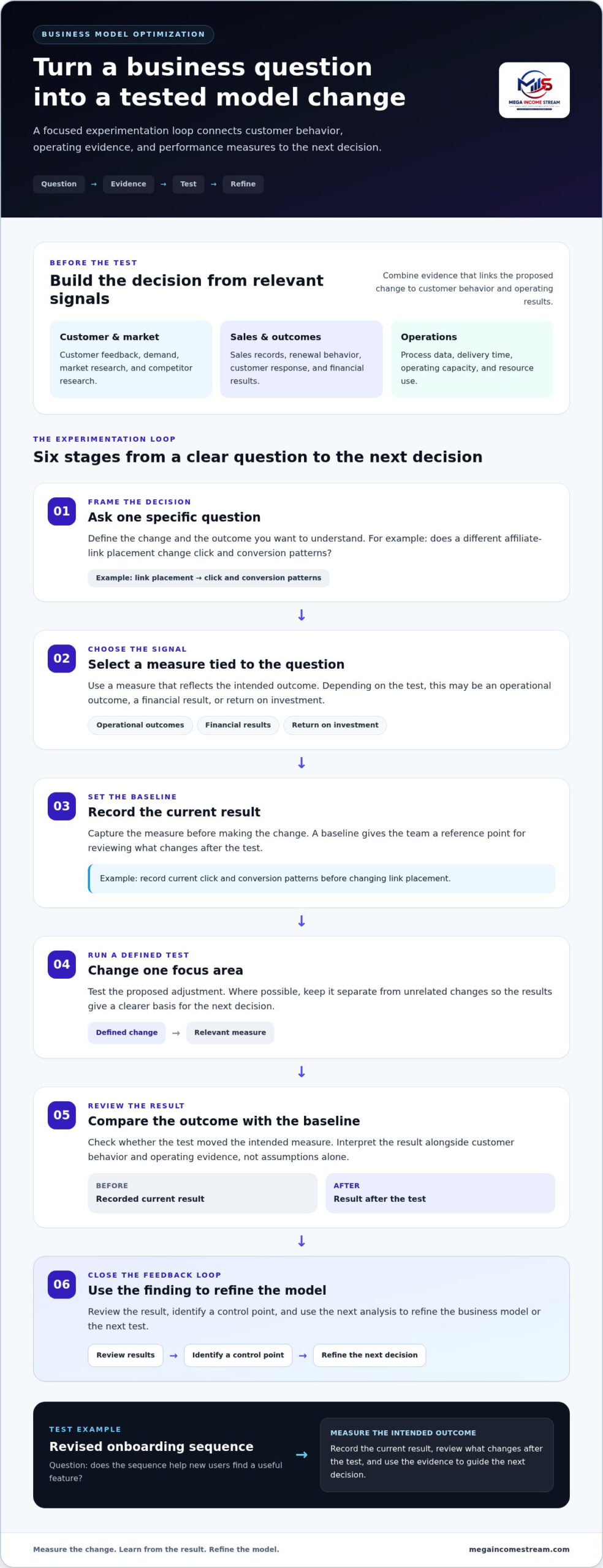
Data-driven experimentation tests a defined change and evaluates its effect using relevant performance measures. A publisher might test a different affiliate-link placement, then compare click and conversion patterns. Testing helps determine whether a proposed adjustment improves the intended outcome before the team applies it more broadly.
Start with a clear question, such as whether a revised onboarding sequence helps new users find a useful feature. Choose a measure tied to that question, record the current result, and review what changes after the test. Where possible, keep the test separate from unrelated changes so the results provide a clearer basis for the next decision.
Performance measures can include operational outcomes, financial results, and return on investment. According to the National Institute of Standards and Technology (NIST), business performance evaluation can use model-generated metrics and measures such as return on investment. A feedback loop makes those measures actionable: review results, identify a control point, and use the next analysis to refine the model.
Business optimization definition and objectives
Business optimization improves how a company’s strategy, resources, and operations support its objectives. A strategic redesign starts by defining the value the business provides and the outcomes it needs to monitor.
Business Model Definition and Value Creation
A business model describes how a company creates, delivers, and captures value, including how it earns revenue and supports long-term sustainability. Business model optimization examines how these elements interact, then adjusts practical levers to improve balance and profitability. For example, a freelance design firm could assess whether custom projects, repeatable packages, or both best fit customer needs and delivery capacity.
How strategies differ depends on industry and company size. A small affiliate publisher may refine content, offers, and commission-based revenue, while a manufacturer may review production, suppliers, and distribution. Larger organizations also need clear decision-making responsibilities across regions, products, or functions. A smaller team can often coordinate changes directly.
Optimization Objectives and Benefits
Business optimization aligns strategy and operations to improve efficiency, productivity, speed, and cost control. It matters because a business can increase activity without increasing the value it captures from that work. For example, a service firm could redesign project handoffs to reduce repeated tasks while protecting the quality customers expect.
The objective is to strengthen the business model, not simply cut spending. Teams can monitor customer response, delivery performance, and financial outcomes to see whether a change supports strategic goals. What is business model optimization? It is the ongoing process of understanding how elements of the model interact and using practical levers to restore balance and improve profitability.
Components, Tools, and Frameworks
Optimization can target the value proposition, customer experience, revenue streams, pricing, sales channels, resource allocation, or processes. These components affect one another: changing a sales channel may alter customer access, operating demands, and revenue quality. Define the target customer and offering first, then assess which components best deliver that value.
What tools and frameworks are commonly used? Teams use performance measures, customer and market analysis, forecasting, and process frameworks such as DMAIC. DMAIC means define, measure, analyze, improve, and control. Its stages help teams scope a problem, set a baseline, find causes, test improvements, and monitor whether gains last.
Costs, Returns, and Risks
Costs and expected ROI depend on the scope of the redesign, the resources required, and the financial or operational outcomes being measured. A business can compare implementation effort with expected gains, such as stronger retention, better productivity, or improved revenue quality. The National Institute of Standards and Technology (NIST) identifies ROI as one measure used in business performance evaluation.
Common pitfalls include changing several components at once, relying on untested assumptions about demand, and leaving decision-making responsibilities unclear. These choices can obscure cause and effect or lead to duplicated work. What are the key risks? A redesign may disrupt customer experience or strain delivery capacity if teams fail to test assumptions and monitor outcomes. Where practical, separate changes, assign ownership, and review results before expanding a new approach.
Operating model and cost structure alignment
An operating model connects strategy to roles, workflows, and resources. Aligning it with costs helps a company deliver value without adding avoidable friction.
Revenue Streams, Margins, and Retention
Revenue, margins, and retention indicate whether a company’s offer and delivery model work together. A subscription business can analyze cancellations, then refine its service around recurring customer needs. Exclusive content or added benefits may support retention when they strengthen the value customers receive.
To improve revenue and margins, review pricing, product availability, delivery costs, and the channels customers use. A digital publisher could compare affiliate conversions across content placements, then prioritize those that generate useful sales without unnecessary production work. Pair revenue measures with retention signals so short-term sales don’t hide customer losses.
Performance and Profitability Metrics
Performance metrics connect financial results with operational outcomes, helping leaders assess whether the model is productive and profitable. Which metrics measure business model performance and profitability? Track revenue, costs, margins, productivity, retention, and return on investment alongside service delivery outcomes. The National Institute of Standards and Technology (NIST) includes productivity and ROI among possible performance measures.
Choose measures that reflect how the business earns revenue. A fee-for-service firm can examine billable work and delivery effort, while a marketplace can assess commission revenue alongside platform usability and customer service. Compare trends over time and across relevant offerings. A single overall figure can hide a costly process or an underperforming customer segment.
Operational Process Improvement
Process improvement refines workflows to reduce waste and make output more consistent. A company can map how an order moves from purchase through fulfillment, then identify repeated approvals, delays, or handoffs. Business process management can standardize revised steps, helping teams deliver consistent service across departments.
Supply chain analytics can reveal where production, storage, or shipping could be more efficient. For example, a food business can review inventory movement to identify products that spoil before sale. Process improvements should support a business outcome, such as smoother service delivery or more productive use of resources.
Cost Structure and Resource Allocation
Cost alignment means matching spending and resource allocation to the work that creates customer value. Review asset acquisition, supply chain design, distribution, staffing, and automation as connected decisions. Before adopting automation, identify the task it will replace or support, then assess the effects on service quality and staff capacity.
Cloud-based software can reduce storage needs, while project management tools can help teams coordinate work. The right choice depends on how the organization operates, not on adopting technology for its own sake. Track operating costs and productivity afterward to determine whether the tool supports the intended business objective.
Decision Rights and Operating Friction
Clear decision-making responsibilities assign ownership for choices across teams, functions, and regions. Without them, departments may duplicate work or create conflicting processes. For example, if regional leaders hold budget and profit-and-loss responsibility, central functions need to clarify which decisions stay centralized and which belong to regional teams.
What strategies can improve revenue, margins, and customer retention? Align decision-making responsibilities with customer-facing priorities, simplify duplicated processes, and use cancellation feedback to refine subscription offers. Review how each change affects delivery and customer experience. This keeps operational efficiency connected to competitive value rather than making cost reduction the sole objective.
Business model innovation and scalability
Business model innovation involves changing how a company creates, delivers, or captures value. For example, a subscription publisher can pair recurring access with useful content and refine its offer as customer needs shift.
Choose a Model That Fits the Value
Start with the customer problem, then match the revenue model to how customers use the offer. A pay-per-use service needs accurate usage measurement and transparent pricing. A subscription model fits recurring value, while bundling combines related products or services into one offer.
Other structures involve different trade-offs. In a freemium model, a free version attracts users, while paid features provide a path to conversion. A razor-blade model generates revenue from refills or consumables after the core product is sold. Each choice affects customer access, revenue timing, and delivery requirements.
Test the Design Before Scaling
Prototype a model before committing the whole organization to a transformation. Define the target customer, offer, and purchase conditions, then assess how the model handles demand, costs, and delivery. For example, a creator considering paid membership can test whether members value exclusive content before building a larger library.
Use customer feedback and operating results to refine the prototype. A marketplace can strengthen trust with clear ratings and policies, then improve usability and customer service. A retailer can connect online and physical channels while using inventory information to keep product availability aligned with demand.
Build for Adaptation
Scalability depends on components that can expand without requiring a complete redesign. Where practical, separate the offer, pricing logic, delivery process, and partner roles. For example, a modular digital service can add a customer segment without rebuilding every workflow.
Partnerships and platforms can extend reach, share risk, or provide complementary capabilities. A small software business might use a partner’s distribution network while retaining control of its core product. Establish clear responsibilities and customer value before relying on the arrangement to support growth.
Govern Innovation as an Ongoing Capability
Innovation works best as an ongoing capability, not a one-time launch. Set guardrails for which ideas fit the strategy, who can approve tests, and how resources will support promising options. A company can assess experiments against customer response and delivery capacity before scaling them.
Market shifts can change which parts of a model work. Recombine modular offers, channels, or revenue mechanisms as customer behavior and technology evolve. A franchise model, for example, requires operating guidance and support to preserve consistency as independent operators deliver the service. Review the model regularly and expand only where the organization can maintain its value proposition.
Consulting support for business model optimization
Consulting support helps leaders examine how strategy, operations, and revenue fit together. An external perspective can reveal gaps internal teams may overlook, such as a service that attracts demand but uses too much delivery capacity.
A useful consulting engagement starts with a focused business question. Is growth constrained by customer acquisition, fulfillment, pricing, or unclear ownership? A consultant can map the current model, review financial and operational information, and identify how decisions affect results. For example, a digital agency might compare custom project workflows with repeatable service packages before changing its sales approach.
An assessment should connect recommendations to evidence. A consultant can examine customer segments, revenue sources, operating processes, and risks, then show how they interact. If a subscription offer loses customers after onboarding, the analysis might compare cancellation feedback with the steps customers take before renewal. This produces a more specific recommendation than simply proposing a new marketing campaign.
Consultants can also help leaders set priorities. A changing market may present several opportunities, but pursuing them all at once can stretch people and systems. A practical action plan ranks work by strategic value, execution difficulty, and available capabilities. For instance, a small software firm could improve customer onboarding before launching another product tier.
Change requires coordination, not just a slide deck. Consulting techniques can clarify decision-making responsibilities, assign owners, and sequence implementation across teams. A company redesigning its sales process might define which team qualifies leads, who approves exceptions, and how feedback reaches product staff. Clear responsibilities reduce duplicated work and help leaders monitor whether the new approach is working as intended.
External advisors can also challenge assumptions without replacing internal expertise. Leaders understand customer relationships and delivery constraints; consultants bring structured analysis and comparisons across functions. Together, they can assess a proposal’s implications for staffing, technology, customer experience, and financial performance before committing broader resources.
Useful consulting outcomes include a sharper strategic diagnosis, prioritized recommendations, and a plan for testing changes. The work enables leaders to connect each initiative to an intended business outcome, then review evidence before expanding it. If your next move is clarifying growth priorities, develop a focused business growth strategy around the model’s most important constraints.
Mega Income Stream: Business Strategies
Mega Income Stream helps entrepreneurs turn growth questions into practical business strategies and money-making insights. Consider this support when your revenue model, delivery process, or growth priorities need clearer direction.
For example, a freelance operator weighing packaged services against custom projects can use structured analysis to compare delivery demands and revenue potential. A digital business exploring new income streams can assess customer opportunities and the capabilities needed to serve them. The focus is on identifying workable options, not pursuing growth without an operating plan.
Mega Income Stream also offers consulting business support for leaders who want an external perspective on strategic decisions. Bring a defined challenge, such as choosing which opportunity to prioritize or clarifying how a model can scale. Contact Mega Income Stream to discuss your business strategy needs.
Turn the Next Decision Into a Growth Test
Make the next move a focused decision, not a sweeping overhaul. Identify the business constraint that most limits progress, assign someone to address it, and choose an outcome that will show whether the change is working. This gives your team a practical starting point without committing the entire operation to an untested redesign.
Then set a review point and decide what evidence would justify continuing, adjusting, or stopping the change. This discipline keeps business model optimization grounded in actual operating conditions rather than assumptions. It also helps leaders protect customer value while adapting to new opportunities.
If you’re ready to turn a growth question into a clear next step, start a conversation about your business strategy. A deliberate test can create useful evidence, sharpen priorities, and give your next decision a stronger foundation.
Frequently Asked Questions
What are the 5 steps of optimization?
The DMAIC framework has five stages: define, measure, analyze, improve, and control. Define the performance problem, such as delayed order fulfillment. Measure the current process using relevant records. Analyze where delays occur and what causes them. Improve the workflow by addressing those causes. Control the updated process by monitoring results and maintaining the revised steps. This sequence helps teams turn a specific operational issue into sustained process improvement.
What is a business model?
A business model explains how a company turns an offer into value for customers and revenue for the organization. A meal-kit company, for example, selects recipes, sources ingredients, packages deliveries, and charges customers for orders or subscriptions. Each choice shapes customer access, operational demands, and revenue. Viewing the model as a connected system helps leaders understand why changing one element, such as delivery frequency, can affect other parts of the business.
What steps are involved in optimizing a business model?
Begin by identifying a strategic constraint, such as customers abandoning the purchase process or teams struggling to fulfill complex orders. Trace where the issue appears across customer interactions, internal responsibilities, and revenue activity. Choose a change that addresses the constraint, assign an owner, and define what evidence will guide the next decision. For example, a service company could simplify its proposal process and track whether prospects move more smoothly into delivery.
How can businesses validate changes to their business model?
Validate a change by testing it with a defined customer group or operating unit before expanding it. Record the current result, introduce the change, then compare relevant outcomes such as repeat purchases, delivery effort, or customer feedback. A digital publisher could trial a new membership benefit with a limited audience and review renewal behavior alongside support requests. Keep the test focused, document unexpected effects, and use the findings to refine the offer or rollout plan.











Comments