
 By

What if the right support depends less on the title and more on who needs to own the next decision? The choice between a business strategy consultant vs business coach can feel unclear when growth stalls, operations are strained, or leadership decisions keep slipping. Choose the wrong kind of support, and you risk having thoughtful conversations without a clear path to progress.
It makes sense to want practical help, not just another perspective. A consultant typically analyzes the business and develops strategic options or a roadmap. A coach helps leaders strengthen decision-making and follow through on commitments. The distinction matters because your challenge may call for sharper strategy, stronger execution habits, or both.
This article compares how each engagement works, what you can expect to contribute, and the outputs and accountability each may involve. You’ll learn how to identify whether your main constraint is strategic, operational, or leadership-related, then choose a focused next step tied to business priorities and measurable indicators. For businesses seeking growth opportunities, refined business models, or more sustainable income streams, the goal is a clear route from diagnosis to action.
Key Takeaways
- Choose support based on who needs to own the diagnosis, decisions, and execution, not just the job title.
- The business strategy consultant vs business coach comparison can help pinpoint whether your main gap is strategic analysis or leadership capacity.
- Match the challenge to the work: structured recommendations may address growth bottlenecks, while coaching can support alignment and accountability.
- Define the decision you need to make, the outputs you expect, and how you’ll measure progress before choosing an engagement.
- Explore how tailored strategic guidance can turn revenue opportunities and business-model questions into an actionable growth roadmap.
Business Strategy Consultant vs. Business Coach: What Actually Changes?
Do you need guided leadership development, or specialized analysis that leads to strategic recommendations? The difference affects who frames the problem, who develops options, and who carries the work forward. In the business strategy consultant vs business coach decision, start with the challenge itself, not the title on someone’s profile.
A business coach guides leaders through questions and reflection so they can examine assumptions, clarify priorities, and strengthen decision-making. A strategy consultant analyzes business conditions and shapes tailored recommendations. The scope can shift these roles in practice, so define responsibilities and expected outputs before work begins.
What does a business coach typically help a leader do?
A coach may help a founder see how leadership habits affect execution. If decisions keep returning to the owner, for example, reflective questions can help identify whether the issue is unclear delegation, competing priorities, or discomfort with letting the team take ownership. The coach supports the leader’s thinking rather than automatically prescribing a business solution.
Goal-setting and accountability may also be part of coaching, depending on the engagement. A coach might help a leader turn a broad intention, such as improving team alignment, into a specific commitment and revisit progress in later sessions. This work develops individual or team capacity. It isn’t a substitute for specialist analysis of market demand, revenue streams, or operating economics.
What does a business strategy consultant typically deliver?
A consultant looks for evidence behind a business challenge. That can mean examining growth bottlenecks, identifying market opportunities, and comparing strategic choices before recommending a direction. Established management consulting practices provide useful context for this diagnostic and advisory approach.
Depending on the scope, outputs may include structured recommendations, a customized roadmap, or ongoing advisory support. A business facing stalled growth, for instance, may need to assess its business model and revenue opportunities before deciding where to focus resources. Analysis can clarify the options, but leaders still need to decide how to act and assign ownership.
A coach facilitates discovery so leaders can develop their own answers; a consultant structures business analysis to recommend strategic options. This is a useful distinction, not an absolute rule. Some coaches bring business expertise, and some consultants support leaders through implementation. The engagement agreement should spell out who analyzes, who recommends, and who executes.
Focus: A coach centers on leadership and decision-making; a consultant centers on business conditions and strategic choices.
Process: A coach may use reflection and questions; a consultant may gather evidence and structure analysis.
Client ownership: Coaching typically keeps discovery with the leader; consulting may include consultant-led diagnosis and recommendations.
Outputs: Coaching may produce clearer goals and commitments; consulting may produce recommendations and a tailored roadmap.
Suitable challenges: Coaching may fit alignment or accountability needs; consulting may fit growth bottlenecks, market opportunities, or business-model questions.
Before engaging either type of support, make the work concrete: name the decision to be made, the output you need, and who will own implementation. That clarity turns a broad search for support into a focused business choice.
How Coaching and Consulting Differ in Diagnosis, Decisions, and Execution
Support can look similar in a meeting yet differ sharply in who structures the work. To compare a business strategy consultant vs business coach in practice, trace the engagement from the first problem statement to the actions taken afterward. A coach may facilitate reflection along the way; a consultant may lead or structure analysis. The agreed scope determines the actual split.
Who owns the diagnosis and strategic recommendation?
With coaching, the leader often defines the challenge and explores it through questions: What has changed? Which assumptions are driving the current approach? What decision feels difficult? This process can reveal priorities or leadership patterns that affect results. The International Coaching Federation research offers broader context on coaching’s professional practice and organizational applications, but each engagement still needs a clear scope.
A consultant may take a more structured role in diagnosing business conditions and developing recommendations. Imagine revenue has stalled while website traffic remains steady. The constraint could involve conversion, pricing, customer retention, or the offer itself. A consultant can organize relevant evidence, compare possible causes, and present strategic options. Useful analysis depends on access to relevant information, such as sales trends, customer behavior, and current business priorities. Incomplete inputs can lead to recommendations that miss the real constraint.
Who turns decisions into execution?
Strategic direction identifies what the business should prioritize; business strategy implementation turns that choice into work. A consultant may create a roadmap or advise on sequencing, while a coach may help a leader stay focused on commitments and address habits that interfere with follow-through. Neither role automatically transfers decision rights from the business owner. Leaders decide what to adopt and assign the internal resources needed to carry it out.
Advice can inform execution, but it can’t replace the people, priorities, and follow-through required to implement a decision. Once a direction is chosen, name an owner, set milestones, and select measures that reveal progress. A roadmap is a deliverable; improved revenue, retention, or operating performance is an outcome that depends on execution and market conditions.
Use this checklist to make the working agreement concrete before an engagement begins:
- Problem definition: Who frames the question, and how will it be refined?
- Evidence: What business information will be reviewed, and who provides it?
- Options: Will the adviser facilitate exploration, develop recommendations, or do both?
- Decision rights: Which decisions remain with the leader?
- Implementation: Who owns each action, milestone, and progress measure?
Clear answers reduce the risk of receiving the wrong kind of help or mistaking a polished deliverable for completed change. If strategic analysis is the gap, explore tailored business strategy guidance to clarify growth bottlenecks, options, and next steps.
Which Is the Better Fit? Compare Business Challenges Side by Side
Which problem needs solving first: a leadership pattern that slows action, or a business constraint that’s hard to diagnose? The business strategy consultant vs business coach choice becomes clearer when you connect the challenge to the work required and define how progress will show up. Use the scenarios below as a starting point, not a fixed rulebook.
Scenario matrix: match the constraint to the work and a progress signal.
Challenge: Leaders disagree on priorities.
Likely support need: Coaching may help with leadership alignment.
Expected work: Surface assumptions, clarify shared priorities, and agree on decision-making habits.
Progress indicator: Fewer unresolved priority conflicts and clearer ownership of decisions.
Challenge: Goals are set but follow-through is inconsistent.
Likely support need: Coaching may help strengthen accountability.
Expected work: Examine barriers, refine commitments, and establish a review rhythm.
Progress indicator: Agreed actions are completed and reviewed consistently.
Challenge: Revenue has plateaued, but the cause is unclear.
Likely support need: Consulting may help diagnose growth bottlenecks.
Expected work: Assess relevant business evidence, compare possible constraints, and develop strategic options.
Progress indicator: The team can identify a priority constraint and track a relevant measure, such as conversion or retention.
Challenge: The business is weighing a new market or business-model direction.
Likely support need: Consulting may help structure the strategic choice.
Expected work: Evaluate opportunities and trade-offs, then shape recommendations or a practical roadmap.
Progress indicator: Leaders select a direction, assign an owner, and define milestones for testing it.
When might a business coach be the more useful fit?
Coaching may fit when the central constraint is how leaders communicate, set priorities, or follow through, rather than a lack of business analysis. Structured reflection can help a leader notice patterns and turn broad intentions into clearer commitments. Leadership alignment and SMART goals can be useful concepts in that work, but they aren’t guaranteed deliverables. Define what accountability should look like for your team.
When might a business strategy consultant be the more useful fit?
Consulting may fit when growth priorities compete, revenue opportunities are unclear, or leaders need to assess market choices or business-model questions. Structured analysis can turn those questions into strategic options, tailored recommendations, and a practical roadmap. If the constraint is primarily leadership behavior, coaching may help; if the business evidence or strategic direction is unclear, consulting may be the better match.
Some challenges are mixed. A business may need clearer analysis to choose a growth direction and stronger leadership alignment to carry it out. Complementary support can address both needs, but there’s no universal sequence. Determine which constraint is currently blocking the next decision or action, then scope support around that priority.
Company stage alone doesn’t settle the choice. A new venture can face a complex market decision, while an established business can be held back by leadership habits. Name the specific constraint first, then use the expected work and progress indicator to identify the support model that fits.
How to Choose a Business Strategy Consultant or Coach: A Decision Framework
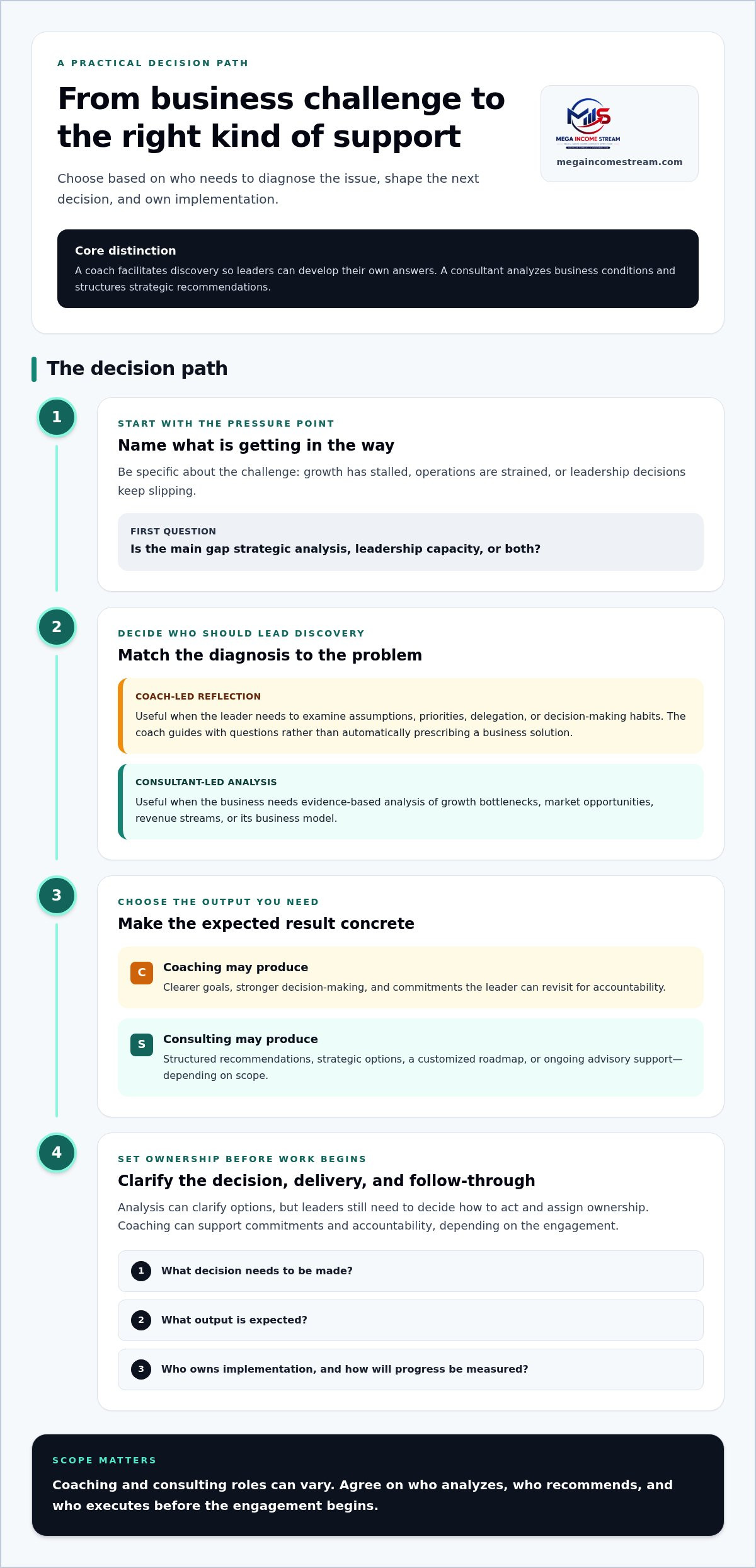
Before choosing a coach or consultant, turn “we need to grow” into a decision you need to make. Do you need to identify why sales are slowing, choose which revenue opportunity to pursue, or improve how your leadership team follows through? That distinction gives an initial conversation a working brief instead of leaving the scope open-ended.
Define the problem before choosing the professional
Start by separating the visible symptom from its possible causes. Slow sales, for example, could reflect fewer qualified opportunities, a weak conversion process, unclear positioning, or inconsistent execution. List the decision that’s currently blocked and the information that could help resolve it. Then identify your main gap: specialist expertise, leadership alignment, or consistent follow-through. The business strategy consultant vs business coach choice should follow that diagnosis.
Set scope, ownership, and measures of progress
Use these five steps to shape an engagement around a real business priority:
- Define the constraint. State the problem in specific terms, then name the decision it prevents. “Growth is slow” is broad; “we need to determine whether to improve conversion or test a different offer” gives the work a sharper focus.
- Identify the expertise gap. Decide what’s missing to move forward. If your team lacks evidence or strategic analysis, consulting may fit. If the direction is clear but leaders struggle to align or act consistently, coaching may be relevant.
- Specify the outputs. Describe what useful work should produce: an assessment of a bottleneck, strategic options, a customized roadmap, or support for leadership accountability. Separate those deliverables from hoped-for results; a roadmap alone doesn’t guarantee a financial outcome.
- Set ownership. Agree on who supplies information, who develops recommendations or facilitates reflection, who makes the final decision, and who implements it. Assign internal owners for actions, milestones, and follow-up so the plan doesn’t sit outside day-to-day operations.
- Choose measures. Record a baseline before work begins, then select indicators that show movement toward the decision. Depending on the objective, these could include qualified opportunities, completion of decision milestones, or progress on testing a revenue hypothesis.
Measures should reflect what the engagement can influence. If the work is about selecting a market direction, a completed decision and a defined test may be more useful early signals than revenue, which can depend on later execution and market response. Set a review point to examine the evidence and adjust actions without confusing activity with impact.
A clear brief makes the first discussion more productive: describe the constraint, the decision at stake, the support you need, and how you’ll recognize progress. For leaders seeking structured analysis of growth bottlenecks, market opportunities, or business-model choices, explore Mega Income Stream’s strategic consulting approach for tailored guidance and a practical roadmap.
How Mega Income Stream Turns Strategy Questions into a Growth Roadmap
When a business has several possible paths to growth, which opportunity deserves focus, and what’s keeping current performance from moving forward? Mega Income Stream provides consulting and advisory support for leaders who need structured strategic analysis and revenue guidance to make clearer choices. The work focuses on growth bottlenecks, market opportunities, business-model refinement, and sustainable income streams.
This offers a practical point of comparison in the business strategy consultant vs business coach decision. If the core need is to assess business conditions, explore strategic options, and define a roadmap, consulting can organize the challenge around evidence and priorities. The aim is not a quick-win promise. It’s a more deliberate basis for business decisions and execution.
From growth bottleneck to tailored strategic roadmap
A useful starting point is one clearly framed question: Is a growth bottleneck limiting revenue, is there a market opportunity worth pursuing, or does the business model need refinement? Relevant goals, assumptions, and available business information can then focus the analysis. The better defined the question, the easier it is to compare options against the business’s actual priorities.
Mega Income Stream provides tailored strategic guidance and advisory support. Recommendations help prioritize choices and translate them into a customized roadmap, connecting high-level direction with practical next steps. For example, a business considering additional income streams can assess how potential opportunities fit its model and longer-term plans, rather than treating each new idea as an automatic growth lever. The roadmap clarifies intended actions and priorities; results depend on implementation and market conditions.
That distinction matters. An actionable plan can clarify responsibilities and direction, but sustainable income takes more than identifying an opportunity. Leaders still need to decide what to pursue, allocate resources, and monitor whether the chosen approach is working. Strategic advice can support revenue optimization and diversification without guaranteeing a specific increase in revenue or profitability.
Make the next step specific and measurable
Before starting a conversation, identify one strategic decision or revenue constraint you want to address. Bring the goals connected to that decision, your current assumptions, and any available business metrics that help show the situation. You don’t need to have the answer already; the point is to make the question concrete enough to guide useful analysis.
- Decision: What choice is currently delayed or unclear?
- Constraint: What may be limiting growth or revenue?
- Evidence: Which business indicators or observations can inform the discussion?
- Progress: What decision, milestone, or indicator would show that the work is moving forward?
A focused starting question makes it easier to connect strategic guidance to a business priority. Explore business strategy consulting with Mega Income Stream and bring a specific growth challenge into the conversation.
Turn Your Next Business Decision into Forward Momentum
The most useful next step isn’t choosing a title; it’s choosing the business decision you’re ready to move forward. Write it down, identify what’s holding it up, and decide what evidence or perspective would help you act with greater confidence. That focus keeps the business strategy consultant vs business coach choice tied to a real priority, rather than a vague ambition to grow.
Once the need is clear, shape support around the work ahead and define how you’ll recognize progress. A focused decision can also reveal where new strategic insight may help you build more deliberately, without treating any single recommendation as a guaranteed result.
If you’re ready to clarify a growth challenge and explore a strategic path forward, explore strategic consulting with Mega Income Stream. Bring one question you want to resolve and take the next step with purpose.
Frequently Asked Questions
Can a business coach give strategic advice?
Yes, a business coach can offer strategic advice, but its depth and role depend on their expertise and the agreed scope. A coach might help an owner examine assumptions behind a proposed new offer, while detailed market or financial analysis calls for a clearly defined analytical scope. In the business strategy consultant vs business coach decision, clarify whether you need guided thinking, direct recommendations, or both, and what evidence will inform the advice.
Is business coaching only for struggling businesses?
No. A business can use coaching while performing well, especially when its leader is preparing for a major transition, entering a new phase of growth, or taking on a broader role. For example, a founder moving from handling daily decisions to leading a larger team may want support developing delegation and communication habits before bottlenecks appear. Coaching can support development and decision-making, not just a response to a crisis.
How long does it take to see results from a consultant or coach?
There’s no reliable universal timeline. Early signs of progress may include a clarified decision, a new leadership commitment, or agreement on a specific experiment. Business outcomes, such as improved sales or retention, can take longer because they depend on implementation and market response as well as the advisory work. Set review points at the outset, and distinguish progress in the work from changes in business performance.
Can a business owner work with a coach and a consultant at the same time?
Yes, provided the responsibilities are clear and the work supports the same business priorities. For instance, a consultant might assess options for changing an offer, while a coach helps the owner manage team discussions about the decision. Set a shared objective, define what information can be discussed across engagements, and keep final decisions with the appropriate business leaders. Without coordination, separate advice can create competing priorities.
How should I prepare for an initial conversation with a business consultant?
Bring a concise snapshot of the business issue: what’s happening, when it began, and what you’ve already tried. Include relevant context such as your current offer, target customer, recent sales patterns, and the decision you’re trying to make. You don’t need a polished presentation. A few reliable facts, your working assumptions, and the constraints you’re facing can make the discussion more focused and useful.
What should a business strategy consulting engagement measure?
Measure progress against the purpose of the work, using a baseline and indicators that fit the decision. A market assessment might track which key assumptions have been validated; a revenue strategy could monitor changes in sales mix, conversion by channel, or customer retention. Pair these indicators with agreed milestones, then review them consistently. No single metric captures the full picture, and results shouldn’t be treated as guaranteed.









Comments