
 By

What if the strategy isn’t failing because the goal is wrong, but because nobody knows who owns the next move? That’s the execution gap at the heart of business strategy implementation: priorities lose traction when they aren’t translated into funded initiatives, clear decisions, and measurable outcomes. A plan can look compelling on paper and still leave teams unsure what to do first, what to deprioritize, or how to tell whether the work is paying off.
Leaders know the frustration of watching promising priorities dissolve into busy calendars and disconnected team targets. The answer isn’t another layer of activity or a rigid plan that ignores changing conditions. It’s a practical system that makes ownership visible, connects everyday work to strategic outcomes, and gives leaders a regular way to adjust based on evidence.
This playbook shows you how to turn strategic choices into accountable initiatives, select useful leading indicators alongside outcome measures, and establish a manageable review cadence. You’ll also learn how to adapt priorities without losing focus, including a first-90-days structure for clarifying trade-offs, aligning resources, and tracking early progress. The result is strategy execution teams can act on and leaders can assess.
Key Takeaways
- Separate the strategic choice from the operating work required to deliver it, so teams can see what execution actually demands.
- Turn each priority into a focused initiative, then make capacity, dependencies, and stop-doing decisions visible.
- Choose a business strategy implementation framework based on the execution problem you need to solve, not its popularity.
- Use the first 90 days to mobilize work, establish a review rhythm, and learn from early evidence without treating the timeline as a guaranteed outcome.
- Use a tailored strategic roadmap and advisory perspective to clarify priorities, sequence work, and connect execution with growth opportunities.
Business strategy implementation: why good plans stall before results appear
Choosing where to compete is a strategic decision. Organizing people, time, funding, and decisions to deliver that choice is an execution challenge. A company may decide to grow a particular revenue stream, for example, but that direction won’t change results unless teams know which work advances it and what must wait.
Business strategy implementation is the process of assigning, resourcing, executing, and reviewing initiatives that put strategic choices into practice. It connects high-level direction to operational decisions: who leads each initiative, which teams contribute, what capacity is available, and how progress will be assessed. Foundational strategy implementation principles also emphasize aligning organizational structures and processes with the strategy.
What does business strategy implementation mean?
Strategy sets intent; implementation turns intent into coordinated work. If growth is a priority, leaders might define an initiative to improve customer retention, assign one accountable owner, and agree on the teams, resources, and evidence needed to manage it. The owner doesn’t have to complete every task personally, but must move decisions forward and surface barriers. That link between choice and ownership makes the strategy actionable.
Why do strategic plans lose momentum?
Plans often stall when leaders treat every promising idea as a current priority. Teams then split their attention across new initiatives, routine operations, and urgent requests, leaving too little capacity to move any one priority forward at a useful pace. Without explicit trade-offs, employees are left to guess which work should come first.
Ownership can be just as blurry. A cross-functional initiative may involve sales, operations, and finance, but if no one is accountable for resolving handoffs, each team can complete its own tasks while the overall decision remains stuck. Add measures that track activity but not progress toward the intended result, and leaders may see a full calendar without knowing whether the strategy is gaining traction.
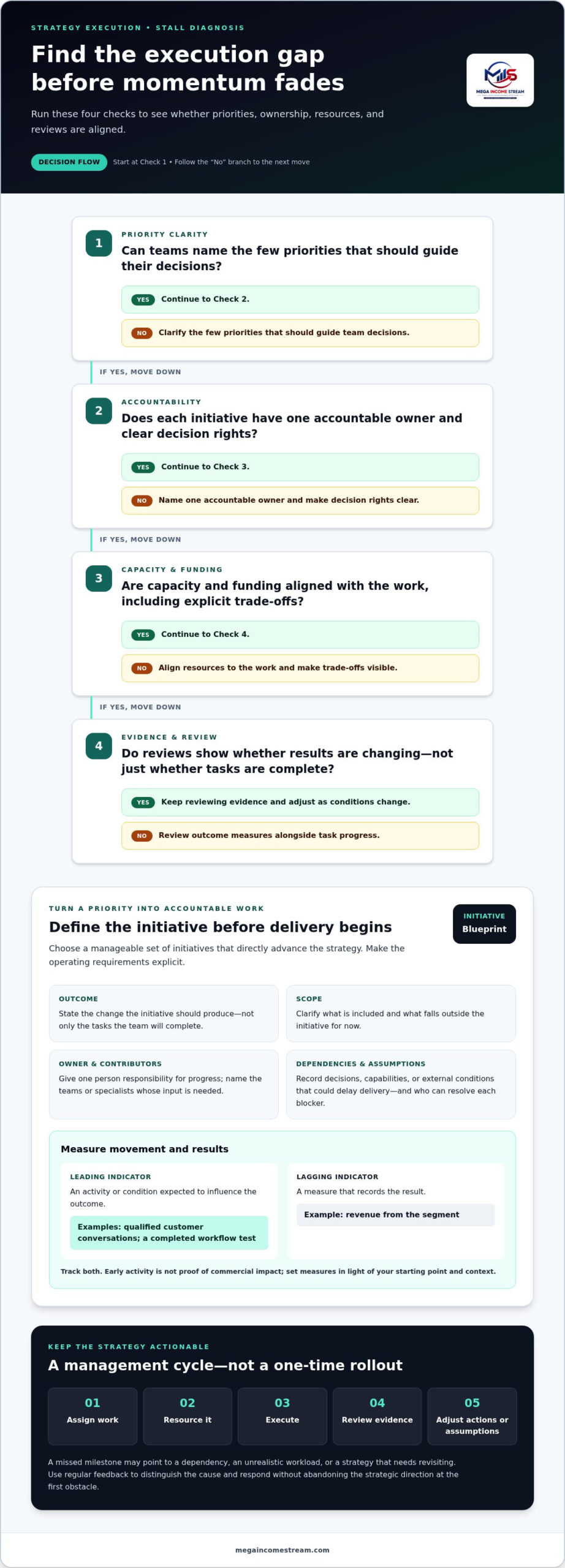
Execution gaps grow when accountability is unclear and resources stay committed to work that no longer supports the chosen priorities. To diagnose a stall, ask:
- Can teams name the few priorities that should guide their decisions?
- Does each initiative have one accountable owner and clear decision rights?
- Are capacity and funding aligned with the work, including explicit trade-offs?
- Do reviews reveal whether results are changing, not just whether tasks are complete?
Implementation isn’t a one-time rollout that ends when a plan is announced. It’s a management cycle: assign work, resource it, execute, review evidence, then adjust actions or assumptions as conditions change. A missed milestone may point to a dependency, an unrealistic workload, or a strategy that needs revisiting. Regular feedback helps leaders distinguish those causes and respond without abandoning the strategic direction at the first obstacle.
Turn strategic priorities into accountable work, resources, and decisions
A strategic priority becomes executable only when it changes what people will work on, what resources they can use, and who can make decisions. For business strategy implementation, the goal isn’t to turn every ambition into a project. It’s to select a manageable set of initiatives that directly advance the strategy, then make their operating requirements explicit.
Convert each priority into a defined initiative
Start with the result the priority is meant to create, then define the initiative’s scope and boundaries. For example, if a business aims to grow through a new customer segment, its initiative might test demand in that segment before committing to a broader launch. Name one accountable owner, identify contributors, and set a time horizon that fits the work.
- Outcome: State the change the initiative should produce, not just the tasks the team will complete.
- Scope: Clarify what’s included and what falls outside the initiative for now.
- Owner and contributors: Give one person responsibility for progress, while naming the teams or specialists whose input is needed.
- Dependencies and assumptions: Record decisions, capabilities, or external conditions that could delay delivery, and identify who can resolve each blocker.
Next, establish a baseline and choose indicators that show whether the work is moving in the right direction. A leading indicator reflects an activity or condition expected to influence the outcome, such as qualified customer conversations or a completed workflow test. A lagging indicator records the result, such as revenue from the segment. Track both, but don’t mistake early activity for proof of commercial impact or impose universal targets without considering your starting point and context.
This connection between strategic intent and operating choices is central to the strategy implementation process. Measures should help leaders make decisions: continue, adjust scope, remove a blocker, or stop work that no longer supports the priority.
Match ownership with real capacity
Before assigning a delivery date, compare the initiative’s demands with actual team capacity. Look beyond headcount: consider specialist skills, budget, existing commitments, decision delays, and dependencies on other teams. A plan that allocates the same people to several top-priority initiatives hasn’t resolved a resource conflict. It has hidden one.
Make trade-offs visible. If a team takes on the new customer-segment test, decide which existing work will pause, shrink, or move later. Then document decision rights: which choices the initiative owner can make, which require agreement from contributing teams, and which must be escalated to leadership. Clear boundaries reduce handoff delays without sending every small choice up the chain.
Ownership without capacity is a name on a plan, not a credible execution commitment. Review initiative demands together, resolve competing claims, and adjust scope before teams are held accountable for delivery. Tailored strategic roadmap guidance can help connect execution commitments with growth opportunities.
Choose the right strategy implementation framework for the problem
Which tool should you use: an alignment model, a goal-setting method, or a role-clarity matrix? Start with the execution problem, not the framework’s profile. A diagnostic framework helps reveal why the organization may be misaligned; an accountability mechanism helps teams coordinate and monitor chosen work. Neither makes the strategic choices for leaders. Frameworks structure discussion and expose gaps, but leaders still need to decide what matters, what gets resources, and what changes.
Use the simplest method that addresses the bottleneck. For example, OKRs can connect objectives to measurable results in fast-moving environments, while the 4 Disciplines of Execution can help teams focus on a vital goal alongside routine operations. A Balanced Scorecard can organize enterprise-level measures across financial, customer, internal-process, and learning-and-growth perspectives. Hoshin Kanri supports policy deployment through dialogue between leadership and operational teams. These methods solve different problems; adopting all of them at once can create parallel meetings and scorecards instead of better execution.
When is McKinsey 7S useful for implementation?
McKinsey 7S is an alignment lens for examining how strategy, structure, systems, shared values, skills, style, and staff fit together. Use it when execution problems may stem from organizational misalignment, such as a growth direction that depends on capabilities teams don’t have or systems that reinforce old priorities. The review helps locate friction; it doesn’t rank initiatives or allocate resources. Complete that leadership work separately.
How do OKRs and responsibility matrices differ?
OKRs express an objective and the measurable results that would indicate progress, without prescribing one target that suits every organization. A responsibility matrix, such as RACI, clarifies who is responsible, accountable, consulted, or informed across shared work. Use OKRs when teams lack outcome focus; use a responsibility matrix when handoffs or decision roles are unclear. Choose based on evidence of the gap, not habit.
Before introducing a framework, state the symptom in plain language: “Teams don’t agree on the result,” “decisions stall between departments,” or “our structure blocks the chosen direction.” Then select one primary mechanism to address it. If the problem is misalignment, diagnose connected organizational elements first. If the direction is clear but progress is hard to track, define objectives and results. If ownership across functions is contested, map roles and escalation paths.
Keep the system lean. A framework should reduce ambiguity or improve decisions, not add reporting for its own sake. If a new tool duplicates an existing review, combines measures that serve different purposes, or asks teams to maintain data leaders never use, remove or simplify it. In business strategy implementation, the useful framework is the one that makes a real constraint visible and helps people act on it. Review whether it’s improving decisions, then adapt or retire it as the execution need changes.
A practical business strategy implementation playbook for the first 90 days
Use the first 90 days to build an execution rhythm, not to promise a fixed result. Divide the period into mobilization, focused execution, and evidence-led review. Each phase should produce a leadership decision, a team action, and a checkpoint that shows what has changed or needs attention. Adapt the pace to your business and existing operating cycle.
- Days 1 to 30, mobilize. Confirm the strategic choices and translate them into a focused set of initiatives with clear scope, accountable owners, and realistic capacity assumptions. Leaders decide what takes priority and what work must pause; teams validate dependencies and surface risks. At the checkpoint, confirm that owners understand their remit, teams know how to raise concerns, and baseline measures are recorded.
- Days 31 to 60, execute and unblock. Start the agreed work, resolve cross-team dependencies, and check whether people, skills, and budget match the commitments. Leaders decide which barriers require escalation or a resource trade-off; teams report progress against early indicators. At the checkpoint, review whether the work is moving as expected and whether assumptions still hold.
- Days 61 to 90, review and adapt. Compare emerging evidence with the baseline and intended outcomes. Leaders decide whether to continue, adjust, resequence, or stop initiatives; teams document what they’ve learned and the next actions. At the checkpoint, record decisions and owners, then use the findings to set the next execution cycle.
What should leaders do in the first 30 days?
Mobilization is also a communication test. Explain what’s changing, what remains stable, and how employees can flag execution risks. Set the initial review cadence, clarify who makes which decisions, and capture baseline measures before activity ramps up. The aim isn’t to remove every uncertainty; it’s to ensure teams can act while leaders see emerging constraints early.
Keep the dashboard compact enough to use in a decision meeting. For each initiative, show status, one or two leading indicators, relevant outcome measures, key risks or dependencies, and decisions needed. Include an owner and next checkpoint. A red or delayed status should prompt a discussion about cause and response, not a longer explanation of completed tasks. Choose measures that fit the initiative rather than imposing universal targets.
How should implementation reviews change the plan?
Review evidence, capacity, dependencies, and risk together. Continue when progress and assumptions remain credible; adjust when evidence points to a correctable issue; resequence when a dependency or capacity constraint changes timing; stop when the initiative no longer supports the strategy or its core assumption has failed. Record each decision, its owner, and a follow-up date so the review produces action.
For leaders shaping a practical execution roadmap, tailored strategy consulting can help connect priorities, ownership, and growth opportunities.
Sustain business strategy implementation with focused advisory support
A sound execution system still needs to respond when customer demand shifts, assumptions weaken, or internal capacity tightens. The aim isn’t to revise the strategy every time conditions change. It’s to use evidence from implementation reviews to distinguish temporary friction from a real change in the opportunity, then adjust the roadmap without losing sight of the business’s direction.
Keep the focus by returning to a few practical questions: Are the priorities still relevant? Are initiatives producing evidence that supports their assumptions? Do owners have the capacity and authority to move the work forward? What new opportunity or risk deserves leadership attention? Consistent answers help leaders adapt choices deliberately, rather than allowing urgent requests to quietly crowd out strategic work.
When can an external strategy adviser add leverage?
Outside strategic support can be useful when internal leaders are too close to competing priorities, initiatives have stalled without a clear diagnosis, or the next growth opportunity is difficult to assess. An adviser can bring structure to the analysis, help compare options, and shape a roadmap that clarifies sequencing, ownership, and key assumptions. The purpose is to strengthen leadership decisions, not replace them.
Before adding support, assess the constraint. Is the challenge a lack of alignment on what matters, limited capacity to evaluate choices, or difficulty turning a decision into coordinated work? If leaders already agree on priorities and have the time and capability to execute, adding another layer of review may create process without leverage. If the gap is strategic clarity or coordination, focused advisory can help the team move from discussion to a workable plan.
Mega Income Stream provides business strategy consulting and advisory support, including customized strategic roadmaps and guidance tailored to growth opportunities and sustainable income streams. That outside perspective can help leaders identify bottlenecks, clarify trade-offs, and connect execution priorities with potential sources of growth, without treating any outcome as guaranteed.
Connect execution discipline to sustainable growth
Reviews can reveal more than delivery issues. A change in customer response may challenge an assumption behind an initiative, while recurring capacity constraints can expose a business-model bottleneck. Leaders can use those signals to revisit the roadmap, test an emerging opportunity, or redirect effort toward work with stronger strategic fit. Make changes based on evidence and explicit choices, not momentum alone.
Over time, this discipline helps keep priorities connected to the conditions the business actually faces. A tailored roadmap can support that process by showing what to pursue, what to sequence, and which assumptions need continued attention. Strategic business guidance can connect strategic choices with execution and growth opportunities.
Build momentum around your next strategic choice
The next phase of business strategy implementation isn’t about adding more initiatives. It’s about making the next important choice executable: identifying what needs to change, what evidence would support that move, and where leadership attention can create the most leverage. Treat each review as a chance to sharpen your direction, not just report on work already underway.
If competing priorities or unclear growth options are making that choice harder, an outside perspective can help bring the decision into focus. Mega Income Stream’s tailored roadmaps and advisory support help businesses examine growth bottlenecks, assess revenue opportunities, and shape a practical path forward, without assuming that one plan fits every organization.
Choose a next step your team can own, then build from what you learn. Explore strategic business guidance to consider how focused support could fit your priorities. With clear choices and steady attention, your strategy can keep moving as the business evolves.
Frequently Asked Questions
What is the difference between strategy formulation and strategy implementation?
Strategy formulation chooses the direction; implementation organizes the decisions and work needed to pursue it. For example, formulation might identify a new customer segment as a growth opportunity. Implementation determines whether to test demand, which team will lead the test, and what evidence would justify further investment. The distinction matters because a sound choice can still be poorly executed, while efficient execution can’t rescue a strategy based on the wrong opportunity.
Why do business strategies fail during implementation?
Strategies can falter when plans rely on assumptions that aren’t tested, incentives reward conflicting behaviors, or teams don’t understand why a change matters to their work. For instance, a sales team focused only on closing volume may resist a strategy that prioritizes customer retention if performance measures stay unchanged. Look beyond missed deadlines: examine whether incentives, skills, communication, and customer evidence support the intended direction.
How do you measure whether a business strategy is being implemented?
Measure whether the work is progressing and whether it is contributing to the intended business outcome. In business strategy implementation, connect each initiative to a result, then select a small set of indicators with reliable data sources. For a retention initiative, monitor completion of customer interviews alongside renewal patterns. Compare results with a baseline, and note outside factors that may affect performance before attributing a change to the initiative.
Can a company change its strategy while implementation is underway?
Yes, a company can change direction during implementation when new evidence materially weakens the original assumptions or changes the opportunity. Separate a strategic pivot, which changes where or how the business competes, from an execution adjustment, such as changing a test sequence. Before pivoting, document what evidence changed, which commitments are affected, and what teams should stop or continue. Communicate the rationale so revised priorities don’t look arbitrary.
Who should be responsible for implementing a business strategy?
Senior leaders are responsible for setting direction and making enterprise-level trade-offs, while initiative owners are responsible for coordinating delivery within their remit. Functional managers translate those commitments into team plans, and contributors flag constraints early. For example, an executive sponsor can resolve a dispute over shared capacity while the initiative owner manages day-to-day coordination. Responsibility is shared, but decision authority should be clear at each level.
How often should leaders review strategy implementation?
Set review frequency according to how quickly the business, initiative, and underlying assumptions can change. A team testing a fast-moving customer offer may need frequent operational checks, while a longer capability-building effort may benefit from less frequent milestone reviews. Keep separate spaces for quick blocker resolution and broader strategic decisions. If a review produces no decisions, risk signals, or learning, reconsider its timing or agenda.
What happens if employees resist a new business strategy?
Resistance is a signal to investigate, not simply an obstacle to suppress. Employees may see customer impacts, workload conflicts, or capability gaps that leaders haven’t considered. Explain what is changing and why, invite specific concerns, then distinguish practical risks from discomfort with unfamiliar work. If a new process is involved, run a limited test, gather feedback, and adjust guidance or training before expecting broad adoption.











Comments