
 By

Yes, Backend as a Service (BaaS) systems can be secure because major providers include strong built-in security features such as data encryption, access control, and compliance certifications. However, the total security of a BaaS implementation is strongly reliant on how developers setup and use these capabilities.
How BaaS Providers Ensure Security
BaaS providers, such as Firebase and AWS Amplify, handle much of the underlying infrastructure security, which includes:
- Data Encryption: Data is typically encrypted both in transit (using protocols like SSL/TLS when moving between the client and server) and at rest (when stored in databases and file storage, often using algorithms like AES). This ensures that even if unauthorized access to the physical storage occurs, the data remains unreadable without the decryption key.
- Authentication and User Management: BaaS platforms offer pre-built, strong authentication services, supporting features like multi-factor authentication (MFA), OAuth, and role-based access control (RBAC).
- Secure APIs: Communication between the client and the backend happens via secure APIs. Providers implement measures such as API keys, tokens (like JWT), rate limiting, and input validation to prevent common attacks and unauthorized access.
- Compliance: Many providers ensure their services comply with various international data privacy regulations such as GDPR and HIPAA, which is essential for applications dealing with sensitive user data.
- Automated Backups and Monitoring: Regular, encrypted data backups are standard practice to ensure data integrity and disaster recovery. Providers also offer real-time monitoring and logging tools to detect suspicious activity.
The Role of the Developer: Shared Responsibility
While the provider manages the security of the core platform, the developer is responsible for the secure implementation within the application’s business logic. Common security pitfalls arise from developer-side misconfigurations, such as:
- Misconfigured Access Controls: Failing to set granular access permissions for different user roles can lead to unauthorized users accessing sensitive data.
- Poor Authentication Practices: Relying only on basic default app authentication methods (e.g., just an app ID and secret key) without implementing user-specific authentication can create vulnerabilities.
- Human Error: Simple misconfigurations in cloud storage settings have led to data leaks in the past (e.g., a past Firebase incident with an Android app leak).
- Lack of Proactive Measures: Not utilizing all available security features or failing to regularly update application components introduces risks.
BaaS is a secure option when security best practices are followed. It offloads a significant security burden from developers, allowing them to focus on core app features, but still requires careful configuration and a multi-layered security approach to ensure full data protection.
Backend security is the protection against potential cyberthreats and unauthorized access to a system’s server-side components, which include databases, applications, and servers. Prioritizing backend security is critical for protecting sensitive data and preventing cyberattacks that could jeopardize a system’s integrity.
Putting robust security measures in place can help businesses safeguard their reputation and operations by ensuring that their backend systems are discreet, available, and secure.
With that in mind, let’s look at some backend security themes to learn more about the common threats and how to secure your backend from cyber assaults.
BaaS Security
When we compare software to a car, the front-end components are the ones we engage with directly: the steering wheel, the gas and brake pedals, and the multimedia system. The engine, transmission, and suspension, on the other hand, are the underlying backend components; we rarely see them, yet they keep everything running.
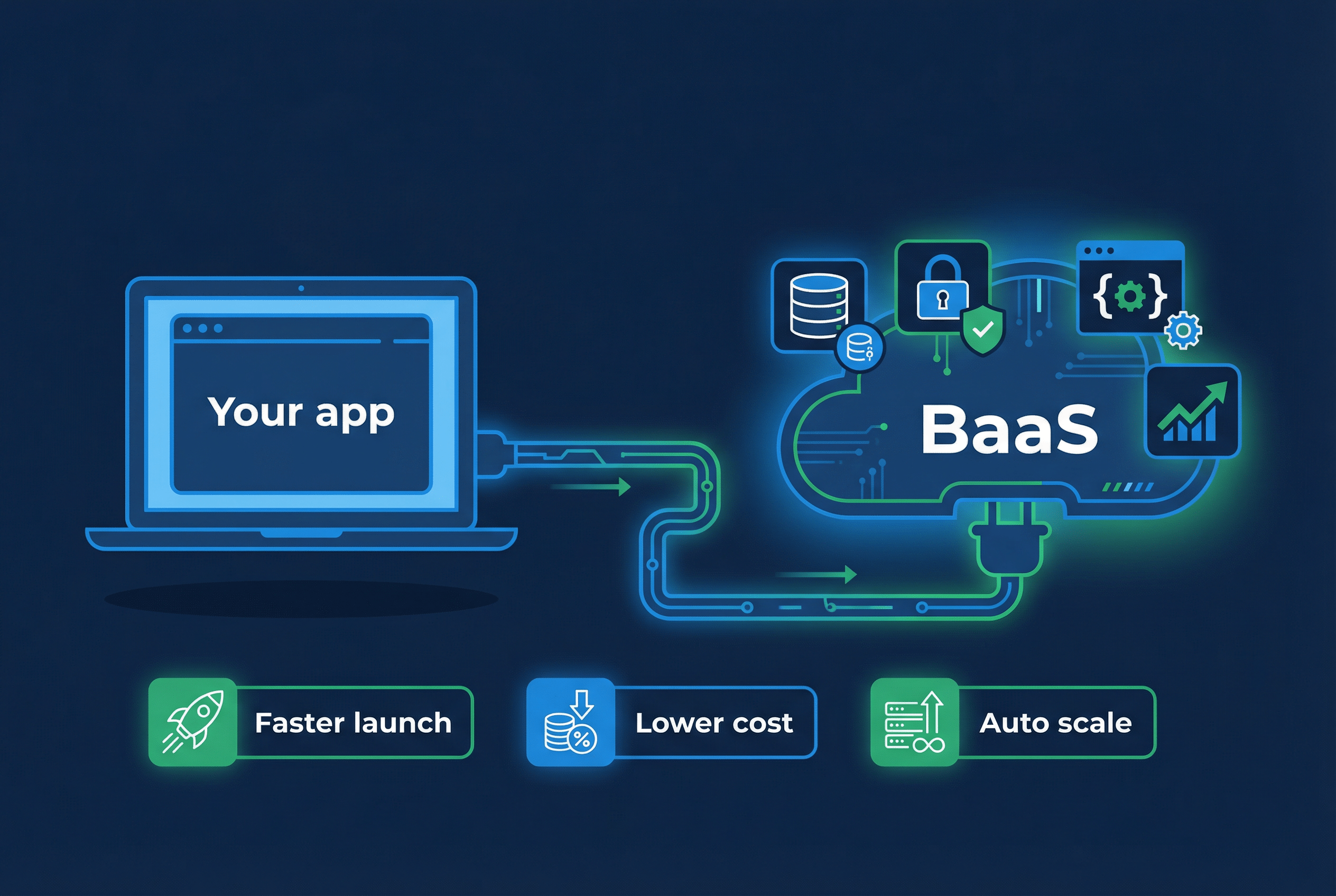
Backend-as-a-Service (BaaS), not to be confused with Backup-as-a-Service or Blockchain-as-a-Service, is a cloud-based solution for backend operations. Developers can focus their efforts on the frontend by using SDKs (Software Development Kits) for feature deployment and APIs (Application Programming Interfaces) for program communication.
In reality, this means you can use the resources saved by using Backend-as-a-service to enhance user experience, business logic, and design. It’s as if someone has already put together most of the car’s internal parts for you.
These are some of the backend features that BaaS takes care of:
- Databases and file storage
- Authentication and access management
- APIs (Application Programming Interfaces)
- Infrastructure (physical servers software runs on, network scalability, etc.)
- Notifications (email, push, etc.)
- Social media integration
In short, using a BaaS platform is an excellent way to outsource the maintenance of the server infrastructure and automate the development of backend services. To enjoy these perks, you can either choose a pre-configured solution from a cloud service provider or go with a custom-built BaaS platform. The important thing to remember is: client authentication and data security are handled at the BaaS level, so choose wisely.
BaaS Architecture
Knowing the principles a typical BaaS platform is built on will help you understand the strengths and weaknesses of its security protocols. Just the basic principles, we promise to not go in too deep.
The three layers of BaaS
Most Backend-as-a-Service solutions comprise three distinctive layers:
- Foundation layer. This layer contains your databases and files. It’s a cluster of servers the system uses to store, retrieve, and backup your data. Depending on your provider and your scalability needs, the machines may run an SQL or a NoSQL database.
- Application layer. At this level, software processes requests (for instance, user authentication) and communicates with the data layer. It’s done via API calls and is based on the integrated business logic. The choice of the tech stack here is much broader and may include programming languages like Java, Python, Pearl, and more.
- Connection layer. This layer provides your servers with a secure connection to the internet. For optimal operation, it also includes load balancers.
If you’ve already done some reading on the subject, you might have come across the term “tier” used alongside “layer”. Note that these are not identical in meaning. The notion of layers pertains to functional differences, while tiers represent separate parts of the infrastructure that host those layers.
Running databases and APIs on different server clusters (tiers) is recommended both for security and flexibility reasons. Most options from major BaaS vendors, as well as custom-made solutions, are built in accordance with this principle.
Speaking of vendors, there’s a growing number of BaaS providers on the market, which reflects the high demand for the model. AWS Amplify, Google Firebase, Microsoft Azure, and Parse (now owned by Facebook) are currently some of the best-known names in the industry. Each of them has implemented their own practices and follows a set of standards to ensure security at every level, from authentication to data and file storage.
Read Also: BaaS for Mobile Apps: Native vs Cross-Platform Considerations
But be sure to always study the provider’s offer in advance, as you might end up in vendor lock-in, with important safety features missing in the chosen package.
And let’s not forget how much of any software’s functionality revolves around data. Your proprietary and customer data are valuable commodities and should be kept safe at all times. How’s BaaS doing in that regard? Let’s find out.
BaaS data and file storage practices
Developers achieve security of data and files in Backend-as-a-Service systems thanks to:
- Data encryption. Be it a custom solution or a provider’s product, BaaS-based systems always use encryption protocols. Data is encrypted in transit between servers, as well as in storage — both in the API and database tiers.
- Automatic backup. Standard practice for cloud-based services, data is backed up regularly and mirrored on several servers, often in different physical locations.
- File access policies. Customizable access rights are hardwired into the very fabric of BaaS. With careful implementation, precise permissions can be set at the API level, as well as for different users.
Even though the BaaS model uses multi-tier architecture and has solid file and data security practices, it may still be vulnerable to attacks. More on this — in the next section.
Main BaaS Security Concerns
As with most software, customer data safety is the number one priority for BaaS-based systems. From our experience, BaaS security threats are mostly explained by suboptimal authentication practices and poorly implemented user/customer roles. This can result in data breaches by malicious agents, as well as users getting access to information that was not intended for their eyes.
Remember, once you integrate compromised backend services into your software, it will automatically inherit those security flaws. Another source of problems is too trivial: human error. Even the mighty Google isn’t immune to this: the infamous Android app leak occurred due to a misconfiguration in Firebase.
Let’s see what possible BaaS security issues there are and how they can present themselves in different situations.
Authentication
When developers employ ready BaaS solutions, they mostly rely on built-in security tools. After all, not having to reinvent the wheel is the reason to use those pre-manufactured blocks of code. The fact is, not everyone reads instructions on implementing security features that BaaS providers supply with their products. So customers often receive products with basic authentication methods.
Here’s the culprit: when a user requests data, many BaaS systems will only require identification from the app that makes the API call. That is not the only security feature available, but the one many developers use by default. The app authenticates by providing its ID and a secret key as proof that it has the right to use that ID. If someone has sufficient expertise to get hold of those two identifiers and create an impostor app, they can gain access to the database. Since most apps store keys in their binaries, the chances of this happening are much higher than we might think.
To avoid this problem, developers should use additional methods of authenticating the user who initiates the request. When the user’s identity is linked to that of the app making the API call, it becomes nearly impossible to fake.
However, other issues may arise when multiple users require access to the same data in different ways.
Granular access
Oftentimes, an app’s business logic requires differentiated access to data, depending on who’s asking. For instance, managerial staff has to be able to change certain fields, while other employees only need to view that information. Moreover, some data may need to be distributed on a strict need-to-know basis.
Even though BaaS security settings are quite flexible, it can be a real headache for developers. It’s easy to get lost in multiple user access permissions and configurations, especially with pressing deadlines. Keep in mind, BaaS solutions are often advertised as a magic wand that will speed up delivery and help cut costs (which they do). Naturally, engineers may succumb to taking a shortcut here and there, using default user roles and simpler hierarchies.
The result? Unauthorized access to sensitive information and possible exploits by third parties, leading to reputational and financial losses.
To prevent this from happening, we can recommend taking two simple precautions:
- Set app and user privileges with more precision
- Never use the same channels for user and administrative access
There’s another concern we need to mention. Rather than being a functional flaw, this one is about obeying the law.
Compliance with data privacy regulations
When it comes to private data, regulatory compliance requirements are strict, especially if you’re in the healthcare business. Not all ready-made BaaS solutions are HIPAA-compliant, although most are designed in accordance with GDPR. Make sure to check this before settling for a BaaS provider — or request compliance with specific standards from the vendor that’s building your custom product.
Failure to implement a data protection privacy policy for BaaS that’s required in your domain may lead to fines and lawsuits.
These are all the BaaS security threats we could think of. In all fairness, our experience with BaaS has been overwhelmingly positive, and the possible security shortcomings are minor compared to the benefits.
Why BaaS is a Secure Option for Backend
If we dig a little deeper, it turns out there are many upsides of using Backend-as-a-Service for end-user security, as well as for protecting your proprietary data. The model lends itself well to tying those loose safety ends, and it’s more about developers taking the time to unleash its full potential.
Here are the essential security mechanisms a properly designed Baas solution will have.
Multi-tier security
The BaaS security hierarchy may seem complex at first, but it’s also very effective. The idea is that security is enforced at multiple levels by defining access permissions for different users and roles. Moreover, you can set specific rules at every tier of the platform. Provided you’ve teamed up with a software vendor experienced in BaaS.
BaaS API security
In a properly set up BaaS, API calls are linked to the IDs of both the app and the user. This prevents unauthorized access to the app’s functions and data. Besides that, you can assign API permissions for every role. This makes invoking API requests virtually impossible for users without the appropriate rights.
BaaS files security
Similar permissions can be defined at the file access level. Allow or restrict reading, altering, or deleting files for each user role. You can do so globally or specify files or folders.
BaaS owner policies
Another useful security feature of BaaS that rests upon its sophisticated user hierarchy. When it comes to managing data for modern web applications, different parts of a program may request access to the same fields in data tables. Owner policies prevent apps from accessing data that they did not create.
In addition to the points listed above, software developers should adhere to common security principles such as:
- Isolate databases
- Set up anti-malware software
- Perform regular security updates
As you can probably see by now, BaaS security and privacy features are diverse and highly customizable. Let’s do a quick summary, and we’ll be on our way to building more BaaS projects.
5 Common Backend Security Risks
Given how quickly attackers evolve, backend security might be eternally hazardous. However, certain attacks are more common than others. The Security Trails blog describes several common backend security issues; nevertheless, these five are more likely to occur.
Risk 1: Data Injection
Injection attacks can be used against the backend of your web application in the same way that they can impact the front end.
Attackers can construct queries on the backend of your online application, and if you don’t have any protections in place to identify where the query came from, they can execute instructions directly on your backend that would otherwise be screened and halted by the frontend. One effective way to prevent data injection attacks is to safeguard your backend so that it cannot receive input from unauthorised sources.
Risk 2: Lack of authentication security
Multiple services with authentication requirements make up web application backends.
Logins are necessary for database and console/OS level access, because all of these services function at the operating system level. As a result, maintaining robust authentication security is critical; otherwise, any vulnerability that infiltrates the system may compromise the entire operating system. For example, using HTTP authentication in development areas, limiting logins to specific people or IP addresses, and implementing automated brute force detection systems (which instantly prohibit offending IP addresses) are all highly beneficial to the web server.
Risk 3: Misconfigurations in Access Control-Related
Access control levels (ACLs) are a feature of online applications that is frequently overlooked. ACLs define which portions of a backend a client or team member may access. Errors in this domain may grant clients or coworkers access to secret portions of your web application.
In many other cases, ACL misconfigurations can lead to targeted assaults in which compromised team members’ workstations are utilized to obtain access to confidential areas of your web application. When managing the security of your online application, it’s vital to ensure that both your customers and team members have the necessary permissions.
Risk 4: Misconfigurations in Software
The front end of your website depends on its back end to handle user input processing and heavy lifting.
Therefore, if there are any backend configuration errors, the user may be presented with sensitive information. For instance, when configuring software, error messages and error handling in general are commonly disregarded. These error messages occasionally include sensitive information, such as variable names and data paths, which can direct attackers to these files and variables.
It is strongly advised that you set up the software that manages and runs your backend, such as your webserver, coding language, or run-time handler like PHP, so that it does not display sensitive error messages to the user.
The risk of DoS attacks is another misconfiguration hazard.
These attacks aim to deplete system resources by exploiting software that is misconfigured and lacks resource limitations. The web application may behave oddly after the system’s resources are depleted, with the base operating system terminating any process that it sees fitting. This might result in the web server crashing while the database is still active or the database crashing while the web server is still running. Customers and end users would both have a bad experience in either case.
Risk 5: Outdated Software or System Components
Any web application requires multiple software components to function, with web servers, databases, and other software helping to improve performance.
The security of every single application needs to be taken into account with all these pieces of software in use. For instance, if your web server is weak, it may expose sensitive areas of your web application by accepting user input. This could make your entire web application weak.
Having any out-of-date or end-of-life software component on the public internet is exceedingly dangerous. This is especially relevant now that users can use tools such as Shodan to search for servers running specific software versions. If you are using out-of-date or end-of-life software, this can make you and your web application a simple target.
How to Secure Your Backend from Cyber Attacks
Protecting sensitive data and maintaining the continuity of your business operations depend on the security of your backend against cyberattacks. Regular security audits can reduce the possibility of cyberattacks. Moreover, multi-factor authentication and encryption can be used to further improve the security of your backend system.
Aside from that, here are some necessary steps to improve backend security:
- Data Injection Prevention: Ensure that your backend applications don’t accept or process inputs from unauthorised and unverified sources. This can help block requests from unverified sources.
- Access Control: Regularly examine your Access Control Levels (ACLs) to ensure that all parties using your web applications have the right level of access. Misconfigurations in your ACLs could cause unauthorized access to your system.
- Use HTTPS: Implement HTTPS instead of HTTP to encrypt the data transmitted between the client and server. Also, implement secure headers, such as HTTP Strict Transport Security (HSTS), to enforce the use of HTTPS.
- Data Encryption: Encrypt all data at rest and use secure getaways or SSL for data in transit. Limit access to only legitimate users by enforcing key-based encryption.
- Multi-Factor Authentication (MFA): MFA allows the system to ensure that there is no identity theft involved. It adds an extra layer of security by requiring multiple forms of verification.
- Automate Data Backups: Regular data backups can help recover information in case of a data breach.
- SSL Certificate: Get an SSL certificate for your website to establish a secure connection between a web server and a browser.
- Professional Help: Consider hiring professionals to monitor your website’s security.
Finally
BaaS solutions, in our opinion, do an excellent job of ensuring data security while remaining completely scalable. Adding a team of competent software engineers to the mix also allows you to check the “functionality” box.
The goal is to avoid complacency when integrating BaaS code into the customer’s solution. It is the developer’s obligation to fully utilize the solution’s security mechanisms, including additional features as needed.







Comments