
 By

GDPR and BaaS require developers to build privacy-by-design into apps, focusing on data minimization (collecting only necessary data), securing it (encryption, access control), obtaining explicit user consent, and enabling data subject rights (access, erasure, portability) through features, all while understanding your BaaS provider’s role in data management. Developers must incorporate clear consent, strong security (encryption), data lifecycle management (retention/deletion), and user request workflows to ensure that the entire data flow, including third-party services, adheres to GDPR’s high criteria for lawful, transparent data processing.
Key GDPR Principles for Developers
- Lawfulness, Fairness, Transparency:
- Clear Consent: Get explicit, informed opt-in consent before collecting data.
- Inform Users: Clearly explain what data, why, how long, and who has access.
- Data Minimization:
- Collect only the minimum personal data necessary for the specific function.
- Avoid collecting non-essential data (e.g., phone number for a simple service).
- Purpose Limitation:
- Define clear, specific, legitimate reasons for data collection.
- Accuracy:
- Implement validation and allow users to easily update/correct their data.
- Storage Limitation:
- Establish retention policies and automate deletion of old data.
- Integrity & Confidentiality (Security):
- Encrypt data at rest (storage) and in transit (HTTPS).
- Use strong access controls (RBAC) and audit logging.
- Accountability:
- Document everything, maintain logs, and be prepared to prove compliance.
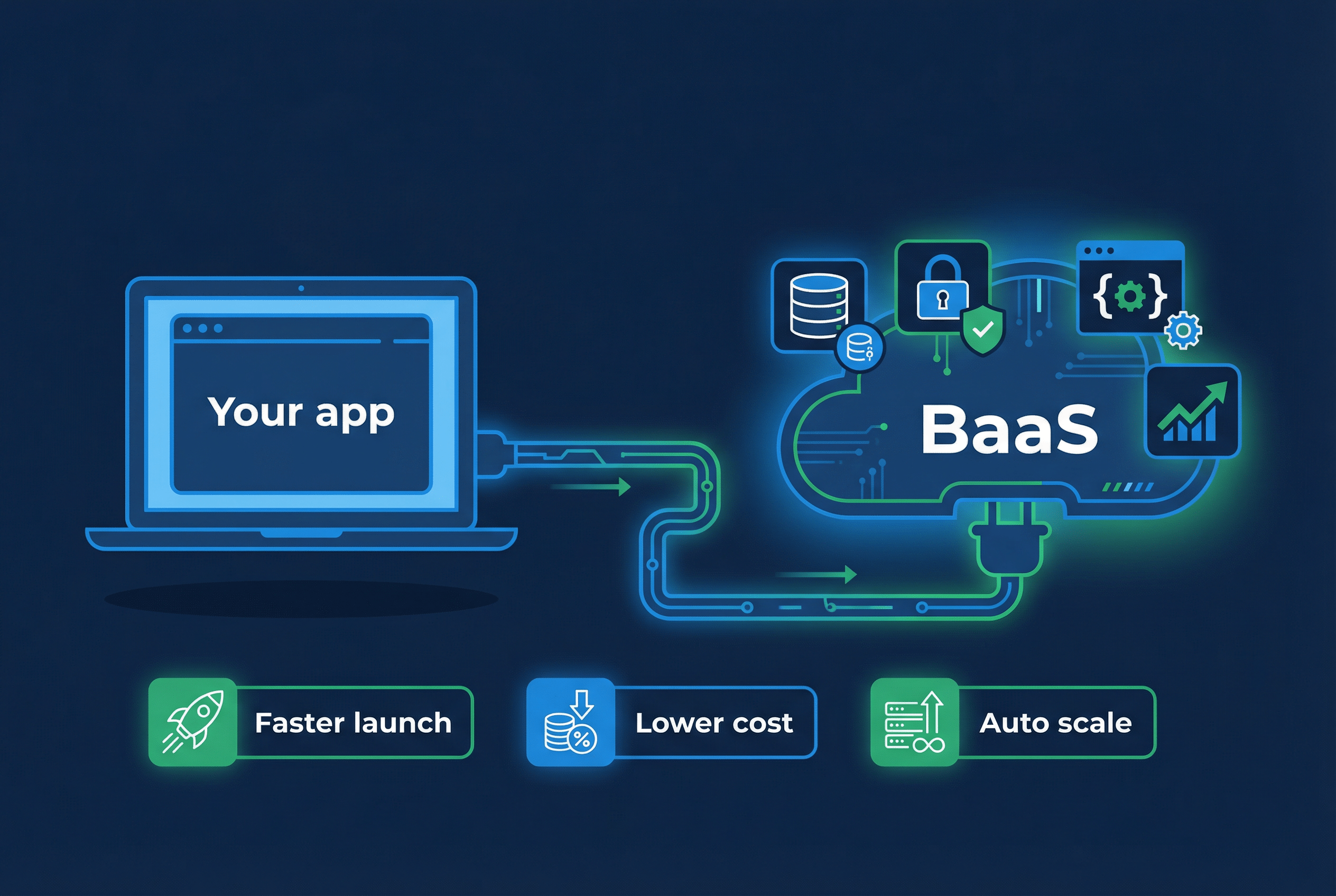
Integrating with Backend-as-a-Service (BaaS)
- Understand Your Provider: Know what data your BaaS (like Firebase, AWS Amplify) collects, where it’s stored, and their security measures.
- Contractual Obligations: Ensure contracts (DPAs) with your BaaS vendor meet GDPR requirements.
- Data Flow Mapping: Trace personal data from your app through the BaaS to any other third parties.
- Coordinate Requests: Be ready to coordinate with your BaaS provider to fulfill user requests (access, deletion).
Developer Actions
- Privacy by Design: Make privacy the default setting, not an optional add-on.
- Build Data Subject Rights (DSR) Features: Develop mechanisms for users to:
- Request, access, rectify, and export their data (Data Portability).
- Delete their account and data (Right to Erasure).
- Audit & Test: Regularly review your app and BaaS usage for compliance gaps.
By embedding these principles from the start, developers build trusted, compliant applications, leveraging BaaS while upholding user privacy rights.
GDPR compliance is more than just a legal requirement; it is an essential component of ethical software development and corporate credibility. With increased public awareness of digital privacy, organizations are under strong pressure to handle personal data with precision, accountability, and transparency. While compliance strategies are frequently handled by legal and data governance teams, developers play a critical role in integrating privacy into the fundamental DNA of digital goods.
As a software development firm, ensuring that your developer teams are in line with increasing data privacy standards is more than simply a compliance issue; it is also a competitive benefit. Understanding GDPR is critical for developers who want to build secure, future-ready applications that prioritize user trust.
Developer’s Guide to GDPR Regulations
For software professionals, GDPR means that a few things that used to be “nice-to-haves” are now requirements.
- You must get explicit consent to collect data. If you’re collecting data on people, you have to explicitly ask for it. You have to specify exactly what information you’re collecting, the reason you’re collecting it, how long you plan on storing it, and what you plan to do with it. (You can thank the latter for the proliferation of all those cookie banners a few years ago.) Furthermore, you must give your users the right to say no. You can’t just leverage a full-screen non-dismissible modal that doesn’t allow them to continue without accepting it.
- You can only collect data for legitimate purposes. Just because someone’s willing to give you data doesn’t mean you’re allowed to take it. One of the biggest headaches I got into with regard to GDPR was when a client wanted to gate some white papers behind an email signup. I explained multiple times that you can’t require an email address for a good or service unless the email address was required to provide said good or service. No matter how many times the client insisted that he had seen someone else doing the same thing, I was unable to build the illegal interaction.
- Users have the right to ask for the data you have stored, and to have it deleted. Users can ask to see what data you have stored on them, and you’re required to provide it (including, again, why you have that data stored). And, unless it’s being used for legitimate processing purposes, you have to delete that data if the user requests it (the “right to be forgotten”).
And all of this applies to any organization or company that provides a good or service to any person in the EU. Not just paid, either – it explicitly says that you do not have to charge money to be covered under the GDPR. So if your organization has an app in the App Store that can be downloaded in Ireland, Italy, France, or other EU country, it, and likely a lot more of your company’s services, falls under GDPR.
Read Also: Is BaaS Secure? A Look at Data Protection and Encryption
How Is GDPR Enforced?
In terms of enforcement, corporations can face fines of up to €20 million or 4% of their annual global turnover from the previous fiscal year, whichever is higher. Amazon Europe was fined €746 million for alleged “[manipulation of] customers for commercial means by choosing what advertising and information they receive[d]” through the use of personal data. Meta has been fined a quarter of a billion euros several times.
But this isn’t only affecting major corporations. A translation firm was fined €20,000 for “excessive video surveillance of employees” (a fine that would be unthinkable in the United States if there were no cameras in a private area such as a bathroom), and a retailer in Belgium was fined €10,000 for forcing users to submit an ID card to create a loyalty account (even though that information was not required).
Conclusion
Data compliance is vital, and the punitive features of GDPR enforcement need your team to have a robust compliance strategy.
The most crucial aspect of dealing with any regulatory issue is understanding what is required for your organization. Yes, you are gathering emails, but to what end? If the data is required for your business to function, you’ve met your basic criteria.
Matching those to the necessary legislation will provide you a starting point from which to design the processes, procedures, and apps that will help your firm succeed. Do not use “that’s how we’ve always done it” or “we’ve seen other people do x” as a company strategy.
The regulatory environment is continuously changing, and it is critical to stay current while also understanding which data and services are critical to your company’s performance. Keeping up with current standards can help you not only avoid lawsuits, but will also demonstrate to your companies that you are a trustworthy and reliable partner.









Comments