
 By

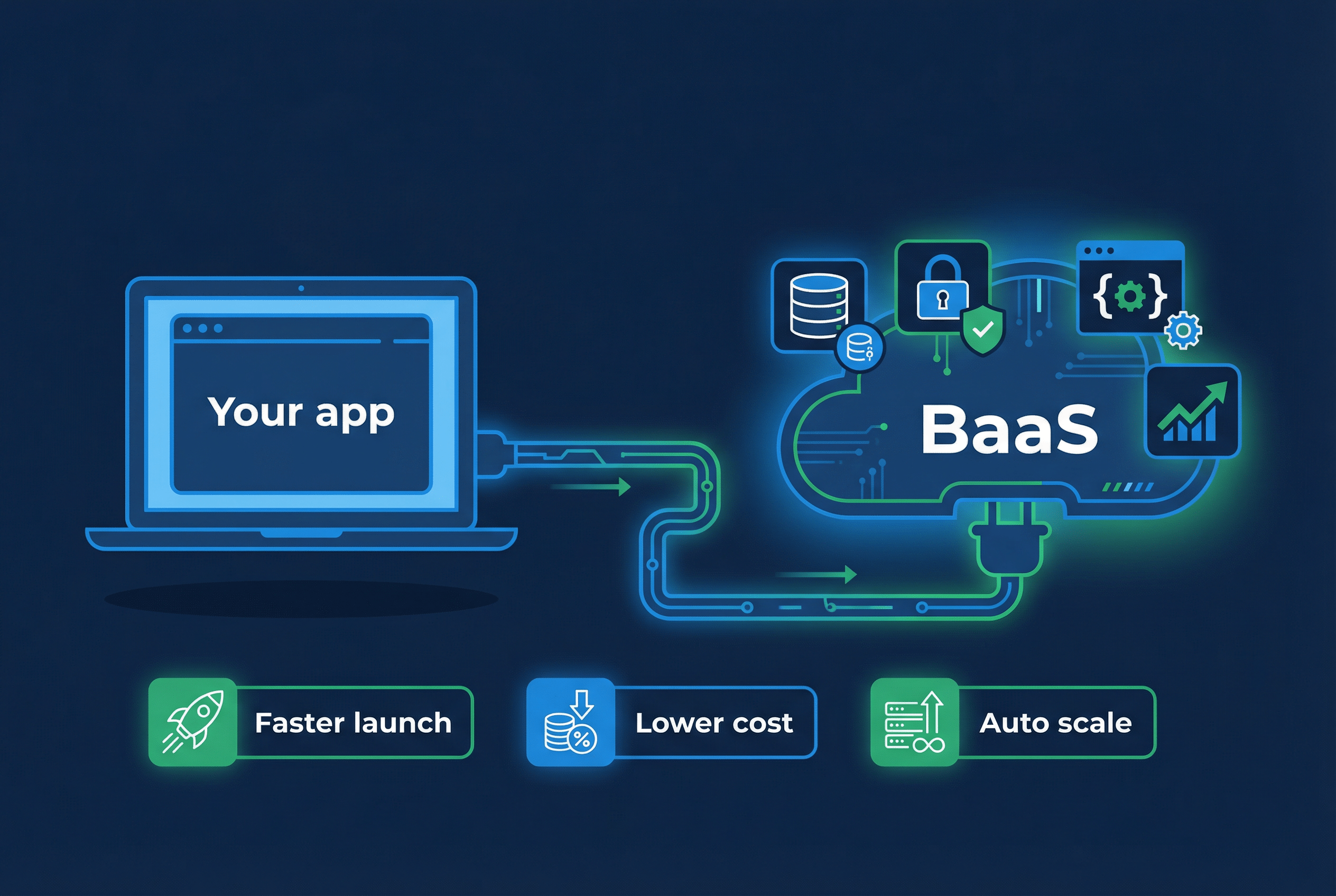
Because Backend as a Service (BaaS) offers pre-built, maintained backend infrastructure, developers can avoid months of “boilerplate” code and server setup, greatly accelerating time-to-market for SaaS companies.
Core Impacts on Time-to-Market
- Reduced Development Lifecycle: BaaS can reduce app development time by an estimated 50%. Traditional backend development typically takes about 10 weeks, whereas BaaS allows core functionalities to be set up in hours.
- Rapid MVP Launch: Startups can launch a Minimum Viable Product (MVP) in days or weeks instead of months, enabling faster market validation and user feedback loops.
- Elimination of Infrastructure Setup: Developers avoid weeks spent on server provisioning, database configuration, and setting up DevOps pipelines.
- Focus on Frontend/UX: Teams can shift 100% of their focus to unique user-centric features and business logic, rather than managing complex infrastructure.
Time-Saving Features
BaaS platforms provide ready-to-use modules that would otherwise require manual development:
- Authentication: Out-of-the-box user management, including email/social logins and role-based access.
- Database & Storage: Fully managed, auto-scaling databases and cloud file storage.
- Serverless Functions: Integration of custom business logic without managing underlying server resources.
- Built-in Security: Compliance (GDPR, HIPAA) and security patches are handled by the provider, removing these time-intensive tasks from the internal team.
Comparison: BaaS vs. Custom Backend
| Criterion | Backend as a Service (BaaS) | Custom Backend |
|---|---|---|
| Setup Time | Minutes to hours | Days to weeks |
| Time to Market | Days to weeks (for MVP) | Weeks to months |
| Team Size | Small (Frontend-only possible) | Larger (Requires Backend/DevOps) |
| Scaling | Automatic/One-click | Manual/Complex |
While BaaS accelerates the initial launch, it may introduce long-term trade-offs such as vendor lock-in and limited customization for highly complex business logic.
These resources highlight how Backend as a Service (BaaS) streamlines development and reduces time-to-market for SaaS applications.
In the early days of a startup, speed isn’t just an advantage but a sound survival strategy. Investors, those early users, and even your own team expect visible progress fast. But without a strong backend team in place, many technical founders find themselves stuck: frontend prototypes are ready, but nothing connects behind the scenes.
From experience, this is the moment where a delayed backend becomes the bottleneck. You’re not blocked by product vision — you’re blocked by infrastructure. And building that infrastructure from scratch means weeks of hiring, configurations, and iteration before users even see a login screen.
“Founders often over-engineer the backend before they even have product-market fit. What matters early on is getting something usable in front of real users — even if it’s duct-taped with Firebase.” — Artem Arkhipov, Web Expert at TechMagic
A well-chosen BaaS solution can bridge this gap. It won’t be perfect, but perfection isn’t the point. Validation is. That means logins that work, data that saves, and push notifications that fire. All within weeks, not quarters.
What Is Backend-as-a-Service (BaaS)
Backend-as-a-Service (BaaS) is a pre-built backend you can plug your app into. With no need for infrastructure setup, no DevOps pipeline, and no need to reinvent login, database rules, or notifications from scratch. You get out-of-the-box building blocks like authentication, real-time data sync, file storage, serverless functions, and push messaging.
Read Also: Cost Comparison: BaaS vs Custom Backend Development
It’s not a new idea. Firebase has been around for a decade. But what’s changed is how mature and flexible these platforms have become. Today’s BaaS isn’t just for hobby projects, and companies are raising seed rounds on top of them.
“Modern BaaS platforms like Supabase and Appwrite give you 80% of what most MVPs need — with far more transparency and control than older black-box services.” — Egor Romanov, Former CTO, startup advisor
Compared to a traditional backend, you don’t start from zero. There’s no need to write custom API endpoints for CRUD operations, or figure out how to handle JWT tokens securely. The backend is already waiting — you just wire it to your frontend.
But it’s important to remember: BaaS is not one size fits all. It accelerates your launch, but you still need to understand its limits, especially as your product grows.
When to Use BaaS and When Not To
BaaS shines when speed matters more than flexibility. If you’re building an MVP, testing a new market, or trying to prove traction before raising a round, then it’s a shortcut worth taking. You can stand up an app blazing fast, and skip hiring a backend team in the early stage.
It’s also great for hackathons, pilot launches, or tools with narrow use cases.
But there’s a ceiling.
BaaS platforms start to become a bottleneck when your product needs:
- Complex data relationships beyond basic joins.
- Heavy traffic or multi-region performance tuning.
- Deep integrations with external systems.
- Custom auth flows or granular access controls.
“BaaS is great for zero-to-one, but we’ve seen too many teams cling to it past the point of usefulness. When your devs start fighting the platform instead of shipping features, that’s your cue to move on.” — Andrew Romanyuk, Co-Founder & SVP of Growth at Pynest
Signs you’ve outgrown BaaS include:
- Workarounds piling up in your logic layer.
- Latency issues from rigid database structures.
- Limitations when syncing data across systems.
- Security rules that require bending platform defaults.
If you find yourself writing more glue code than product code, it’s time to rethink your stack.
BaaS Architecture Pitfalls: Vendor Lock-In, Complexity, and Debugging
BaaS is convenient, but convenience often comes at the cost of control. When you’re tied to a specific provider, migrating later can be painful. Schema migrations, auth flows, cloud functions — they’re all built the “platform way,” which rarely translates cleanly to your own stack.
Debugging is another weak spot. Serverless functions can be hard to trace in production, logs may lack depth, and many BaaS tools don’t support local replication out of the box.
“The biggest risk with BaaS is not technical debt — it’s strategic debt. You move faster now, but you might pay for it with reduced agility later. We always advise startups to build an ‘exit strategy’ from day one.” — Tim Potter, Principal at Deloitte Consulting
Common pitfalls to watch for:
- Custom business logic buried in vendor-specific cloud functions
- Non-portable authentication or permissions logic
- Limited visibility into background jobs or real-time listeners
- Difficulty implementing advanced monitoring or tracing
BaaS should help you ship fast — not lock you in. Plan your escape route early, even if you don’t expect to use it soon.
Final Thought
BaaS is a powerful shortcut — but shortcuts have trade-offs. Used wisely, they save money. Used carelessly, they delay real growth. Your job isn’t to avoid BaaS or to build everything from scratch. It’s to choose the right tools for where you are right now, and be ready to evolve when you grow.






Comments