
 By
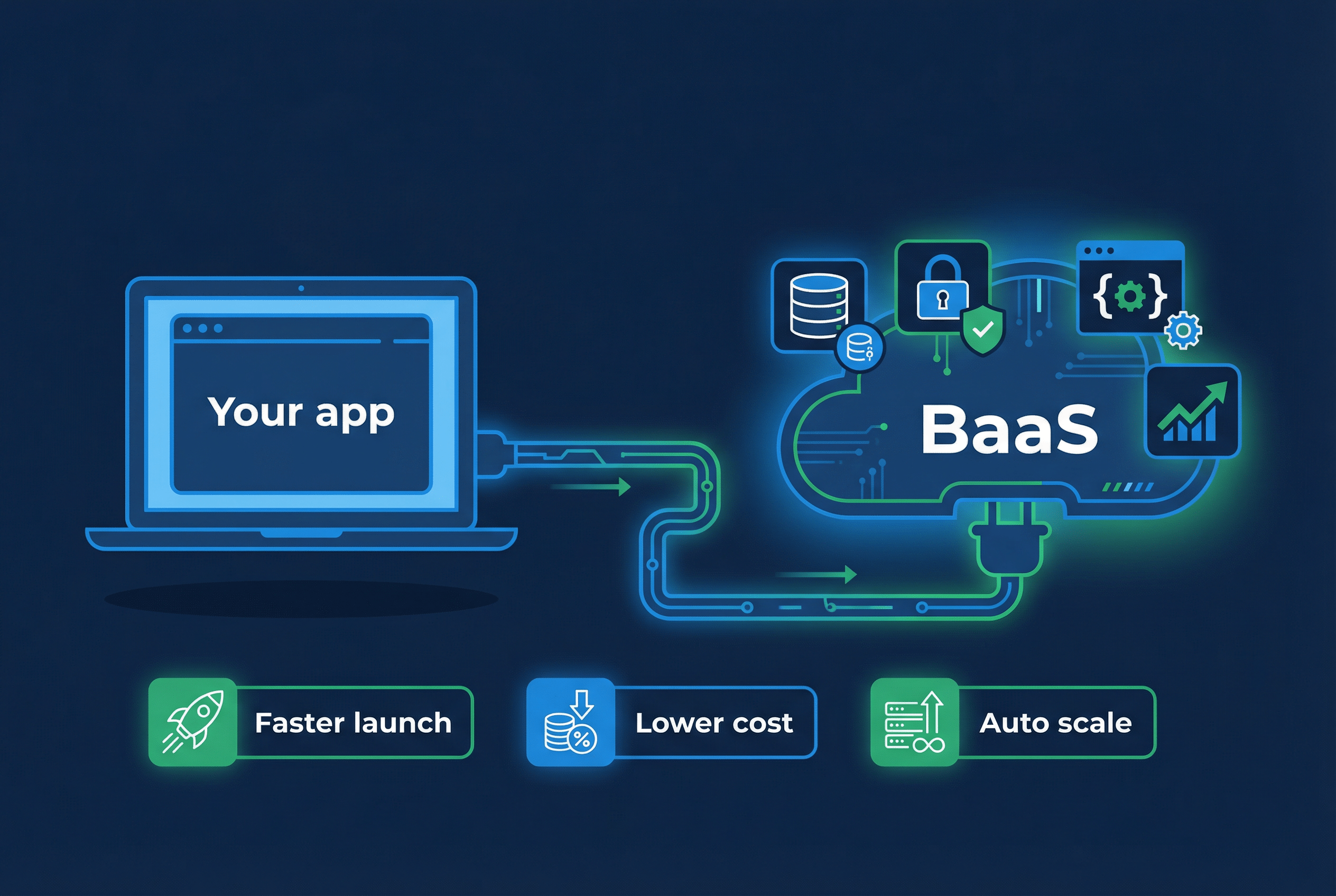
Backend-as-a-Service (BaaS) scalability is perfect for MVPs and early growth since it enables quick development and low upfront expenditures. But when companies grow, they frequently encounter constraints in terms of performance, adaptability, and cost effectiveness. The choice to migrate (self-hosted or custom backend) or upgrade (higher tier) depends on weighing operating costs against the requirement for complete control.
When to Upgrade (Staying with BaaS)
Upgrading to a higher-tier BaaS plan is suitable when the current provider supports your growth path but you need more resources.
- Sudden Spikes in Traffic: Upgrading provides immediate, scalable resources to handle increased users without manual intervention.
- Predictable Growth: When your business is scaling rapidly, but the costs of API requests and data transfer (variable costs) are still lower than the expense of hiring a dedicated DevOps team.
- Need for Enhanced Support: High-tier plans offer better SLAs (Service Level Agreements) and prioritized support to maintain uptime.
- Feature Gaps in Low-Tier: When you need advanced, but standardized, features like enhanced security, automated backups, or more sophisticated database capabilities.
When to Migrate (Moving to Custom/Self-Hosted)
Migration is necessary when the convenience of BaaS is outweighed by its limitations, or when the business model evolves beyond the provider’s capabilities.
- Cost Explosion: As transaction volumes and user bases grow, BaaS pricing can become prohibitive because costs increase linearly without economies of scale.
- Need for Complex Business Logic: If your application requires highly customized logic that goes beyond basic CRUD operations (e.g., specialized financial algorithms), you will likely outgrow standard BaaS offerings.
- Vendor Lock-in and Autonomy: If you need to avoid the risk of a provider shutting down or changing terms (e.g., the Parse case), migrating to a self-hosted platform gives you ownership and independence.
- Data Privacy and Regulatory Compliance: For businesses in heavily regulated industries, moving to a custom backend allows for complete control over data residency and compliance, bypassing limitations of the shared BaaS environment.
- Performance Bottlenecks: When you reach the API rate limits or query limitations, causing performance drops that cannot be solved by a higher tier.
Summary Checklist for Decision Making
| Factor | Upgrade BaaS | Migrate to Custom Backend |
|---|---|---|
| Costs | Low/Moderate upfront, high variable costs | High upfront, lower, predictable operational costs |
| Flexibility | Limited to provider’s ecosystem | Total control over technology stack |
| Team Size | Small/Non-existent backend team | Requires in-house DevOps/Backend engineers |
| Speed to Market | Very Fast | Slower (requires building infrastructure) |
| Key Risk | Vendor dependency, rising costs | Maintenance, technical debt |
Start with BaaS for rapid market entry (MVP). Plan a migration when your business model is proven and the cost or feature limitations of BaaS begin to hinder growth, usually during the transition from a startup to a scale-up.
The back end of an app or website can seem like an endless list of things to do. Before you even consider the things that people genuinely care about, there are servers to configure, databases to set up, and security protocols to put in place. A alternate strategy is provided by Backend as a Service (also called BaaS or back end as a service), where you connect to services that do the hard lifting rather than creating everything from scratch.
How BaaS Platforms Actually Work
When you work with backend as a service providers, you’re essentially plugging into pre-built infrastructure. You can picture it as moving into a fully furnished apartment instead of buying and assembling all the furniture yourself. The platform takes care of things like data storage, user authentication, and server management, so you can focus on creating the features that make your application unique.
Most BaaS platforms offer some of the same core capabilities. You usually get:
- Database management with automatic synchronization across devices
- User authentication systems that support everything from basic email logins to social media accounts
- File storage for images and documents
- APIs that let your front end communicate with the back end smoothly.
Some platforms also include push notifications, analytics, and even the ability to run custom server-side code when you need something more specific.
Why Teams Choose BaaS
What draws teams to use BaaS is mainly speed. When you use Firebase backend as a service or similar platforms, you can launch a working prototype in days instead of weeks. You don’t need to hire specialists for every aspect of infrastructure nor have to become an expert in server configuration, database optimization, or security protocols yourself.
Read Also: How BaaS Impacts Time-to-Market for SaaS Products
Real-time features are another major advantage. If you’re creating something like a collaboration tool, a chat app, or a live dashboard where multiple users need instant updates, BaaS platforms take care of the tricky part of keeping everyone in sync. When one user makes a change, everyone else sees it immediately without needing to refresh manually or deal with complex coding.
Security gets a lot easier too. The platform takes care of authentication, manages user permissions, keeps your data encrypted, and ensures it’s always up to date with the latest security patches. Rather than stressing over every possible vulnerability, you can trust providers who focus on maintaining system security.
And when your application takes off and you suddenly have thousands of users instead of just dozens, you won’t have to panic about upgrading servers or rewriting database queries. BaaS platforms scale on their own, handling the surge in traffic and data without needing you to manually adjust the infrastructure or stay up all night watching performance.
The Practical Reality of BaaS
Of course, backend as a service / BaaS isn’t a perfect solution for every situation. These platforms work best when your needs match what they offer out of the box. If you need very specific custom functionality or have unique performance requirements, you might eventually need a more tailored solution.
The cost structure is something else to think about. Most BaaS providers bill you based on how much you use, so your costs will increase as your user base grows. For startups and MVPs, this is often a budget-friendly option compared to running your own infrastructure. However, as you grow, it’s a good idea to check if the convenience is still worth the price regularly.
There’s also the matter of platform dependence. When you build on a BaaS platform, switching to a different provider or moving to a custom back end later requires a lot of work. This isn’t necessarily a dealbreaker, but it’s something to think about if you’re building something with a long-term vision in mind.
Making the Choice
Opting for backend as a service isn’t really about it being “better” than traditional development in a general way. It’s more about what fits your particular needs. If you’re looking to get things up and running fast, have typical back-end needs, and want to focus your energy on features that set your product apart, BaaS can be very effective. However, if you have specific performance needs, unique functionalities, or worries about being tied to a vendor long-term, you might want to explore other options or at least think about future migration plans.
The key is understanding what you’re optimizing for. Are you trying to validate an idea as quickly as possible? Build a minimum viable product to show investors? Launch a side project without a full development team? Or are you building something that will become a core part of your business for years to come? Your answer to these questions should guide your decision.
What are the Pros of BaaS?
With your backend taken care of, BaaS sounds like a dream for developers. But what are the other advantages of BaaS?
1. Faster development time
As your BaaS provider manages your infrastructure, all developers need to worry about is developing their code for frontend use. This can massively speed up coding time and general processes, as developers won’t need to worry about any of the backend provisionings for their coding environment. It’s essentially a plug-and-play solution for devs!
2. Can be a cost-effective solution
If you have development resources but can’t afford an IaaS solution, then BaaS may be the next best thing, particularly if you have a tight budget. Provisioning a private cloud or an IaaS and PaaS solution can be costly, as they require far more technical expertise to provision. However, with a backend as a service solution, you cut the worry for this expenditure entirely.
3. Simplifies dev time
With a BaaS solution, developers don’t need to worry themselves with server-side coding, meaning they can focus on the languages they do know to code solutions for clients. This makes BaaS a great solution for those who wish to focus purely on coding in an environment with relevant APIs at their disposal.
4. Scalability
Scaling is incredibly important so that your application can handle numerous requests and users. Essentially, when your demands and business grows – so should your BaaS (and any cloud solution you opt for). A good BaaS solution will show you complete transparency on performance data from your apps to help you pinpoint why your application might be lagging, and may even prompt you to scale up to accommodate further resources.
5. Patches are taken care of
Fortunately, a Backend as a Service provider will handle almost all patches, including those for security, bug fixes and the like. These can be set to update automatically, meaning you don’t have to worry about manually checking for updates yourself.
However, we always recommend checking up on any managed service solution just to ensure you’ve crossed your Ts and dotted your Is, as a simple patch update can make a huge difference in data protection, the smooth-running of your cloud service and much more.
What are the Cons of BaaS as a Cloud Service Model?
Whilst it’s true that BaaS solutions can bring plenty of benefits for some dev teams, they’re not always the best choice for every development project. Here’s why:
1. Coding limits
Backend as a Service, while offering faster dev time, can come with its own suite of features that may not be able to be tailored to business-specific requirements. This can be a huge disadvantage, especially if the BaaS’s features can’t be customised. Plus, depending on your allocated monthly billing resources, you may only have a limited number of API requests and serverless functions you can run, or a limited amount of data storage.
2. Vendor lock-in
As with most public cloud solutions, choosing a BaaS provider could lead to vendor lock-in. This is essentially when a business may rely too heavily on a cloud provider and their proprietary systems and technologies, making the switch to another provider quite troublesome.
But why is this the case? Essentially, the use of APIs as provided by the cloud service may not be easy to migrate to another – particularly if the other provider doesn’t have the most robust solution. This can be even tougher (though not impossible) if you decide to go for a full root access solution like a private cloud or Bare Metal.
3. Data security concerns
As we’ve previously mentioned, backend as a service is a type of public cloud – which means developers rely on a third-party platform to operate. The reason this may bring about data concerns is that the developer may be working with sensitive data, which is stored on the cloud solution.
If the provider experiences a data breach, this will mean that all customers on the platform are at risk too, especially when it’s hard to determine how robust the BaaS platform’s security protocols really are. This is why it’s incredibly important to pick a BaaS provider with reputable credentials.
4. Latency concerns
When opting for a BaaS solution, the provider’s data centre can be anywhere in the world. While this is advantageous in terms of accessing the service remotely, this can lead to lag issues – particularly if the data centre is far away. This can be worsened by the fact that a BaaS service has many users with varying levels of resources, and while they’re kept separate from other users on the platform, unexpected surges in use can cause the entire platform to slow down. This reliance on the provider’s infrastructure can occasionally lead to slow response speeds, and in turn, user experience.
Finally
The way developers create apps is being altered by BaaS. Backend as a Service provides scalable, secure, and affordable backend solutions so developers can concentrate on creating amazing user experiences. BaaS will become more and more dominant in the future as it develops into more potent tools and features that let developers to create more intricate, high-performing applications with ease.







Comments