
 By
By offering pre-built, secure systems for sign-up, login, and access control, BaaS (Backend as a Service) manages user management and authentication. It abstracts away complicated backend development for features like social logins (OAuth), multi-factor authentication (MFA), password encryption, and role-based access (RBAC) through straightforward APIs and SDKs, freeing developers to concentrate on the front end while guaranteeing user security and scalability.
Key Authentication Features
- Secure Login/Signup: Handles user registration, password storage (hashing), session management, and password resets without manual coding.
- Social & Third-Party Logins: Supports OAuth (Google, Facebook, GitHub) and SSO, reducing friction for users.
- Multi-Factor Authentication (MFA): Adds an extra layer of security for user accounts.
- Token Management: Securely handles authentication tokens (like JWTs) for sessions.
Key User Management Features
- User Profiles: Stores and manages user data in an integrated database.
- Role-Based Access Control (RBAC): Allows defining user roles and permissions to control data access (e.g., admin, standard user).
- Data Security: Implements encryption and compliance (like GDPR, HIPAA) out-of-the-box.
How Developers Use It
- APIs & SDKs: Developers use pre-built APIs and SDKs (for web, iOS, Android) to integrate these features into their apps with minimal code.
- Cloud Functions: Enables custom serverless functions for logic like sending welcome emails upon signup.
In essence, BaaS acts as a complete, managed backend for identity, letting developers skip building complex, sensitive infrastructure from scratch and instead focus on the user experience.
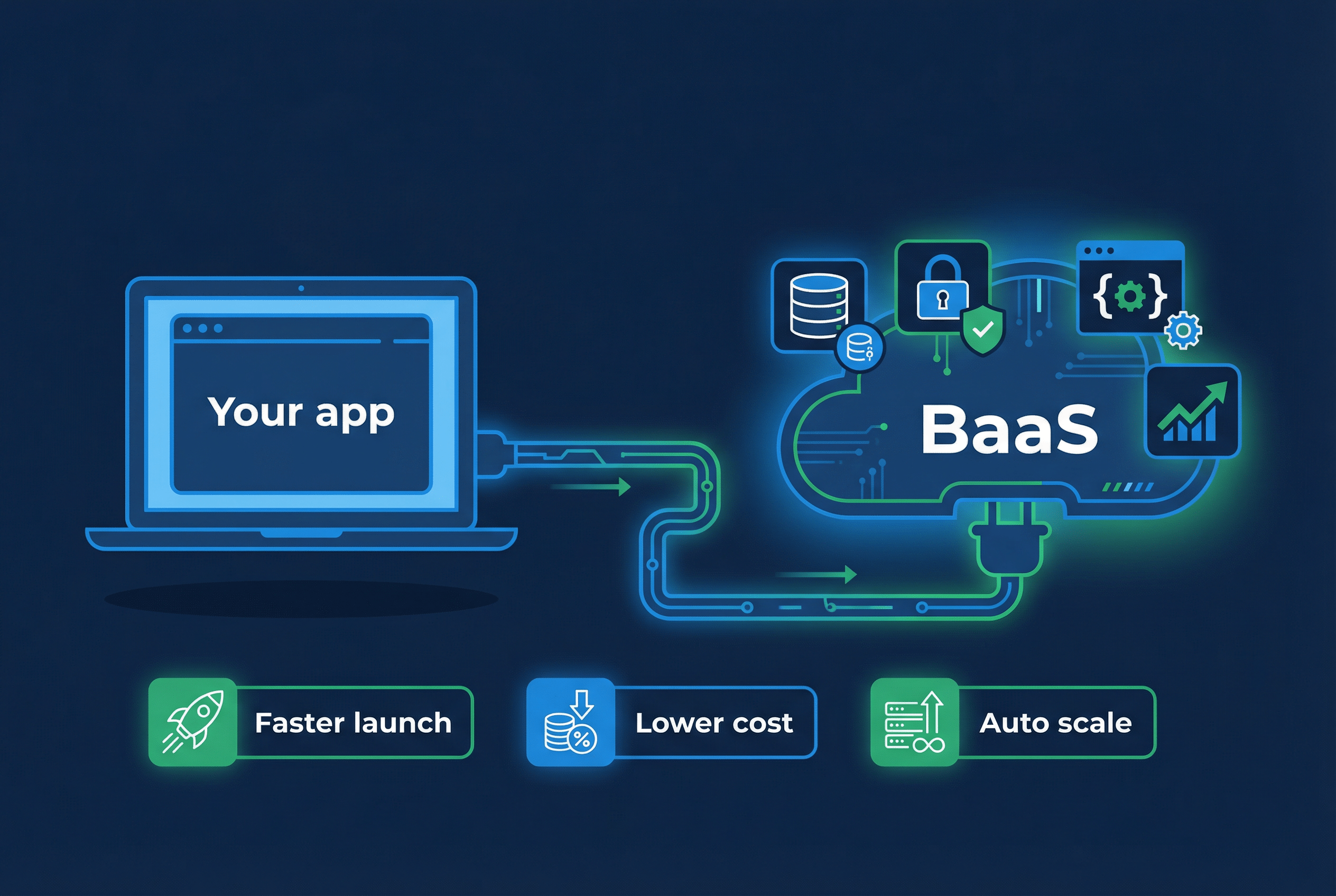
BaaS, also known as Mobile Backend as a Service (MBaaS), is a cloud computing service model that offers companies ready-to-use backend infrastructure, such as database management, server upkeep, and user authentication. This frees up businesses to concentrate on developing and implementing their applications rather than handling intricate backend procedures.
Businesses can profit from BaaS systems in a number of ways, such as increased productivity, quicker time-to-market, scalability, and affordability. Businesses may reallocate resources to core company operations, spur innovation, and maintain their competitiveness in the digital marketplace by contracting out backend management responsibilities to BaaS providers.
Benefits of Using BaaS
Platforms known as backend-as-a-service (BaaS) transform how companies oversee their application development procedures. These platforms provide a number of benefits that improve productivity and streamline processes. BaaS allows businesses to concentrate entirely on innovation and customer engagement by offering pre-configured backend infrastructure and guaranteeing quick application launch. The revolutionary advantages of BaaS, such as increased productivity, quicker time-to-market, scalability, and substantial cost reductions, are examined in this section.
- Enhanced Efficiency: BaaS provides ready-to-use backend infrastructure, allowing companies to focus on application development and deployment without the burden of managing complex backend processes.
- Accelerated Time-to-Market: By offloading backend management tasks, businesses can rapidly develop and launch applications, gaining a competitive edge and meeting market demands promptly.
- Scalability: BaaS platforms offer scalability options, enabling businesses to adapt to changing operational demands and seamlessly accommodate user growth without extensive backend reengineering.
- Cost-Effectiveness: By leveraging BaaS providers, businesses can reduce the costs associated with infrastructure maintenance, server management, and database upkeep, allowing them to reallocate resources to core business activities.
Key Features of BaaS Platforms
Backend-as-a-Service (BaaS) systems provide key capabilities that improve and expedite the creation and administration of business applications. By taking care of crucial tasks like database administration, server upkeep, and user authentication, these platforms relieve businesses of the difficulties associated with backend infrastructure. Additionally, BaaS systems offer cutting-edge features like seamless interaction with third-party services and real-time analytics, enabling companies to grow and develop quickly in the cutthroat digital market of today.
- Server Maintenance: BaaS providers handle server-side infrastructure, ensuring that companies do not have to manage server maintenance, updates, or downtime issues.
- Database Management: BaaS platforms offer database services, including data storage, management, and query processing, streamlining businesses’ data operations.
- User Authentication: BaaS solutions provide robust user authentication mechanisms, ensuring secure access to applications and sensitive data.
- Real-Time Analytics: BaaS platforms may offer real-time analytics capabilities, empowering businesses to derive insights from data and make informed decisions.
Integration with Third-Party Services: BaaS solutions often integrate with various third-party services, enabling businesses to leverage a wide range of functionalities and tools for their applications.
Uses of BaaS in Mobile App Development
BaaS (Backend as a Service) is a cloud computing service that provides developers with a backend infrastructure for building and deploying mobile applications. Here are some of the uses of BaaS in mobile app development:
- User Management: BaaS platforms typically offer built-in authentication services that support common authentication methods, such as email/password, social media logins (e.g., Google, Facebook, Twitter), and third-party identity providers (e.g., OAuth). This allows developers to implement secure authentication without having to build and manage their authentication systems.
- Data Storage: BaaS provides cloud-based data storage solutions that allow developers to store and retrieve app data such as user profiles, images, videos, and audio files. This eliminates the need for developers to manage their own database and server infrastructure.
- Push Notifications: BaaS provides push notification services that enable developers to send real-time notifications to users. This feature is essential for mobile applications that need to send alerts and updates to users even when the app is not active.
- Analytics: BaaS provides analytics tools that enable developers to track user behavior and app performance. This data can be used to optimize the app’s user experience, improve app performance, and increase user engagement.
- APIs and Integrations: BaaS provides APIs and integrations that allow developers to easily integrate third-party services such as social media, payment gateways, and messaging platforms into their mobile applications.
- Database Management: BaaS provides database management features that allow developers to store, manage, and retrieve data for web applications. This eliminates the need for developers to manage their own server infrastructure and database management system.
- Security: BaaS provides security features such as data encryption, user authentication, and access control that help to protect user data and prevent unauthorized access.
- File Storage: BaaS provides cloud-based file storage solutions that allow developers to store and retrieve files such as images, videos, and documents for web applications. This eliminates the need for developers to manage their own server infrastructure for file storage.
Overall, BaaS simplifies the development process for mobile applications by providing a backend infrastructure that handles essential features such as user management, data storage, and push notifications. This allows developers to focus on building the front-end of their mobile applications, saving time and resources.
Uses of BaaS in Internet of Things (IoT) Applications
BaaS (Backend as a Service) can also be used in Internet of Things (IoT) applications to simplify the development process and provide a reliable backend infrastructure. Here are some of the uses of BaaS in IoT applications:
- Device Management: BaaS provides device management features that allow developers to manage and authenticate IoT devices. It enables developers to implement features such as device registration, device data collection, and device status tracking.
- Data Management: BaaS provides data management features that allow developers to store, manage, and analyze data from IoT devices. This eliminates the need for developers to manage their own server infrastructure and database management system.
- Scalability: BaaS provides scalable infrastructure that can handle large volumes of data and traffic for IoT applications. This ensures that the application can handle the growth in the number of devices and users over time.
Overall, BaaS simplifies the development process for IoT applications by providing a backend infrastructure that handles essential features such as device management, data management, and analytics. This allows developers to focus on building the front-end of their IoT applications, saving time and resources.
Use Cases / Domains for BaaS
- Gaming: In the gaming industry, BaaS supports user authentication, real-time multiplayer functionality, leaderboards, in-app purchases, and player insights.
- Healthcare: BaaS aids in patient data management, appointment scheduling, telemedicine, and electronic health records, ensuring security and compliance with regulations.
- Finance and Fintech: BaaS supports secure user authentication, transaction processing, KYC compliance, and financial analytics for fintech apps.
- Education: BaaS manages user profiles, content delivery, and collaborative features among students and educators.
- E-commerce: BaaS handles inventory management, order processing, and payment gateway integration, ensuring scalability during peak shopping periods.
- Social Networking: BaaS supports user authentication, content sharing, and real-time updates for an interactive user experience.
- Travel and Hospitality: BaaS aids in booking management, user profiles, and third-party service integrations like maps and weather.
- Real Estate: BaaS manages property listings, user accounts, and communication channels between buyers, sellers, and agents.
- IoT: BaaS provides backend support for device management, data storage, and communication between connected devices.
- Media and Entertainment: BaaS facilitates content delivery, user authentication, and user preference management for personalized recommendations.
- Logistics and Supply Chain: BaaS supports shipment tracking, inventory management, and route optimization.
- HR and Recruitment: BaaS streamlines candidate profiles, interview scheduling, and communication channels.
- Food Delivery and Restaurant Services: BaaS aids in order management, user authentication, and payment integration.
- Government and Public Services: BaaS supports citizen engagement, data management, and communication with public agencies.
Strategies for Leveraging BaaS Effectively
Businesses must adopt a strategic approach, taking into account their unique backend requirements and coordinating BaaS adoption with their overall business objectives, in order to efficiently utilize BaaS platforms. Here are a few tactics to think about:
Read Also: Common Misconceptions About Backend-as-a-Service (BaaS)
Determine Particular Backend Requirements: Prior to using BaaS, companies should assess their backend requirements and take into account push notifications, real-time analytics, data storage, user authentication, and integrations with other services. This evaluation aids in ensuring that the selected BaaS platform has all the features and functionalities needed by the company.
Choose the Right BaaS Provider
It’s crucial to conduct thorough research and choose a reliable BaaS provider that aligns with the business requirements. Consider factors such as the provider’s reputation, level of customer support, scalability options, security measures, cost-effectiveness, and integration capabilities. Engaging with the BaaS provider in discussions and seeking recommendations from industry peers can provide valuable insights in making an informed decision.
Align BaaS Implementation with Business Goals
BaaS should complement the business’s overall strategies and goals. By understanding how BaaS fits within the broader context of the organization, companies can identify the key areas where BaaS can drive growth, enhance customer experiences, and optimize operations. This alignment ensures that the implementation of BaaS contributes to the achievement of strategic objectives.
Embrace Agile Development Methodologies
Agile methodologies, such as Scrum or Kanban, promote iterative and incremental development, allowing businesses to adapt quickly to changing market dynamics. Adopting agile practices with BaaS enables businesses to continuously improve their applications, respond to customer feedback, and expedite the release of new features and updates.
Encourage Cross-Functional Collaboration
Effective collaboration between various teams, such as developers, designers, product managers, and business stakeholders, is essential for successful BaaS implementation. By fostering cross-functional collaboration, businesses can leverage the strengths and expertise of each team member, ensuring smooth integration of the BaaS platform with existing systems and the creation of high-value applications.
By implementing these strategies, businesses can maximize the potential of BaaS platforms and effectively leverage the benefits they bring, enabling accelerated growth, improved operational efficiency, and enhanced customer experiences.
Choosing the Right BaaS Platform
Selecting the right Backend as a Service (BaaS) platform is a crucial decision that can significantly impact your business’s efficiency, scalability, and overall success. With numerous options available, it’s essential to understand the key factors that should guide your choice. In this section, we’ll outline the critical criteria to consider and provide a comparison of popular BaaS providers, including Firebase, AWS Amplify, and Back4App, to help you make an informed decision.
When selecting a Backend as a Service (BaaS) platform, it’s essential to consider several key factors to ensure you choose the best fit for your business needs:
Cost
- Pricing Models: Look at the pricing structures of various BaaS providers. Some offer pay-as-you-go models, while others have tiered pricing based on usage.
- Hidden Costs: Be aware of potential hidden costs, such as additional fees for exceeding data limits or premium features.
Scalability
- Growth Support: Choose a platform that can scale with your business. Ensure it can handle increased data loads and user numbers without performance degradation.
- Flexibility: Check if the platform offers flexible scalability options, both vertically (adding more power to existing resources) and horizontally (adding more nodes).
Features
- Core Features: Evaluate the core features provided, such as data storage, user authentication, push notifications, and cloud functions.
- Advanced Features: Look for advanced features that might be beneficial, like machine learning integration, real-time databases, and analytics.
Support
- Customer Support: Assess the level of customer support available. Is there 24/7 support, and how responsive is it?
- Community and Documentation: Check if there’s a robust community and comprehensive documentation to help with troubleshooting and development.
Integration Capabilities
- API Support: Ensure the platform supports easy integration with your existing systems and third-party services through robust APIs.
- Compatibility: Verify compatibility with the programming languages and frameworks you’re using.
Security
- Data Protection: Evaluate the security measures in place to protect your data, including encryption, authentication, and compliance with industry standards.
- Backup and Recovery: Ensure there are reliable backup and recovery options to prevent data loss.
Comparison of Popular BaaS Providers
Here’s a comparison of three leading BaaS providers to help you make an informed decision:
Firebase
- Overview: Firebase, by Google, is a comprehensive app development platform.
- Key Features: Real-time database, Firestore, authentication, cloud storage, hosting, machine learning, and performance monitoring.
- Strengths: Excellent integration with other Google services, strong real-time capabilities, and extensive documentation.
- Weaknesses: Can become costly as you scale, especially for large applications with high data throughput.
AWS Amplify
- Overview: AWS Amplify, by Amazon Web Services, offers tools to build scalable mobile and web applications.
- Key Features: Data storage with DynamoDB, user authentication, API (GraphQL and REST) integration, AI/ML services, and real-time data sync.
- Strengths: Strong scalability, robust security features, and seamless integration with other AWS services.
- Weaknesses: Steeper learning curve for beginners, and costs can escalate with extensive use of multiple AWS services.
Back4App
- Overview: Back4App is a flexible and scalable BaaS platform built on the open-source Parse framework.
- Key Features: Data storage, user authentication, real-time database, cloud code functions, and file storage.
- Strengths: Open-source nature provides flexibility and transparency, good for rapid prototyping, and reasonable pricing.
- Weaknesses: Smaller community compared to Firebase and AWS, and may lack some advanced features offered by larger providers.
When choosing a BaaS platform, consider your specific business requirements, budget, and long-term goals. By carefully evaluating these criteria and comparing popular providers, you can select a BaaS solution that best supports your business’s growth and technological needs.
BaaS Best Practices
There are many benefits to using Backend as a Service (BaaS) platforms, such as easier development and effective backend management. However, in order to optimize these advantages and minimize possible hazards, companies need to manage a number of crucial factors. Successful BaaS installation depends on critical areas including security and data protection, smooth interaction with current systems, and comprehensive cost and ROI analyses. Businesses can make sure they fully utilize BaaS while protecting their data, streamlining operations, and generating positive financial results by following best practices in these areas.
These important factors and recommended strategies for BaaS adoption are examined in more detail below.
Security and Data Protection
BaaS platforms offer numerous benefits, including efficient backend management and reduced development complexities. However, with the convenience of BaaS solutions, businesses must prioritize data security and privacy. As companies increasingly rely on cloud-based backend solutions, ensuring that the BaaS provider meets the highest security standards and adheres to regulatory compliance requirements is essential. By implementing best practices, businesses can mitigate security risks and advance their focus on innovation.
Some best practices to consider for the security and data protection of BaaS platforms are:
- Evaluate Security Measures: While selecting a BaaS provider, it is essential to evaluate their security measures, such as data encryption, secure data transmission, and user authentication. The BaaS provider should also have periodic security audits and penetration testing to ensure their platform is safe.
- Implement End-to-End Encryption: Businesses must implement end-to-end encryption to secure data transmission between front-end and back-end components. This encryption ensures that data is transmitted securely and that only authorized users can access it.
- Maintain Regulatory Compliance: Businesses must ensure that the BaaS provider complies with regulatory guidelines such as GDPR, HIPAA, and PCI DSS. These regulations protect customer data and provide enhanced privacy for sensitive business information.
By implementing these best practices, businesses can safeguard their data while adopting BaaS solutions.
Integration with Existing Systems
Businesses adopting BaaS platforms must ensure the solution integrates seamlessly with their existing systems. Integration requires careful planning and proper execution to avoid the risk of data inconsistencies, corrupted data, or application crashes. To effectively integrate BaaS platforms with existing systems, businesses should consider adopting the following best practices:
- API Integrations: API or Application Programming Interface integrations enable an efficient and secure connection between systems. Businesses should ensure that the BaaS provider offers robust APIs with detailed documentation to facilitate an easy integration process.
- Proper Migration Strategy: Migrating the existing backend to a BaaS platform requires careful planning, and businesses should create a comprehensive data migration plan to minimize disruptions and potential data loss.
- Comprehensive Testing: Testing the integration between BaaS platforms and existing systems is crucial to ensure seamless connectivity, ease of use, and data accuracy. By executing comprehensive testing, businesses can effectively identify and resolve any integration issues.
By implementing these best practices, businesses can ensure a smooth and seamless integration process between BaaS platforms and existing systems.
Cost Analysis and ROI
While adopting a BaaS platform can offer several benefits and efficiencies, conducting a thorough cost-benefit analysis is essential to determine the financial implications of adopting new cloud-based backend solutions. The study should consider subscription costs, potential savings, and projected ROI. Here are some best practices that businesses can consider to ensure optimal cost-benefit analysis:
- Evaluate Subscription Costs: BaaS providers offer different subscription plans with varying features and services. Businesses should evaluate subscription costs across various providers and choose the one best suits their requirements and budget.
- Potential Savings: Adopting BaaS platforms helps businesses reduce backend development and maintenance costs associated with server and database management. Companies should estimate the potential savings and include them in their cost-benefit analysis.
- Project ROI: A thorough cost-benefit analysis should project the long-term ROI of adopting BaaS platforms. The ROI should consider the enhanced productivity, accelerated innovation, and reduced time-to-market gained by leveraging the BaaS platform.
By evaluating these factors comprehensively, businesses can make informed decisions while adopting BaaS platforms.
Bottomline
In a fast-paced, cutthroat industry, BaaS platforms offer businesses a compelling chance to improve operations, spur innovation, and accelerate growth. Adopting BaaS can lead to many benefits, such as increased cost-effectiveness, scalability, and efficiency, allowing companies to concentrate on their strategic goals and core skills.
In order to advance their operations, obtain a competitive advantage, and pursue sustainable growth in the digital age, businesses are urged to investigate the potential of utilizing BaaS platforms.







Comments