
 By
It’s simple to integrate Backend-as-a-Service (BaaS) with frontend frameworks like React, Vue, and Angular. This is mostly done by using the SDKs and APIs that the BaaS platform offers to manage basic backend operations like file storage, real-time data synchronization, and authentication.
General Integration Steps
The core of BaaS integration involves using platform-specific Software Development Kits (SDKs) and APIs. The general workflow is consistent across frameworks:
- Initialize the BaaS SDK: Install the BaaS provider’s library via npm or yarn and initialize it within your application’s entry point (e.g.,
index.jsin React,main.tsin Angular,main.jsin Vue). - Use Services via Components/Services: Utilize the BaaS features (authentication, database operations, file storage) within your frontend components or dedicated service layers. This involves making API calls using the SDK’s methods.
- Manage State: Implement state management (e.g., React Context/Redux, Vuex/Pinia, Angular Services) to handle user sessions, real-time data updates, and loading states provided by the BaaS.
- Handle Authentication and Routing: Use the BaaS authentication services (email/password, OAuth) to manage user login/logout and implement protected routes in your frontend application using the framework’s router (e.g., React Router, Vue Router, Angular Router).
- Environment Variables: Store sensitive keys (API keys, project IDs) in environment variables for security.
Framework-Specific Considerations
While the general steps are similar, each framework has specific patterns:
- React: React’s flexibility means you often integrate BaaS functionalities using custom hooks or a
Contextprovider for global state management and data fetching within functional components. - Vue: Vue’s component-based, progressive nature allows for easy integration, often leveraging its reactivity system and state management libraries like Pinia for seamless data flow from the BaaS to the UI.
- Angular: Angular is a comprehensive, opinionated framework that uses a strong service layer and dependency injection to manage interactions with the BaaS, fitting well with its structured architecture and TypeScript usage. Firebase is a popular BaaS choice due to its strong integration with Angular, as both are backed by Google.
Popular BaaS Options and Resources
Popular BaaS platforms offer detailed documentation and SDKs for these frontend frameworks:
- Firebase: A widely used platform by Google, known for its real-time database, authentication, and hosting features, with excellent support for all major frameworks.
- Supabase: An open-source alternative to Firebase offering a PostgreSQL database, authentication, and storage.
- Convex: A backend platform that guarantees real-time synchronization between the database and frontend components without manual cache invalidation.
- PocketBase: A self-hostable, open-source BaaS that combines a real-time database, authentication, and file storage into a single executable file.
It is much simpler to create a fantastic frontend when you are not simultaneously struggling with the backend. This is precisely where Backend-as-a-Service (BaaS) excels: rather than requiring small teams to run complete DevOps setups, it allows React, Vue, Angular, and mobile frontends to plug into a ready backend.
The dilemma is more acute for AI-first businesses, independent developers, and lean product teams in (or serving) the EU: you need quick iterations and real-time user experiences, but you can’t sacrifice GDPR compliance or data sovereignty.
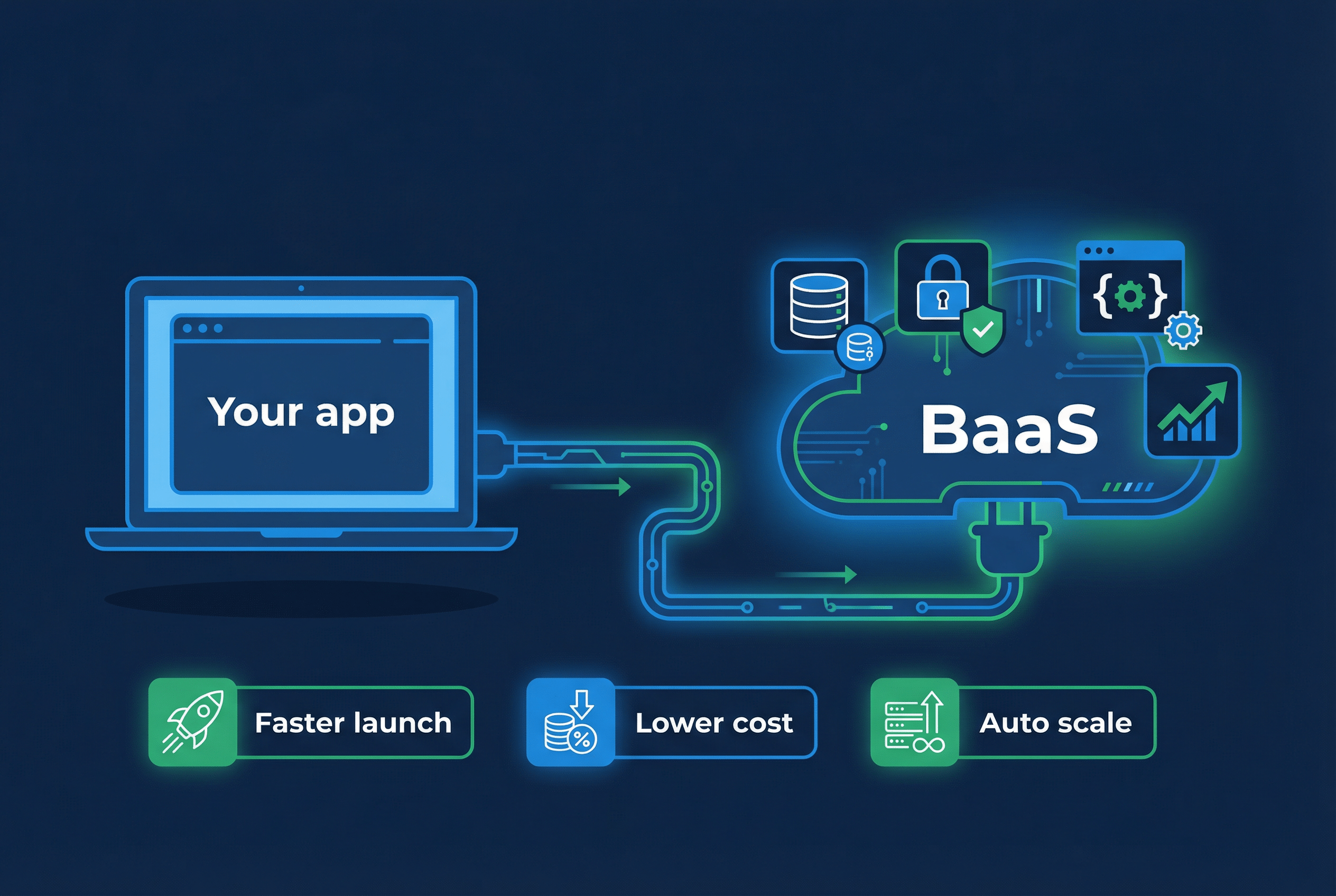
Backend-as-a-Service is a managed platform that gives you the core building blocks of an app backend out of the box:
- User authentication and authorization
- Database and file storage
- Real-time subscriptions and events
- APIs (REST and often GraphQL)
- Background jobs and scheduled tasks
- Push notifications and email hooks
Instead of provisioning servers, configuring databases, wiring up security, and doing mobile API management by hand, you consume these building blocks via SDKs and APIs.
Under the hood you still have a real backend (servers, containers, databases, queues), but the platform operator runs and scales it for you.
Benefits of Using BaaS for Frontend Framework
For small teams and solo builders, the benefits are concrete:
- No DevOps tax – You can avoid learning Kubernetes, CI/CD pipelines, multi-AZ redundancy, and TLS certificates just to get an MVP out the door.
- Faster time to market – A working backend in hours or days, not weeks. Frontend devs can call APIs immediately instead of waiting for a backend sprint.
- Common Frontend Frameworks and What They Need from the BackendBuilt-in best practices – Secure authentication, rate-limited APIs, and sensible defaults that follow industry standards like OWASP recommendations for auth and session management (OWASP Cheat Sheet Series).
- Predictable pricing – Most BaaS platforms offer transparent tiered pricing that’s easier to forecast than bespoke infra.
- Focus on UX and product – Your team spends its cycles on flows, onboarding, and AI features instead of infra tickets.
The trade-off: you agree to the BaaS platform’s abstractions. If you need a very unusual data model, exotic protocols, or deeply customized infrastructure, a generic BaaS may feel constraining.
Common Frontend Frameworks and When to Use Them
Frontend frameworks are essential for creating scalable, quick, and maintainable user interfaces in the realm of contemporary web development. But how can you pick the finest option for your project when there are so many to select from?
The three most widely used frontend frameworks nowadays are briefly described here, along with the appropriate times to utilize each:
React
Created by Facebook, React is a library (often called a framework due to its ecosystem) for building user interfaces based on components.
An open-source JavaScript library for creating user interfaces is called React. It was created by Facebook and focuses on using a component-based architecture to create dynamic and interactive web applications.
React improves performance by effectively updating the real DOM through the usage of a virtual DOM. Because of its declarative nature, developers can specify how the user interface should appear in response to data changes.
- Why choose React?
- Large community and ecosystem
- Flexible and highly customizable
- Great for Single Page Applications (SPAs)
- Supported by Next.js for server-side rendering (SSR)
- Easy to integrate with other libraries
When to use:
React is ideal when you need flexibility, plan to build with micro-frontends, or want to integrate with different backends or tools.
Angular
Developed by Google, Angular is a full-featured framework based on TypeScript, offering everything out-of-the-box (routing, HTTP, forms, etc.). Although it is created and maintained by Google, it is also a component of these extensive frontend frameworks. It enables programmers to use TypeScript, a JavaScript superset, to create reliable SPAs.
Angular offers an organized framework for handling routing, data binding, dynamic view creation, and more. Its two-way data binding makes it easier to synchronize data between the model and the view, and its modular architecture with components and services promotes reusable and maintainable code.
- Why choose Angular?
- Complete solution, ready for enterprise applications
- Strong typing with TypeScript
- Built-in CLI and testing tools
- Two-way data binding
- Excellent for large teams and structured development
When to use:
Choose Angular when you’re working on complex enterprise applications, internal systems, or when you need strong architecture and scalability.
Vue.js
Created by Evan You, Vue is a progressive framework that balances the best of React and Angular, with simplicity and great performance. It’s a progressive JavaScript framework for creating user interfaces. It blends the greatest features of component-based architecture and reactive data binding.
Read Also: Real-Time Data with BaaS: WebSockets, Pub/Sub, and More
Vue.js is simple to include into already-existing projects and lightweight. Because of its adaptable and user-friendly structure, developers can progressively incorporate its features as needed. Vue.js is a great option for both novice and seasoned developers because it makes creating interactive user interfaces easier by offering a simple and understandable syntax.
Why choose Vue?
Gentle learning curve
Lightweight and fast
Clear documentation
Reactive data binding
Vue CLI and ecosystem (Nuxt.js, Pinia, etc.)
When to use:
Vue is great for small to medium-sized projects, quick MVPs, or if you want easy onboarding for new developers.
React is the default choice for many startups. React frontends typically need:
- A clean HTTP or WebSocket API to fetch and sync data
- Authentication flows (sign up, sign in, password reset, social login)
- Real-time updates for notifications, chat, dashboards, and collaboration
Vue appeals to teams that want a gentle learning curve and a compact ecosystem. Vue apps integrate best with BaaS options that provide:
- Simple SDKs that work well in SPA or SSR contexts
- Lightweight state management for caching API responses
- Support for both REST and GraphQL
Angular is still strong in enterprise and more structured projects. Angular developers often expect:
- Type-safe clients and clear API contracts
- Robust mobile API management for complex apps
- Strong authentication and role-based access control for multi-tenant apps
Beyond SPAs, frameworks like Next.js and Nuxt blur the line between frontend and backend. They benefit from a BaaS that:
- Exposes flexible HTTP APIs you can call from server-side and client-side code
- Works well with incremental static regeneration or SSR
- Offers edge-friendly features like JWT-based auth instead of sticky sessions
For teams deploying on Vercel, the integration story is especially important. Vercel’s serverless functions and edge runtime work best with BaaS platforms that provide:
- Low-latency API endpoints that can be called from edge locations
- Stateless authentication (JWT tokens) that don’t require sticky sessions
- APIs that play nicely with Vercel’s caching and revalidation strategies
- Support for environment variables and secrets management that aligns with Vercel’s deployment model
Real-time apps-chats, multiplayer tools, live dashboards-need a backend with low-latency real-time apps support (WebSockets, live queries, or similar) and efficient syncing to avoid constant polling.
Deep Dive into Frontend Frameworks
There are additional frontend frameworks that can be suitable for you, even though the ones listed above are the best. We will, however, delve into the specifics of our top three.
React, Angular, and Vue are the three front-end JavaScript frameworks. Despite their differences, prominent frontend frameworks like js have a few things in common:
- Component-Based Architecture: promote a component-based architecture, allowing developers to create reusable and encapsulated UI components for building complex user interfaces.
- Reactivity and Data Binding: Reactivity is a key feature in all three frameworks, enabling automatic updates of the UI when underlying data changes.
- Single-Page Application: well-suited for building SPAs, where content is dynamically loaded and updated without full page reloads.
- Developer Tools: Each framework provides developer tools that aid in debugging, inspecting components, and understanding app behavior during development.
- Community and Ecosystem: communities and extensive ecosystems of libraries, packages, and resources that enhance development efficiency and address needs.
- Routing solutions to manage navigation within SPAs, allowing users to move between different views without full page reloads.
- Testing Support: tools and patterns for testing components and application logic, facilitating the creation of robust and maintainable code.
- State Management: while the specifics differ, they offer solutions for managing app state, ensuring consistent and predictable data flow within the UI.
- Server-Side Rendering: it can improve initial load times, enhance SEO, and provide a better user experience.
- Community Learning Resources: extensive documentation, tutorials, and online resources that help developers learn and master the technologies.
- Internationalization and Localization: support for internationalization [i18n] and localization [l10n] to create apps that cater to everyone.
While there are similarities, it’s important to note that each framework also has its own unique features, syntax, and design philosophies that differentiate them.
| Aspect | React | Angular | Vue.js |
| PROS | |||
| Component Reusability | ✔️ High modularity and reusability | ✔️ Modular architecture and reusability | ✔️ Encourages component-based approach |
| Performance | ✔️ Efficient Virtual DOM for updates | ✔️ Powerful change detection mechanism | ✔️ Efficient reactivity system |
| Community Support | ✔️ Large and active community | ✔️ Strong Google support | ✔️ Growing and supportive community |
| Mobile Development | ✔️ React native enables cross-platform mobile apps | ❌ Not directly applicable | ❌ Not directly applicable |
| Flexibility | ✔️ Gradual adoption and integration | ✔️ Full-featured framework | ✔️ Can be incrementally adopted |
| JSX and Declarativity | ✔️ Intuitive JSX syntax | ❌ Angular template syntax | ✔️ Simple and intuitive template syntax |
| State Management | ✔️ Works well with Redux, MobX, etc. | ✔️ Built-in state management (RxJS) | ✔️ Options like Vuex for state |
| Ecosystem and Tooling | ✔️ Wide range of libraries and tools | ✔️ Robust development environment | ✔️ Growing ecosystem and tooling |
| CONS | |||
| Learning Curve | ❌ JSX and concepts can be complex | ❌ Steeper learning curve | ❌ May be less suitable for large apps |
| Verbosity | ❌ JSX can lead to more verbose code | ❌ Boilerplate code in some cases | ❌ Less verbose than Angular, React |
| Size | ❌ Can lead to larger bundle sizes | ❌ Bigger bundle sizes | ❌ Can lead to larger bundle sizes |
| Opinionated Approach | ❌ Less opinionated on architecture | ✔️ Strong opinions on architecture | ❌ Opinionated but less than Angular |
| Two-Way Data Binding | ❌ No built-in two-way binding | ✔️ Supports two-way data binding | ❌ Supports two-way binding |
| Learning Curve (RxJS) | ❌ Additional learning curve for RxJS | ✔️ Learning RxJS for complex apps | ❌ No built-in complex reactive system |
| Development Trend | ✔️ Still highly popular and evolving | ❌ Trend may be declining | ✔️ Trending upward in popularity |
A Comprehensive Analysis of React, Angular, and Vue.js
A holistic approach to this will requiere a frontend and backend frameworks’ synergy analysis; full-stack is the real thing. But, we’re going to unpack these titans.
Let’s follow these criteria:
1. Popularity and Community Support:
- React: Highly popular, with a large and active community. Abundant resources, libraries, and tools are available.
- Angular: Established and backed by Google. Strong community support, though less popular compared to React.
- Vue.js: Rapidly growing in popularity, with an active and supportive community. Offers a balanced ecosystem.
2. Learning Curve:
- React: Relatively moderate learning curve, especially for those familiar with JavaScript and JSX.
- Angular: Steeper learning curve due to its opinionated architecture, TypeScript usage, and comprehensive features.
- Vue.js: Gentle learning curve, suitable for beginners. Clear documentation and simple syntax aid in quick adoption.
3. Architecture and Design:
- React: Component-based architecture using JSX. Offers flexibility and encourages modular design.
- Angular: Full-fledged framework with strong opinions on architecture. Utilizes TypeScript and features modules, components, and services.
- Vue.js: Component-based architecture similar to React, with Vue Single File Components (SFCs) providing a clear structure.
4. Data Binding and Reactivity:
- React: Uses a one-way data flow and Virtual DOM for efficient updates.
- Angular: Employs two-way data binding and a powerful change detection mechanism.
- Vue.js: Utilizes a reactive system to efficiently update the UI based on data changes.
5. State Management:
- React: Offers state management through libraries like Redux, MobX, or built-in Context API.
- Angular: Provides built-in state management with RxJS for reactive programming.
- Vue.js: Offers Vuex, a dedicated state management solution inspired by Redux, simplifying global state management.
6. Performance:
- React: Optimizes performance through the Virtual DOM, enabling efficient rendering and updates.
- Angular: Performs well with its change detection mechanism but may require additional optimization for complex applications.
- Vue.js: Offers efficient reactivity and rendering, competitive with React and Angular.
7. Tooling and Ecosystem:
- React: Offers a rich ecosystem of libraries, tools (like Create React App), and extensions (like React Router).
- Angular: Comprehensive tooling with Angular CLI, along with a wide range of built-in features and official packages.
- Vue.js: Features Vue CLI, Vue Router, and VueX for state management, alongside a growing ecosystem.
8. Flexibility and Integration:
- React: Highly flexible, allowing integration into existing projects or adoption of specific parts.
- Angular: More opinionated but provides an end-to-end solution, suitable for large applications.
- Vue.js: Offers a balanced approach, allowing incremental adoption and integration.
9. Server-Side Rendering (SSR):
- React: Supports SSR through libraries like Next.js.
- Angular: Supports SSR with Angular Universal.
- Vue.js: Supports SSR out of the box using Vue Server Renderer.
10. Mobile Development:
- React: Offers React Native for building cross-platform mobile apps using React concepts.
- Angular: Supports mobile development through Ionic framework and NativeScript integration.
- Vue.js: Can be used with NativeScript for mobile app development.
11. Future Trends:
- React: Continues to be popular and evolve, maintaining its strong position.
- Angular: Steadily evolving, with Google’s backing ensuring long-term support.
- Vue.js: Gaining popularity rapidly and likely to continue growing.
As we always say, the choice between them relies on project requirements, team expertise, and long-term goals. Each framework has its strengths and weaknesses.
Features That Make a BaaS Easy to Use with Frontend Tools
Not every BaaS is equal from a frontend perspective. Here are the features that actually move the needle.
Essential Features for Smooth Integration
- First-class SDKs
- Native SDKs for JavaScript/TypeScript (browser and Node.js)
- Good support for React, Vue, Angular, React Native, and potentially Flutter
- Idiomatic patterns (promises/async, TypeScript definitions)
- Flexible data model and queries
- A document or relational database with a query language that can be used safely from the client
- Pagination, filtering, and full-text search where needed
- Strong schema controls and role-based access
- Real-time subscriptions
- WebSocket or similar channels for live updates
- Fine-grained subscriptions to avoid flooding the client
- Integrations that make it easy to reflect server events into client state (e.g., updating React Query or Vue Query caches)
- Authentication and authorization
- Email/password plus single sign-on options (Google, Apple, etc.)
- Session management designed for SPAs and mobile apps
- Support for mobile backend authentication flows such as device-based tokens, refresh tokens, and secure storage patterns
- API styles: REST and GraphQL
- REST for simplicity and great tooling support
- GraphQL for highly interactive UIs that need to batch and shape data
- Operational basics handled for you
- Automatic scaling of API nodes and databases
- Global or regional infrastructure, depending on your data residency needs
- Monitoring, logging, and error tracking hooks
Mobile API Management & Background Work
If your frontend includes native or cross-platform mobile apps, the backend needs to support:
- Rate limiting and quotas for mobile API calls to protect your backend
- Easy handling of push notifications (APNs, FCM)
- Background jobs for sending digests, cleaning stale sessions, and processing heavy tasks off the request path
A solid BaaS abstracts these into simple configuration and code hooks instead of requiring you to stitch together multiple cloud services.
Picking the Right BaaS for Frontend Integration
Choosing a BaaS is not just a technical question; it affects your roadmap, compliance posture, and long-term flexibility.
Key Technical Factors to Consider
When evaluating platforms, check:
- API ergonomics – Is the SDK pleasant to use in your chosen framework? Does it support async/await, streaming, and subscriptions?
- Performance – Latency from your users to the region where your backend runs. Benchmarks matter more than marketing claims.
- Real-time capabilities – Do you get practical primitives for real-time apps, or do you need to layer third-party services on top?
- Extensibility – Can you run custom logic (cloud functions, webhooks, jobs) without standing up a separate microservice?
- Data access – Can you connect directly to the database (e.g., MongoDB or Postgres) for analytics and migrations when needed?
- Platform compatibility – If you’re deploying on Vercel or similar edge platforms, does the BaaS work seamlessly with serverless functions, edge middleware, and ISR/SSR patterns?
Business & Compliance Considerations (Especially for EU Teams)
If you operate in the EU-or handle EU residents’ data-you need to consider:
- Data residency and sovereignty – Is your data stored exclusively in the EU, or replicated to the US or other regions? The GDPR and Schrems II rulings make this a critical question.
- Vendor lock-in – Does the BaaS run on open standards and open-source components (e.g., Parse Server, Postgres) that you could self-host in a worst-case scenario?
- Security posture – Certifications, encryption in transit and at rest, access controls, and audit logs.
- Pricing transparency – Clear thresholds and overage policies, especially around API calls, storage, and real-time connections.
For many EU startups, the sweet spot is a Parse-based BaaS or another open-source core, deployed fully on EU infrastructure. You gain the speed of a platform with the option to take your data and stack elsewhere if necessary.
Summary
Backend-as-a-Service platforms free you from building commodity infrastructure and let you pour that time into UX, experiments, and customer feedback.
To recap:
- Modern frontends (React, Vue, Angular, mobile) and deployment platforms like Vercel thrive when they talk to a BaaS with strong SDKs, real-time features, and flexible data access.
- Essential capabilities include authentication, authorization, mobile API management, real-time apps support, and both REST and GraphQL APIs.
- Your BaaS choice should reflect not just developer experience, but also data residency, GDPR obligations, deployment platform compatibility (like Vercel), and long-term escape hatches (open-source cores, exportable data).
- EU-native Parse backends provide a pragmatic balance for European teams: rapid development, no DevOps, clear data sovereignty, and seamless integration with modern deployment platforms.
If you pick a platform that aligns with your frontend stack, deployment platform, and regulatory context, you can move from idea to production quickly-without sacrificing scalability, security, or ownership of your data.








Comments