
 By

By offering ready-to-use, pre-built backend functionalities (such as user authentication and data storage), Backend-as-a-Service (BaaS) speeds up the development of Minimum Viable Products (MVPs) for startups. This allows development teams to concentrate resources on the frontend and core business logic, greatly reducing development time, cost, and time-to-market.
Key Ways BaaS Accelerates MVP Development
- Faster Development Speed: BaaS platforms provide reusable components and APIs for common features, eliminating the need to build the entire backend infrastructure from scratch. This automation saves weeks or months of development time.
- Reduced Time-to-Market: By streamlining the development process, startups can launch their MVP faster, enabling quicker market validation and the ability to gather early user feedback sooner.
- Cost-Effectiveness: BaaS reduces development costs by requiring fewer software engineers (especially DevOps specialists) and avoiding large upfront investments in server infrastructure. The pay-as-you-go model is particularly beneficial for startups with limited budgets.
- Focus on Core Product and UX: Developers can concentrate on building the unique, user-facing features and user experience (UX) that differentiate the product, while the BaaS provider handles routine backend tasks.
- Built-in Essential Features: BaaS includes out-of-the-box functionalities crucial for an MVP, such as:
- User authentication and management
- Scalable databases (SQL and NoSQL) and cloud storage
- Push notifications and email verification
- APIs and SDKs for easy integration across multiple platforms (iOS, Android, web)
- Automatic Scalability and Maintenance: BaaS providers manage the infrastructure, including automatic scaling to handle increased user loads, security updates, and data backups. This frees startups from worrying about performance bottlenecks as user numbers grow.
- Faster Iteration: The simplified architecture and pre-built components allow for quicker iterations and updates based on user feedback, which is central to the lean startup methodology of “build-measure-learn”.
In essence, BaaS helps startups bring a functional product to market rapidly and efficiently, reducing the risk of investing heavily in an unvalidated idea and providing tangible proof of concept to attract future investors.
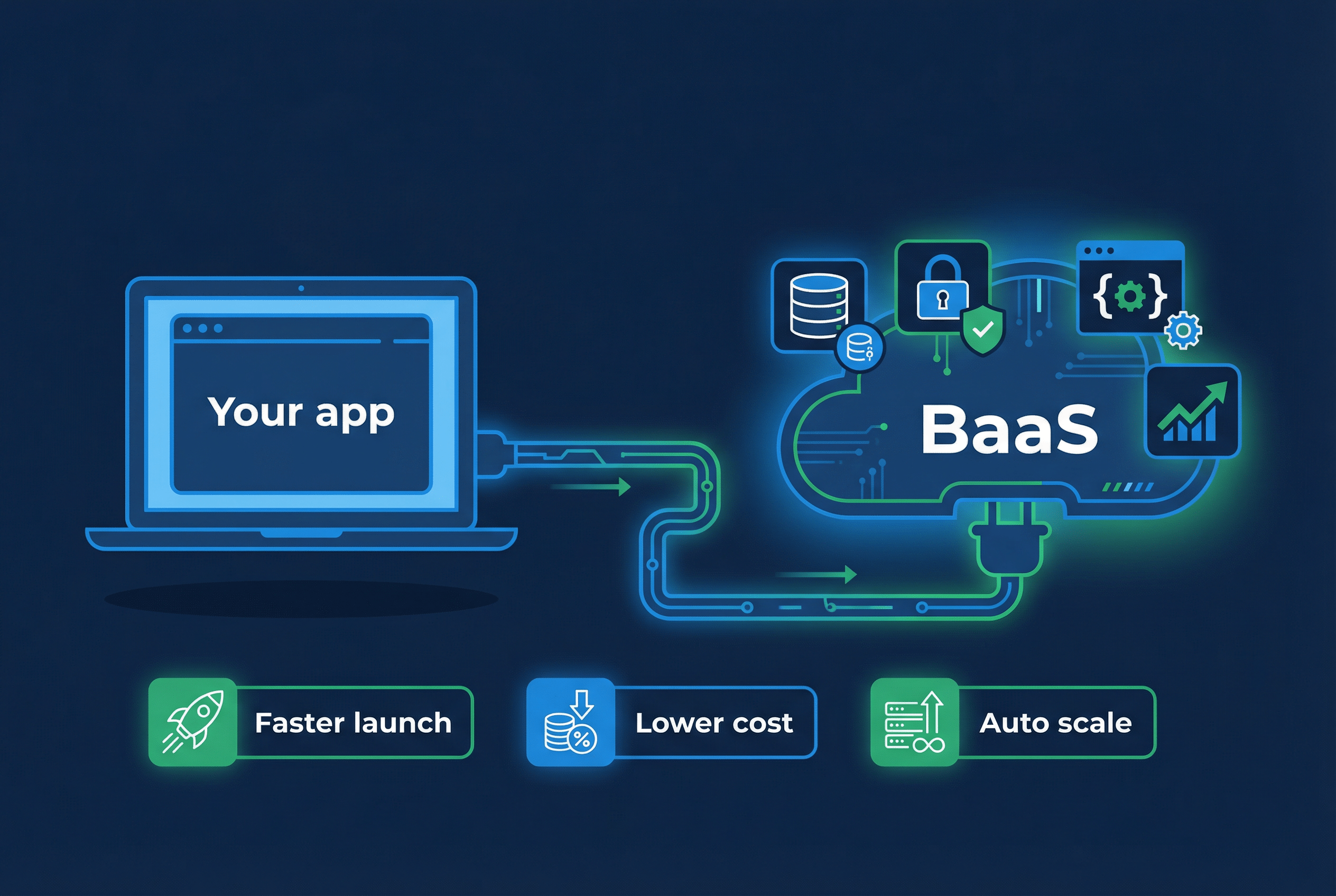
Backend as a Service (BaaS) is a cloud-based architecture that lets developers hire outside companies like Firebase, Supabase, AWS Amplify, or Backendless to manage an application’s backend features, such as databases, file storage, authentication, real-time data sync, APIs, and server-side logic. Instead of building backend infrastructure from scratch, startups can connect to pre-built modules and focus only on frontend functionality and user experience.
Startups don’t fail because of poor programming. They fail because they launch too slowly or make excessive investments in non-core infrastructure development. This is where BaaS shines:
- Quicker Development
Developers can get from concept to prototype in days rather than months when using off-the-shelf backend services. No need to start from scratch with database structures, user administration, or authentication. - Reduced Expenses of Development
Startups can save money on infrastructure administration, DevOps setups, and backend developers by utilizing prebuilt cloud functionalities and services. - Pay Attention to the Frontend
The user experience, not the elegance of your backend’s coding, is what makes your MVP valuable. You can devote more time to creating and perfecting that experience using BaaS. - Inherent Scalability
The majority of BaaS platforms scale on their own. You don’t need to reinvent your backend architecture to accommodate thousands of users.
How Can it Help with App Development?
In addition to cloud storage and hosting, BaaS providers typically supply pre-written software for the most popular server services, like user authentication, database management, and push notifications for mobile apps.
Let’s consider creating an application without utilizing BaaS to direct a film in order to gain a better understanding of this idea. Managing the camera crews, lighting, set construction, costumes, casting, production scheduling, filming, and directing are just a few of the many tasks that fall under the purview of a film director.
Imagine for a moment that the director simply needed to direct and shoot the sequences because a service would do all the background work.
Read Also: BaaS vs Traditional Backend Development: Pros and Cons
The concept behind BaaS is that the developer may concentrate entirely on what the end user sees and experiences (in the analogy, filming and directing the movie), while the provider handles server-side functions (such as setting up the set, hiring camera crews, etc.).
Outsourcing cloud management responsibilities to a backend as a service platform for small to medium-sized projects can result in significant productivity gains and cost savings.
One of the most significant advantages of BaaS is a faster time-to-market for software projects. Delaying product delivery for several months can jeopardize market opportunities or cause businesses to lag behind their competition.
By utilizing BaaS, companies can:
- Reduce time-to-market
- Save money and decrease development costs
- Assign fewer backend developers to a project without sacrificing results
- Outsource cloud infrastructure management
Additionally, BaaS can assist entrepreneurs in verifying their concepts in the actual market. Businesses can swiftly and effectively develop MVPs with BaaS, test them in the marketplace, and make adjustments in response to feedback. This strategy saves time and money while lowering the possibility of creating a product that doesn’t satisfy consumer demands.
Businesses can save the expense of hiring a backend/infrastructure engineer by outsourcing cloud infrastructure management to BaaS providers. This cost-cutting strategy can have a big impact, particularly for small and beginning companies that have limited funding.
Businesses may simplify their development process, concentrate on their core skills, cut expenses, and accomplish their objectives more quickly and effectively by leveraging the advantages of a BaaS platform.
Bottomline
Backend as a Service is an effective technique that provides developers with a number of technological benefits. BaaS frees up frontend developers to concentrate on producing excellent front-end code and user experiences by removing the need to set up multiple stacks and standardizing the development environment.
BaaS also provides pre-configured and proven security settings and backup procedures, as well as the ability for developers to clone programs and establish testing environments.
However, BaaS is not limited to frontend devs. BaaS can help backend developers expedite their development process and cut down on time spent on tedious chores. Because BaaS providers offer pre-built capabilities that are simple to incorporate into an app, they can use BaaS to swiftly prototype new concepts.
Another benefit of BaaS for backend developers is that it frees them up to concentrate on developing high-value products instead of tedious jobs like server setup, database management, and authentication module creation.
Backend developers can concentrate on creating more intricate, unique, and creative services because BaaS providers already have specialized teams that manage infrastructure and handle scaling.
In summary, Backend as a Service is a priceless tool for developers trying to cut expenses and optimize their development process. With BaaS, developers can concentrate on developing sophisticated and creative features while BaaS providers take care of the management and infrastructure.







Comments