
 By
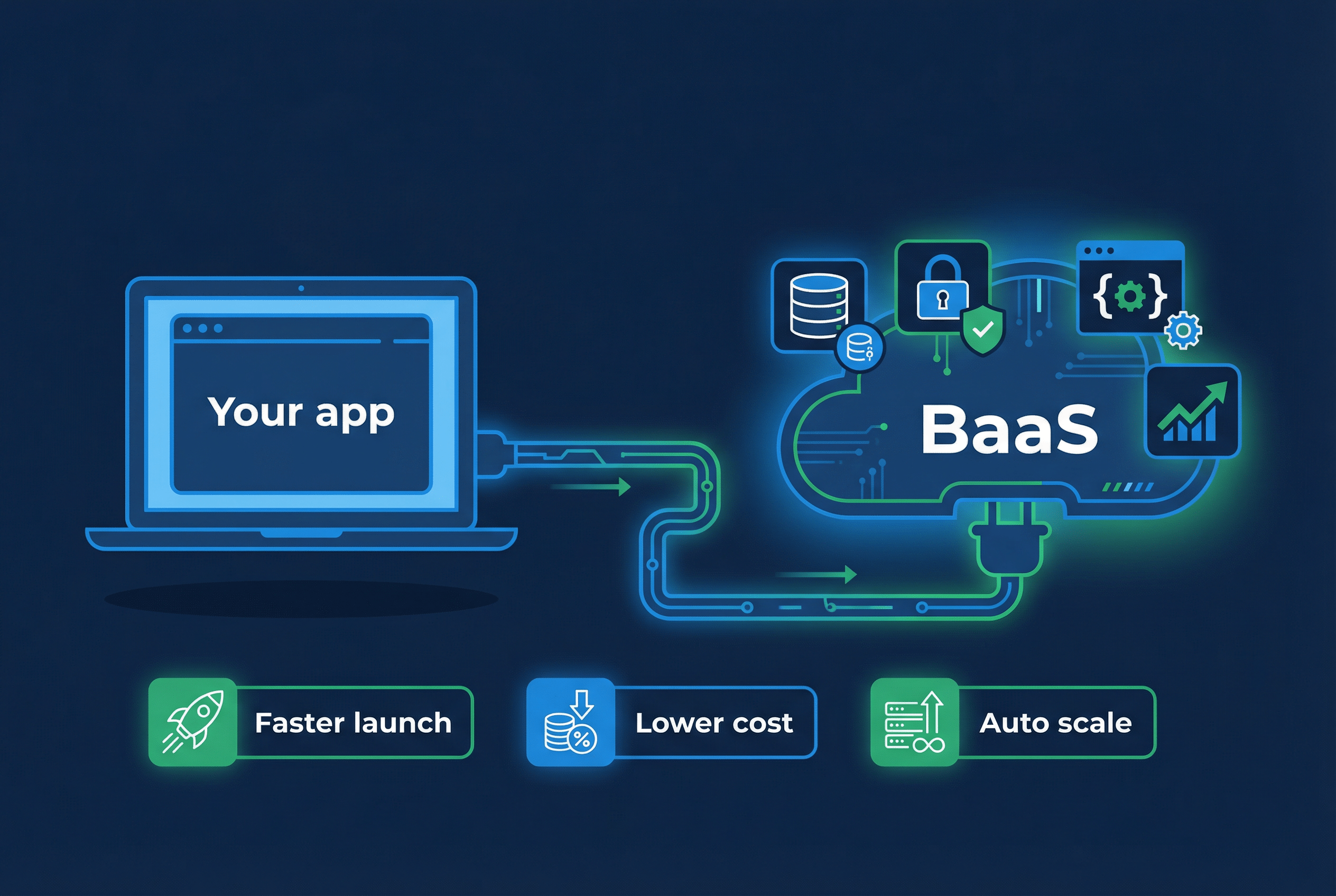
Backend as a Service (BaaS) is a cloud-based paradigm that lets developers concentrate on the front-end user experience by having a third-party provider handle the backend infrastructure for apps. It is crucial for quicker product releases and startups since it speeds up development, reduces costs, offers automatic scaling and security, and makes integration with other services easier.
Managing servers, databases, and user logins can be daunting for people who are unfamiliar with development or lack technical know-how. Backend as a Service (BaaS) is useful in this situation.
App development is made easier by the pre-built backend solutions offered by BaaS platforms. BaaS enables you to concentrate on the benefits of your app rather than managing backend complexity, regardless of your level of coding expertise.
What is Backend as a Service (BaaS)?
Backend-as-a-Service (BaaS) is a cloud service concept where developers just need to design and maintain the frontend of a web or mobile application by outsourcing all of the backend work. BaaS providers offer pre-written software for server-related tasks such cloud storage and hosting, user authentication, database management, remote updating, and push alerts (for mobile apps).
Consider creating an application without utilizing a BaaS provider to be similar to directing a film. In addition to actually filming and directing the sequences that will be in the film, a film director is also in charge of organizing camera crews, lighting, set construction, costume, actor casting, and the production timeline. Now consider a scenario where the director only needed to direct and shoot the sequence because a service handled all the behind-the-scenes work. This is the concept behind BaaS: The director (the developer) can concentrate on the “action”—what the end user sees and experiences—while the vendor handles the “lights” and the “camera” (or server-side* functions).
Developers can concentrate on creating the front-end application code thanks to BaaS. They can incorporate all the backend functionality they require without having to construct the backend themselves thanks to the BaaS vendor’s SDKs (software development kits) and APIs (a mechanism for a program to make a request of another program). Additionally, they are not need to maintain servers, virtual machines, or containers in order to maintain the functionality of the application. They are therefore able to develop and release web applications, including single-page apps, and mobile applications faster.
Read Also: Building a Winning SaaS Product: From Idea to Launch
Here are some features of BaaS:
- BaaS makes it easy to create and manage user accounts and logins without much coding.
- It lets you store and manage data, eliminating the need to set up a database from scratch.
- BaaS comes with tools (APIs and SDKs) that help connect your application to the backend easily.
- Many BaaS platforms let you see updates in real time, so your application can show live data to users.
- BaaS offers space in the cloud to store files and images, making it easy to handle user uploads.
- You don’t need to worry about managing servers—BaaS takes care of that for you, so you can focus on building your application.
- Some BaaS platforms allow you to send notifications to users about updates or messages.
- BaaS often provides tools to track user interactions, helping you understand what works and what doesn’t.
- It also makes it easy to integrate with other services like payment systems and social media with minimal effort.
- As your app grows, BaaS scales with it, handling more users and data seamlessly.
Why use Backend as a Service (BaaS)?
There are several key reasons why BaaS is an excellent choice for developers:
- Pre-built features reduce development time, allowing you to focus on design and functionality instead of backend issues.
- With BaaS, you don’t have to worry about servers, scaling, or security updates—the provider takes care of it all.
- Most BaaS platforms offer essential features like user authentication, data storage, and real-time updates, helping you build your app without starting from scratch.
- As your application gets more users, BaaS can handle it! These services adjust to support more users and data, so you can focus on growing your app.
- BaaS handles the infrastructure so you don’t need to spend time or money on the backend. This allows you to focus on design and creating user experiences that add value to your users.
When to Use Backend as a Service (BaaS)
BaaS is perfect for building an app in a short amount of time without managing the backend. Here are the scenarios when BaaS makes sense:
- BaaS handles your app’s backend, letting you focus on its features. For example, when building a to-do list app, BaaS makes it easy to manage user logins and task data without setting up servers from scratch.
- For small teams or solo devs, BaaS handles the backend. You do not need extra resources.
- If you’re launching a startup, Baas lets you release a Minimum Viable Product (MVP) without delay. It helps you speed up development and cut costs.
- If your app needs features like user authentication, data storage, or push notifications, BaaS provides them out of the box. For example, when building a social media app, BaaS simplifies user logins and file uploads, saving you from starting from scratch.
- BaaS automatically scales to support more users, allowing you to focus on improving your app. For example, a small multiplayer game can start with a few players, and as it grows, BaaS will seamlessly handle thousands without extra backend effort.
What are the Popular Backend as a Service Tools?
Here are some well-known platforms you can utilize if you want to explore BaaS:
1. Clerk
Clerk software focuses on user management. It offers tools for authentication, user profiles, and permissions management. It’s great for developers who need simple user management in their apps.

Features of clerk
Clerk provides:
- Multi-factor authentication (MFA)
- Passwordless login (magic links, OTPs)
- Social & OAuth login (Google, GitHub, and so on)
- Enterprise SSO (SAML, OAuth)
- Biometric login (Face ID, Touch ID)
It also handles:
- User profiles & custom attributes
- Roles & permissions
- Teams & organizations
- Session management
For security, it offers:
- Token-based authentication (JWT)
- Rate limiting
- Audit logs
- GDPR & SOC 2 compliance
For developers, it comes with:
- Prebuilt UI components
- SDKs for React, Next.js, Vue, and so on
- Custom email & SMS templates
Pricing
Clerk offers a Free Plan that includes up to 10,000 Monthly Active Users (MAUs) at no cost. For more advanced features, the Pro Plan is available at $25 per month, which also includes the first 10,000 MAUs.
2. Firebase
Firebase is a Google-backed BaaS platform. It is known for its real-time databases, authentication, and cloud storage. It also has easy-to-use tools for web and mobile apps.

Features of Firebase
Firebase provides:
Backend Services
- Firestore & Realtime Database
- Cloud Storage
- Serverless Functions
- Web Hosting
Authentication
- Email & password login
- Social logins (Google, Facebook, and so on)
- Phone authentication
- Anonymous sign-in
Analytics & Monitoring
- Google Analytics
- Crash tracking (Crashlytics)
- Performance monitoring
- A/B testing
Engagement Tools
- Push notifications
- Remote app updates
- In-app messaging
Machine Learning
- Text recognition
- Image labelling
Pricing plan
Firebase offers a Spark Plan (free tier) and a Blaze Plan (pay-as-you-go). The Spark Plan provides limited free usage, while the Blaze Plan charges based on your actual usage.
3. Convex
Convex is a serverless BaaS platform. It provides real-time data sync and scalable backend services. The design simplifies serverless computing for developers.

Convex Features
- Database – Real-time data storage
- Serverless Functions – Run backend logic without managing servers
- Authentication – Built-in user auth & access control
- Caching – Faster data retrieval
- Webhooks & Crons – Automate tasks & trigger events
Pricing
- Free Plan – Limited resources for small projects
- Pro Plan – Pay-as-you-go based on usage
4. 8base
A low-code platform that allows developers to build serverless apps with minimal setup. It provides database management, authentication, and API development tools.

8base Features
- Backend Builder – Manage your database easily.
- Serverless Functions – Run custom backend logic.
- GraphQL API – Auto-generated API for your data.
- Authentication – Built-in user login & access control.
- File Management – Store and manage files.
Pricing
- Free Plan – $0/month (1 developer, basic features).
- Developer Plan – $25/month per developer.
- Professional Plan – $150/month (5 developers).
- Custom Plan – Contact 8base for enterprise solutions.
5. Backendless
Backendless is a no-code platform that makes app development easy. It provides APIs, data storage, user management, and real-time updates in one place.

Features
- UI Builder: Design your app’s front end visually without coding.
- Real-Time Database: Store and sync data in real-time across clients.
- User Authentication: Manage user sign-ups, logins, and roles.
- Cloud Code: Implement custom server-side logic without managing servers.
- Push Notifications: Send real-time alerts to users on various devices.
Pricing
Backendless offers several plans to suit different needs:
- Free Plan: Ideal for small projects or learning purposes.
- Scale Fixed Plan: Provides predictable monthly billing with set resource limits.
- Scale Variable Plan: Offers flexibility with usage-based billing, scaling as your app grows.
- Backendless Pro: A self-hosted solution for enterprises requiring unlimited scalability and control.
6. Appwrite
Appwrite is an open-source BaaS that provides databases, authentication, file storage, real-time updates, serverless functions, and API management. It supports multiple platforms and offers built-in security and scalability for modern apps.

Features
- Authentication: Secure user login with over 30 methods, including email/password, OAuth, and magic URLs.
- Database: Scalable storage with advanced permissions, custom data validation, and support for relationships.
- Functions: Deploy serverless functions in over 13 languages, with automatic GitHub deployment and custom domain support.
- Storage: Manage and serve files with built-in security and privacy features.
- Real-Time: Subscribe to database events for instant updates.
Pricing
- Free – $0/month (5GB bandwidth, 2GB storage, 750K function runs).
- Pro – Starts at $15/month (more storage, bandwidth, & features).
- Scale – Starts at $599/month (for large-scale projects).
Finally
For developers, Backend as a Service (BaaS) is perfect. It offers a productive and economical method of managing backend development work. BaaS can help you develop more quickly. You can skip managing servers thanks to it. After that, you may concentrate on creating better apps.
Check out the BaaS tools in this article if you’re new to backend development. They can make your workflow easier. Take your work to the next level by giving BaaS a try!







Comments