
 By

Social commerce is shopping in which social interaction, recommendations, or community content shape discovery or the purchase, not merely an ad that sends people to a separate store.
If someone discovers a product through a creator, asks other buyers about it, and then pays on the retailer's website, why wouldn't that count? That question exposes the problem with defining social commerce only as checkout inside an app.
For owners and creators, the useful distinction is what helps someone decide to buy, not just which screen collects the payment. The right approach depends on your audience, your product, and the shopping habits in your market.
Table of Contents
- What Social Commerce Actually Means
- Social Commerce Compared with Traditional E-commerce
- How the Social Commerce Funnel Works
- Social Commerce by Market Not One Pattern
- Ways Businesses Sell Through Social Commerce
- When a Social Purchase Goes Wrong
- Choose a Social Commerce Model That Fits
What Social Commerce Actually Means
Social commerce joins e-commerce to social interaction. People discover products, exchange recommendations, watch demonstrations, contribute reviews, and sometimes complete payment within a social network or related community feature.
A traditional online store is like a shop on a street. Social commerce is a sale that starts in a conversation already happening among friends, fans, or a livestream audience.
Say a home baker watches a creator demonstrate a mixing bowl. Other viewers ask whether it slips on the counter, existing customers share photos, and the creator demonstrates the base. The baker isn't evaluating the bowl from a catalog alone. Other people contribute information that shapes the decision.
Participation makes the difference
A brand publishing a product photograph hasn't automatically created social commerce. The stronger signal is meaningful participation: a recommendation, a useful answer, a customer demonstration, or a community discussion that influences shopping.
Yahoo introduced the term social commerce in 2005, according to the academic review of social-commerce development. Scholars subsequently treated it as an area connecting electronic commerce, online communities, advertising, word of mouth, and participatory web technologies.
The concept map shows how these activities fit together.
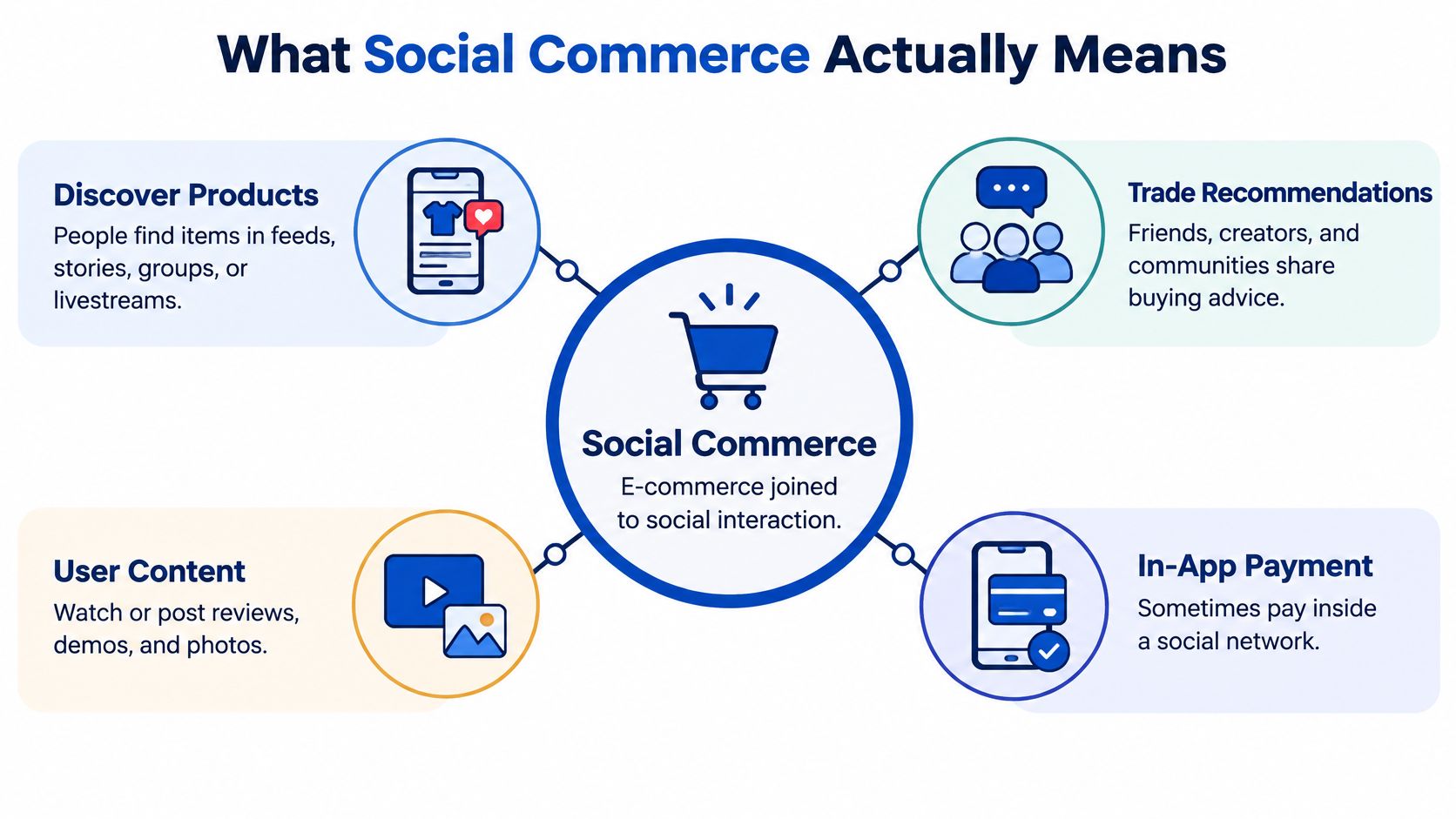
The payment node is optional, not the definition's sole requirement. A community can materially influence a purchase even when the merchant handles payment elsewhere.
Published estimates of the social commerce market
Market estimates help establish scale, but they aren't interchangeable. Keep the publisher, period, and measurement label attached to each figure.
| Source | Year covered | Published figure |
|---|---|---|
| Grand View Research | 2025 market value | USD 1,484.5 billion |
| Future Market Insights | 2025 market estimate | USD 1.6 trillion |
| Expert Market Research | 2025 market value | USD 1,490.12 billion |
| Quantumrun | 2024 global sales | USD 997.8 billion |
These are independent published figures, not observations from a single consistent series. Don't subtract one publisher's sales figure from another publisher's market estimate and call the difference growth.
For practical purposes, the formats that count include:
- Social shopping, where people evaluate products together.
- Creator-led selling, where a demonstration or recommendation supports a purchase.
- Live commerce and shoppable posts, where content connects directly to product access.
- Community recommendations and platform checkout, where participation or transaction tools support buying.
Choosing among platforms comes after understanding that mechanism. HiveHQ's guide to the best platforms for selling on social can help you compare channel options against the kind of interaction your customers need.
The answer to what is social commerce is therefore broader than an app feature, but narrower than every brand activity on social media. The social element must contribute to shopping.
Social Commerce Compared with Traditional E-commerce
Social commerce versus traditional e-commerce
| Stage | Traditional e-commerce | Social commerce |
|---|---|---|
| Discovery | Search, email, and ads lead to a store | Feeds, profiles, groups, and livestreams surface products |
| Checkout | Brand site or marketplace cart | In-app checkout, mini program, or a link to another retailer |
| Trust signals | Product page, specs, and store reviews | Ratings, creator demos, referrals, and community discussion |
| Who makes the selling content | The brand or retailer | The brand plus customers and creators |
| What to measure | Visits, add-to-cart, and orders | Exposure through repeat purchase as one event sequence |
| If it is done poorly | Weak on-site conversion | Manipulated proof or an unclear seller damages trust |
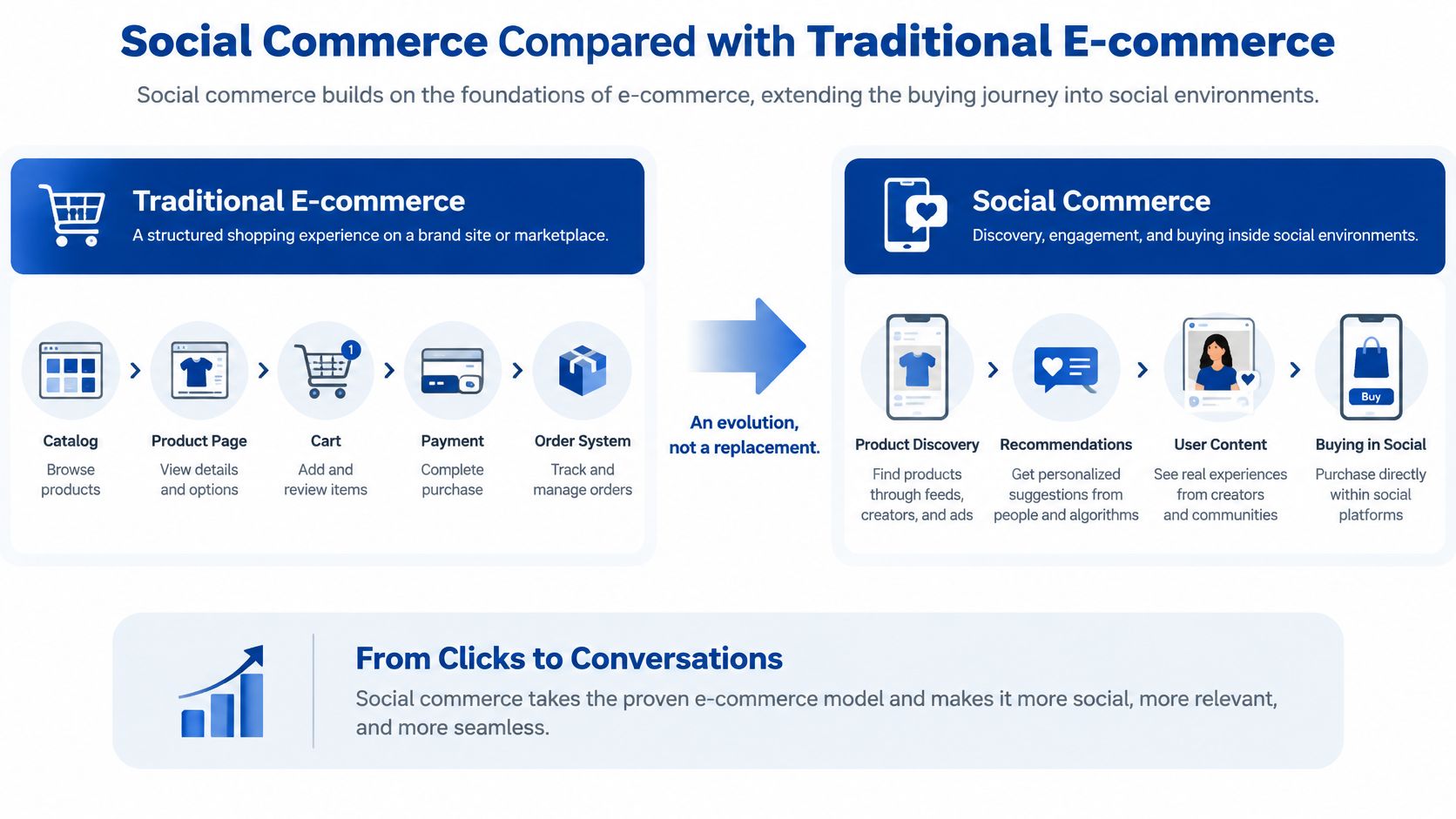
Think of traditional e-commerce as a store with a staffed information desk. Social commerce adds customers and creators who can explain, demonstrate, and challenge what the store says. The transaction machinery remains necessary, but more people contribute to the buying decision.
The visual comparison separates that machinery from the surrounding interaction.
Discovery and checkout serve different jobs
Discovery concerns how someone encounters a product. A conventional store often receives shoppers who arrive with a search query, an email offer, or an advertising message. A social environment can introduce an item while someone is watching content or discussing a related problem.
Checkout concerns where the order is completed. Neither a social discovery experience nor a community recommendation dictates the payment location. What matters operationally is that the product, price, availability, and delivery promise remain consistent when the shopper changes screens.
An academic review available through PubMed Central describes social commerce as combining transactional functions with profiles, communities, ratings, referrals, recommendations, and user-generated content. It's an evolution within e-commerce, not a reason to discard catalogs, payment processing, or order management.
For businesses examining the technical separation between storefront experiences and commerce systems, our discussion of headless commerce and e-commerce architecture provides related context. Changing the front end doesn't remove the need for reliable operations behind it.
Trust and content have more contributors
Trust signals expand beyond specifications and merchant-written descriptions. Buyers can examine whether a creator uses the item convincingly, whether customer experiences agree, and whether questions receive direct answers.
Content creation also changes. The retailer still supplies essential facts, but customers and creators add demonstrations, comparisons, objections, and usage details. That contribution is valuable only when it's relevant and credible. A polished endorsement isn't a substitute for an accurate description.
For another visual explanation of the relationship, this video offers a supplementary view.
Measurement must connect participation to commercial behavior. An engaging comment thread may help someone buy later, while a heavily viewed post may generate no qualified demand.
Failure also looks different. An ordinary store can lose buyers through confusing navigation or weak product information. A social seller can suffer those problems while also losing credibility through planted reviews, evasive replies, or unclear sponsorship.
Operator's test: Did the social feature help generate a purchase that the ordinary store experience wouldn't have earned, and was the information behind that decision trustworthy?
That test is more useful than treating every social referral as evidence that a social strategy works.
How the Social Commerce Funnel Works
A social-commerce sale resembles a conversation around a demonstration table, not a conveyor belt. Someone watches, asks a question, checks another person's experience, and may return after buying to help the next shopper.
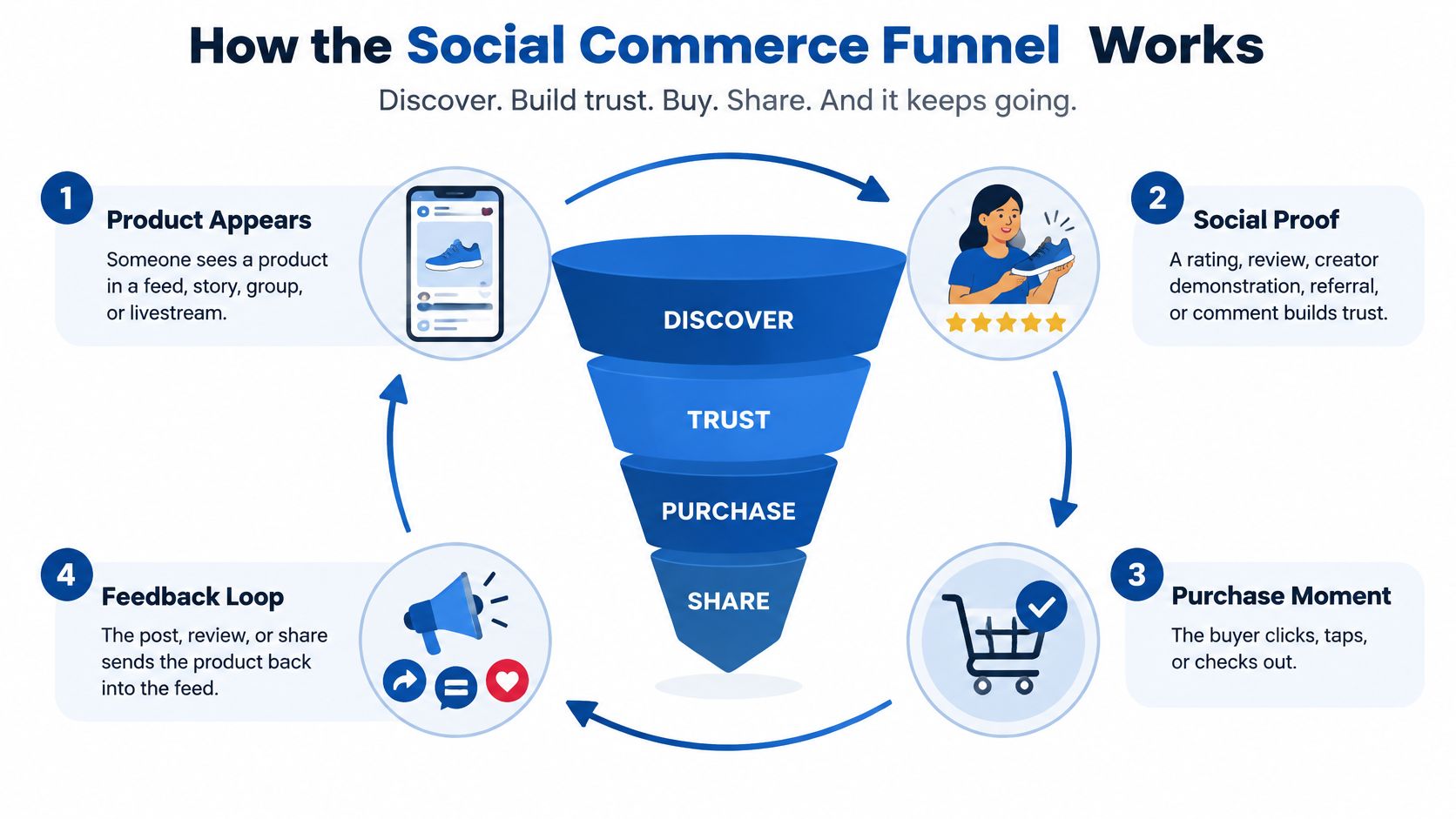
The funnel is a sequence of decisions with feedback, rather than a link followed by an order.
Follow the buying sequence
The product appears. A shopper encounters an item in a feed, story, group, or livestream. At this stage, show the product clearly enough that viewers understand what it does and who it's for.
Social proof becomes available. A rating, review, referral, comment, or creator demonstration provides information beyond the seller's promise. Make useful evidence accessible instead of burying it beneath promotional captions.
The shopper evaluates fit. They ask about dimensions, compatibility, materials, delivery, or another practical concern. A precise answer helps them judge suitability. An enthusiastic but irrelevant answer doesn't.
The shopper opens a purchase path. They use an in-app product view or a tagged outbound page. Match the item, variation, and offer to the content they just watched.
The shopper pays. Payment happens through the available platform or merchant checkout. Confirm the total and delivery expectations before asking for commitment.
The buyer contributes feedback. A review, complaint, repeat order, or shared photograph becomes information for future shoppers. Treat post-purchase support as part of the selling process.
The diagram condenses these decisions into a loop.
Measure confidence before measuring completion
Trust formation is the central mechanism, not an automatic benefit of adding comments. A meta-analytic structural-equation study synthesized 189 findings from 68 social-commerce studies, examining relationships among social, technological, motivational, intention, and usage variables.
That breadth supports looking beyond advertising exposure. A buyer needs information that feels credible, relevant to the product, and authentic enough to use.
Attach an intermediate metric to each important uncertainty:
- Review exposure, the share of viewers who encounter a credible customer review.
- Review helpfulness, whether buyers consider the information useful for deciding.
- Creator-to-product fit, whether the creator can demonstrate the relevant use convincingly.
- Response time, how long shoppers wait for an answer to a purchase question.
- Referral and assisted conversion, whether social interactions contribute to completed orders.
- Repeat purchase by creator or community, whether the relationship produces buyers who return.
Choose a primary metric for the test rather than treating every dashboard value as equally important. For a product with frequent compatibility questions, that might be completed orders among shoppers who received a compatibility answer.
The accompanying trust condition should be explicit: the answer must be accurate, specific, and consistent with the product documentation. Speed alone isn't success.
Test the contribution fairly
Randomly vary exposure to a review or demonstration where your tools allow it. Alternatively, keep a comparable audience out of the social-proof treatment, or assign creator-specific landing pages so you can examine the resulting buying behavior.
Keep prices, availability, and other major conditions comparable. Otherwise, a discount or stock difference may explain the result better than the social feature.
Poor or manipulated content can attract clicks while disappointing buyers. If questions remain unanswered or reviews look planted, don't assume a checkout redesign will solve the underlying problem. Repair the information people use to decide.
Social Commerce by Market Not One Pattern
How does social commerce work across markets? A shopping journey can begin in a social feed and end on a retailer's website, much like seeing a product in a shop window before buying it elsewhere. The route from discovery to payment varies by audience and market.
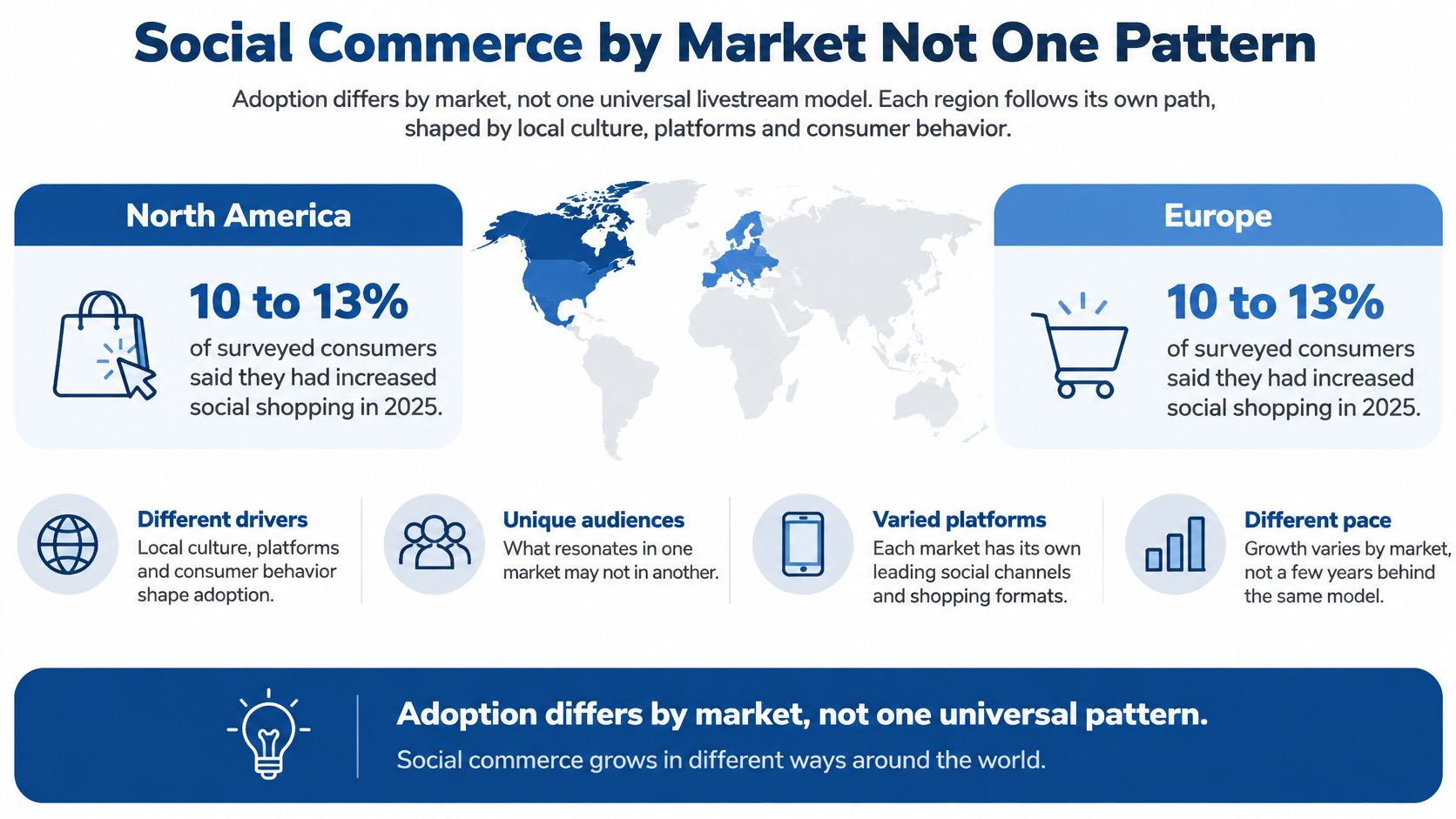
NielsenIQ's commerce trends report reports live-shopping participation of 87% in China, 64% in Latin America, 52% in Europe, and 43% in the United States. The report also says 10%–13% of surveyed consumers in Europe and North America reported increased purchasing through live commerce on social platforms in 2025.
These figures measure different things. Participation indicates involvement, while increased purchasing describes a change in buying behavior. Neither figure predicts how many customers will buy during a particular event.
Social and live commerce signals by market
A comparison works only when each measure is kept distinct. The figures below show reported live-shopping participation alongside reported changes in purchasing.
| Signal | Place | Figure |
|---|---|---|
| Live-shopping participation, NielsenIQ | China | 87% |
| Live-shopping participation, NielsenIQ | Latin America | 64% |
| Live-shopping participation, NielsenIQ | Europe | 52% |
| Live-shopping participation, NielsenIQ | United States | 43% |
| Consumers reporting more live-commerce purchasing in 2025, NielsenIQ | Europe and North America | 10%–13% |
The infographic focuses on the change in live-commerce purchasing. Its adoption shorthand refers specifically to increased live-commerce purchasing, not total social-commerce adoption.
An ecosystem isn't just a video format
A livestream is one part of a buying system, like a shop's front window: it attracts attention, but the purchase also depends on what happens inside. In the United States, a customer may watch a creator's recommendation and then buy through an outbound link or platform checkout. In China, social commerce can connect entertainment, a host, payment, customer service, and fulfillment within a mobile ecosystem.
That difference affects the work behind the screen. Frequent broadcasts require hosts, preparation, product knowledge, moderation, inventory coordination, and customer support. Fulfillment matters too: a persuasive host cannot make unavailable stock or an unfamiliar payment process easier for customers.
A large social audience tells you where people pay attention. It doesn't tell you where they're comfortable paying.
A viewer may enjoy a product demonstration yet prefer to complete payment through a retailer they already know. Social discovery can therefore be valuable even when checkout happens elsewhere.
Estimate demand for the behavior you need
Customer interest in social media is not the same as interest in buying through it, like browsing a shop window is not the same as entering the store. Ask about specific actions: whether customers have bought during a live session, used product tags, or saved an item to purchase later.
Plan separately for discovery demand and checkout demand. Tagged visits and orders influenced by social content can help show the value of discovery, while purchases completed within the social platform indicate demand for in-platform checkout.
Before scheduling frequent livestreams, run a limited event. Review attendance, relevant questions, completed orders, support workload, and returns. Use what customers do to decide whether a live-shopping operation fits your market.
Ways Businesses Sell Through Social Commerce
Choosing a social-commerce format is like choosing a sales tool. A product tag, a creator recommendation, and a live demonstration do different jobs, so the most elaborate option isn't automatically the best one.
Start with the constraint you need to solve: product access, borrowed trust, demonstration, community participation, or integrated service.
Match the format to the job
Shoppable posts and stories connect content to a specific item. Their job is to help an interested viewer reach the right product without searching through an unrelated catalog.
The operating requirement is catalog accuracy. Check product identifiers, variations, availability, and destination pages before publishing. If you already use those services, Carti's guide can help you optimize your Shopify Instagram sales setup, subject to the features currently available for your account and market.
Creator and affiliate arrangements give a seller access to someone else's audience relationship. A tracked recommendation can introduce the product to people who already value that creator's judgment.
Agree on compensation, disclosure, approved factual claims, and tracking before content goes live. You're buying access to trust and attention, not acquiring ownership of the audience.
Livestream selling gives a host room to demonstrate a product and answer objections in real time. It suits situations where watching the item work is useful to the purchase decision.
Prepare stock, a moderator, product links, and a fulfillment plan. Any time-limited offer must have genuine terms that the host can explain accurately.
| Format | Main job | Essential operating requirement |
|---|---|---|
| Shoppable content | Connect interest to an item | Accurate product links and catalog |
| Creator or affiliate selling | Borrow relevant trust and reach | Clear agreements and attribution |
| Livestream selling | Demonstrate and answer questions | Host preparation and order capacity |
| Community selling | Support recommendations and repeat buying | Consistent moderation and service |
| In-app marketplace or mini program | Combine shopping and service | Connected catalog, payment, and support |
Community and integration solve different problems
Community selling resembles a specialist club with a useful recommendation desk. Existing buyers exchange experiences, discuss usage, and refer others.
Give the group a purpose beyond promotions. Answer product questions, invite honest reviews, and establish moderation rules that allow criticism without permitting harassment or spam. This approach suits products people use repeatedly or discuss over time.
In-app marketplaces and mini programs bring browsing, service, and payment into a connected environment. WeChat's Mini Programs illustrate this integrated model, where community interaction and mobile services can sit alongside transaction functions.
The operating requirement is coordination. Catalog changes, payment status, order records, and customer-service responsibilities must remain aligned, rather than being maintained as disconnected tasks.
If paid distribution supports any of these formats, use data-driven social media advertising strategies for ROI to connect spending decisions to commercial outcomes.
These formats aren't a maturity ladder. A well-run referral community may fit a business better than a full platform storefront, and a useful demonstration may outperform a larger catalog of weak promotional content.
When a Social Purchase Goes Wrong
25% of global consumers are concerned about security when following purchase links from social media, while 71% worry about the security of personal details when shopping online, according to SOTI's social-commerce industry report.
These are different concerns, but both challenge the assumption that faster checkout is always better. Removing steps can make purchasing easier while leaving buyers unsure who sold the item, who received their information, or who must handle a refund.
A social feed can resemble a shopping center where the signs are more visible than the shop names. Before paying, identify the business behind the counter.
Different purchase paths mean different responsibilities
| Purchase path | What to establish before paying |
|---|---|
| In-app marketplace | The seller's identity and whether the order qualifies for platform protection |
| Affiliate link to an outside retailer | The destination retailer's terms and who handles the order |
| Payment arranged through a direct message | The legal seller, payment method, transaction record, and available dispute process |
An in-app purchase may qualify for platform rules or buyer protection, but eligibility and exclusions matter. Being inside a familiar app doesn't guarantee that every seller or payment arrangement receives the same treatment.
With an affiliate referral, the creator may introduce the item without becoming the seller. After the click, the outside retailer commonly handles payment, delivery, and returns. Check the actual order terms rather than assuming the social platform will resolve a dispute.
A direct-message payment deserves particular caution when the seller requests a payment method without purchase protection. Don't send card details in a chat, and don't assume that a friendly exchange supplies a usable refund process.
Check accountability before convenience
Use a buyer's verification list:
- Confirm the legal seller. Find the business name, contact details, and merchant responsible for the transaction.
- Read return and refund terms. Check deadlines, exclusions, return postage, and the return destination before payment.
- Identify applicable protection. Examine platform rules, payment-provider dispute procedures, and relevant local consumer rights.
- Inspect the destination. Make sure a purchase link leads to the intended retailer rather than an imitation checkout.
- Separate popularity from quality. A creator's following doesn't establish product safety, suitability, or durability.
Rights, payment reversals, data practices, and cross-border return arrangements differ by market. Save the listing, order confirmation, seller correspondence, and applicable terms so you have a record if a problem occurs.
Sellers need a visible resolution process
For a business, trust is an operating requirement. Name the merchant clearly, publish the return window, and explain where customers should request help.
Acknowledge public complaints where the platform permits it, then move order numbers, addresses, and other personal information into a private support channel. Keep payment details with an appropriate payment processor rather than collecting them through messages or improvised forms.
Buyer protection check: Before removing another checkout step, make sure the customer can still identify who must make the problem right.
Convenience is valuable when responsibility remains clear. An easy purchase followed by an impossible refund isn't a successful customer experience.
Choose a Social Commerce Model That Fits
Choose the model that removes your customer's actual obstacle, not the one that produces the most impressive broadcast. A small, measurable operation is a better starting point than an elaborate storefront without a clear buyer need.
Think of the choice as fitting a key to a lock. If customers already like your content but prefer your familiar store, start with shoppable content and tracked outbound purchasing. If buyers already exchange advice in a group, improve answers and referral tracking before hiring a presenter.
Let the situation determine the investment
A product that needs demonstration may justify a limited live event when the audience already attends live sessions. Prepare enough stock, name the refund rule, and assign someone other than the host to handle operational questions.
A full in-app store calls for a different commitment. Budget for catalog maintenance, payment operations, order synchronization, and support within that platform. Treat an integrated mini-program ecosystem as a reference for what coordination can involve, not a template every small business must reproduce.
For campaigns built around a genuine deadline or limited release, Quikly's discussion of urgency-driven selling through social storefronts offers another planning perspective. Keep availability and deadlines truthful, and don't let urgency replace information a buyer needs.
Set boundaries before expanding
- Don't import a broadcast schedule blindly. High-frequency livestreaming needs demonstrated local demand and enough operational capacity.
- Don't count impressions as revenue. Use exposure to diagnose reach, then evaluate orders, repeat buying, and the costs required to serve those buyers.
- Don't hide the merchant of record. Customers should know who accepts payment and handles problems.
For surrounding business context, we publish practical articles across e-commerce, livestream shopping, mobile commerce, digital marketing, and entrepreneurship. Our guide to marketing an Etsy store also provides related reading for sellers evaluating how to attract buyers to an existing storefront.
Pick a single product, a platform your buyers use, and a success measure such as assisted orders or repeat purchases. Run the test through the normal buying and fulfillment cycle, record what customers asked, and decide whether the interaction changed purchasing enough to justify the work.
Mega Income Stream offers practical articles on e-commerce, digital marketing, mobile commerce, and livestream shopping for owners and creators comparing income models. Visit Mega Income Stream to explore the operating and marketing choices behind your next social-commerce test, then turn that reading into a focused product-and-platform experiment.










Comments