
 By

The risks of expanding a business include currency swings, weaker-than-expected demand, compliance gaps, economic volatility, and costs that outlast early revenue. International growth can diversify income, but it may also squeeze margins when exchange rates shift or local conditions change. A sound expansion plan tests both the potential upside and the downside before committing resources.
Look beyond the size of a new market. Customer interest matters, but so do payment timing, local operating requirements, and the cash needed to keep the business running through a downturn. A forecast based on steady sales and stable exchange rates can miss the pressures that turn growth into a cash-flow problem.
This guide explains how to assess demand, account for currency exposure, plan for legal and employment obligations, and stress-test expansion costs. It also shows how scenario planning can help you decide whether to enter now, adjust your approach, or wait until the numbers support a more resilient move.
Key Takeaways
- Stress-test projected margins against currency movements, and consider how payment timing could change the amount you ultimately collect.
- Validate local demand with market research before committing to a full launch, then use results to refine the offer and entry plan.
- Map tax, employment, commercial, and intellectual property obligations across both home and target markets to reduce compliance exposure.
- Build scenarios for inflation, downturns, and regulatory shifts, with clear milestones for reviewing or adjusting the expansion.
- Model setup costs, delayed customer payments, and ongoing operating needs alongside potential diversification and scale benefits.
1. Currency fluctuations and profit margins
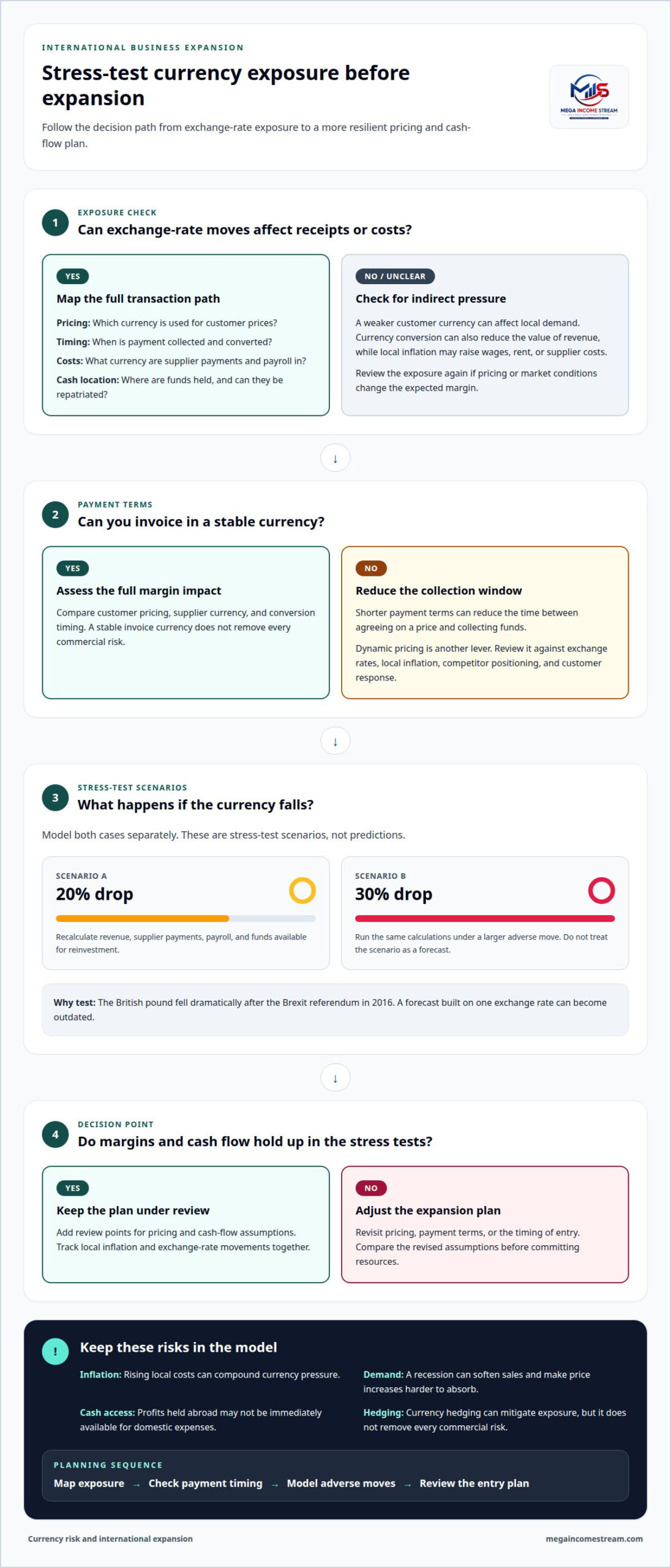
An international sale can grow revenue while shrinking the profit retained after conversion. If a US business invoices a customer in another currency, the exchange rate may shift between the sale, payment, and conversion. Assess the full transaction path: pricing currency, payment terms, conversion timing, supplier currency, and where the business holds its funds. A weaker customer currency can make the same product feel more expensive locally, while converting collected revenue back into dollars can reduce its value. Currency fluctuations can therefore affect both customer demand and the margin recorded at home.
Model adverse moves before committing to expansion. Include a scenario with a 30% currency drop, and separately consider the risk of a 20% drop. These are stress-test scenarios, not predictions. Recalculate revenue, supplier payments, payroll, and the amount available for reinvestment under each case. The Brexit referendum took place in 2016, after which the British pound fell dramatically. That example shows why a forecast based on one exchange rate can become outdated. Add a review step to the financial plan so pricing and cash-flow assumptions change when market conditions move.
Currency hedging can help mitigate exposure in volatile markets, but it does not remove every commercial risk. First, map the transactions that create exposure, including customer receipts and payments to overseas suppliers. Then compare that exposure with available cash-flow flexibility and the business’s tolerance for uncertain margins. If invoicing in a stable currency is not feasible, shorter payment terms can reduce the time between agreeing on a price and collecting funds. Dynamic pricing offers another lever: review prices against exchange rates, local inflation, competitor positioning, and customer response. Avoid sudden changes that could disrupt customer communication or trust.
Inflation can compound currency pressure. Rising local costs may increase wages, rent, or supplier prices while a weakening currency reduces the value of incoming revenue after conversion. A recession in the target market can also soften demand, making price increases harder to absorb. Track local inflation alongside exchange-rate movements, and update unit economics when either changes. For example, compare the margin on a locally priced product before and after supplier costs rise. Include any restrictions on repatriating profits or capital in the cash plan, since revenue held abroad may not be immediately available for domestic expenses.
Rapid growth can strain product quality and customer service when orders outpace staffing, inventory, or support capacity. Set volume triggers for quality reviews and response-time monitoring, then pace expansion if defects or unresolved requests increase. For international teams, cultural differences can also affect customer expectations and internal communication. Use local feedback to adjust service scripts and product details, and review currency exposure whenever a pricing change or market shift alters the expected margin.
2. Demand forecasting and market testing
A promising market can still produce weak sales if customers want different features, prices, or buying channels. Before entering a foreign market, assess its growth potential, local economic conditions, legal context, and competitive pressure. Build a demand forecast from identifiable customer groups rather than the total population. Estimate who needs the offer, how they currently solve the problem, and what could prompt them to switch. Record assumptions separately from observed evidence so an optimistic estimate does not quietly become the operating plan.
Test those assumptions before committing to a large launch. Use surveys to compare customer priorities, focus groups to hear objections, and sales or web analytics to observe behavior. Local knowledge can explain why responses differ across regions, especially when cultural preferences affect product use or communication. For example, test several value propositions with local audiences, then compare purchase intent and actual engagement. A useful research plan also examines regional competitors, their positioning, distribution methods, and customer reviews. That evidence can reveal opportunities to differentiate without assuming that demand for a similar product guarantees demand for yours.
Expansion setbacks show what weak market research can cost. Target’s expansion into Canada and Walmart’s expansion in Germany are cited as examples of difficulties associated with insufficient research. Starbucks’ initial struggles in Australia and KFC’s challenges in China illustrate how cultural misunderstandings can affect customer response. Treat these examples as prompts for specific checks, not proof that every foreign market behaves alike. Map local preferences, competitor strengths, regulations, and economic conditions before forecasting sales. Then document threats that could undermine each assumption and define a mitigation step for each.
Entry mode affects the level of exposure. Exporting is generally the lowest-risk entry mode for companies entering foreign markets because it avoids some commitments associated with building a local operation. It still requires demand validation, suitable distribution, and a clear understanding of local competition. Other approaches may provide more direct access to customers or operations, but can require greater resources and local coordination. Compare each option by control, investment needs, delivery complexity, and ability to adapt. Choose the mode that fits the evidence, not the one that assumes the fastest growth.
Turn research into a decision gate. Set milestones for customer interest, sales conversion, repeat demand, and delivery capacity, then review them before increasing inventory or marketing commitments. If survey responses are strong but trial purchases remain weak, investigate price, product fit, and purchase friction. If competitors dominate a channel, test another route to customers. This disciplined process helps teams pursue international expansion while limiting exposure to assumptions. A focused market-entry plan can also turn the findings into practical business strategies before resources are committed.
3. Regulatory, legal, tax, and employment compliance
Entering a target market means applying its regulatory framework alongside the rules that govern the home market. Tax, labor, commercial, trade, and intellectual property requirements can differ across countries. Map these obligations before choosing a market-entry structure or signing local contracts. Political instability, regulatory changes, corruption, limited institutional transparency, and weak intellectual property protection can also affect operations. Due diligence should identify risks that could disrupt sales, hiring, payments, or ownership of business assets.
Build a country-specific compliance map using local legal knowledge. Organize it by activity: selling, hiring, storing customer or business records, and protecting intellectual property. For each activity, identify the relevant local requirements, internal owner, documents, and review process. Local legal experts can clarify how rules apply to the planned business model and flag issues for further analysis. For example, a retention of title clause may need registration, notarization, or translation in some jurisdictions to remain valid. A contract template used at home may therefore need adapting.
Employment creates a separate set of obligations. Local employment laws can affect contracts, payroll processes, benefits, and workplace practices. A contract copied from the home market may omit protections or terms required in the target country. Work with local legal and human resources experts to understand those differences and develop compliant employment contracts. Also map who handles payroll, benefits administration, employee records, and recurring reporting. Missed requirements can lead to fines, legal disputes, reputational damage, or operational delays.
Operationally, expanding across borders adds country-specific HR, payroll, and benefits workflows. If ownership is unclear, these processes can create administrative bottlenecks, errors, and duplicated work. Assign a responsible person to each process, document approval steps, and establish a communication route between local and central teams. Businesses may use a foreign subsidiary, an employer of record, or a global employment platform, depending on their needs. Compare each structure against hiring plans, operating control, administrative capacity, and applicable local rules.
Tax and commercial compliance also shape cash flow and market access. Assess how the target market treats the planned sales activity, contracts, and business presence, then align recordkeeping and internal reporting with those obligations. Review intellectual property protection for the names, content, software, and other assets used to compete locally. In markets with political or regulatory uncertainty, maintain a contingency plan for rule changes or restricted operations. Review the compliance map when the business changes its products, hiring model, or local presence, and keep decision records accessible to those responsible for execution.
4. Economic volatility, inflation, and scenario planning
Economic shifts can turn a viable expansion forecast into operational strain. Build scenarios around declining demand, rising local costs, supply interruptions, and regulatory changes. For each scenario, estimate how revenue, sourcing, staffing, and cash availability would change. Compare the results with the resources available to keep the new operation running. A forecast that tests only expected conditions can miss the pressure created when several disruptions occur together.
The Black Sea blockade in 2022 drove wheat prices up and triggered a grain shortage of 30 million tons across Africa. This example shows how conflict can disrupt supply chains and affect prices far beyond the affected area. Identify critical suppliers, transport routes, and inputs before entering a new region. Then assess which alternatives exist if a key source becomes unavailable. A contingency plan should name decision owners, operational responses, and the conditions that trigger each action.
Inflation and downturns can change customer spending and business costs at the same time. Map which expenses depend on local economic conditions, then test how changes could affect sales, supplier terms, and staffing plans. Separate fixed commitments from costs that can be adjusted. This helps clarify how long the operation can withstand weaker demand. Include unexpected regulatory shifts in the review, since changes in local requirements can alter processes or increase operating pressure.
A business should delay or avoid expansion when its scenarios show it cannot sustain operations through plausible disruptions, or when critical risks lack workable mitigation plans. Delaying may also make sense when financial, technological, or human resources are not ready to support the target region. Use those gaps as decision criteria rather than relying on an optimistic forecast.
Set a review process before launch. Involve key stakeholders in defining goals, milestones, timelines, and contingency actions. Keep communication open with local teams and stakeholders so operational changes reach decision-makers quickly. Monthly check-ins, chats, or video conferences can provide a regular cadence for surfacing new risks. Use each review to compare actual performance with scenario assumptions, then adjust strategies as market conditions evolve. Record the change, the evidence behind it, and the next action.
Expansion can diversify risk by reducing dependence on a single domestic market and limiting exposure to local economic fluctuations. That benefit depends on how the new operation performs alongside the existing business. Review both markets together rather than treating international growth as a separate revenue line. If a downturn hits the target region, assess whether domestic performance can support continued operations. If both markets weaken, activate the contingency plan and reassess commitments before adding capacity.
5. Financial considerations for global expansion
Expansion costs depend on the market, operating model, staffing needs, and launch plan. Budget for local hiring, facilities, marketing, distribution, compliance, and adapting products or processes. Separate one-time setup expenses from recurring commitments, such as salaries, rent, inventory, and customer support. This distinction shows how much cash the launch consumes before revenue stabilizes. It also makes it easier to compare entry models without treating every expense as a single launch figure.
Hiring costs include recruitment, onboarding, payroll administration, and locally appropriate benefits. Facility expenses can include rent, utilities, equipment, and lease obligations. Marketing requires local positioning, translated or adapted creative, and channels that reach target customers. Contracts and supplier terms can also create fixed commitments. Model each expense by when it must be paid, which market drives it, and whether it can change if demand falls. A facility commitment, for example, may continue even when sales slow.
Expansion can pressure cash flow because spending often starts before customer payments arrive. Inventory, payroll, and launch marketing may require cash upfront, while customers pay later. That gap increases working-capital needs and can leave less cash for domestic operations. Forecast expected receipts alongside payment dates, supplier obligations, and recurring costs. Tie the forecast to operational decisions, such as when to hire or replenish stock, rather than relying only on projected sales.
Stress-test the plan against a major customer failing to pay for six months. Estimate which expenses would still fall due during that period, then assess how much working capital would remain for both markets. Also model slower sales, delayed deliveries, and additional inventory holding. These scenarios reveal whether expansion depends on prompt collections to cover essential expenses. Review contracts, payment schedules, and purchasing plans together so one delayed receipt does not trigger several avoidable cash shortfalls.
A major US retailer spent about $1 billion before withdrawing from Germany after nine years. The example underscores why financial planning must account for sustained operating costs, not just launch spending. Estimate how long the business can support local operations if results lag, then set review milestones tied to actual performance. Define in advance which commitments can be reduced, paused, or renegotiated if the market underperforms.
Global expansion can diversify revenue beyond one domestic market and create economies of scale through more efficient production and distribution. Those benefits depend on execution, customer demand, and the cost of coordinating cross-border processes. Compare expected unit costs with local logistics, supplier reliability, and service requirements. Then review actual performance against the original plan and adjust investment as conditions change. A practical financial model connects each major commitment to its payment timing, business purpose, and measurable operating result.
Mega Income Stream: Business Strategies
Mega Income Stream offers Business Strategies to help entrepreneurs turn expansion analysis into practical growth decisions. If currency exposure, market demand, compliance, or cash-flow assumptions still feel disconnected, strategic planning can help organize them into a clearer operating plan. The focus is on identifying opportunities, evaluating revenue potential, and building sustainable income streams around the business’s goals.
Consider the offering when you have assessed the main risks but need a coherent next step, such as prioritizing markets or aligning growth plans with revenue objectives. Mega Income Stream also offers a Consulting Business for entrepreneurs seeking strategic guidance on business growth and revenue optimization. These offerings support planning; they do not replace local legal or tax expertise when specialized advice is needed.
Contact Mega Income Stream to discuss business strategies for your expansion plans.
Turn expansion planning into a clear next move
The risks of expanding a business are easier to weigh when growth is treated as a sequence of choices, not a single leap. Decide what the next market must prove before it receives more attention. This keeps leadership focused on strategic fit rather than momentum alone.
Consider the opportunity cost of expansion. Time spent building a new market cannot also support product development, customer retention, or a stronger sales channel at home. Compare those competing uses of attention with the business’s long-term direction. A measured decision may mean advancing the expansion, refining its scope, or prioritizing another growth path.
Keep the next move specific: identify the strategic question that remains unresolved, name the evidence that would answer it, and use that evidence to choose a direction. This turns a broad ambition into a decision the team can own. Growth becomes more deliberate when each move has a clear purpose and fits the business’s wider priorities.
Frequently Asked Questions
What are the main risks of expanding a business?
The core risks are execution strain, weak customer uptake, funding pressure, and management attention shifting away from the existing business. These issues can compound: leaders focused on a new location may miss service or retention problems at home. Assign an owner to protect current operations while another tracks the expansion. Review existing customer retention and service quality alongside new-market performance so growth does not hide damage to the business that funds it.
What legal, tax, and regulatory requirements apply when expanding a business in the United States?
Requirements vary by business structure, activity, and location. Build a checklist for business registration, federal and state tax responsibilities, local permits, and employment obligations, then track each item by jurisdiction and responsible owner. The U.S. Small Business Administration’s registration guidance explains how structure and location affect registration steps. The IRS small-business resources cover federal tax topics for small businesses and self-employed people.
What risks should a business consider when expanding into a new market or state?
Consider whether the new location will stretch delivery coverage, management capacity, or the consistency of the customer experience. A company that sells nationally online may still face local fulfillment, support, or returns challenges after opening a physical presence. Map the customer journey from order to resolution, then identify where distance or local partners add handoffs. Compare that operating model with the existing one before adding a location or sales channel.
How can expansion increase debt and financial risk?
Borrowing to fund expansion creates repayment obligations even if the new operation takes longer to generate cash. Debt can also reduce flexibility if revenue falls while fixed commitments remain. Before borrowing, separate funds for launch assets from the working capital needed for routine operations. Track the effect of each proposed loan payment on the existing business’s planned spending, and compare borrowing with a slower rollout funded by retained cash.
How can businesses assess demand and market risk before expanding?
Use a small paid pilot to test whether customers will complete a purchase, not just express interest. Track the full path from first contact to payment, delivery, refund, and repeat purchase. Compare results across customer groups or sales channels to see where the offer converts and where it stalls. Record the pilot’s assumptions and constraints, then use the results to revise the launch plan before increasing inventory or service capacity.
What steps can reduce the risks of business expansion?
Define a go-or-pause decision before launch, with clear owners for sales, operations, and financial tracking. Keep early commitments reversible where possible, such as using a limited product range or a temporary sales channel. Set a process for escalating customer complaints, delivery failures, or unexpected expenses. After each review, document the decision and its rationale. This creates an audit trail and helps teams act consistently as the expansion develops.










Comments