
 By
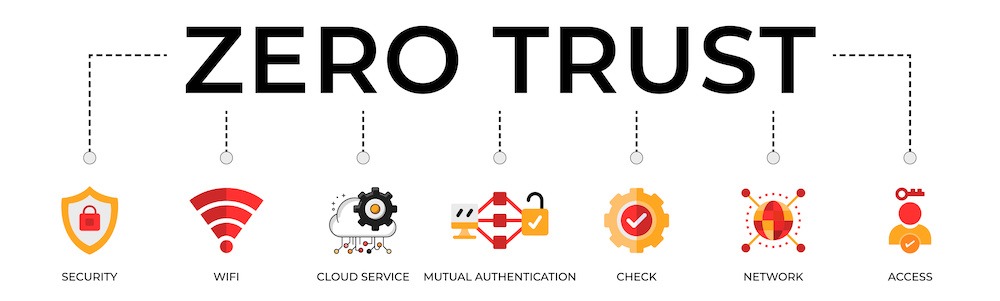
The Zero Trust Architecture (ZTA) is a cloud security framework that eliminates implicit trust by requiring constant verification for all users, devices, and applications that access resources, regardless of network location. It moves away from traditional perimeter-based security and toward a granular, context-aware strategy that enforces least-privilege access and continuously monitors for threats to reduce the effect of potential breaches in complex, cloud-based systems.
What is Zero Trust security?
Zero Trust security is an IT security architecture that involves tight identity verification for any person or device attempting to access resources on a private network, whether they are inside or outside the network perimeter. ZTNA is the primary technology associated with Zero Trust architecture; nevertheless, Zero Trust is a comprehensive approach to network security that includes a variety of principles and technologies.
Traditional IT network security relies on the castle-and-moat model. Castle-and-moat security makes it difficult to gain access from outside the network, but everyone inside is trusted by default. The issue with this strategy is that once an attacker gains access to the network, they have complete control over everything inside.
This vulnerability in castle-and-moat security systems is exacerbated by the fact that businesses no longer keep their data in a single location. Today, information is frequently dispersed among cloud vendors, making it more difficult to implement a single security control for a complete network.
Zero Trust security means that no one, inside or outside the network, is automatically trusted, and everyone attempting to obtain access to network resources must verify their identity. This additional layer of security has been found to help avoid data breaches. According to studies, the average cost of a data breach exceeds $3 million. Considering that figure, it should come as no surprise that many organizations are now eager to adopt a Zero Trust security policy.
What are the Main Principles Behind Zero Trust?
Continuous monitoring and validation
The Zero Trust network theory implies that there are attackers both inside and outside the network, hence no users or machines should be automatically trusted. Zero Trust authenticates user identification and privileges, as well as device identity and security. Logins and connections expire after a certain length of time, forcing users and devices to be re-verified on a regular basis.
Device access control
In addition to limitations on human access, Zero Trust demands rigorous controls on device access. Zero Trust systems must monitor the number of different devices attempting to access their network, check that each device is authorized, and assess all devices to guarantee they have not been compromised. This further reduces the network’s attack surface.
Microsegmentation
Zero Trust networks also make use of microsegmentation. Microsegmentation is the practice of dividing security perimeters into small zones to provide distinct access to different areas of the network. For example, a network with files housed in a single data center that uses microsegmentation could have dozens of different, secure zones. A person or program with access to one of those zones will be unable to access any of the other zones without additional authorization.
Preventing lateral movement
In network security, “lateral movement” refers to how an attacker moves within a network after acquiring access to it. Even if the attacker’s access point is identified, lateral movement can be difficult to detect since the attacker may have compromised other areas of the network.
Read Also: Cloud Security Best Practices for 2026
Zero Trust is intended to contain attackers so that they cannot move laterally. Because Zero Trust access is segmented and must be re-established on a regular basis, an attacker cannot move across microsegments of the network. Once the attacker’s presence is detected, the compromised device or user account can be quarantined, preventing further access.
Multi-factor authentication (MFA)
Multi-factor authentication (MFA) is also a key component of Zero Trust security. MFA requires more than one piece of evidence to authenticate a user; simply inputting a password is insufficient to gain access. MFA is often used for 2-factor authorization (2FA) on online sites such as Facebook and Google. In addition to typing a password, customers who enable 2FA for these services must enter a code sent to another device, such as a cell phone, providing two pieces of proof that they are who they claim to be.
What are the Benefits of Zero Trust?
Zero Trust as a philosophy is more appropriate for modern IT environments than old security measures. With such a diverse set of users and devices accessing internal data, and data kept both within and outside the network (in the cloud), it is considerably safer to assume that no user or device is trustworthy than to assume that preventative security measures have closed all the gaps.
The fundamental benefit of implementing Zero Trust principles is that it reduces an organization’s attack surface. Furthermore, Zero Trust reduces the harm when an assault occurs by limiting the breach to a small area through microsegmentation, lowering the cost of recovery. Zero Trust mitigates the impact of user credential theft and phishing attempts by requiring multiple authentication methods. It aids in the elimination of threats that circumvent typical perimeter-based defenses.
Furthermore, by checking each request, Zero Trust security decreases the risk provided by weak devices, especially IoT devices, which are frequently difficult to secure and update.
Any firm that uses a network and keeps digital data will most likely consider implementing a Zero Trust architecture. However, some of the most common use cases for Zero Trust are:
- Replacing or augmenting a VPN: Many organizations rely on VPNs to protect their data, but as described above, VPNs are often not ideal for defending against today’s risks.
- Securely supporting remote work: While VPNs create bottlenecks and can slow productivity for remote workers, Zero Trust can extend secure access control to connections from anywhere.
- Access control for cloud and multi-cloud: A Zero Trust network verifies any request, no matter its source or destination. It can also help reduce the use of unauthorized cloud-based services (a situation called “shadow IT”) by controlling or blocking the use of unsanctioned apps.
- Onboarding third parties and contractors: Zero Trust can quickly extend restricted, least-privilege access to external parties, who typically use computers that are not managed by internal IT teams.
- Rapidly onboarding new employees: Zero Trust networks can also facilitate quickly onboarding new internal users, making them a good fit for fast-growing organizations. In contrast, a VPN may need to add more capacity to accommodate large numbers of new users.







Comments