
 By
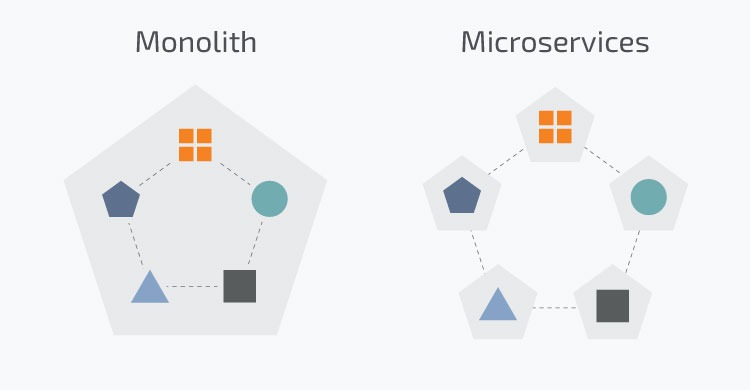
A monolith is a single, massive entity, whereas microservices divide an application into smaller, independent services that are more suited to the scalability and flexibility of the cloud. While a monolith scales the entire program and a single failure can bring down the entire system, microservices enable independent scaling of specific services, simpler upgrades, and greater fault separation in a cloud environment. While monoliths work well for smaller projects when getting started quickly is a top concern, microservices are best suited for large, sophisticated applications.
Below are some features of both microservices and monoliths:
Microservices
- Architecture: A collection of small, independent, and loosely coupled services that communicate via APIs.
- Scalability: Individual services can be scaled independently based on demand, making it highly efficient and well-suited for large, complex applications.
- Fault Isolation: A failure in one service is less likely to affect the others, containing the problem to a single service.
- Deployment: Each service can be developed, deployed, and updated independently, allowing for faster and more frequent updates.
- Cloud Suitability: The cloud’s elasticity and distributed nature make it an excellent environment for hosting and managing independent microservices.
- Complexity: Introduces operational complexity, such as managing inter-service dependencies and a steeper learning curve for development teams.
Monoliths
- Architecture: A single, cohesive codebase where all components are tightly coupled.
- Scalability: The entire application must be scaled, even if only one component is experiencing high load. Scaling is often limited to vertical scaling (more powerful hardware).
- Fault Isolation: Represents a single point of failure; a bug or failure in one part can bring down the entire application.
- Deployment: The entire application must be redeployed for even minor updates, making deployments slower and more complex.
- Cloud Suitability: Can be deployed in the cloud but doesn’t fully leverage the cloud’s capabilities for scaling and resilience as microservices do.
- Simplicity: Simpler to develop and get started with, making it a good choice for smaller applications with less complex needs.
Use Case Recommendations
There is a near unlimited supply of use cases that can be achieved by using either a monolithic architecture or a microservices architecture. Here are some of the most prevalent.
Monolithic architecture use cases
- Startups: Companies just starting out need two things: flexibility and start-up funding (and plenty of both). A monolithic architecture is the best way to start fledgling businesses. Further, it can be constructed by lean development teams in a cost-effective manner that doesn’t impose too steep a learning curve on those small teams.
- Basic projects: Having a single codebase pays dividends in convenience, especially with projects that are rudimentary in scope. When the software can go through the development process without needing to incorporate data from multiple sources, it’s a win for the organization.
Microservices architecture use cases
- Entertainment platforms: Running an international entertainment platform requires the ability to ride the changing tide of workloads, whether that demand turns into light workloads or heavy workloads. In the case of Netflix, the streaming video giant transitioned from a monolithic architecture to a cloud-based microservices architecture. The new Netflix backend contains plenty of load balancer support, which assists its efforts to optimize workloads.
- E-commerce: E-commerce depends on microservices architecture to make the magic of the electronic marketplace come alive with a seamless user experience. With ambitious retailers like Amazon (AWS) prompting sales with greater convenience and faster delivery, it’s easy to see why the 2023 ecommerce sales market topped 5.8 trillion USD.
- Toughest jobs: The ongoing use of microservices typically requires the implementation and administration skills of trained DevOps teams who can go about creating the specific services needed for that architectural framework. Those skills are especially useful when encountering complex applications.
Any full-scale deployment of microservices or monolithic architecture will unavoidably be misdirected if its design is finished in a vacuum without taking into account the most crucial factor—the unique requirements of your digital firm.
Read Also: What Is Cloud-Native Architecture?
When it comes to making judgments about your software infrastructure, this is the most important task for an IT director. It’s crucial to know when to employ a particular architectural style and to determine which system is best for your needs.
Because it is your responsibility to accurately anticipate the architectural system your business will require in the months and years to come, in addition to choosing the best architectural system for your firm, the self-analysis exercise is quite helpful. In a sense, you’re being given the responsibility of making future predictions.
Therefore, it is your responsibility to estimate future expansion even though a monolithic architecture could seem suitable for your startup. Additionally, it might be more prudent to invest in a microservices design if rapid expansion is anticipated. There are many factors to take into account:
- Business logic in use: Just as computer logic dictates what is and isn’t possible with a computer, business logic is based on business rules that govern how a business can and can’t be operated. Technically, it translates into the algorithms that define how information is passed between a database and a user interface.
- Front-end development: As early as planning the front-end of your software architecture, you need to define which architectural approach you are following, because each has a unique structure. In a monolithic architecture, the front-end application is manifested as one large codebase that houses all application code. In a microservices front-end application, multiple independently operating microservices can be put into operation.
- Fault tolerance: Another consideration that must be made involves how much fault tolerance is expected to be needed. Fault tolerance is a very tricky issue, because it can bring down an entire application if just one component in that system fails. A monolithic architecture lacks any isolation between components, and that can aggravate the lack of fault tolerance and lead to extended periods of downtime.
- Expected rate of change: The choice between monolithic architecture and microservices architecture is not merely a matter of software architecture. It’s really a selection between two business mindsets, one that simply wants to get into operation and another that insists on achieving substantive business growth. Growth can be tricky, but it’s well supported by microservices architecture attributes like faster development cycles and boosted scalability.







Comments