
 By

You answered a question in a meeting last month, and someone said, half joking, that you should charge for that. Since then the idea has been sitting there. You have years of operating knowledge, a phone full of people who still take your calls, and no real sense of whether a consulting practice is a business or a polite way to be unemployed in six months.
If you've been typing how do I start my own consulting business into a search bar late at night, the answer is less romantic than the question. The expertise was never the bottleneck. The bottleneck is packaging, pricing, and the discipline to sell before you build. Strong operators routinely spend four months on a name and a website without sending a single invoice, while quieter ones with a rough one-page offer land a paid diagnostic in three weeks.
What follows is the sequence I would run, in the order I would run it, with the trade-offs that decide whether the thing survives.
Table of Contents
- The Launch Sequence From Idea to First Invoice
- Define an Offer Buyers Will Pay For
- Set Prices Without Guessing
- Find Your First Clients Through a Weekly Pipeline
- Set Up Operations Before the First Contract
- Mistakes That Stall a New Consulting Practice
- Confirm Your First Offer This Week
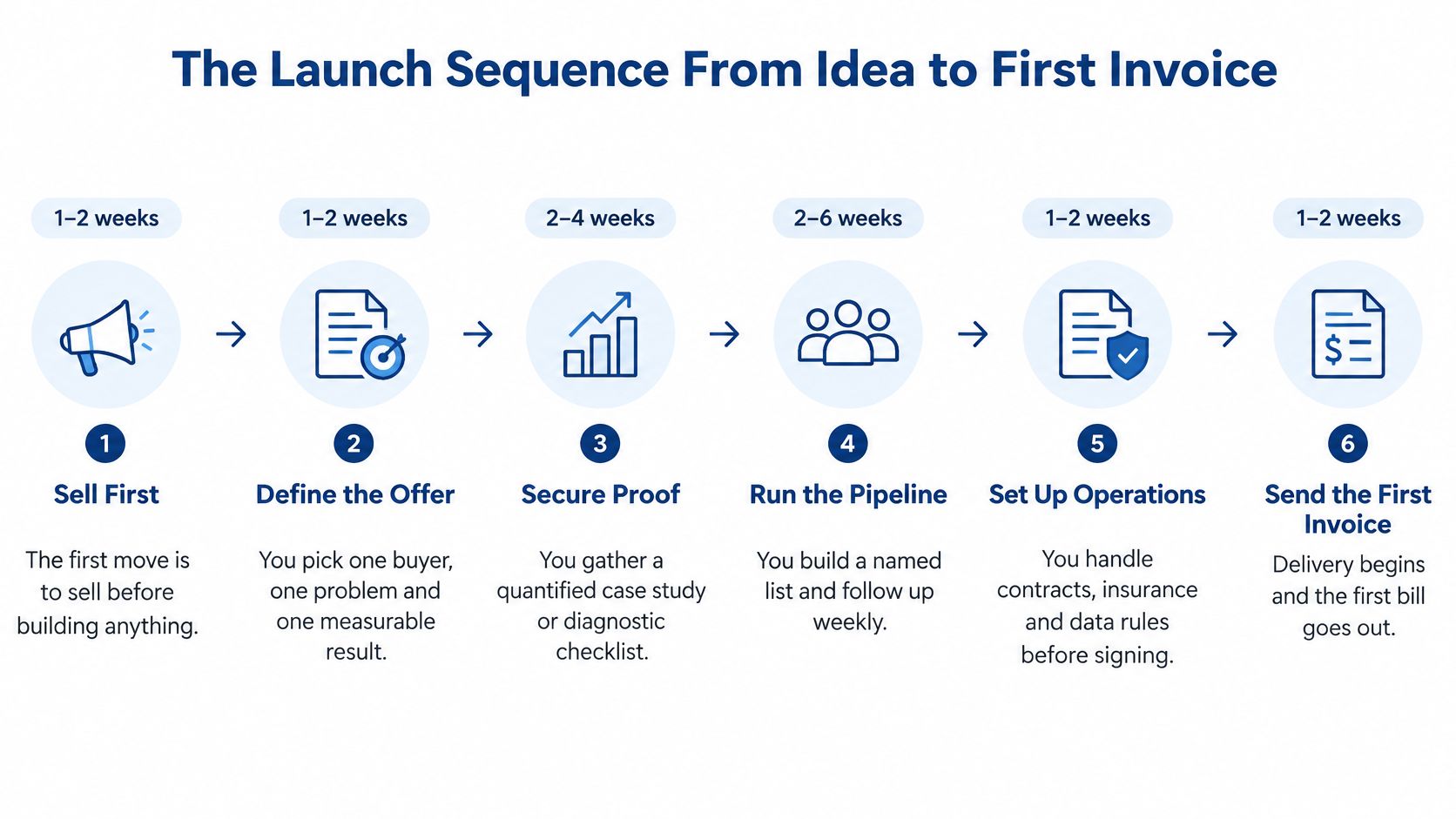
The Launch Sequence From Idea to First Invoice
The first invoice usually comes before the first logo. A capable operator can spend a month choosing a name while the actual risk sits untouched: whether a specific buyer will pay for judgment, implementation and accountability in a market where generic advice is cheap. Launch in the order that tests that risk first.
| Phase | Main action | Typical time | Done when |
|---|---|---|---|
| 1. Define the offer | Pick one buyer, one costly problem and one measurable result | 1-3 weeks | You can state the offer in one sentence |
| 2. Validate demand | Run 10 to 15 structured buyer interviews, then sell one paid diagnostic | 2-4 weeks | At least one buyer pays for the diagnostic |
| 3. Set prices | Build the fee from hours, costs, utilization and margin | About 1 week | Every proposal has a fixed fee or stated rate |
| 4. Set up operations | Choose structure, bank account, insurance and contract templates | 1-2 weeks | Contract and insurance are in place before kickoff |
| 5. Build the pipeline | Create proof assets and run a weekly outreach routine | Ongoing | Five qualified conversations happen each week |
| 6. Deliver and review | Run the first engagement and document the result | 4-12 weeks | The client signs off and agrees to a case study or referral |
That order protects cash and effort. Validation comes before operations so the paperwork matches a real engagement, and pricing waits until the offer names whose problem is being solved. The ranges assume a solo start and overlap in practice; pipeline work begins while contracts and insurance are still being set up.
Why one person can run the whole sequence alone
A consultancy starts light because the product is judgment applied to a costly problem. There is no stock to buy, no premises to lease and no production line to finance. The Bureau of Labor Statistics' self-employment overview describes independent management analysts as paid directly by clients, usually by the hour or by project, which means revenue starts only when a buyer accepts a scope and an invoice goes out.
That makes the early trade-off plain. AI can produce a decent-looking framework quickly, so a new practice has to prove it can choose, implement and stand behind the result rather than resell information. The diagnostic in phase 2 is the first test of that promise. If buyers will pay for a bounded piece of judgment, the setup work is worth doing. If they only want free insight, a better website will not fix it.
The early risk nobody budgets for: professional expertise creates a false sense of readiness. Being excellent at the work is evidence of capability, and the market still gets to decide whether the packaged offer is worth approving.
What to do this week
Write the phase 1 output as one sentence and stop there until it exists: buyer, problem, result. Example: "I help operations leads at mid-sized ecommerce brands cut customer acquisition cost by fixing the retention gap that makes paid traffic expensive." It is checkable, narrow enough to build a list from, and free of adjectives about passion.
Then use the sentence to make the next moves concrete. Find accounts that match it, draft interview questions, price the diagnostic and sketch the scope before any registration paperwork. When the offer needs to become weekly delivery rather than a positioning statement, the strategy execution framework shows how to translate it into recurring work.
Define an Offer Buyers Will Pay For
An offer is one buyer, one costly problem, one measurable result. Not a menu of services, not "strategy, operations and growth advisory." Buyers don't purchase capability. They purchase a specific outcome they can describe to their boss.

The U.S. Bureau of Labor Statistics projects employment of management analysts to grow 10% from 2025 to 2035, faster than the average for all occupations, and notes that growth is expected to be strongest among smaller consulting companies specialising in a specific industry or business function. Generalists are competing with everyone. Specialists are competing with three other people.
Here's how to build the offer in five steps.
- Pick one buyer segment. Not "SMEs" but operations leads at 20 to 200 person ecommerce brands, or finance directors at independent schools. Narrow enough that you can name 50 real companies this week.
- Name the problem in the buyer's words. Customer acquisition cost rising faster than revenue. Month-end close eating nine days of a five-person finance team. Use their phrasing, not consultant phrasing, because recognition is what makes someone reply to an email.
- Attach one deliverable and one metric. "A retention diagnostic with a prioritised fix list, measured against cost per acquired customer over one quarter." The metric is what separates consulting from advice.
- Test it with 10 to 15 structured interviews. Ask what they tried last year, what it cost, and who signed the invoice. Their answers tell you whether the problem is urgent or merely interesting, and those are very different markets.
- Run the AI test before you price anything. List every part of the proposed service a client could now hand to software. Then sell only the remainder: judgment, implementation, change management and accountability.
The AI test that decides what you sell
The premise of most advice businesses has shifted under their feet. The Management Consultancies Association's 2024 survey found that 53% of consulting professionals reported already using artificial intelligence in their work. Your buyer is in that group or hiring from it.
The demand side is moving too. The UK government's AI adoption plan for professional and business services reports that 43.4% of UK professional and business-services firms used AI in December 2025, up from 31.4% a year earlier, and cites OECD research across seven countries in which 14.3% of SMEs said generative AI had reduced their reliance on external contractors.
That last number is the one to sit with. It's a minority, not a collapse, but it tells you which half of the market is shrinking. Research, benchmarking, summarising, drafting frameworks and producing reports are now cheap. Compliance implementation, workflow redesign, human change management, data governance and getting three incompatible systems to talk to each other are not. Package the second list.
If a client can get 60% of your deliverable from a tool they already pay for, you're selling information. Sell the 40% that requires someone to sit in the room and be accountable for the outcome.
Vague versus sharp, side by side
A vague version reads: "I'm a business consultant helping companies improve performance and drive growth." It gives the reader nothing to act on, no reason to believe you, and no way to refer you.
A sharp version reads: "I help subscription ecommerce brands diagnose why repeat purchase rates are falling, and I deliver a 90-day retention plan with a measured target for cost per acquired customer." Same person, same skills, completely different response rate. The before-and-after offer statement is your working draft: rewrite yours until it names the buyer, the problem, the deliverable and the metric in a single paragraph a stranger could repeat.
Set Prices Without Guessing
Pricing goes wrong when it starts from a salary target. You decide you need $120,000, divide by 2,000 hours, and quote $60 an hour, which assumes you bill every working hour of the year. You won't. Solo consultants spend large blocks of time selling, invoicing, learning and chasing payment.
Four models cover almost everything, and the choice matters less than the arithmetic underneath it.
| Pricing model | Best for | Main risk | How to calculate |
|---|---|---|---|
| Hourly | Short, open-ended advice with unclear scope | Income is capped by billable hours | Target income divided by realistic billable hours |
| Fixed project fee | A defined deliverable with a clear end | Scope creep erodes margin | Estimated hours times rate, plus 20-30% contingency |
| Monthly retainer | Ongoing reviews or accountability | Client underuses it or cancels | Fixed monthly fee with included hours and an overage rate |
| Value-based fee | A measurable outcome such as cost saved or revenue gained | Hard to prove without a baseline | Share of proven gain, usually with a fixed minimum |
Build the fee from the bottom up
Work through this in order and don't skip step three, which is where most quotes break.
- Estimate hours per deliverable, including review rounds. If you think the analysis takes 30 hours, budget 36, because the write-up and the second review always cost more than the first estimate.
- Add direct costs. Subcontractors, software licences, data purchases, insurance allocated to the project, travel if any.
- Divide target income by realistic billable hours. A solo consultant early on might bill 60 hours in a month out of roughly 160 working hours. That ratio, not the calendar, sets your rate.
- Load the nonbillable work explicitly. Selling, administration, training, holidays, bad debt and professional overhead all come out of billed revenue, so they belong in the rate.
- Add contingency and margin. Around 20% to 30% contingency on fixed fees, then a margin on top, because the fixed fee transfers the overrun risk to you.
Say a retention diagnostic runs 30 hours of analysis and interviews plus 6 hours of review and write-up. With a target of $6,000 a month from 60 billable hours, your base rate is $100 an hour. Direct labour costs $3,600. Add $200 of software and data costs and you're at $3,800. A 25% contingency takes it to $4,750, and a 15% margin takes it to roughly $5,460, which you quote as $5,500. That's a number you can defend line by line.
The BLS occupational data puts the median annual wage for management analysts at $101,860 in the cited figures, but that wage excludes self-employed compensation and isn't a freelance rate. Don't anchor a quote to it.
Practical rule: price the job, not the lifestyle. The moment you price from a desired salary, you've excluded every cost of running a business and built a shortfall into the contract.
Raise rates without losing the client
Rate increases work best in steps rather than jumps, and they work far better when the client already sees the result. Our guide, The Freelancers Guide to Raising Rates Without Losing Clients, covers the sequencing. If you want the fixed-cost floor underneath your fee, the accounting break-even formula shows how monthly overhead sets the number below which no project is worth taking.
Then test it in the market. Quote one real project at the calculated price and watch the response. Immediate yes with no questions usually means the price is too low. A long pause followed by "can you do it for less" is information, not rejection. Total silence across several prospects means the offer is wrong before the price is.
Find Your First Clients Through a Weekly Pipeline
Clients don't arrive because your website is live. They arrive because a named person at a named company was contacted, followed up with, and given a reason to reply. The whole job is turning that into a routine you repeat every week whether or not you feel like it.

Before you contact anyone, build two or three proof assets. A quantified case study from a past employer, a diagnostic checklist that shows your thinking, or an anonymised before-and-after analysis of a problem your buyer recognises. These do more selling than any pitch deck, because they demonstrate judgment instead of describing it.
The weekly routine
- Build a named list of qualified accounts. Fifty companies that match your buyer segment, with the person who owns the problem in each. Not a wishlist, a spreadsheet with names and roles.
- Ask for introductions. Former colleagues, ex-clients, suppliers you got on with. A warm request gets read; a cold one competes with everything else in the inbox.
- Run problem-focused discovery calls. Ask what the problem costs each month, what they've tried, and what stopped it working. Say very little about yourself until they ask.
- Send tightly scoped proposals within 48 hours. One page, fixed fee, defined deliverable, named start date. Speed signals competence, because slow proposals read as overloaded consultants.
- Follow up on a fixed cadence. Log every outcome in the same place so you can see the shape of your funnel rather than remembering the loudest conversation.
Read the funnel, not the calendar
Referral research in professional services found that visible expertise accounted for 37.3% of the factors that drive referrals, client relationships for 23.1% and professional social relationships for 17.7%. The same study reported an average of seven referrals received in six months, against more than 21 among the top 20% of referral makers.
Those are survey benchmarks, not conversion guarantees, so measure your own numbers. Track conversations, qualified opportunities, proposals, wins, revenue and referral source every week. Then review monthly and act on what the numbers say. If outreach gets no replies, the problem is positioning. If calls happen but nothing closes, the problem is the offer or the price. If wins happen but the pipeline dries up two months later, the problem is that you stopped prospecting the moment you got busy.
A habit that separates the two groups: interview lost prospects. Fifteen minutes, one question. "What made you choose the other option?" The answers are worth more than any marketing course.
Marketing before positioning is the classic dead end. A generic "business consultant" description gives a prospect no reason to act, so paid ads, content and newsletter signups all convert at near zero and you conclude marketing doesn't work for you.
Set Up Operations Before the First Contract
Starting with no money is not universally safe advice. If you serve a regulated industry, handle personal data, give financial or technical recommendations, or bring subcontractors onto a job, the cheapest possible launch can become the most expensive one. Work through this in order.
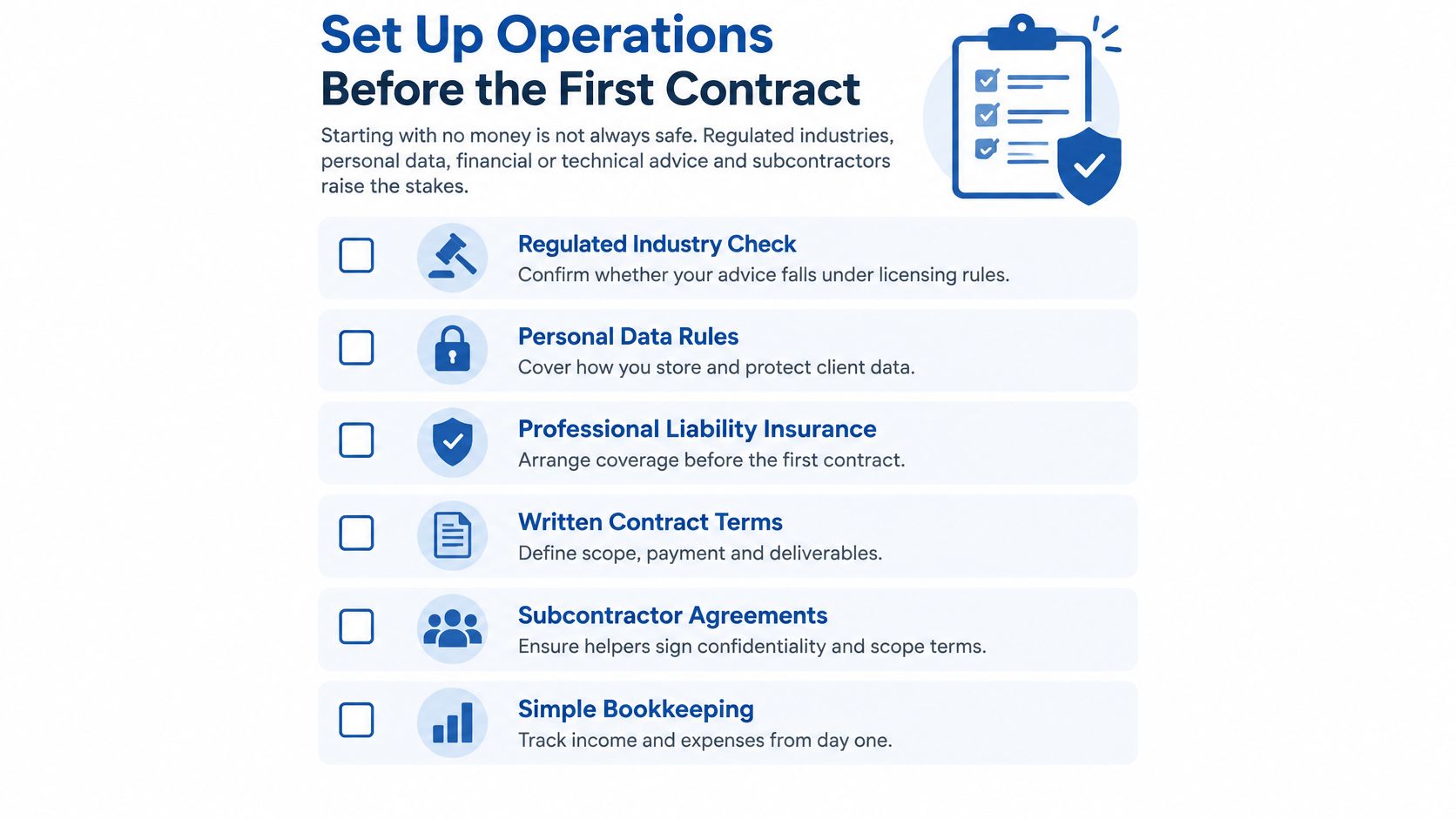
- Choose a legal structure that fits your country and write down why you chose it in three lines. Sole trader, limited company and partnership differ on tax, liability and how buyers perceive you. Our walkthrough on how to incorporate a business covers the registration mechanics.
- Open a separate business bank account and set up invoicing before the first payment, not after. Mixing personal and business cash flow creates an accounting problem you'll pay someone to untangle.
- Buy professional liability insurance. Insurance-market data puts average professional-liability premiums for consultants at about $51 per month, roughly $610 a year, but enterprise and government buyers may require $1 million or $2 million limits before they'll sign. Check exclusions, retroactive coverage dates and subcontractor terms, because the cheapest policy often excludes the exact activity you perform.
- Use a written statement of work every time. Scope, assumptions, milestones, acceptance criteria, dependencies, change-order rules, payment schedule, late-payment clause, confidentiality, intellectual property ownership, liability limits and termination rights. The late-payment clause matters more than the rest, because a single client who pays at 90 days can break a solo practice.
- Set aside tax from every payment and confirm estimated payment dates with an accountant in your jurisdiction. Treat that percentage as money you never had. Retirement contributions work the same way, which is why we advise entrepreneurs to set up automatic contributions, diversify the portfolio and hold a tax-advantaged account, and why we publish guides on Traditional and Roth IRAs, SEP IRAs, SIMPLE IRAs and Solo 401(k) plans.
- Build a cash runway covering the selling period. You need enough to fund living costs through the months before the first invoice is paid, not the months before it's issued.
The rule that prevents most disasters: no kickoff happens until the contract is signed and the insurance is active. Not a verbal go-ahead, not a promise to send the paperwork later.
Mistakes That Stall a New Consulting Practice
Readiness is not what's missing. Most stalled practices are waiting for a polished launch they'll never feel ready for, while their faster competitors are quoting imperfect offers and learning from the replies. What separates the two is diagnosis, not effort.
| Symptom | Likely cause | Fix |
|---|---|---|
| Outreach gets no replies | Generic business-consultant positioning | Rewrite the offer around one buyer, one problem and one result |
| Discovery calls never convert | Free work starts before a fee is agreed | Offer a paid diagnostic at a fixed fee from the first call |
| Clients ask what AI could do for free | Offer sells information rather than judgment | Package implementation, accountability and industry access |
| No referrals arrive after projects | No documented result from the engagement | Write a case study with one measured outcome |
| Pipeline empties after two clients | No weekly outreach routine | Block a recurring weekly slot for prospecting |
Every symptom on that list traces back to one of three root causes.
Positioning. A founder sends 200 emails describing themselves as a business consultant and gets three replies. Nothing is wrong with the emails. The description gave the reader no reason to believe this person understood their specific problem, so the fix is the one-sentence offer from the start of the launch sequence.
Selling. Another founder runs weeks of unpaid discovery calls, gives away the diagnosis, then can't get a yes because the client already has what they wanted. The fix is a paid diagnostic at a fixed fee, offered on the first call, which tests willingness to pay before you spend another hour.
Cash. A third founder wins a good client, delivers well, and runs out of money because payment lands 60 days after the work finishes. The fix is the runway and the payment milestones, not a bigger pipeline.
Fixing these takes different amounts of time. Rewriting the offer is a week's work. A case study with a measured result needs at least one completed engagement behind it, which is a quarter. Review the table monthly and change one variable at a time, so you know which change moved the number.
Confirm Your First Offer This Week
You can settle the question with four actions, none of which require a website.
- Write the offer as one sentence naming the buyer, the problem and the measurable result.
- Book five discovery calls with people who fit that buyer exactly.
- Quote one paid diagnostic at a fixed fee and ask directly whether they would sign it.
- Confirm the contract template and insurance are in place before any kickoff.
Then read the response. If none of five qualified prospects would pay for the diagnostic, the buyer or the problem is probably wrong, not the price. Change the segment before you discount the fee, because a discounted offer aimed at the wrong buyer loses money more slowly.
That first engagement is the evidence base for everything after it. It becomes the case study, the referral source, the pricing benchmark and the confidence you need to raise your rate on the next quote. Nothing else in the launch produces that.
The single action for the next 48 hours is to write the sentence and send it to three people who fit the description, asking one question. Would they pay for this? Their answer is worth more than another month of preparation.
Mega Income Stream publishes practical guidance for people building independent income, including our breakdown of starting a consulting business and the operating basics that keep a solo practice solvent. If you're turning expertise into a paid offer, our business and finance sections cover the pricing, contracts and cash-flow decisions that decide whether year one survives. Start with the offer sentence, then use our resources to build the rest of the practice around it.










Comments