
 By
Most advice on how to monetize a podcast starts with a CPM and a download threshold. That sequence fits a minority of shows and burns a year for everyone else. Sponsors buy a listener group they can describe and measure, not a stack of episodes. A specialist show with a few hundred people who already pay to solve one problem can sell a membership, a template, or an hour of advice long before an ad network will fill a single spot.
The category itself is not speculative. U.S. podcast advertising has grown into a multi-billion-dollar business. That scale still does not mean your first check should come from an advertiser. Match the offer to what a small, engaged audience can buy, then check whether the hours, fees, and refunds leave anything after break-even. This guide starts with that choice, then shows how to test an offer without turning every episode into a sales pitch.
Table of Contents
- Choose a Revenue Stream by Audience Size
- Balance Ads, Paywalls and Listener Trust
- Set Up the Audience Data Sponsors Will Ask For
- Find and Price Your First Sponsors
- How to Sell a Host-Read Sponsorship and Prove It Works
- How to Build a Listener-Supported Conversion Ladder
- Affiliate Offers and Products That Keep Trust
- Start With One Offer and Measure It
Choose a Revenue Stream by Audience Size
Do not start with sponsors by default. Most independent shows never clear the reach a media buyer will pay for, and chasing that check first is how a good show stays unpaid. Pick the stream that matches who already listens and what they already spend money on. Audience size matters, but buying intent matters too: 300 listeners with an expensive, specific work problem can be more useful to a consultant than 3,000 people who simply enjoy the conversation.
| Revenue stream | Audience it suits | Setup effort | Income source | Main risk |
|---|---|---|---|---|
| Host-read sponsorships | Broad, measurable listener base | Medium: pitch, script and reporting | Advertiser budgets | Hard to sell without listener proof |
| Dynamically inserted ads | Consistent downloads over time | Low once hosting is set up | Ad networks | Fill rate and pricing vary widely |
| Paid subscriptions or memberships | Small, loyal niche | Medium: tiers, perks and billing | Recurring payments | Churn when perks feel thin |
| Affiliate offers | Listeners who trust your product picks | Low to medium | Commission per sale | Lost trust if picks look paid |
| Digital products or courses | A clear problem and a defined buyer | High: creation and support | Direct sales | Production time with no sales |
| Consulting, events or services | Few high-value clients | Medium to high | Client fees or ticket sales | Limited calendar and hours |
| Listener donations or tips | Very engaged fans | Low | Voluntary payments | Unpredictable income |
The table describes fit, not a required order. A tip link is easy to set up but gives you little reason to expect steady income. A service takes more delivery time, yet a single client might validate the show as a source of qualified buyers. A product can eventually sell without booking calls, but it demands more work before you know whether anyone wants it.
Read the pattern, not the headline rate
Host-read sponsorships and dynamically inserted ads need reach you can prove, episode after episode. Memberships, affiliate offers, donations, and services do not. A few hundred committed listeners can fund a paid tier or a client offer if the subject is specific. One payroll manager who hires you is worth more than thousands of generic impressions on a hobby show.
The 2025 Independent Podcaster Report is a reality check. 85% of respondents reported earning no money, and audience growth and discoverability were the top challenge for 72%. Even among people who did earn, sponsorships were common and still not the route most of them called their best. Plan year one around a direct relationship, not a sponsor invoice. The same matching logic shows up when you monetize a website: sell what that audience already wants, not the format with the biggest industry total.
Consider two shows with 800 regular listeners each. One interviews working bookkeepers about recurring client problems; the other discusses a different pop-culture release each week. The bookkeeping show might test a paid checklist or a small-group workshop because listeners can use the result at work. The entertainment show may have stronger community participation but no shared purchasing problem; a bonus discussion or supporter tier may fit better. Neither should choose a revenue stream solely because another show reports a high ad rate.
Three questions to answer this week
- Returning listeners: How many people come back each month, not how many times an episode file was requested? Look at comparable recent episodes rather than your all-time total.
- Paid problem: What problem do they already pay someone else to solve, in software, advice, or training? Save the exact words listeners use in emails and questions.
- Selling hours: How many hours a week can you spend pitching, fulfilling, or supporting, after you finish the episode? Include administration and follow-up, not just the visible delivery time.
Two honest answers beat seven half-built offers. A B2B or local show usually starts with consulting, a tight membership, or one affiliate the host already uses. A broad entertainment show with steady downloads can test a host-read later. Break-even still includes production time, payment fees, refunds, and the hours spent finding each buyer. A pretty rate that ignores those costs is a hobby with invoices.
For example, a local gardening show might have 600 regular listeners, most within driving distance. A workshop with 12 paid seats could be more realistic than pitching a national advertiser. A payroll show with the same audience might sell a document review or a template instead. Neither needs to pretend that 600 listeners make an attractive mass-market ad buy. Write down one plausible buyer action for your show, then choose the revenue stream that makes that action easiest.
If you are unsure, run a low-cost signal test. Mention a proposed workshop and invite replies, or put a clearly described template on a waitlist. You are looking for evidence of a specific action, not applause for an idea. If listeners ask about timing, price, or what they will receive, you have a better starting point than a general comment that the show is useful.
Balance Ads, Paywalls and Listener Trust
Ads, subscriptions, and products are not a sequence you graduate through. They pull against each other, and the tension that decides the model is trust: every revenue choice either spends the relationship you have with listeners or builds on it.
Host-read ads and prerecorded spots are different products. A read in the host's voice carries a personal recommendation, and listeners treat it that way; an inserted spot is inventory, and they discount it accordingly. The trade runs both directions. The read earns more per slot because it borrows your credibility, and it costs more of that credibility when the product disappoints. A paywall or a service asks for money instead of attention. It fits a smaller audience with a strong identity or an urgent problem, and it leaves the episode itself clean.
Think through the cost to the listener as well as the money to the show. An ad costs attention, especially when it interrupts an explanation. A membership costs money and requires a reason to renew. A paid workshop costs money and a place on the calendar. Each can be fair if the benefit is clear and the free episode remains worthwhile.
Four criteria, not one score
Predictability favors sponsorship once you can prove reach, because a signed campaign pays on a schedule. Membership income renews each cycle until the month it doesn't, and churn rarely announces itself in advance. Affiliate and product revenue moves with sales weeks and launch pushes, not with your publishing calendar. If stable cash flow matters most, compare what is contracted with what merely recurred last month.
Audience size cuts the other way. Documented reach is what sponsors buy, so ad income scales with a base you can measure. A paid tier can break even on a few hundred loyal listeners who each pay monthly, because the math is per person, not per download. Owned products sit between the two: they need fewer buyers than ads need ears, but the buyer has to be obvious.
Conversion friction stays low while the listener only has to keep playing. It jumps the moment you ask for a card, a checkout, or a calendar booking. That friction is fine if the offer fixes a problem they already feel and already pay to solve. Reduce unnecessary steps: a single page explaining one benefit is easier to act on than five tiers with overlapping perks.
Editorial independence is where shows get hurt. A sponsor can tilt topics, guests, and adjectives, sometimes without asking directly. A membership or an honest product pick leaves the voice intact, provided you still label anything you are paid to mention. Decide in advance whether a brand can review factual claims, request a different placement, or ask you to avoid a competitor. Those are different permissions.
| Model | Predictability | Audience size needed | Conversion friction | Editorial independence |
|---|---|---|---|---|
| Host-read sponsorships | Predictable once reach is proven | Medium to large | Low for listeners | Moderate, sponsor influence on content |
| Dynamically inserted ads | Variable fill and pricing | Large | Low | Moderate |
| Paid subscriptions or memberships | Recurring but churn-prone | Small and loyal | Medium, payment step | High |
| Affiliate or owned products | Variable, tied to sales | Small to medium | Medium | High if picks are honest |
Listeners who hate ads and will still pay
Some audiences skip every read and still pay for access, a bonus feed, a community, or a result they can use. Take an indie technology show with a few thousand regular listeners. A pre-roll on every episode gives the most loyal people a reason to leave. An ad-free public feed plus a monthly Q&A behind a paywall might fit better, provided the host can deliver the Q&A and enough listeners actually join. Test that assumption before treating it as income.
Run one sponsor layer and one offer you own. Decline any sponsor whose product fights the show's editorial voice, even when the fee looks easy.
Two revenue lines beat one bet when each has a clear role. Sponsorship cash arrives while reach is real and stops when the campaign ends. The owned offer, membership or product, can continue selling, but only while listeners find it useful. Diversification is not permission to ask for money at every turn.
Consider the listener experience before adding either line. A finance show could keep its main episode free, place one clearly labelled host-read in the middle, and offer a paid monthly case-study session for listeners who want to go deeper. The ad reaches everyone without making the episode hard to follow; the session serves people asking for detail the free show cannot fit. If a sponsor asks the host to praise a tool they have not tested, that is not a minor wording request. It is a reason to decline or renegotiate the read.
A useful check is to listen to one episode as a new subscriber. Count every request to follow, review, join, buy, and use a code. If the calls to action compete with the content, remove one before adding another. The audience should know which action matters without feeling that the episode exists to deliver it.
Set Up the Audience Data Sponsors Will Ask For
Sponsors do not buy your enthusiasm. They buy a segment. Build that proof before you write a pitch, or the conversation dies on the first call. The same exercise helps with direct offers: if you cannot describe whom the show serves, you cannot write a useful membership perk or product page.
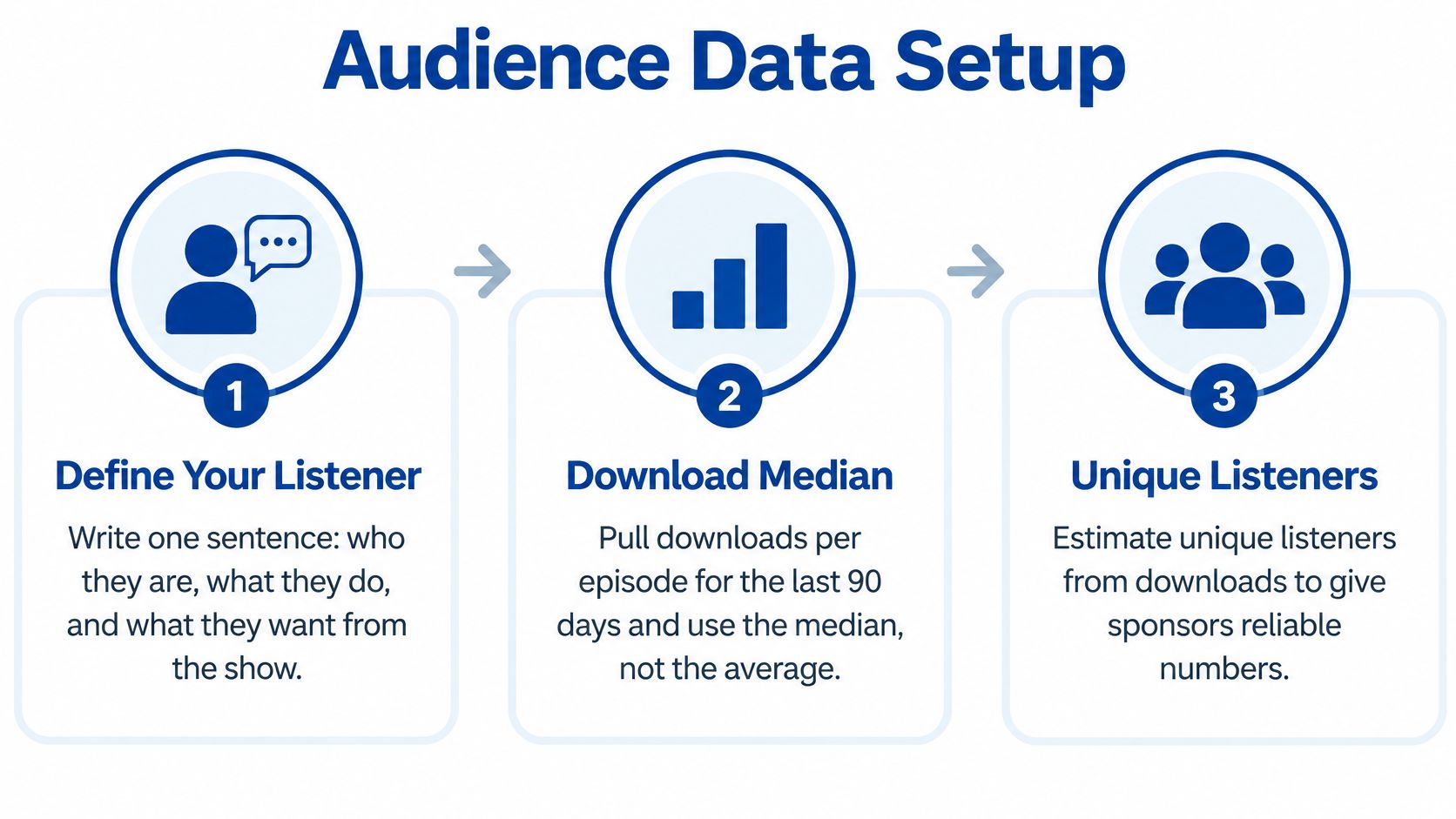
Seven steps that fit on one page
- Define the listener in one sentence. Say who they are, what they do for work or at home, and what they want from the show. "People who like business" is not a segment. "HR managers at firms under 200 staff who need payroll answers they can use Monday" is. If you do not know their roles, ask; do not turn a few vocal listeners into a claim about everyone.
- Use the median, not the average. Pull downloads per episode for the last 90 days in your host, whether that is Buzzsprout, Transistor, or Spotify for Podcasters. Compare episodes at the same age, such as their first 30 days. One viral episode pulls the average up and makes the next pitch look like a lie.
- Check whether anyone finishes. Look at completion rate or average listen time where your platform provides it. A 45-minute episode that dies at minute 6 is not sponsor material, no matter what the download tile says. Note where a planned read would sit relative to the listening data.
- Count people you can reach again. Email subscribers, community members, and regular replies or reviews are contacts or engagement signals you can revisit. Downloads are not. Do not add these figures together and call the sum unique people.
- Write a one-page audience summary. Put the numbers, where they came from, and the date range on a single page so it drops into a deck without a rewrite. A short note about the show's topic and typical listener questions is more useful than a page of vague audience adjectives.
- Set disclosure rules before you sell. Decide where a read can sit, how affiliate links get labelled, and which categories you will not promote. Changing that mid-deal costs more trust than the fee is worth.
- Pick one owned channel for the first offer. An email list or a small community server should carry the membership, the template, or the booking link. Do not split the first test across five platforms; you will struggle to tell what brought a buyer in.
A simple audience page might show a one-sentence profile, the median first-30-day downloads for the last eight episodes, the time window, available listening data, and the size of the email list. Below that, add two or three anonymized listener questions that illustrate why the topic matters. Keep the raw exports so you can update the page rather than rebuilding it from memory before each pitch.
Why a smaller owned list can outrank a vague total
Say a show averages about 3,000 downloads an episode and has about 400 newsletter subscribers who open the practical episodes. That show might be able to sell a niche membership sooner than a generic ad package. The list offers a way to invite a response and measure it. It does not prove that every subscriber will pay, or that every download represents a separate person.
I would rather walk into a pitch with a dated median, a completion note, and a list of 400 subscribers I can email than with a round download number and no idea who pressed play.
Make the audience page easy to audit. Label each number by source and window, such as "median downloads per episode, first 30 days, episodes published July to September." Keep email opens separate from downloads: they describe different actions and may include some of the same people. If your host cannot show reliable unique listeners or completion, say so rather than converting downloads into a made-up listener count. Ask new subscribers one optional question about their role or biggest problem; a handful of specific answers can sharpen the segment without claiming they represent the whole audience.
Suppose the newsletter gets questions about onboarding new payroll staff. That pattern could support a paid checklist test and a sponsor pitch to a relevant training provider. It should not become a claim that all 3,000 downloads came from payroll teams. Use observed questions to guide the offer, and reserve audience-wide claims for data that can support them.
Find and Price Your First Sponsors
A one-page offer that names a listener group closes faster than a media kit full of totals. The buyer is purchasing a segment and a way to see whether anyone acted. Start with a small pilot you can deliver cleanly, then let the results inform a renewal.
- List five to ten matching companies. Use the one-sentence listener profile. Drop anyone who conflicts with the disclosure rules you already wrote. A company can sell to the right industry and still be wrong for your listeners.
- Prefer brands that already buy audio. A company with a past podcast or radio placement understands a pilot. Cold brands that have never left search ads need a longer education, and you are not their media trainer.
- Price from your own numbers. Take the median downloads and the available listening data from the audience summary. Quote a modest flat fee per episode for one pilot read. Do not quote a CPM you cannot verify from your host. Account separately for scripting, revisions, recording, and reporting.
- Write the offer on one page. Cover the listener segment, read placement, episode count, tracked URL or promo code, the report you will send, and the fee. If the page needs a second page, you are padding.
- Ask for four to six episodes, with a renewal tied to results. A short pilot is easy to approve. A year-long insertion order is not, especially from a show they have never bought. Choose the review date before the first read airs.
For the conversation itself, Fundl's guide to negotiating creator sponsorship deals is a useful pass on how to hold scope and price without turning the call into a discount session. Run the fee through a simple break-even formula before you send it, so hosting, editing, and the hour you spend on the read are inside the number.
A payroll-compliance show with a clearly described HR-manager audience can price one pilot read and a tracked template link before it has any national reach story. The segment is the product. The download chart is supporting evidence. For a gardening show, the better prospect might be a local workshop venue or supplier rather than a national consumer brand. The pitch should explain the geographic fit instead of pretending the show offers broad reach.
A concise pitch could say: "Our recent episodes reach HR managers at small employers. We propose one mid-roll read in each of four episodes, pointing to a landing page made for these listeners. We will report episode downloads and tracked visits after the run." Attach the dated audience page and quote one total pilot fee. Specify whether the sponsor reviews the factual product description, when payment is due, and whether the category is exclusive during the pilot. Those details prevent a small test from becoming an open-ended production assignment.
Keep the scope explicit. A sponsor that buys four reads has not automatically bought a newsletter placement, social clips, perpetual use of your voice in its ads, or control over the episode topic. If they want any of those, discuss them as separate deliverables before recording. This protects your time and makes the final report easier to interpret.
How to Sell a Host-Read Sponsorship and Prove It Works
Sell the read as a measured pilot, not as a vibe. Agree the attribution method before episode one, or the renewal call becomes an argument about whose spreadsheet is real. Also agree what the report will not prove: a listener may remember a brand without clicking, and a code redemption may have more than one influence.
- Package one read around their customer. Use a pre-roll or a mid-roll, a single offer, and one tracked URL or promo code. Two offers in one read split the result and give you nothing clean to report. Write the factual product description together, then make the spoken version sound like the show.
- Set a four-week baseline first. Record comparable episode downloads, any available unique reach and completion data, and landing-page visits before the ad runs. If the sponsor has never used the landing page, say that the pre-campaign traffic baseline may be zero rather than implying it measures all prior demand.
- Hold the pilot still. Run the same core script, the same offer, and the same exposure frequency across four to six episodes. Natural delivery can vary; the promise and call to action should not. Changing the offer every week makes the test difficult to read.
- Compare exposed episodes with the baseline. Use comparable measurement windows and note other promotions running at the same time. If the advertiser runs a brand-lift survey, ask for those results rather than inventing a story from code redemptions.
- Renew against the goal you agreed on. Assess observed results, cost, and the sponsor's own sales data where available. If the numbers miss the goal, consider changing placement or offer before extending. A better-looking metric invented after the fact is not evidence that the first pilot worked.
Host-read execution is the part listeners respond to. People rate podcast hosts as likeable, relatable, and credible. Nielsen's brand-lift work on podcast advertising reports that podcast advertising can produce a 13-percentage-point increase in brand awareness, and the cited benchmark found that 70% of exposed listeners recalled the advertised brand. Those are study results, not a forecast for your show. Measurement is still the weak point on the buyer side. Only 49% of surveyed marketers were extremely or very confident they could measure podcast-ad ROI. A documented baseline gives your sponsor a clearer account of what happened, even when it cannot establish causation.
What each metric can and cannot prove
| Metric | What it tells you | Known limitation |
|---|---|---|
| Downloads per episode | Estimated reach potential | File requests do not establish that each person listened or heard the read |
| Unique reach | Estimated number of distinct listeners reached | Availability and definitions depend on the analytics provider |
| Completion rate | Whether tracked listeners stay through the episode | Often comes from a platform subset and may not identify ad exposure |
| Promo-code redemptions | Purchases or actions using that code | Misses listeners who buy without the code and may include shared codes |
| Tracked landing-page visits | Visits through the campaign link | Misses searches, offline actions, and some cross-device journeys |
| Brand-lift survey | Measured change in awareness or intent among surveyed groups | Costs more and depends on survey design and sample quality |
Choose a primary metric that fits the advertiser's goal. A campaign introducing an unfamiliar brand may care about recall; a limited-time offer may care about qualified visits or orders. Report secondary numbers too, but do not silently swap the goal because a different column looks stronger.
Say this before you renew
Do not claim the promo code caused every sale. Codes undercount conversions when listeners search the brand directly, and they can be shared beyond the show. Downloads overstate attentive reach because a file request is not proof that somebody heard the read. State both limits in the report. A buyer who hears that from you on week one is easier to renew than a buyer who discovers the gap after finance asks for proof.
I would rather lose a renewal than defend a code count I know is incomplete. The next sponsor will ask how you counted, and a straight answer is the sales asset.
Suppose the pilot brings 90 tracked visits and six code redemptions. Report those as observed actions, not 90 buyers or six sales caused solely by the podcast. Note any concurrent email promotion, a change in landing-page design, or an unusually popular guest episode. If the sponsor shares its own sales data, compare dates and attribution rules before drawing a conclusion. A renewal can still make sense when the code count is modest, but it should be based on a metric both sides agreed to evaluate.
The final report can fit on one page: campaign dates and placements, the agreed goal, episode-level delivery figures, tracked actions, relevant context, and a recommendation. If the test was inconclusive, say what you would change in a second pilot. That is more useful than calling every outcome a success.
How to Build a Listener-Supported Conversion Ladder
Listener revenue is a ladder, not a tip jar with a sad outro. People pay for a next step they can see, after they already trust the free show. Each rung should answer a different question: why listen, why stay in touch, and why pay now?
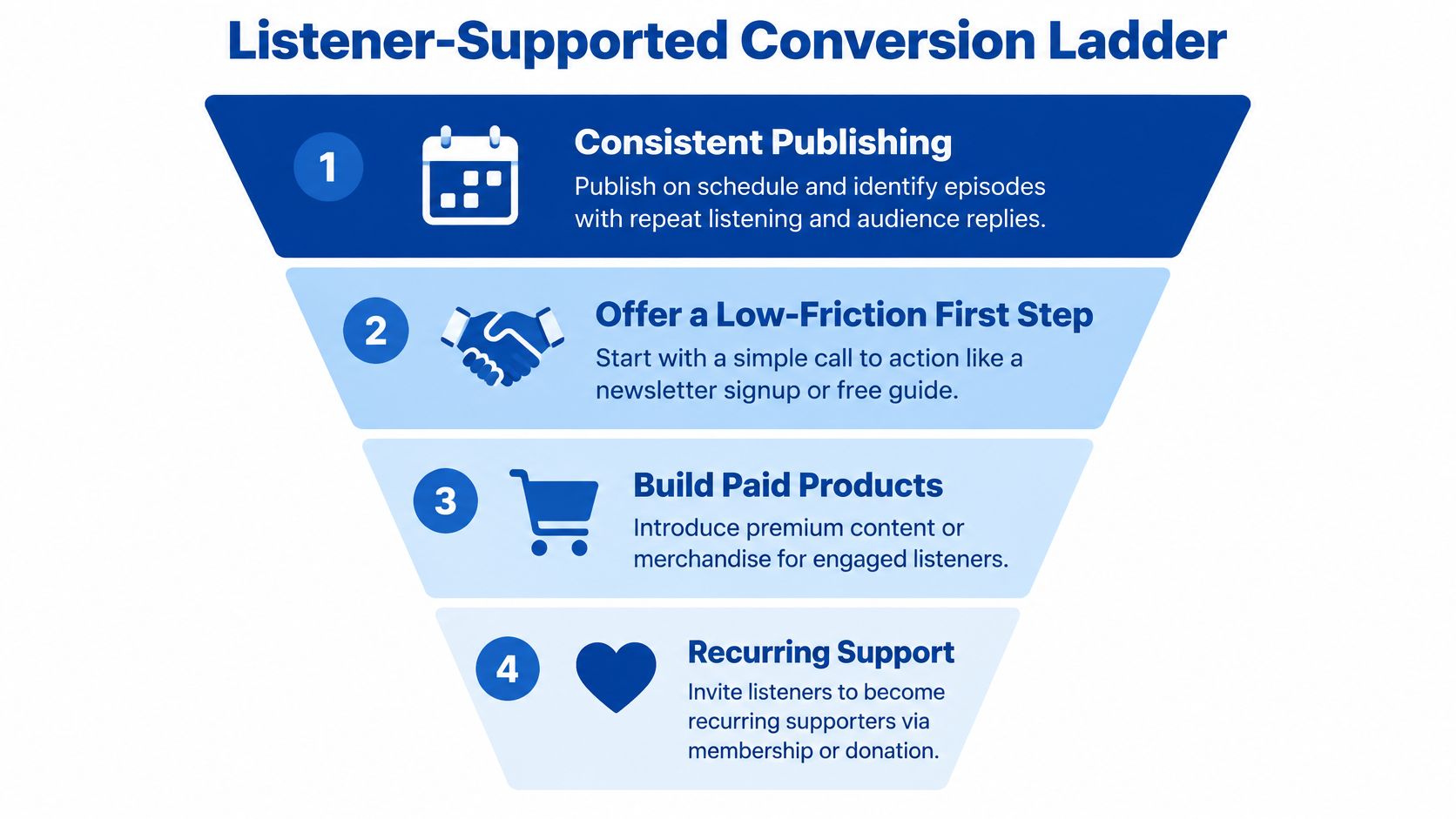
- Publish on a schedule and mark what gets replies. Note the episodes and segments people finish and write back about. That is the raw material for a perk, not your favorite topic. Track recurring requests separately from one enthusiastic message.
- Move anonymous listeners onto a list or a community. A free email or a small channel turns a download into someone you can reach when the paid tier exists. Ask for that before you ask for a card. Tell people what they will receive and how often.
- Launch one low-friction paid tier. Differentiate it clearly: ad-free episodes, a bonus, an archive, or a private Q&A. Test a clear benefit and price rather than five tiers on day one. Apple Podcasts Subscriptions or a host paid feed such as Buzzsprout Subscriptions can deliver the audio without a custom app. Check your chosen platform's current fees and access rules before committing.
- Measure by cohort, not by a launch-week spike. Paid members divided by engaged free listeners, monthly churn, average revenue per paying member, and trial-to-paid conversion tell you if the tier is a product or a novelty. Compare people who joined in the same month so early enthusiasm does not hide later cancellations.
- Add courses, events, or consulting only after retention holds. Several calm months beat a launch screenshot. Higher-priced work on top of a leaky membership just multiplies the support load.
A Claritas podcast attribution paper reported a 1.8% conversion rate among households exposed to podcast advertising versus 0.7% for streaming audio. That is a reason a relevant audio message can move people to act. It is not a membership conversion benchmark and not a reason to sell the top rung first.
For a practical example, imagine listeners routinely ask for the sources behind a history show. The free episode tells the story; the email list shares a few public reading links; a paid tier adds carefully annotated monthly source notes and an archive. The paid benefit extends the subject without making free listeners feel they received half an episode. Before launching, the host can ask subscribers whether annotated notes are something they would actually use.
Where shows break the ladder
Charging before trust exists produces a handful of polite signups and a quiet cancel button. Promising a weekly private episode you cannot sustain turns the membership into unpaid overtime. Treating every download as an active listener makes the conversion rate look tiny and the offer look broken, when the audience was always smaller.
Cohort conversion shows whether engaged free listeners become members. Monthly churn shows whether they stay. Revenue per paying member shows whether the price matches the perk, after you account for fees and discounts. Trial-to-paid shows whether the trial taught the value or just delayed the no. Define each denominator before you start reporting it.
A signup spike followed by fast churn usually means the perk was a one-time bonus, not the show. Fix onboarding and the recurring benefit before you add another price.
For example, a history show might promise a monthly source-notes email instead of an extra weekly episode. The smaller promise can still be valuable to listeners who want reading links, and it is easier to deliver consistently. Send new members a welcome note that shows where to find the archive and when the next notes arrive. Then compare the first and second renewal cycles for each signup month. If people leave before they receive the recurring perk, fix that delay before testing a higher price.
Ask departing members one optional question about why they canceled. "I joined for one archive item" calls for a different fix than "I could not find the paid feed." Do not chase every response with a new feature. Group the answers, check them against behavior, and improve the benefit you can sustain.
Affiliate Offers and Products That Keep Trust
Affiliate revenue belongs on shows where the host already uses the thing. A recommendation you would make anyway is easier to explain honestly than a read you tolerate. Check the commission, the cookie length, payout conditions, and whether the program pays on recurring billing before you mention it. A fat first-month bounty with a one-day cookie may be a worse fit than a smaller rate on a product listeners keep using. Read the program terms rather than assuming a click earns a commission.
Give the listener enough context to judge the recommendation. Explain whom the tool suits, what you have personally used, and one reason it might not fit. A payroll show might recommend software for small teams but note that a listener with complex international operations needs to check features carefully. That caveat makes the recommendation more useful, not weaker.
Owned products need a break-even pass before you build them. Count production hours, fulfillment time, payment processing fees, refunds, and the work of finding each buyer. Say a B2B payroll podcast plans a $49 template. Forty sales would bring in $1,960 before fees and refunds. If those deductions leave roughly $1,800, then 30 hours of drafting, design, and support work out to about $60 per hour before other costs and taxes. Whether that is worthwhile depends on the creator's alternative use of those hours and whether future sales require the same support.
Our Affiliate Marketing articles cover how those commission choices play out on other content businesses, and the same arithmetic belongs on a show. Do not let an attractive commission set the editorial calendar. The episode should help a listener who never clicks the link.
Test the offer before you build the file
- Pre-sell or waitlist it. Put a checkout for a clearly scoped pre-order, or a short interest form, in the show notes for two or three episodes before you design the template. State the delivery date and refund terms if you collect payment.
- Count replies and clicks, not compliments. "Great idea" in a DM is not a buyer. A click on the tracked link is closer, and a paid pre-order is stronger evidence still.
- Set a kill number. Decide in advance how many paid orders would cover your estimated hours and direct costs. If the test misses that number, stop or change the scope. Do not "finish it anyway" because the outline exists.
- Label every paid link. Disclose the affiliate relationship in the script when you recommend the product and clearly label it in the episode notes. Listeners should not have to inspect a URL to learn that you may earn a commission.
Build the product only after that test. A practical walk-through of creating digital products helps once the waitlist proves people want the file, not before. Promote only what you would recommend to a friend who asked. If you would not, the commission is not worth the listens you lose.
Suppose 20 listeners join a waitlist for a proposed template but none commit when you show the price and contents. That is a useful result, not an invitation to polish the design. Ask what they expected the template to do, then decide whether the missing piece is the offer, the audience, or the problem itself. Conversely, a handful of paid pre-orders may justify a small first version with clear limits rather than a full course.
Start With One Offer and Measure It
Pick one stream from the comparison you already made. Use the audience page and the disclosure rules as the filter, not whichever tactic a thread called hottest this month. Set that stream up the way the matching steps describe: a four-to-six-episode sponsor pilot, one paid tier on the ladder, or a pre-order before you build a product. Give the test enough time to observe behavior, up to 90 days for a recurring offer. A short sponsor pilot or a pre-order can produce a decision sooner.
Record the same figures each week so the review is boring on purpose.
- Listeners reached: median downloads over a consistent window or list sends, not a single spike. Keep the two measures separate.
- Replies: people who answered, clicked, or booked, with each action counted in its own column.
- Conversion: buyers or members divided by the eligible, engaged group you defined in advance, not by all-time downloads.
- Churn or pilot result: cancellations and renewals for a membership, or performance against the sponsor goal agreed before the pilot.
- Time spent: hours producing, selling, fulfilling, reporting, and supporting the offer. Revenue without time costs can flatter a weak test.
A basic weekly log might have one row per episode or campaign week and columns for the offer mentioned, audience window, visits, purchases, refunds, and hours. Add a note when an unusual guest, holiday, or outside promotion changes the context. A small, consistent sheet will answer more questions than an elaborate dashboard you stop updating.
Three review rules
- Sponsor pilot. Compare the agreed metric with the goal, note attribution limits, then renew, change one variable, or pause. Do not extend a flat fee out of politeness or claim causation the data cannot establish.
- Paid tier. If it loses more people than it gains after two months, investigate onboarding and the recurring perk before you add another price. Look at which signup groups leave and when.
- Product. If the pre-order fails its planned threshold, do not build the full version. Keep the listener questions; the outline can wait.
Add a second stream only after the first one produces repeatable results and the trust checks still hold. A sponsor plus a membership can be a portfolio. A sponsor, a course, a Slack, and three affiliates in the same quarter is a production job you did not staff.
Most podcast revenue is the slow compound of an engaged audience, not one large deal. I would start with the offer you can measure fastest, keep the public show worth finishing, and let the second stream wait until the first one pays without you renegotiating your standards.
Mega Income Stream publishes practical guides on earning methods, from sponsorships and memberships to affiliate offers and digital products, written for creators and small operators who need a plan they can run. If you are mapping how to monetize a podcast without guessing at download thresholds, start with the audience you already have and the offer they can buy this quarter. Visit Mega Income Stream for more step-by-step income guides.










Comments