
 By

Real customer demand is the strongest reason to pursue a new market, but it must connect to a viable way to serve buyers. To evaluate a new market opportunity, weigh customer interest against competition, access to the market, and your ability to deliver. A large category or visible trend may attract attention, but neither automatically creates a sustainable revenue opportunity.
That distinction matters whether you’re an independent operator testing a new offer, a freelancer considering a different customer segment, or a business weighing expansion into another country. Each choice uses resources. A disciplined assessment clarifies what evidence supports the move, which assumptions still need testing, and what could make execution difficult. It helps separate a promising possibility from an appealing idea without a practical route to buyers.
This guide explains how to assess demand, identify relevant customer groups, and understand the conditions shaping a market. It also covers growth signals and common assessment mistakes to consider before choosing a direction. Use the analysis to make a grounded decision: pursue the opportunity, refine the offer, or focus elsewhere. The goal isn’t to predict every outcome, but to make your next business move with clearer priorities and better evidence.
Key Takeaways
- Triangulate market size with customer demand, competitor activity, and broader market context instead of relying on one estimate.
- Map buyer segments, decision-makers, and purchase touchpoints to identify channels that can reach real customers.
- Compare market appeal with your capabilities, resources, and ability to meet local customer needs.
- Use aligned trend signals to spot potential shifts, then test whether they connect to a viable customer problem.
- Avoid broad estimates and assumptions that success in one market will automatically transfer to another.
Research Methodology Elements: How do you conduct a market opportunity assessment?
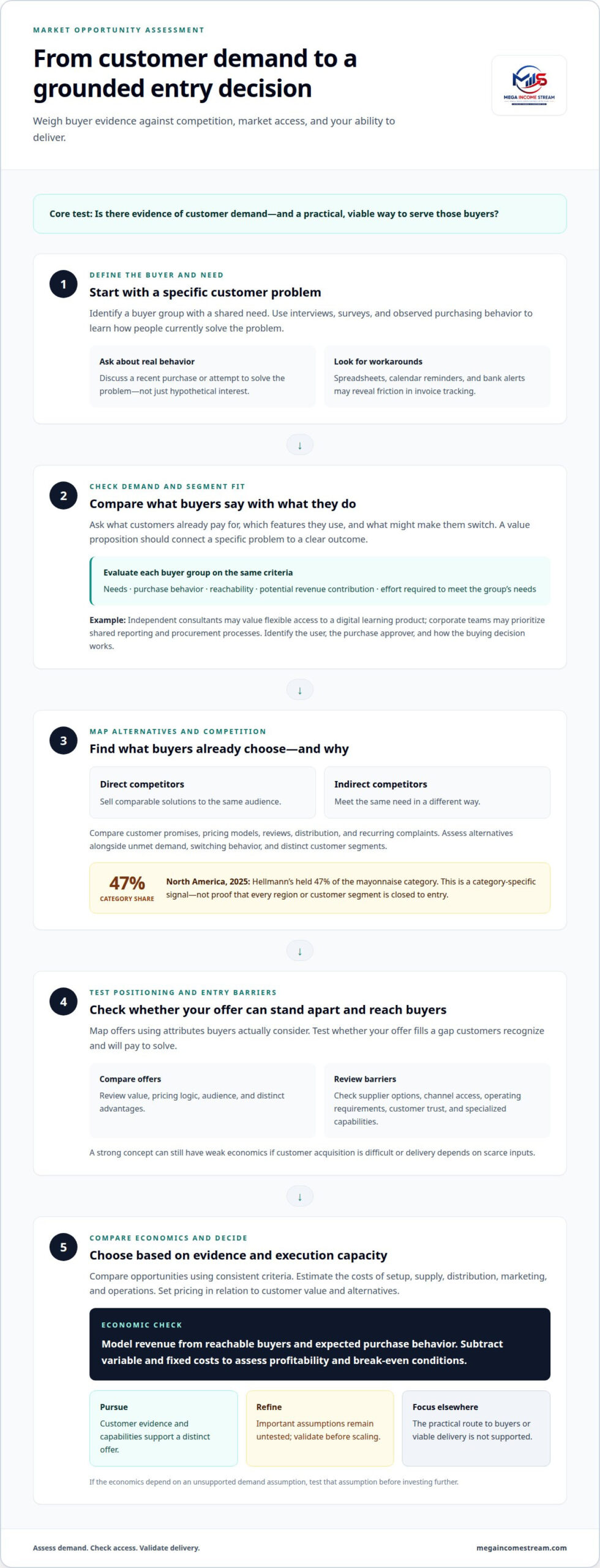
Compare customer demand with competitive pressure, entry barriers, and your ability to serve the audience. A market opportunity assessment turns these signals into an investment decision based on commercial and operational evidence.
Direct and Indirect Competitor Analysis
Direct competitors sell comparable solutions to the same audience, while indirect competitors meet the same need in different ways. Compare both to understand what customers already choose and where existing alternatives leave needs unmet.
For a meal-planning app, direct competitors may offer similar subscription features; indirect alternatives include recipe sites, grocery services, or spreadsheets. Assess their customer promises, pricing models, reviews, distribution, and recurring complaints. To judge saturation, weigh the number and strength of alternatives against evidence of unmet demand, switching behavior, and distinct customer segments. A crowded category can still contain a viable niche, but customers need a clear reason to switch.
Competitive Share and Brand Perceptions
Market share shows how demand is distributed, while brand perceptions help explain why customers favor particular options. Together, they indicate whether a new entrant must displace established preferences or can serve overlooked buyers.
In North America, Hellmann’s held a 47% share of the mayonnaise category in 2025. Treat that as a category-specific signal, not proof that every region or customer segment is closed to entry. Pair share data with surveys of potential buyers: ask which brands they recognize, what they associate with each, and what would change their choice. Compare those answers with competitor claims and customer reviews to identify perception gaps, such as a need for simpler ingredients or more convenient packaging.
Competitive Positioning and Entry Barriers
Competitive positioning compares each offer’s value, pricing logic, audience, and distinct advantage. Entry barriers are conditions that make launching or scaling harder, such as access to suppliers and distribution, customer trust, or specialized capabilities.
Map competitors using attributes buyers actually consider, not features businesses assume matter. Then test whether your offer fills a gap customers recognize and will pay to solve. Review supplier options, channel access, operating requirements, and incumbent advantages. Even a strong concept may have weak economics if customer acquisition is difficult or delivery depends on scarce inputs. Porter’s Five Forces can structure this analysis by examining rivalry, substitutes, buyer power, supplier power, and new entrants.
Comparing Opportunities and Entry Decisions
Compare opportunities by assessing demand, competitive intensity, entry barriers, strategic fit, and execution capacity against consistent criteria. How do you compare markets and decide whether to enter? Favor the market where customer evidence and your capabilities support a distinct offer, then validate unresolved assumptions before scaling.
Estimate entry costs by listing setup, supply, distribution, marketing, and operating needs. Set pricing in relation to customer value and alternatives. Model revenue from reachable buyers and expected purchase behavior, then subtract variable and fixed costs to assess profitability and break-even conditions. If the economics rely on an unsupported demand assumption, refine the test before investing further. This comparison keeps attractive industry headlines from outweighing the practical route to revenue.
Customer segments, marketing channels, and messaging
Use buyer interviews, surveys, and observed purchasing behavior to identify target customers and test willingness to pay. Compare what buyers say with what they do, then connect the strongest evidence to a market-entry strategy.
Target Customers and Value Propositions
A target customer is a defined buyer group with a shared need, while a value proposition explains why your offer meets that need better. For a bookkeeping tool, the group might be freelance designers who spend time tracking invoices manually. Ask about their current process, workarounds, and desired results. A useful proposition links a specific problem to a clear outcome, not a broad promise.
To uncover unmet needs, ask people to describe their last purchase or their most recent attempt to solve the problem. A freelancer might combine spreadsheets, calendar reminders, and bank alerts to track overdue invoices. That workaround reveals friction you can investigate. Ask what they already pay for, which features they use most, and what would make them switch. Concrete examples reveal preferences more reliably than hypothetical approval.
Customer Segment Evaluation
Segment evaluation compares buyer groups by their needs, purchase behavior, reachability, and potential contribution to revenue. It helps you focus development on customers whose problems align with your offer and available channels.
Compare segments using the same criteria. For a digital learning product, independent consultants may value flexible access, while corporate teams may prioritize shared reporting and procurement processes. Identify who uses the product, who approves the purchase, and whether buying is routine or strategic. Then assess the effort needed to reach each group and meet its needs.
Each research method reveals different signals. Interviews with prospective buyers explain motivations; surveys compare preferences across a defined audience. Conversations with channel partners and industry experts can clarify how customers discover and buy similar offers. To test willingness to pay, ask buyers to choose between clearly described packages, then compare their stated choices with their response to a real pilot offer. Interest alone doesn’t establish intent to purchase.
Map the path to purchase before choosing channels. If buyers discover workflow software through professional communities, test useful demonstrations and peer recommendations there. If a product is usually purchased through distributors, direct online messaging may miss the decision-maker. Test one channel at a time and track qualified inquiries, completed purchases, and reasons prospects decline. These signals help refine the message and show whether the channel can reach the target segment efficiently.
When expanding across countries, compare local language, customer expectations, buying habits, and routes to market. A message emphasizing convenience may resonate with one audience, while another prioritizes control or support. Adapt the value proposition to those preferences, then use buyer feedback to refine your strategy before investing in broader campaigns.
What kind of organisations should undertake market opportunity assessments?
Any organization considering expansion, a new offer, or a shift in customer focus can use a market assessment. It helps decision-makers weigh potential growth against the investment, risk, and operating capacity required.
A startup testing a digital product, a freelancer adding a service, and an established company entering another country face different constraints. Each needs evidence that buyers exist and that the organization can reach and serve them. An assessment also helps teams compare expansion with growth among existing customers, where unmet needs may offer a more direct route to revenue.
Start with market size, defined by the total value or volume in a given year and at a clearly specified point in the supply chain. Separate the Total Available Market, or TAM, from the Serviceable Available Market, or SAM. TAM reflects the underlying potential; SAM narrows the estimate to customers reachable through current capabilities and channels. Combine demand-side research, competitor revenue, and top-down market analysis. If these methods produce different estimates, investigate the assumptions before committing resources.
Growth trends need context. Estimate how the market may perform over the next 2-5 years, then identify the forces behind that outlook. PESTLE analysis organizes political, economic, societal, technological, legal, and environmental factors. For example, a digital service entering a new country could face strong customer interest but limited payment access or unfamiliar buying habits. Link each trend to its effect on demand, operating needs, or messaging.
Organizations should also assess their capacity to deliver. A growing audience creates little value if the team lacks supplier access, customer support, or operational capacity. SWOT analysis connects internal strengths and weaknesses with external opportunities and threats. The Directional Policy Matrix compares market attractiveness with the organization’s ability to fulfill the opportunity. Together, these tools help leaders distinguish an appealing market from a feasible entry.
For foreign expansion, what regulatory, legal, and local market requirements should be considered? Assess local regulations and legal obligations, cultural expectations, competitors, and purchasing behavior before entering. For example, review whether local rules affect how a product can be marketed or delivered, then adapt operations and messaging to suit the market.
Use consistent criteria to compare countries, products, or segments. Record demand evidence, growth drivers, capability gaps, financial constraints, and operational risks for each option. A business with limited resources may prioritize a smaller SAM it can serve efficiently, while a larger organization may assess several routes at once. Base the decision on evidence and execution capacity, not market size alone.
Market trends, drivers, and performance outlook
Market trends help explain changes in buyer behavior and whether those shifts could affect your revenue model. Treat each signal as a hypothesis, then examine what it means for customer expectations, delivery, and competitive pressure.
Consumer Trends and Changing Needs
Consumer trends are observable shifts in preferences, habits, or expectations that can reshape demand. They matter because changing behavior may alter what buyers value, even when the underlying need stays the same.
Global retail shows how channel preference can move: e-commerce accounted for 18% of global retail sales in 2020 and 24% in 2025, according to Statista’s global e-commerce share data. For a business assessing online expansion, the useful question is not simply whether digital retail is growing. Consider how the change affects product discovery, delivery expectations, and repeat purchasing in the intended customer base.
Look for shifts that change the buyer’s job. A customer who once valued broad selection may now prioritize faster access or easier comparison. A business selling through physical outlets could test whether shoppers want online ordering, local pickup, or a different service experience. These are distinct operational choices, not interchangeable versions of “going digital.” Connect each trend to a specific customer behavior before changing your offer.
Tracking Trends and Demand Signals
Trend tracking compares market evidence over time to distinguish lasting behavior changes from temporary attention. This matters because investment decisions need signals connected to customer choices and business performance.
Use a simple trend log. Record the signal, where it appeared, which customer group it affects, and what decision it might change. For example, a retailer could track repeated requests for delivery updates alongside support inquiries and repeat orders. UNCTAD’s e-commerce and digital economy research offers broader context for digital-market shifts, while customer behavior reveals how those shifts apply to a specific offer.
Separate leading indicators from commercial outcomes. Search interest or social discussion can signal attention; completed purchases, repeat use, and lower cancellation rates reflect behavior closer to revenue. Compare signals across customer groups and channels. If attention rises while purchases remain flat, examine offer fit, trust, and the buying process before treating the trend as an opportunity.
Timing also depends on how quickly the business can respond. A shift may create a competitive opening, but a slow product cycle or limited distribution can reduce its value. Map the trend to the decisions it affects, such as feature priorities, service capacity, or channel mix. Then define what new evidence would change the plan. This keeps trend analysis tied to execution instead of treating a forecast as a launch signal.
Common market evaluation mistakes
A market can look attractive on a slide and still fail in execution. Costly evaluation mistakes often come from treating broad signals as proof, overlooking operating constraints, or assuming another market will behave the same way. Use these checks to make evidence inform an expansion decision rather than simply support a preferred answer.
Mistake: treating a broad market estimate as reachable demand. A top-down calculation that applies a penetration assumption to an industry report can produce a large but non-actionable figure, particularly for niche businesses. An industry report may describe the market without showing whether buyers need your specific offer. Narrow the estimate to identifiable customers, reachable channels, and a problem your solution addresses. Then compare it with buyer conversations and competitor activity.
Mistake: treating attention as purchase intent. Search interest, social engagement, and survey responses can inform an early hypothesis, but they don’t prove revenue potential on their own. For example, a popular post about meal planning doesn’t show that readers will pay for a subscription. Look for stronger evidence, such as repeat purchases, pilot participation, or prospects taking a concrete step toward buying. Distinguish curiosity from behavior in your assessment.
Mistake: copying success from another market. A product that performs well in one country or customer segment may face different needs, competitors, and buying behavior elsewhere. A message built around convenience, for instance, may not address the priority driving buyers in a new market. Before expanding, identify what changes across audiences, channels, and alternatives. Treat past success as a hypothesis to test, not a forecast.
Mistake: overlooking execution limits. A market may show demand while requiring supplier access, customer support, or distribution capabilities the organization can’t sustain. Map each requirement to an owner, process, and available capacity. A small digital business considering a new customer segment should assess onboarding and support workload, not just acquisition potential. Also model whether revenue depends heavily on one channel or customer group.
Mistake: relying on one source or one appealing narrative. Industry studies offer direction, but rarely answer every company-specific question. Compare published data with direct customer evidence and verifiable competitor information. If sources disagree, investigate the assumptions behind each instead of choosing the most favorable result. Record what would change the decision, such as weak repeat demand or an inaccessible route to buyers.
Before committing, write down the strongest demand evidence, the main execution barrier, and the assumption most likely to undermine the plan. Use those findings to set a focused test and a clear decision point. A bottom-up model built on verifiable revenue data can also reveal customer concentration and market whitespace as the business evolves. Turn market findings into a practical expansion strategy.
Mega Income Stream: Business Strategies
Mega Income Stream helps entrepreneurs turn market evidence into practical business strategies and clearer revenue decisions. When demand signals look promising but the next move remains uncertain, its Making Money Insights Advisory can help frame the opportunity and explore potential income paths.
Use this support after assessing customer needs, competitive pressure, and the resources required to enter. For example, a freelancer weighing a new service or a digital operator evaluating a customer segment can turn findings into focused business decisions. Mega Income Stream’s Business Strategy Consulting is a relevant next step when you need strategic guidance to assess growth options and shape a workable direction.
Bring your market findings and the key decision you need to make. Contact Mega Income Stream to discuss your business opportunity.
Turn Market Evidence Into Your Next Move
Set a clear decision rule before committing more resources. Write down what evidence would support a launch, what would prompt another test, and what would lead you to pause. This makes the next move easier to explain to collaborators and prevents new information from being filtered through a preferred outcome. A simple decision memo can capture the customer signal, the commercial assumption, and the operational constraint that matters most.
A disciplined way to evaluate a new market opportunity is to treat each expansion as a learning cycle. Start with the assumption carrying the most risk, then choose a focused experiment to challenge it. Use what you learn to refine the offer, adjust the route to market, or redirect effort toward a better-fit opportunity. The goal isn’t to eliminate uncertainty, but to make each commitment better informed.
If you want strategic input on your next business decision, contact Mega Income Stream. Keep moving with evidence, clear priorities, and a plan you can adapt.
Frequently Asked Questions
Is there real demand?
Real demand is more credible when the problem already consumes time, money, or staff attention. Ask prospective buyers what task they currently perform, who owns it, and what happens when it goes wrong. For example, a shop owner who regularly delays inventory updates may have a more urgent need than someone who simply likes a new dashboard. Prioritize problems buyers are already trying to solve.
What are the barriers to entry?
Barriers can arise from dependencies that delay delivery, not just from established rivals. Map the resources needed to serve the first customer, such as specialist knowledge, supplier access, integrations, or support processes. Then identify which dependency could block launch and who controls it. For a software product, reliance on a third-party system may affect onboarding or functionality, so include that dependency in the market decision.
What’s the market size, and is it growing?
Use a consistent definition when comparing market size or growth. Specify the geography, customer type, product category, and point in the supply chain; otherwise, estimates may describe different markets. Compare like-for-like measures over time, such as units sold or sales value within the same category. If the overall market expands but your intended buyer group does not, the broader trend may have little bearing on your plan.
Who else is already in the space?
Look beyond businesses with similar product names. Buyers may solve the same task with an internal process, a general-purpose tool, or a manual service. For a team scheduling offer, a shared calendar may be the practical alternative. Ask potential customers what they would stop using if they adopted your offer. If they can’t name a current workaround or reason to switch, investigate whether the problem matters enough to support entry.
What are the key steps to evaluate a new market opportunity?
A practical way to evaluate a new market opportunity is to make the decision traceable. Write a short decision memo covering the customer group, unmet need, evidence collected, and assumptions that remain. Assign an owner to each unresolved assumption. Set a clear condition for proceeding, revising the offer, or stopping the test. This keeps enthusiasm from changing the standards used to judge the opportunity.
How do you estimate total addressable market (TAM), serviceable market (SAM), and obtainable market (SOM)?
Build estimates from a transparent model, not a single industry headline. For a business-to-business offer, start with identifiable organizations that fit the customer profile, then estimate relevant annual spending per organization. Narrow that pool to accounts reachable through existing channels, and model the portion your team could realistically win. Keep customer counts, spending assumptions, and capture assumptions as separate inputs so each can be challenged independently.
How can you assess customer demand and validate a market opportunity?
Validation is stronger when different prospects respond to the same offer under comparable conditions. Present a clear description, intended outcome, and next step to a defined buyer group. Record who engages, what information they request, and where they drop out. If interest comes mainly from people outside the intended segment, revise targeting before interpreting the response. Consistent tracking helps distinguish a weak offer from an audience mismatch.
What factors affect market growth, trends, and timing?
Timing can depend on buying calendars, replacement cycles, budget approvals, and the availability of supporting infrastructure. A product for schools, for example, may need to fit procurement windows and staff planning periods. Check whether customers can adopt the offer now or must wait for a contract renewal, system change, or internal approval. These conditions affect when demand becomes actionable, even when the underlying need already exists.










Comments