
 By

The clearest way to identify growth opportunities is to find customer needs your business can meet, then match them to a realistic product or market move. More products do not automatically mean more growth. An opportunity depends on whether customers value the solution and your business can deliver it effectively.
It is easy to focus on the next offer or channel. Stronger decisions start with what customers are trying to accomplish, where current options fall short, and which capabilities your business can use to respond. That is the practical core of how to identify growth opportunities.
This article explains what business growth opportunities are and how customer needs can reveal them. You will learn how market development and diversification differ, why business acumen helps assess risk and fit, and how to turn customer insight into a grounded growth decision.
Key Takeaways
- Look for unmet customer needs before investing in a new offer; feedback can reveal what existing customers value next.
- Assess whether an existing product could serve a new geographic or demographic market, and account for the added market-entry risk.
- Use the Jobs to Be Done lens to understand what customers are trying to accomplish, not just which product they currently buy.
- Compare growth paths by product and market: diversification can open new revenue routes, but it carries greater risk than expanding an existing offer.
- Match opportunities to your business goals, expertise, and ability to deliver, then test the strongest ideas before scaling.
Market development
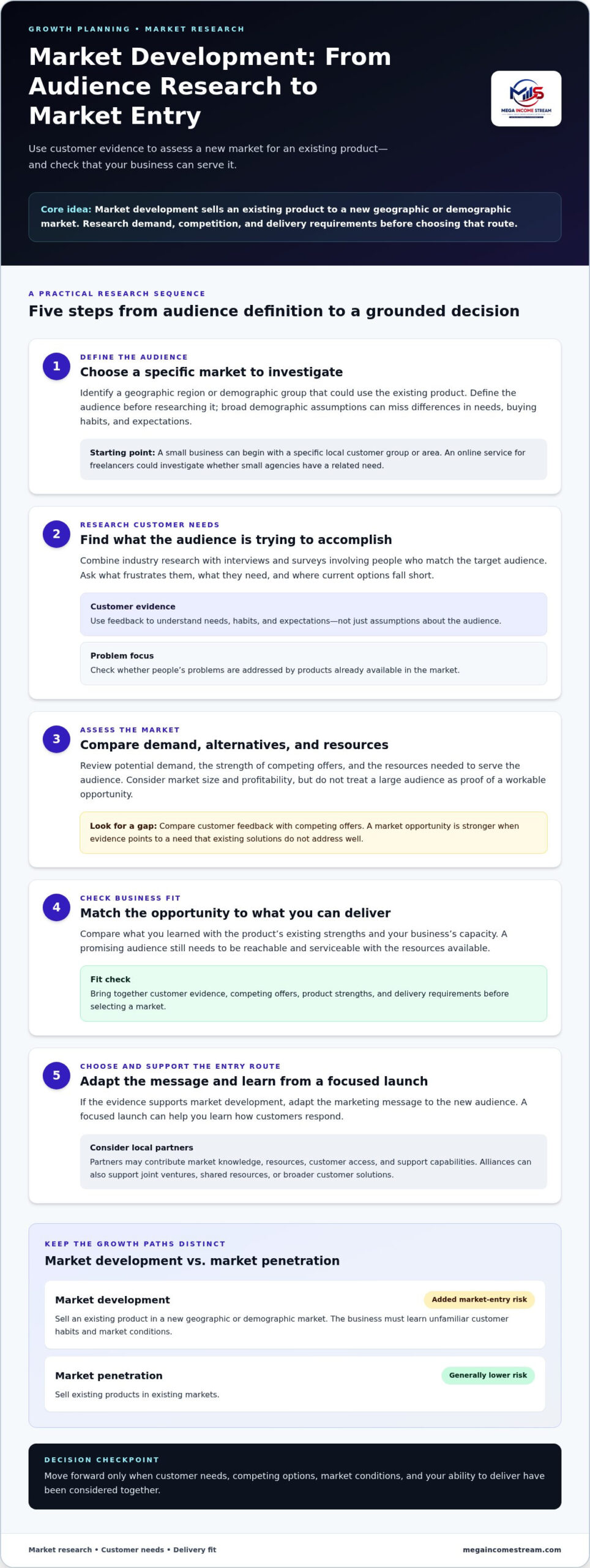
Market development takes existing products into new markets, while market penetration grows sales in current markets. Compare customer demand, competition, and delivery requirements before choosing the route that fits your growth plan.
Market Entry and Penetration
Market development means selling an existing product to a new geographic or demographic market. Market penetration means selling existing products in existing markets. Penetration is generally lower risk, while development requires learning unfamiliar customer habits and market conditions. For example, a business serving one US region could explore another region before creating an entirely new product.
Partner ecosystems can make entering a market more workable. Local partners may contribute market knowledge, resources, customer access, and support capabilities. A partnership or strategic alliance can also enable joint ventures or a broader customer solution. Adapt the marketing message to the new audience, then use a focused launch to learn how customers respond.
Researching Markets and Audiences
Market research combines industry research with interviews and surveys involving people who match a target audience. This matters because demographic assumptions alone can hide differences in needs, buying habits, and expectations. Define the audience first, then investigate its problems and how existing businesses address them.
For strategic growth planning, compare potential regions and customer groups with the product’s existing strengths. An online business, for example, could examine whether a service designed for freelancers also meets small agencies’ needs. Look for evidence in customer feedback, competing offers, and gaps in available solutions before choosing a market to develop.
Comparing Market Opportunities
Compare market size, competition, and profitability by assessing potential demand, the strength of existing alternatives, and the resources needed to serve the market. This helps distinguish a large audience from a commercially workable opportunity. To uncover unmet needs, ask customers what frustrates them, then check whether current products address the problem.
For a small business in the United States, start locally: identify a specific customer group or geographic area, interview people who fit that audience, and review competing offers. Compare what you learn with your capacity to deliver. A local service business might find nearby customers need a more convenient version of an existing service, while a digital seller could test demand in a new region.
Market patterns can inform questions, not replace local evidence. E-commerce can be one factor to consider when assessing a target market, but local demand and competition still need to be validated. Treat that shift as a reason to assess online access in a target market, then validate customer needs and competitive conditions before expanding.
Businesses can examine geographic regions or demographics to identify new markets for existing products. When entering an unfamiliar market, adapt marketing messages and use partnerships or alliances to support entry. Local partners can contribute expertise and resources that help businesses explore local dynamics. Partner networks can also support broader solutions and customer service. Strategic alliances can create opportunities for joint ventures, shared resources, and access to new customer bases. Use research findings to choose an audience and shape the message for that market.
What are Business Growth Opportunities?
A business growth opportunity is a project or investment with the potential to expand a company. Product development offers one path by introducing new products to current customers.
Expanding Product Offerings
Expanding product offerings means developing new products or improving existing ones for current customers. A useful addition can address another need without requiring the business to find an entirely new audience. For example, a company selling design templates could develop matching presentation layouts for customers who already use its templates.
A broader assortment does not automatically generate more revenue. Assess product incrementality: does a new item prompt additional purchases, or simply shift demand from an existing item? A retailer adding another version of a popular product should compare customer uptake and overall category sales, not just the new item’s sales.
Complementary products and services can make an offer more complete. A business selling online courses might add a workbook that helps customers apply the lessons. Upgrades can also address a known limitation, such as adding advanced features to software customers already use. Customer feedback can guide which improvement merits development resources.
Innovation can also come from collaboration. A company might work with a partner that brings technical expertise, customer insight, or complementary capabilities. For example, a scheduling software business and a payments provider could explore a combined workflow. Define the customer problem first, then agree on how each partner will contribute to a solution.
Evaluating Growth Options
Growth metrics help compare potential offerings by showing demand, performance, and delivery efficiency. Track product revenue, repeat purchases, customer retention, gross margin, and support requests. Strong initial sales paired with few repeat purchases, for example, may suggest an item attracts attention but does not meet an ongoing need.
A SWOT analysis identifies a business’s strengths, weaknesses, opportunities, and threats. It can reveal growth options by connecting internal capabilities to external demand. A company with a skilled design team might use that strength to develop a service, while limited production capacity could signal a constraint to address before launch.
Use the analysis to compare ideas, not to justify a preferred one. List each idea, name the customer need it addresses, and assess its fit with current capabilities. Then compare expected demand, delivery costs, and risks such as customer substitution. A new accessory, for instance, should add value rather than simply replace sales of an existing product.
Product development works best when customer need, business capability, and measurable performance align. Research, partner collaboration, and a focused launch can show whether an idea merits further investment or needs refinement.
Jobs to be Done theory and customer needs
Customer feedback and buying behavior can reveal growth opportunities when they expose unmet needs or repeated friction. Compare what customers say with what they do, such as abandoning checkout or repeatedly requesting the same feature. To understand how to identify growth opportunities, trace those signals to the customer’s task and the point where current options fall short.
The Jobs to Be Done approach views customers as hiring products to accomplish a task. A commuter might choose a meal service not simply for the food, but to save time between work and travel. That task suggests which features matter, where the experience breaks down, and what an alternative could deliver. It also gives teams a clearer way to define customer success.
Start with a specific customer task, then look for obstacles before and after purchase. A freelance designer may buy project-management software to keep client approvals moving, yet still use spreadsheets to track revisions. That workaround points to a possible need. Similar patterns across industries can reveal demand that current offerings do not address. Compare the task and workaround before proposing a solution.
Customer interviews and surveys help test these observations. The U.S. Small Business Administration’s market research guidance also covers ways to understand customers and competitors. Ask people to describe a recent purchase, what prompted it, and what they did when a problem appeared. Avoid asking only whether they like a proposed idea. A customer’s account of choosing between existing options gives clearer insight into priorities and decision criteria.
Turn a recurring need into an idea, then test it with people who experience the problem. Chalmers University of Technology describes a process that used a survey of potential customers and screening analysis to identify a promising market. Screen responses against a defined customer profile instead of treating every positive answer as evidence of demand. This helps separate general interest from a need tied to a specific audience.
Improving customer experience can support growth by reducing friction in an existing journey. Map the steps from discovering an offer to using it, then identify where customers need extra help. For an online course, repeated questions about downloading worksheets could signal a confusing lesson page or unclear instructions. Fixing that friction can make the existing offer more useful.
Retention offers another source of insight. Compare feedback from repeat customers with feedback from people who stopped buying, then look for differences in expectations, product use, or support needs. A sustainable improvement might involve clearer onboarding, a useful follow-up resource, or a service change that draws on the team’s existing skills.
Diversification
Diversification means entering new markets with new products. It can open a new revenue path, but is generally considered the riskiest growth strategy because the business must learn about both the offer and its audience. Key risks include weak demand, unfamiliar competitors, and stretching resources beyond what current operations can support.
Igor Ansoff developed the Ansoff Matrix in 1957 to compare growth options by product and market. Diversification occupies the new-product, new-market position. That combination means a company can’t rely solely on its existing customer knowledge or delivery model. A business considering a digital course for a new professional audience, for example, must assess both the course’s value and that audience’s needs.
Assess readiness by looking at the capabilities the business already has. A company with a strong software team might build a new tool for a different customer group, while a retailer might use existing supplier relationships to enter a related category. Both moves still require new market knowledge. Map which skills, processes, and partner resources transfer, then identify gaps that could slow product delivery or customer support.
A new channel can also change operating requirements. A business moving from direct sales to a partner-led model needs to plan how partners will explain the offer and handle customer questions. A company exploring a new region may need to adapt its message and work with local partners who understand customer expectations. Each choice adds dependencies, so clarify responsibilities before committing resources.
Pilot programs let businesses test diversification ideas before a full-scale launch. Set a narrow target audience, define the customer problem, and offer a limited version of the product. For instance, a healthcare provider could pilot a technology partnership that integrates a medical device with telehealth services. Track customer response, delivery issues, and the resources needed to support the pilot, then use those findings to refine the proposal.
Partnerships can provide expertise or resources a business lacks. Healthcare providers partnering with technology companies are one example, with each side contributing capabilities toward a broader service. Mergers or acquisitions can also provide access to expertise and resources, but introduce integration work. Compare that route with developing internal capabilities, especially when systems, teams, or customer workflows must change.
Before scaling, compare the pilot’s customer response with your original assumptions. Check whether the product solves a clear need, whether the intended audience can access it, and whether operations can support delivery. If the evidence points to a mismatch, adjust the offer or audience before expanding. Diversification is more manageable when the business uses a pilot to learn, builds on relevant capabilities, and plans for new demands.
Business acumen and growth opportunities
Business acumen connects customer demand to a company’s goals, capabilities, and resources. It helps leaders assess whether an idea can support business growth instead of chasing demand without a workable plan. Define broad goals and areas of expertise, then compare them with customer needs and the solutions businesses already provide.
Assess a company’s strengths, weaknesses, and growth potential by reviewing its skills, processes, customer relationships, and ability to deliver. A SWOT analysis organizes those findings into strengths, weaknesses, opportunities, and threats. For example, a strong service team could support expansion, while slow onboarding may need improvement before the business takes on more customers.
Next, map products and markets to distinguish practical growth routes. Market penetration builds sales using existing products in existing markets and is generally considered lower risk. Market development takes existing products into new markets; product development introduces new products to current customers. Diversification combines new products and new markets, so it requires a different level of readiness.
Estimate an opportunity’s costs, revenue, and return on investment by listing required resources, forecasting sales based on plausible customer demand, and comparing expected returns with total costs. Include delivery, marketing, support, and operational changes in the cost picture. For example, a new service may attract customers but weaken returns if it requires extensive manual support.
A growth matrix can structure this comparison, but it does not replace commercial judgment. Assess whether existing processes could become faster, cheaper, more sustainable, or more accessible. A freelance agency might streamline client onboarding before entering new sectors; a digital publisher could improve distribution before adding another offer. Each option should connect a market need to a capability the business can use.
Use a consistent evaluation across opportunities:
- Strategic fit: Check whether the idea supports the business’s goals and expertise.
- Customer demand: Identify the need and the current ways customers address it.
- Delivery capacity: Assess the people, processes, and partner resources required.
- Commercial case: Compare expected revenue with the full cost of delivery.
Business acumen turns opportunity discovery into a decision framework: align the idea with customer demand, test the operational fit, and compare its commercial case with other growth paths. Develop a practical business growth strategy to turn that assessment into a focused plan.
Assess the commercial readiness of each option before committing resources. To identify market opportunities, businesses should understand their overall strategies, broad goals, and areas of expertise, then assess consumer needs and how companies meet them. This keeps the search grounded in customer needs and business direction. A growth matrix analyses a business’s products and markets to guide strategic decisions and identify growth opportunities.
Businesses can increase market penetration by strengthening marketing, improving customer retention with loyalty programs, adjusting pricing, and improving distribution. These approaches build on market activity the business already understands. Businesses may consider whether existing offerings provide more features than some customers need when exploring new-market opportunities. Considering those customers alongside company goals and expertise can help distinguish an attractive opening from a poor fit.
Mega Income Stream: Business Strategies
Mega Income Stream helps entrepreneurs turn growth ideas into practical business strategies. When customer research points toward a new market, product, or revenue stream, make a clear plan that connects the opportunity with your capabilities and commercial goals.
Mega Income Stream’s Making Money Insights and Consulting Business offerings can help readers assess potential income paths and organize their next business decisions. This can be a useful next step when you have identified a promising customer need but need to evaluate strategic fit, prioritize options, or shape a focused growth plan.
For support applying these ideas to your business, contact Mega Income Stream.
Turn Your Next Insight into a Growth Decision
Make your next move a focused decision, not a broad expansion plan. Write a short opportunity brief naming the customer, unmet need, proposed response, and evidence that would support moving forward. This makes how to identify growth opportunities a repeatable business practice grounded in customer signals and strategic fit.
Then define what you will learn from a small test. Choose a clear success measure, identify the resources required, and set a decision point for continuing, revising, or stopping. This keeps the idea connected to business priorities while limiting commitment until the evidence is useful.
Mega Income Stream offers Business Strategies, Making Money Insights, and Consulting Business for entrepreneurs assessing growth paths and planning their next move. Contact Mega Income Stream to discuss growth and turn your next customer insight into a considered plan.
Start with one well-defined need, then build on what customers show you. Your next growth decision can be more focused than your last.
Frequently Asked Questions
What are the main types of growth opportunities for a business?
Growth opportunities can come from increasing customer value, reaching buyers through different routes, or improving how the business operates. For example, a company might create a recurring support option for customers who need help after a purchase, or reduce delays caused by a manual handoff between teams. Separate revenue opportunities from capacity improvements: the first aims to generate more sales, while the second helps the business serve demand more effectively.
What steps should a business take to test and prioritize growth opportunities?
Give each opportunity an owner and a written decision rule before work begins. Record the current baseline, the change being tested, the evidence to collect, and what would trigger continuing, revising, or stopping. For example, a team testing a new customer onboarding flow could track completion problems and support requests. Review findings with the people responsible for delivery so operational bottlenecks inform the decision alongside customer response.











Comments