
 By

What if the strategy you need isn’t another ambitious growth plan, but a clear answer to what’s actually holding the business back? Business strategy consulting should turn that uncertainty into decisions you can act on. If recommendations stay abstract or overlook your real constraints, even a polished plan can miss the mark.
Outside advice should clarify priorities, not add complexity. A useful engagement connects growth goals to the realities of your business: its bottlenecks, revenue opportunities, business model, and capacity to execute. Look beyond impressive presentations to the questions a consultant asks, the evidence behind the recommendations, and how the work becomes a usable roadmap.
This guide offers a practical framework for assessing what strategy consultants do and comparing their approach, deliverables, and working relationship with your needs. You’ll learn how to define the decisions an engagement should support, spot recommendations without a clear execution path, and set useful expectations from the start. Mega Income Stream provides customized strategy advisory to clarify growth priorities, refine business models, and build roadmaps for efficient scaling and sustainable financial growth.
Key Takeaways
- Use a specific strategic decision, not a broad growth ambition, to define what outside advice should help resolve.
- Assess whether the diagnosis connects market evidence with your company’s capabilities, objectives, and constraints.
- Compare business strategy consulting options by business fit, diagnostic approach, decision outputs, and advisory relationship.
- Prepare by gathering baseline context, aligning stakeholders, and setting clear measures of progress.
- Explore how tailored advisory can translate growth priorities into a practical roadmap for scaling.
What Business Strategy Consulting Helps a Company Decide
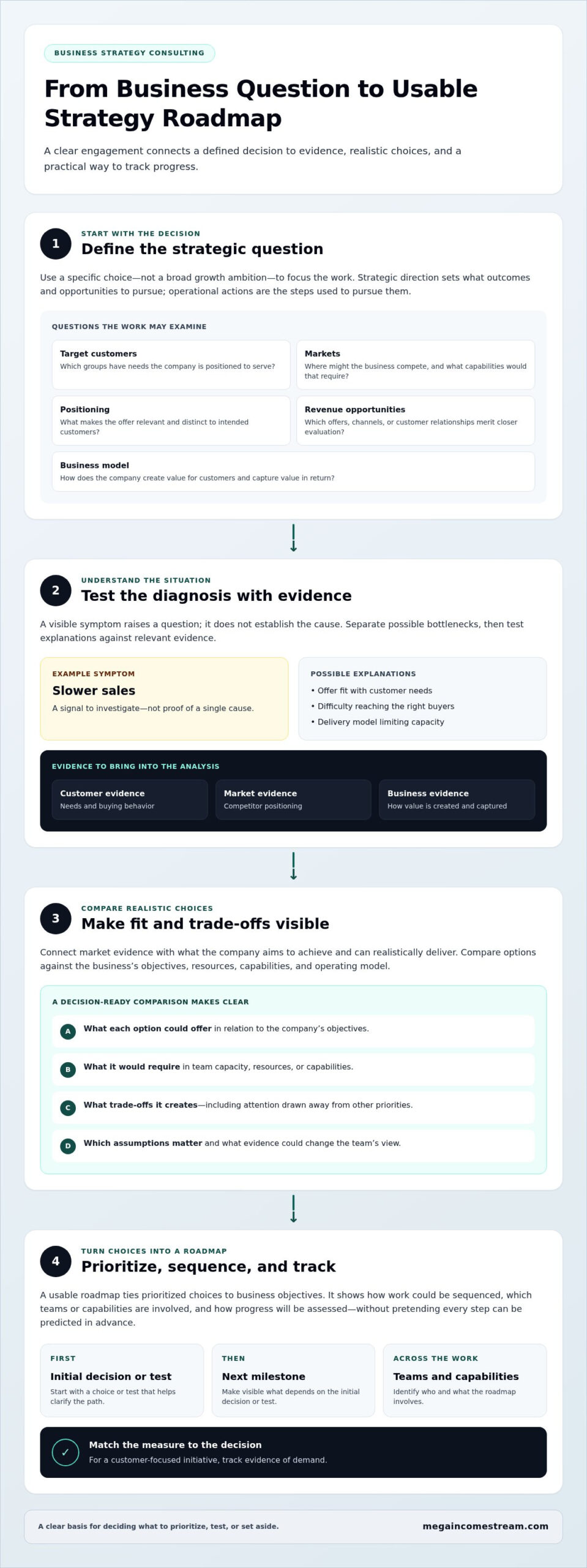
Business strategy consulting helps leaders assess choices and set a direction for the business. It brings structured analysis to decisions about where to focus, how to compete, and which opportunities merit investment. As a specialized part of management consulting, it differs from routine operational support: the goal is to clarify the choices shaping the company’s future, not manage its daily workflow.
Leaders often seek strategic advice when growth stalls despite continued effort, teams pursue competing priorities, or the business model faces pressure from changing customer behavior or market conditions. There may be several plausible options but no shared basis for comparing them. Without clear priorities, budgets, staff time, and leadership attention can spread across initiatives that don’t reinforce one another.
Strategic direction defines which outcomes and opportunities to pursue; operational actions are the steps used to pursue them. Improving a weekly sales process is an operating task. Deciding which customer segment to prioritize, and what value to offer that segment, is a strategic choice. The two are connected, but they call for different levels of analysis.
When Does a Business Need Strategic Advisory?
Outside perspective can help when leaders are too close to a recurring constraint to see its causes clearly, or when attractive market options require different capabilities and investments. A strategy conversation makes the decision explicit before resources are committed. For example, leaders might weigh deepening relationships with existing customers against pursuing a new segment or revising an offer that no longer fits buyer needs.
This isn’t a substitute for leadership judgment. It gives decision-makers a structured way to surface assumptions, weigh trade-offs, and identify what evidence could change their view. That structure is useful when unresolved questions are scattering team attention or delaying action.
Which Decisions Can Business Strategy Consulting Address?
The scope depends on the business question, but strategic advisory commonly helps leaders examine choices such as:
- Target customers: Which groups have needs the company is positioned to serve?
- Markets: Where might the business compete, and what capabilities would that require?
- Positioning: What makes the company’s offer relevant and distinct to its intended customers?
- Revenue opportunities: Which offers, channels, or customer relationships deserve closer evaluation?
- Business model: How does the company create value for customers and capture value in return?
These choices are connected. A new market may require a different offer; a revised offer may affect how it’s priced, delivered, or sold. Strong analysis considers those links alongside the company’s objectives and constraints instead of treating each opportunity as an isolated growth idea. The outcome should be a clearer basis for deciding what to prioritize, what to test, and what to set aside, without assuming any option guarantees better results.
What a Business Strategy Consulting Engagement Should Produce
A useful engagement should leave leaders better equipped to make a defined business decision, not simply with a polished presentation. Before recommending action, a consultant should clarify the question, the company’s current position, and the constraints shaping its options. These may include limited team capacity, gaps in key capabilities, or uncertainty about customer demand.
Analysis becomes decision-ready when it connects market evidence with what the company can realistically deliver and what it aims to achieve. Business strategy consulting should help distinguish an attractive opportunity from one that fits the business’s objectives, resources, and operating model. Leaders should be able to compare the options and understand the reasoning behind them.
From Business Diagnosis to Strategic Choices
Separate a visible symptom from a possible underlying bottleneck. Slower sales, for instance, may reflect a weak fit between an offer and customer needs, difficulty reaching the right buyers, or a delivery model that limits capacity. The symptom raises a question; it doesn’t establish the cause. A sound diagnosis tests possible explanations against relevant evidence.
That evidence might include customer needs and buying behavior, competitor positioning, and how the company creates and captures value through its business model. Recommendations should make trade-offs explicit. If pursuing one customer group requires new capabilities or draws attention away from another, leaders need to see that cost alongside the potential value. A clear rationale also identifies key assumptions, so the team knows what to monitor as conditions change.
From Recommendations to a Usable Roadmap
A recommendation becomes more practical when it shows what to prioritize and how the work could be sequenced. A roadmap might identify an initial decision or test, the next milestone that depends on it, and the capabilities or teams involved. It should make dependencies visible without pretending every step can be predicted in advance.
A useful strategy roadmap ties prioritized choices to business objectives, with clear measures for tracking progress. Measures should fit the decision: a customer-focused initiative may track evidence of demand, while a business-model refinement may monitor whether the revised offer works for the company and its customers. Responsibilities and milestones help leaders review progress and adjust direction when assumptions don’t hold.
Look for outputs that make the work usable after the analysis is complete:
- A concise diagnosis of the business question, current position, and constraints.
- Prioritized strategic choices with supporting evidence, assumptions, and trade-offs.
- A customized roadmap that connects priorities to objectives, responsibilities, and milestones.
- Relevant measures leaders can use to assess progress and revisit decisions.
These outputs create a basis for action, not a promise of results. Outcomes depend on context, the quality of available information, and how decisions are carried out. For leaders seeking a tailored roadmap around growth bottlenecks, revenue opportunities, or business-model refinement, Mega Income Stream’s strategy advisory can help turn those questions into structured priorities.
How to Compare Business Strategy Consulting Options
Proposals can use similar language while describing very different work. To compare business strategy consulting options, start with the decision your company needs to make, then assess how each approach will help you make it. A strong fit depends on relevant business context, transparent reasoning, and outputs that support a real choice, not brand size or impressive terminology alone.
Use these four criteria to organize your comparison:
| Criterion | What to assess | Useful signal |
|---|---|---|
| Business fit | Does the scope address your current decision and growth priorities? | The proposed work reflects your market, objectives, and constraints. |
| Diagnostic approach | How will the consultant understand the business and test assumptions? | The approach identifies relevant evidence and explains how it informs the analysis. |
| Decision outputs | What will leaders be able to decide or do with the findings? | Deliverables include clear choices, rationale, and practical next steps. |
| Advisory relationship | How will the consultant work with decision-makers and stakeholders? | There is room for candid discussion and alignment as the work develops. |
Compare proposals against the same business question. If your priority is evaluating a new customer segment, check whether the proposed scope examines customer needs, your ability to serve that segment, and the trade-offs involved. A broad menu of capabilities may sound comprehensive, but it doesn’t show that the work is tailored to your decision.
Compare the Work, Not Just the Consulting Brand
Look for a defined question, a tailored scope, and a clear explanation of how the analysis will lead to useful outputs. A generic capability list can describe what a consultant knows how to do; it doesn’t establish what they’ll do for your business. Relevant context matters: recommendations for a company with a strong customer base but limited delivery capacity may differ from those for a business still testing demand.
Clarity is the test. Can you tell which decisions the engagement will inform, what evidence it will consider, and what leaders will receive? If the proposal leaves those points open, it’s harder to judge whether the work matches your priorities or will produce analysis without a clear decision path.
Assess Evidence, Trade-Offs, and Working Style
Examine how recommendations will be grounded in business and market evidence. The consultant should explain which information matters, how it will be interpreted, and what assumptions could affect the conclusions. Credible advice doesn’t present every option as a win; it shows the trade-offs, such as balancing entry into a new market against the capabilities and attention needed to serve it.
Working style matters, too. Leaders need to be able to challenge assumptions, share relevant context, and discuss disagreements directly. Consider whether the approach supports alignment among the people responsible for making and carrying out decisions. The strongest proposal is not necessarily the one that sounds most certain, but the one that makes its reasoning, boundaries, and intended decision outputs easiest to understand.
How to Prepare for Business Strategy Consulting
A focused brief helps turn a growth concern into a decision that can be analyzed. Before starting business strategy consulting, clarify what leadership needs to decide, what information can inform that choice, and what progress should look like. You don’t need a perfect dataset or a finished answer. You do need enough shared context to keep the work aimed at the right question.
- Define the decision. Write the choice leaders need to make in one sentence. “We want to grow” is an ambition; “Should we prioritize a new customer segment or deepen sales to existing customers?” gives the analysis direction.
- Gather baseline context. Bring together relevant information already available, such as business goals, current offers, customer feedback, sales patterns, revenue sources, and known operating constraints. Use what you have, and note where information is incomplete rather than delaying the discussion.
- Align stakeholders. Identify who owns the decision and whose perspective can clarify customer needs, delivery capacity, financial considerations, or other relevant factors. Agree on the central question so the conversation doesn’t splinter into separate agendas.
- Set success measures. Decide what evidence would indicate useful progress toward the objective. Measures might relate to validating customer demand, improving visibility into revenue sources, or reaching a decision by a defined point. Treat these as ways to evaluate progress, not promised results.
Define the Strategic Question and Scope
Make the question specific enough to guide research, but broad enough to include factors that could change the decision. State the relevant time horizon, important constraints, and what belongs in scope. For example, a decision about entering a new market may need to consider customer fit and required capabilities. A separate internal process issue can stay outside the core inquiry unless it directly affects that choice.
Align Leaders Around Evidence and Outcomes
Useful preparation doesn’t mean assembling every report the company has. Select information connected to the question, and make its context clear: what period it covers, where it came from, and what it can or can’t show. Bring differing leadership views into the discussion early, then agree on how progress will be assessed. Shared expectations help keep the work grounded in evidence rather than turning it into a contest of assumptions.
Once the question, context, and decision-makers are clear, an advisor can shape the work around your actual priorities. Mega Income Stream’s tailored strategy advisory focuses on clarifying growth bottlenecks, revenue opportunities, and business-model refinements. Explore tailored strategy advisory to develop a more focused starting point for your growth decisions.
How Mega Income Stream Tailors Business Strategy Consulting to Growth
After defining the decision your business needs to make and the support that fits, look for an advisory approach that reflects your actual growth priorities. Mega Income Stream provides business strategy consulting and advisory support for entrepreneurs and business leaders, focusing on growth bottlenecks, revenue opportunities, and business-model refinement.
Growth questions rarely sit in isolation. A company may see room to reach more customers while also facing constraints in its offer or operations. Strategic advice can help leaders examine how those factors connect and clarify where to direct attention. The objective is a more structured basis for choosing priorities, not a guaranteed financial result.
Connect Growth Bottlenecks to Revenue Opportunities
A bottleneck can limit how effectively a business pursues an opportunity. Examining both sides helps leaders avoid focusing on market potential alone: an option may look attractive, but its fit also depends on the company’s business model, capabilities, and objectives. Mega Income Stream’s advisory focuses on bringing growth constraints, potential revenue opportunities, and business-model refinement into the same strategic conversation.
This joined-up view can help clarify which questions deserve attention first. Where could the business create more value for customers? Does the current model support capturing that value sustainably? The answers depend on each organization’s context, so strategy work should inform choices rather than promise a particular level of growth or income.
Turn Strategic Priorities into a Tailored Roadmap
Once priorities are clearer, a customized roadmap can connect strategic direction to a usable path forward. Mega Income Stream provides strategic roadmaps and advisory support for efficient scaling, tailored to business needs. This approach helps leaders translate growth questions into structured priorities that account for their organization’s goals and operating context.
A roadmap gives decision-makers a shared reference point as they consider which opportunities to pursue and how priorities relate to sustainable financial growth. Advisory support keeps attention on the strategic questions behind the plan, rather than treating a roadmap as a one-size-fits-all formula. The choices still belong to the business, and results depend on its circumstances and execution.
If your next growth decision would benefit from a clearer view of bottlenecks, revenue opportunities, or business-model options, explore Mega Income Stream’s business strategy consulting for tailored strategic direction and advisory support.
Make Your Next Growth Decision Deliberately
The strongest next move isn’t always the most ambitious one. It’s the choice your leadership can explain, resource, and revisit as conditions change. Treat business strategy consulting as a way to build decision discipline: clarify what must be true for a direction to work, identify assumptions to test, and decide when to review the course. That keeps strategy responsive instead of turning an initial plan into a commitment no one questions.
You don’t need every uncertainty resolved before taking a useful next step. Start with the decision that matters most now, and make space to learn as you act. Agree on what new information could change your thinking so the team can adjust without losing sight of its priorities. The decisions remain yours; focused advice can help you approach them with more structure and confidence.
Take the next step with Mega Income Stream and give your growth priorities a clearer strategic starting point. Progress begins with a decision you’re ready to make, learn from, and refine.
Frequently Asked Questions
How much does business strategy consulting cost?
Business strategy consulting fees vary with scope, complexity, and the advisory requirements involved. A focused review of one decision may call for different work from a broader examination of several business priorities. Compare the defined work and expected outputs alongside the fee. Neither a low nor a high fee proves that an engagement offers value.
How long does a business strategy consulting engagement take?
Timing depends on the business question, agreed scope, information available, and how involved leaders can be. Assessing one customer segment may require a different level of work from reviewing several parts of the business. There’s no single duration that fits every engagement. A clearly defined scope helps set realistic expectations about the analysis, decisions, and advisory support involved.
Can a small business benefit from strategy consulting?
Yes. A smaller business can benefit when an important decision needs more structure, but size alone doesn’t determine whether advisory support is a fit. For example, an owner weighing whether to expand an offer or focus on existing customers may need help evaluating the options. The scope should match the company’s priorities and capacity to act on recommendations. Outside advice isn’t necessary for every business or every decision.
What information should I prepare before speaking with a strategy consultant?
Bring a clear description of the issue, your current objectives, relevant customer or market context, and available revenue or operating information. If customer demand is the concern, useful starting context might include feedback, sales trends, or changes in buying behavior. You don’t need a perfect dataset before defining the problem. Identify gaps in the information as part of the initial discussion.
Is business strategy consulting the same as writing a business plan?
No, they address different questions, though they can overlap. Strategy consulting focuses on choices about direction, customers, markets, competitive position, and growth priorities. A business plan may document a venture’s model, goals, and operating assumptions for a particular purpose, such as explaining how it intends to work. A plan can reflect strategic decisions, but writing one doesn’t necessarily resolve which direction the business should choose.
How can I tell whether a strategy recommendation is practical?
A practical recommendation explains its reasoning, assumptions, trade-offs, and priorities in terms your leadership team can assess. It should connect to your organization’s actual situation, such as the capabilities required or customers affected, rather than rely on broad slogans. Relevant measures can help you evaluate progress after a decision. Practical doesn’t mean risk-free or certain to succeed; leadership judgment and execution still shape the outcome.
Can business strategy consulting help identify new revenue opportunities?
It can help examine customer needs, market conditions, and the business model to surface possible revenue directions. For instance, leaders might assess whether an existing offer could serve a different customer group, then examine what that would require. Treat each opportunity as a hypothesis, not a guaranteed income stream. Evidence, fit with the company’s capabilities, and clear priorities help determine whether an option merits further consideration. For more on evaluating revenue diversification through customer demand, margins, and operational fit, see this guide to sustainable income streams for businesses.










Comments