
 By

Learn how the amazon marketing affiliate program works, its 24-hour cookie rules, payout timelines, and tips to boost commissions fast.
You keep seeing bloggers and YouTubers link to products on Amazon and wonder if that’s a real way to earn money. It is, and the amazon marketing affiliate program, officially called Amazon Associates, is one of the oldest and easiest ways to start earning commissions online without holding inventory or handling customer service.
Here’s the short answer: you sign up for free, get approved, place special tracking links on your site or social channels, and earn a small commission when someone buys through your link within 24 hours. Amazon handles payment, shipping, and returns. Your job is sending qualified traffic. Commission rates vary by category, usually landing between 1% and 10%, which matters a lot once you start picking what to promote.
In this guide, you’ll learn exactly how the program works from application to payout, what qualifies as a valid sale, and the rules that get accounts banned. We’ll also cover realistic earning expectations and how Amazon’s setup compares to other affiliate marketing programs you might consider alongside it.
Why the Amazon affiliate program matters for creators
Most creators don’t start with crypto or software affiliate deals. They start with affiliate marketing on Amazon because it’s the easiest first step toward making money from your website or blog that doesn’t require a big audience or a sales pitch. You’re not convincing anyone to buy something they weren’t already planning to buy. You’re just pointing them to a trusted checkout page they already use.

Amazon’s brand does the selling for you
People already trust Amazon with their credit card. That single fact removes the biggest obstacle in affiliate marketing programs amazon competitors can’t match: conversion friction. When you link to a blender on your recipe blog, readers aren’t wondering if the checkout is secure or if their package will arrive. They already know the drill. This is why affiliate marketing by amazon consistently outperforms lesser-known merchant programs on conversion rate, even when the commission percentage is lower.
Amazon converts because shoppers trust the checkout, not because the commission rate is generous.
Product breadth means you’re never boxed in
Amazon sells more than 350 million products, according to its own seller data, which means almost any niche you write about has something to link to. A personal finance blog can link budgeting notebooks and desk organizers. A travel site can link packing cubes and neck pillows. This flexibility is a big part of why marketing affiliate amazon setups work so well alongside other income streams covered on sites like ours, from freelancing to data monetization. You’re rarely stuck without a relevant product to recommend.
It scales with almost no extra work
Once your tracking links are live, they keep earning without fresh effort. A blog post from three years ago can still generate commissions today if it still ranks and still gets clicks. Compare that to freelancing, where income stops the moment you stop working. Affiliate marketing for amazon content behaves more like a rental property than a job: you build it once, then collect small payments repeatedly, which is the whole appeal of passive income online.
Real numbers, honestly stated
Don’t expect to quit your job on Amazon commissions alone. Rates range from 1% to 10% depending on category, and average order values on many product types sit under $30. That means most individual commissions land between $0.30 and $3.00. The program earns its keep through volume and traffic, not high per-sale payouts.
Here’s how it stacks up against other common income paths creators consider:
| Income Method | Startup Cost | Time to First Payout | Ongoing Effort |
|---|---|---|---|
| Amazon Associates | $0 | 1-3 months | Low once published |
| Freelance writing | $0 | 1-2 weeks | High, per project |
| Dropshipping | $200+ | 2-4 weeks | Medium to high |
| Niche ad network | $0 | 3-6 months | Low once published |
Why this matters for your broader strategy
For readers exploring affiliate programs with amazon as one piece of a bigger income plan, the appeal isn’t getting rich from one blog post. It’s stacking small, low-effort income streams that don’t compete for your time. Pair it with a side hustle, some freelance work, and maybe a data monetization strategy, and the commissions become a meaningful supplement rather than a lottery ticket. That’s the real reason so many creators keep a permanent spot for Amazon links in their content, even after adding higher-paying affiliate deals elsewhere.
How to qualify and sign up for Amazon Associates
Getting into affiliate marketing programs amazon runs is simpler than most platforms, but Amazon still checks that you have real content before handing out tracking links. You need an active website, blog, YouTube channel, or app with original content, not a bare template or a single post. Amazon wants proof you can actually send traffic, since the whole relationship depends on it.
What you need before applying
Before you even open the application, get these basics in place:
- A live website, blog, or social/YouTube presence with at least a handful of published posts or videos
- A clear privacy policy page, required for compliance with Amazon’s terms
- An active email address and a way to receive payments (bank account or gift card)
- Original content in a niche, not scraped or spun articles
Skipping any of these is the most common reason applications for affiliate programs amazon approves get rejected on the first try.
The sign-up steps
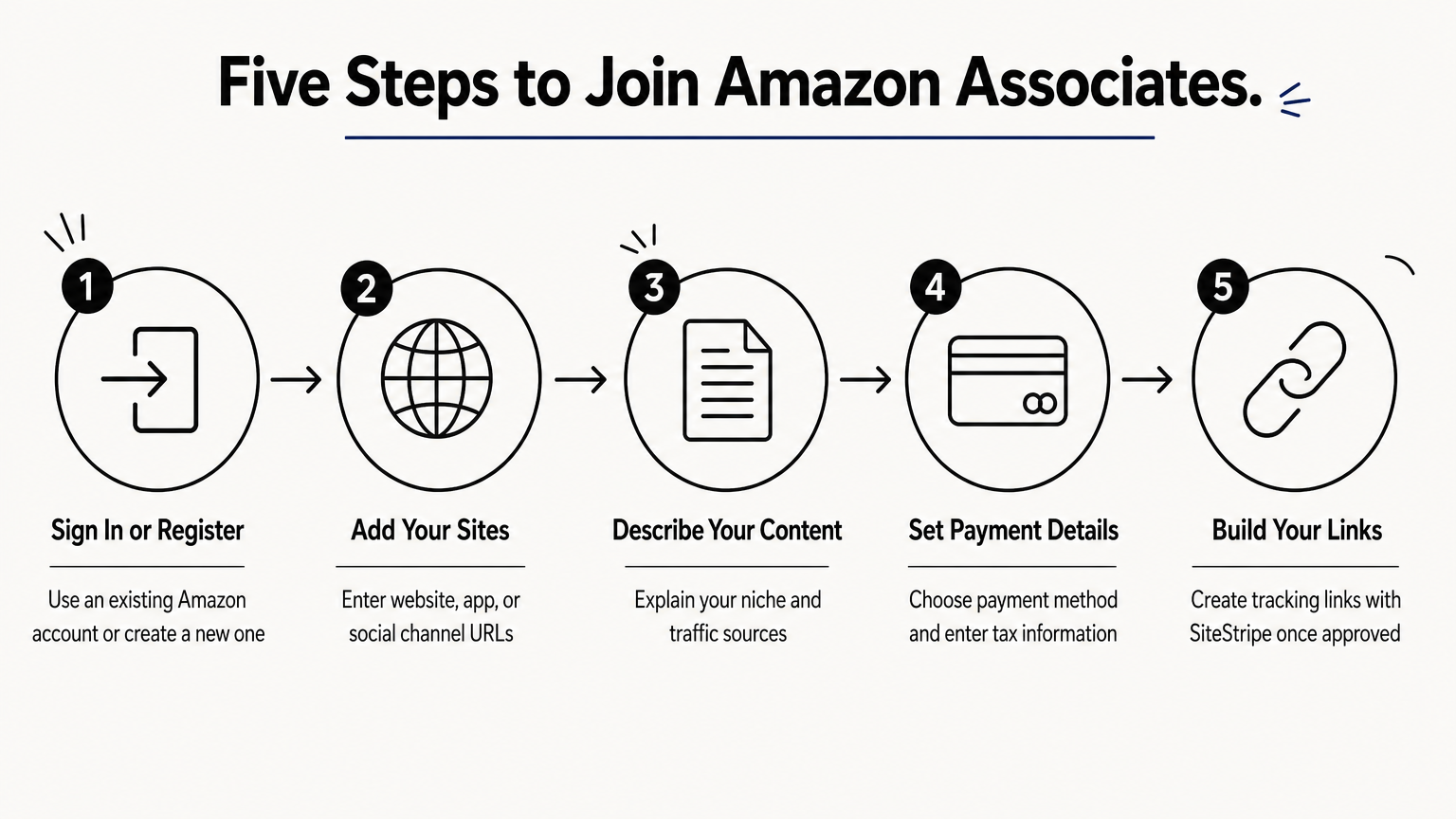
Once your site is ready, the process itself takes about fifteen minutes. Here’s the order Amazon walks you through:
- Go to the Amazon Associates homepage and sign in with an existing Amazon account or create one.
- Enter your website, app, or social channel URLs.
- Describe your content and how you plan to drive traffic.
- Choose a payment method and tax information.
- Build your first tracking links using SiteStripe once approved.
Submitting the application starts a review that usually takes one to three business days, though it can stretch longer during busy periods.
The 180-day trial clock
Here’s the part that trips people up: getting approved isn’t permanent. Amazon gives you a 180-day trial period during which you must generate at least three qualifying sales, or your account gets closed. This rule exists to filter out inactive accounts, and Amazon enforces it strictly.
No sales in 180 days means Amazon closes your account, no warning required.
If that happens, you can reapply later, but you’ll lose your tracking history and have to rebuild trust with the platform. For anyone serious about affiliate marketing in amazon as a real income stream, treat those first six months as a sprint to prove traffic and intent, not a slow ramp-up period.
How commissions, cookies, and payouts work
Understanding the mechanics behind affiliate marketing of amazon links matters more than most beginners realize, because two people can drive identical traffic and see very different earnings based purely on timing and category. The system runs on tracking cookies, tiered commission rates, and payout thresholds that decide when money actually lands in your account.

The 24-hour cookie window
Once someone clicks your Amazon link, a cookie starts tracking their session for 24 hours. Any purchase they make in that window counts toward your commission, even if they buy something completely different from what you linked. Add an item to their cart within that period, though, and the clock extends until checkout or 89 days, whichever comes first. This is why affiliate marketing at amazon rewards evergreen content that ranks for buying-intent keywords: you’re not just earning on the exact product, you’re earning on whatever the shopper decides to grab during that trip.
A single click can pay you for a cart full of unrelated purchases, as long as it happens within 24 hours.
Commission rates by category
Rates vary widely depending on what you promote, and category shopping matters as much as traffic volume:
| Category | Typical Commission Rate |
|---|---|
| Luxury beauty, Amazon devices | 3-10% |
| Furniture, kitchen | 3-8% |
| Toys, groceries | 3% |
| Physical video games | 1% |
| PC and Amazon Fresh | 1% |
Rates change periodically, so check Amazon’s current commission income statement structure before building a strategy around one category.
How and when you get paid
Payouts don’t happen the moment a sale closes. Amazon pays roughly 60 days after the end of the month a commission was earned, giving time for returns and cancellations to process. You’ll need to hit a minimum threshold, typically $10 for direct deposit or $100 for check, before funds release. Three payment options exist: direct deposit, Amazon gift card, or check, with direct deposit being the fastest and most common choice among serious affiliates. For anyone treating affiliate marketing with amazon as a real income line, tracking these dates matters just as much as tracking clicks, since a slow month can mean a two-month wait before you see the money.
Weighing the pros and cons of Amazon Associates
Before committing hours of content creation to affiliate marketing programs amazon runs, it helps to see the tradeoffs laid out plainly. No program is perfect, and Amazon Associates has real limitations alongside its obvious strengths.
The upside
Approval takes days, not weeks, and you don’t need a huge audience to get started. Trust is already built into the platform, so your job shifts from persuading buyers to simply reaching them. Product selection is nearly limitless, letting you match links to almost any niche without hunting for a merchant program that fits. And because links live inside published content, earnings continue long after you hit publish, which is rare among affiliate marketing programs in general.
The downside
Commission rates sit low compared to software or finance affiliate deals, often under 5% for the products readers buy most. The 24-hour cookie window is short next to competitors offering 30 or 60 days, so a reader who bookmarks your link and buys next week earns you nothing. Payouts lag two months behind the sale, and the 180-day trial period can quietly close a slow-starting account. Add strict linking and disclosure rules, and one policy slip can cost you the whole account, not just a warning.
Amazon rewards volume and consistency, not big single-sale payouts.
Where it fits in your overall plan
Honestly, Amazon Associates works best as one piece of a bigger income puzzle, not the whole strategy. Readers researching affiliate marketing for amazon often ask how it stacks against alternatives like ClickBank, niche software programs, or the Home Depot affiliate program’s rates and signup terms, and the answer usually comes down to volume versus payout size. Amazon wins on trust and traffic conversion. Other networks often win on commission percentage. If you’re weighing options side by side, our breakdown of Amazon Associates vs ClickBank walks through which fits different content types better. Combining both, rather than picking one, is how most experienced affiliates actually build steady income.
Tips to boost your Amazon affiliate earnings
Getting approved is the easy part. Turning affiliate marketing on Amazon into real monthly income takes deliberate choices about what you link, where you link it, and how you present it. A few habits separate accounts earning pocket change from ones earning a few hundred dollars a month on the same traffic.
Chase buying intent, not just traffic
A post ranking for “best budget blenders 2026” converts far better than one ranking for “how blenders work,” even with identical visitor counts. Readers searching comparison and “best of” terms already have their wallet out. Build content around affiliate marketing for Amazon keywords that signal someone is close to buying: “vs,” “review,” “best,” and “under $50” all outperform purely informational titles, which is where basic SEO and keyword research pays off.
Traffic that’s ready to buy beats traffic that’s just curious, every time.
Favor categories with better rates
Since commission percentage varies so widely, steer content toward categories that pay more when the product fit makes sense. Luxury beauty and Amazon devices often beat groceries or video games by a wide margin, so a review site with flexibility should lean that direction when possible.
Diversify your link placement
Don’t rely on a single “buy here” button buried at the bottom of a post. Spread links across:
- In-text mentions within the first 200 words, where engaged readers actually click
- Comparison tables summarizing specs and prices for multiple products
- A dedicated “resources” or “gear I use” page linked from your main navigation
- Native SiteStripe images embedded directly in product mentions, plus Amazon native ads on WordPress
Each placement catches readers at a different point in their decision, and tables in particular tend to hold attention longer than plain text links.
Update old posts instead of only publishing new ones
Prices, availability, and product models change constantly on Amazon, and a stale post with dead links or discontinued items quietly bleeds commissions. Set a quarterly reminder to revisit your top ten earning posts, swap outdated products, and refresh screenshots. This single habit often lifts earnings more than writing five new posts from scratch, since affiliate marketing programs amazon runs reward pages that already rank rather than ones starting from zero.
Combine with email and retargeting
Amazon’s 24-hour cookie punishes readers who research today and buy next week. Capture emails through a lead magnet, then send timely reminders around sales events like Prime Day, when purchase intent spikes and your link gets a fresh 24-hour window at the exact moment readers are ready to check out.
Making Amazon Associates work for you
The amazon marketing affiliate program isn’t a shortcut to fast money, but it’s still one of the lowest-risk ways to test whether content creation can pay you. You sign up free, place links inside content you’d likely publish anyway, and let Amazon’s trusted checkout do the heavy lifting on conversions. The tradeoffs are real: thin commissions, a short cookie window, and a trial period that punishes slow starts. None of that cancels out the upside of building an asset that keeps earning long after you hit publish.
Treat it as one income stream among several rather than your whole plan. Stack it with freelancing, other affiliate programs amazon shoppers already trust, or a side hustle, and the small commissions start adding up to something real. If you want more ways to build income streams like this one, work through these proven ways to make money online and start stacking your own.
Article Summary
This guide explains how Amazon Associates, one of the oldest affiliate programs, lets creators earn commissions by linking to products without handling inventory or customer service. After free signup and approval, affiliates place tracking links that earn 1-10% commissions on purchases made within a 24-hour cookie window, extended to 89 days if items are added to cart. Applicants need an active website or channel with original content and a privacy policy; approval takes days, but a 180-day trial requires three qualifying sales or the account closes. Payouts arrive roughly 60 days after the sale month, with minimum thresholds of $10 for direct deposit or $100 for check. Amazon’s strength lies in its trusted checkout reducing conversion friction and its vast product catalog fitting nearly any niche, making content evergreen and low-maintenance once published. Downsides include low commission rates, a short cookie window compared to competitors, delayed payouts, and strict rules that can suddenly close accounts. The article recommends targeting buying-intent keywords, favoring higher-commission categories, diversifying link placement, regularly updating old posts, and pairing Amazon links with email retargeting. Ultimately, it positions Amazon Associates as a low-risk, supplementary income stream best combined with freelancing or other affiliate programs rather than a standalone strategy for significant earnings.



Comments