
 By

To select the best BaaS for your startup, consider your app’s core requirements (auth, database, storage, functions), prioritize scalability, security, performance, and cost (pricing tiers, hidden fees), ensure easy integration with your stack, assess the provider’s dependability (uptime, support, documentation), and determine whether they offer flexibility to avoid vendor lock-in, often starting with BaaS for speed and potentially migrating later.
Key Factors to Evaluate
- Core Features & Ecosystem:
- Must-Haves: Does it offer user authentication, databases (SQL/NoSQL), cloud storage, serverless functions, push notifications, and real-time updates?
- Integrations: Can it easily connect with your existing tools (payment gateways, analytics, etc.)?
- Scalability & Performance:
- Growth Potential: Will the service handle user growth from 100 to 100,000+ users without performance drops?
- Speed: Does it offer fast data handling and quick query responses?
- Cost & Pricing:
- Transparent Tiers: Look for predictable, scalable pricing models, not just free tiers.
- Hidden Fees: Watch for charges on high traffic, storage, or API calls as you scale.
- Security & Compliance:
- Data Protection: Check for features like encryption and robust access controls.
- Regulations: Does the provider meet standards like GDPR or HIPAA if needed?
- Developer Experience & Support:
- Ease of Use: Is the platform user-friendly with a low learning curve and great documentation?
- Support: What’s the quality of customer support and the vendor’s reputation/uptime?
- Flexibility & Lock-in:
- Customization: Can you customize backend logic and data structures?
- Vendor Lock-in: Consider open-source options (like Appwrite, Supabase) for less lock-in, especially if self-hosting is an option.
Popular BaaS Platforms & Types
- Firebase (Google): Popular, NoSQL (Firestore), but high vendor lock-in risk.
- Supabase: Open-source (PostgreSQL), medium lock-in, good for SQL-focused apps.
- Appwrite: Open-source, self-hostable, supports SQL/NoSQL, low lock-in.
- Kinvey/AnyPresence: Enterprise-focused, great for rapid scaling.
Strategy for Startups
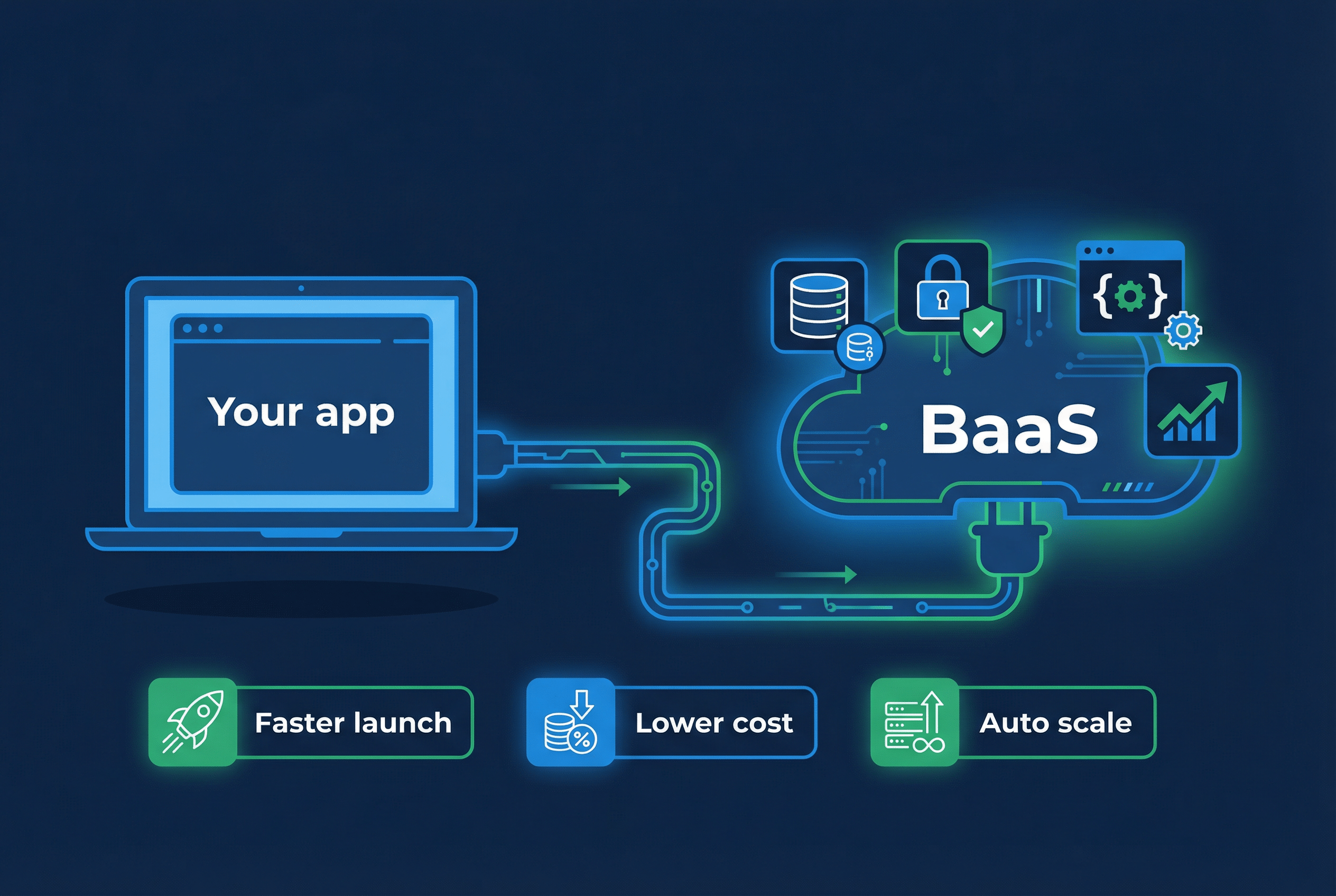
- Start with BaaS: Use BaaS to validate your idea quickly and focus on the front end.
- Consider Hybrid: As you grow, you might shift to a custom backend or a hybrid approach for specific complex features.
What is the purpose of your application? What are you hoping to achieve with it? These questions must be answered before an app may be deployed, as well as when selecting the appropriate backend as a service (BaaS) provider. BaaS is a popular and rapidly expanding delivery platform for cloud services.
BaaS is a solution that allows you to construct and administer a centralised database, allowing your users to share material via the cloud. Nowadays, most programs require a web-based backend. Other technologies, like as PHP and Ruby, were formerly employed, but BaaS has since supplanted them. This is for the following reasons:
- Difficult to scale the earlier methods
- Large amount of time spent to locate and utilise resources
- Expert set of skills was required for delivery
Let us explore how we can identify and choose the right backend as a service platform.
Demand might be unpredictable, making it tough to plan ahead. As a result, it becomes difficult to scale an application appropriately. Scaling apps for iOS and Android can be tricky. Even if the developer can code for iOS and Android, it is tough to create a scalable backend for the program. This requires a certain set of talents. The development of both the front and back ends of the app should be considered independently.
Features of a BaaS platform
There are several web-based backend systems that can be integrated into your app. Let us look at the three most popular ones. However, before that let us understand the usual features of a BaaS platform.
- Backend storage
- iOS library for smooth integration
- Freemium model
- Value for money with use based pricing system
- Increased scalability
- Efficient performance
- Management of commercial risk
- Push notifications
- User management
- File storage
- Geolocation
- Ability to store customised objects
Top BaaS Providers
Let us look at the leading BaaS providers
Kumulos
Kumulos is a popular backend BaaS provider. It provides web-based storage for the app’s database. Since Parse’s closure, it has emerged as a leading BaaS provider. It is used to create, deploy, and optimize an application. Kumulos’ primary selling point is that it works for both independent mobile developers and large companies. If you want to switch from Parse, you can utilize one of the following options:
- Migrate to Parse open source
- Move to an mBaaS and Pus provider
- Build and run the backend system yourself
The second method is by far the best and most efficient, and Kumulos has emerged as the industry leader in this regard. Kumulos also gives a 50% discount on Parse rebuilds.
Read Also: How BaaS Providers Handle Data Breaches
One of Kumulos’ distinguishing qualities is that it supports iOS, OSX, PHP, and Android. It is also free to use while the app project is in progress. The cost is $50 when the app is first launched, followed by a monthly subscription, and includes various additional capabilities that are tailored to the needs of each app. The user-friendly interface for establishing web services allows apps to communicate with the Kumulos service and execute basic CRUD operations on their databases. This facilitates the migration of the database from the old platform to the Kumulos platform. This is a key element of the Kumulos platform.
Kinvey
Kinvey is a popular tool for managing business risk. It aids in the rapid and efficient movement of materials. The platform allows the app to have 200 active users per month, who are not charged anything. When the number of active users each month exceeds 200, the app is on track to become successful and popular. It also indicates that you will be placed in the pan category and will be required to pay for the service once this level is attained. Kinvey focuses on enterprise mobile applications. Kinvey’s crew is responsive, dedicated, and focused. It helps your app launch quickly, efficiently, and flawlessly.
Kinvey has many features which make it a success. One such feature is that it is equipped with a tool that allows you to price up app development on the basis of feature requirements and usage estimates.
AnyPresence
AnyPresence is the third service provider to gain popularity. It is a platform designed to suit the changing demands of mobile, offering a developer ecosystem with fully portable run-time source code and no platform lock-in. This platform is focused on enterprise and assists large enterprises and companies in effectively launching their apps by providing a scalable backend. It has some good features:
- Tools for app development
- Backend services
- API gateway
- Online AnyPresence dashboard
- Supported by most browsers
- Focussed enterprise platform
These are the top BaaS platforms, and with the demise of Parse, many app developers will migrate to them.







Comments