
 By
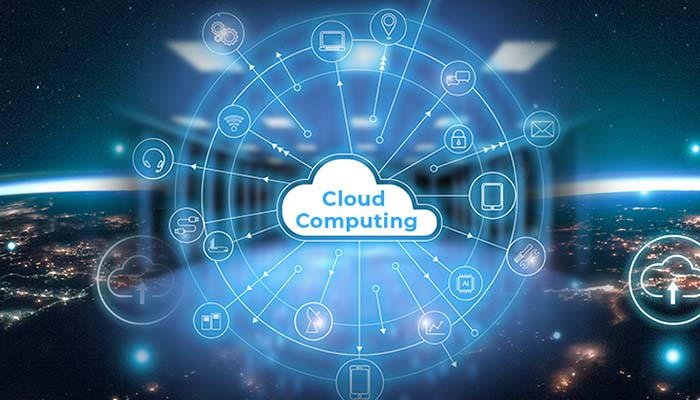
Cloud computing has developed from on-premises data centers and virtualization to Infrastructure-as-a-Service (IaaS), Platform-as-a-Service (PaaS), and Software-as-a-Service (SaaS), with providers taking on infrastructure management. The trend then moved on to containerization with technologies such as Docker and Kubernetes, culminating in serverless computing, which allows developers to run code without managing any servers, providing automatic scaling, increased efficiency, and cost-effectiveness by abstracting all underlying infrastructure.
Cloud computing enables customers to access a diverse set of services stored in the cloud or on the Internet. Cloud computing services include computer resources, data storage, applications, servers, development tools, and networking protocols. They are primarily utilized by IT businesses and for business purposes.
The term “Cloud Computing” was first used in the 1950s to denote internet-related services, and it has grown from distributed computing to the modern technology known as cloud computing. Amazon, Google, and Microsoft all offer cloud computing services. Cloud computing enables customers to access a diverse set of services stored in the cloud or on the Internet. Cloud computing services include computer resources, data storage, applications, servers, development tools, and networking protocols.
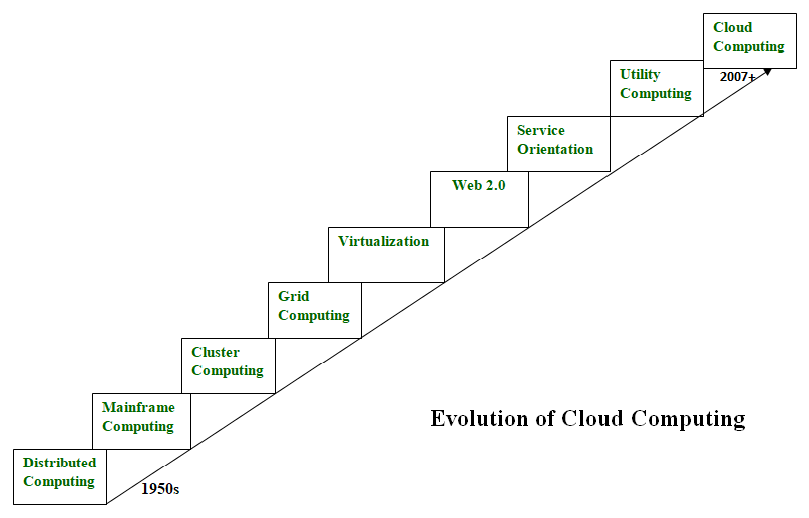
1. Mainframe Computing(1950-1970)
Mainframes, which were originally introduced in 1951, are extremely powerful and dependable computing devices. These handle vast amounts of data, such as massive input-output procedures. Even today, these are employed for large-scale processing jobs such as internet transactions. These systems have nearly minimal downtime and are very fault tolerant. Following the implementation of distributed computing, the system’s processing capacity expanded. But these were really pricey. To lower costs, cluster computing emerged as an alternative to mainframe technology.
2. Distributed Systems(1970-1980)
A distributed system is made up of numerous independent systems, but to users, they all appear to be the same. The goal of distributed systems is to share resources while also maximizing their effectiveness and efficiency. Scalability, concurrency, continuous availability, heterogeneity, and failure-independence are all properties of distributed systems. However, the fundamental issue with this system was that all of the systems had to be present in the same geographical place. To tackle this challenge, distributed computing resulted in three new types of computing: mainframe computing, cluster computing, and grid computing.
3. Cluster Computing(1980-1990)
Cluster computing emerged in the 1980s as a viable alternative to mainframe computer. A high-bandwidth network connected each machine in the cluster. These were much cheaper than the mainframe systems. These were equally capable of doing complex computations. Additionally, new nodes might be readily added to the cluster if necessary. As a result, the cost issue was partially resolved, but the geographical restriction issue remained. To address this, the concept of grid computing was invented.
4. Grid Computing(1990-2000)
Grid computing was first presented in the 1990s. It means that separate systems were installed in completely different geographical areas and connected over the internet. These systems belonged to various organizations, hence the grid was made up of diverse nodes. Although it resolved certain issues, other ones arose as the distance between the nodes increased. The main issue observed was a lack of high bandwidth connectivity, which led to various network-related problems. As a result, cloud computing is frequently referred to as the “successor of grid computing”.
5. Utility Computing(Late 1990-2000)
Utility Computing is a computing model that defines service provisioning techniques for services such as compute services along with other major services such as storage, infrastructure, etc which are provisioned on a pay-per-use basis.
Read Also: Top 10 Cloud Computing Trends to Watch in 2025
6. Virtualization(1980-Present)
Virtualization was introduced nearly 40 years back. It refers to the process of creating a virtual layer over the hardware which allows the user to run multiple instances simultaneously on the hardware. It is a key technology used in cloud computing. It is the base on which major cloud computing services such as Amazon EC2, VMware vCloud, etc work on. Hardware virtualization is still one of the most common types of virtualization.
7. Web 2.0
Web 2.0 is the interface through which the cloud computing services interact with the clients. It is because of Web 2.0 that we have interactive and dynamic web pages. It also increases flexibility among web pages. Popular examples of web 2.0 include Google Maps, Facebook, Twitter, etc. Needless to say, social media is possible because of this technology only. It gained major popularity in 2004.
8. Service Orientation
A service orientation acts as a reference model for cloud computing. It supports low-cost, flexible, and evolvable applications. Two important concepts were introduced in this computing model. These were Quality of Service (QoS) which also includes the SLA (Service Level Agreement) and Software as a Service (SaaS).
Cloud Computing Emergence
Since the development of cloud computing in the mid-2000s, both people and businesses can outsource their computing infrastructures to cloud service providers (CSPs). CSPs offer and manage several types of cloud computing services, including Infrastructure as a Service (IaaS), Platform as a Service (PaaS), and Software as a Service (SaaS).
IaaS, PaaS, and SaaS are sometimes portrayed as a pyramid, with each offering a higher level of abstraction.
This outsourcing represents a fundamental shift in computing methods. Small and large businesses alike can save enormous amounts of money, personnel, and time by customizing their computing infrastructures to their specific needs and reinvesting those resources back into their operations.
The Rise of Serverless
Serverless is a Broad and Global Term
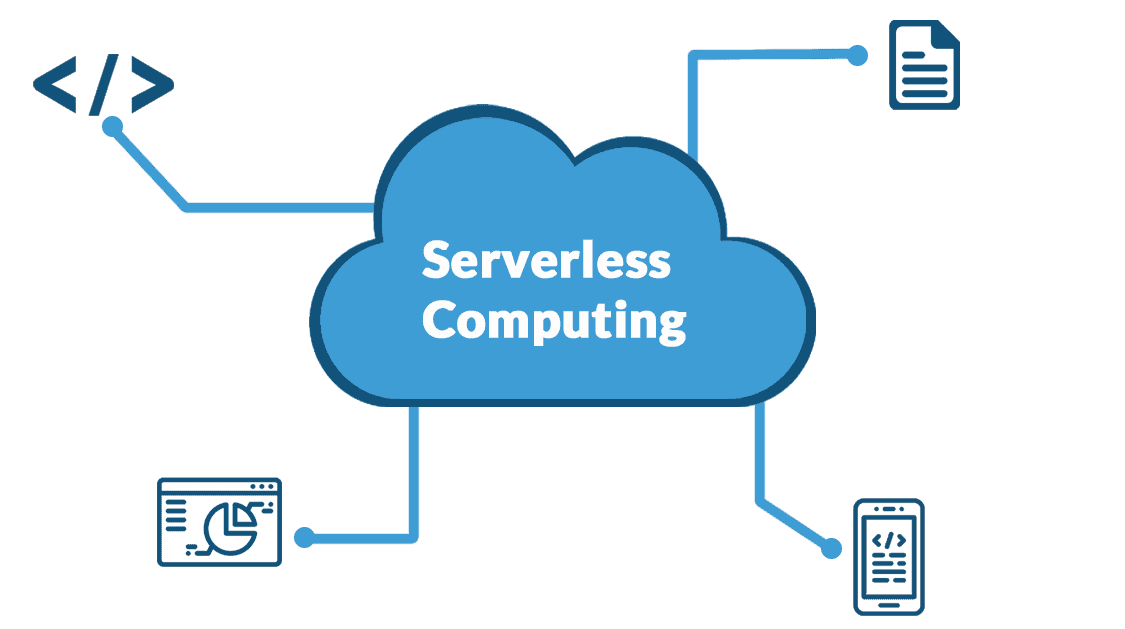
Serverless computing is a development of cloud computing. In layman’s terms, serverless computing means that the user no longer has to install, manage, scale, or upgrade servers.
In truth, the term “serverless” only makes sense from the standpoint of the user, who no longer has to worry about managing the underlying infrastructure. Servers remain in the picture since they conduct computing processes, but the obligation has shifted: the cloud service provider now maintains and supplied them.
In 2015, following the release of AWS Lambda, a serverless Function-as-a-Service (FaaS) platform, the word serverless became widely used in the industry for general computing and online applications. Although FaaS is sometimes associated with the phrase serverless, the two concepts should not be confused. In the years that followed, many more serverless services developed, and the promise of reduced infrastructure complexity soon captivated developers and businesses.
Almost all services, including computation, storage, databases, and messaging, may be made serverless. There are already various types of managed serverless services, including Platform-as-a-Service (PaaS), Function-as-a-Service (FaaS), Container-as-a-Service (CaaS), and Database-as-a-Service (DBaaS), to mention a few.
At its core, being serverless entails outsourcing the task of managing your infrastructure. It means you no longer have to expand, manage, or update the servers that power your applications. Cloud service companies now handle and provide these functions as a service.
The Technologies enabling Serverless
Serverless technologies are possible thanks to a combination of several computer science advancements:
- Containers: The rise of containerized resources with improvements in core Linux cgroups feature, hardware virtualization and the Docker/OCI are core enablers, allowing efficient virtualization and abstraction of physical resources.
- Ability to host arbitrary code: The ability to securely host any code with isolation thanks to virtualization progress is essential to allow mainstream serverless.
- Distributed Computing: The increase in network bandwidth and reduction of network latency has enabled wider distributed computing adoption, which is essential to provide variable amounts of computing power, above the limits of a single physical server.
- Versioning, naming and discovery: The last decade has seen significant progress in continuous deployment technologies with improvements in versioning and service discovery tooling, increasing the capacity to deploy in a distributed environment.
- Events and message passing: Event-driven architectures are a significant enabler for serverless as tasks can easily be distributed and processing power can grow as requests come.
- Microservices: Creating small, specialized services is essential to provide the right amount of resources for each processing function.
- Autoscaling: Finally, autoscaling is a core component of serverless, which has itself been made possible by strong advancements in load-balancing and monitoring technologies.
Conclusion
Finally, cloud computing has emerged as a critical component of modern IT infrastructure, providing unparalleled flexibility, scalability, and efficiency. It has not only overcome the limitations of previous computing models, but it has also paved the way for new applications and services that will continue to drive technological advancement and economic growth.





Comments