
 By
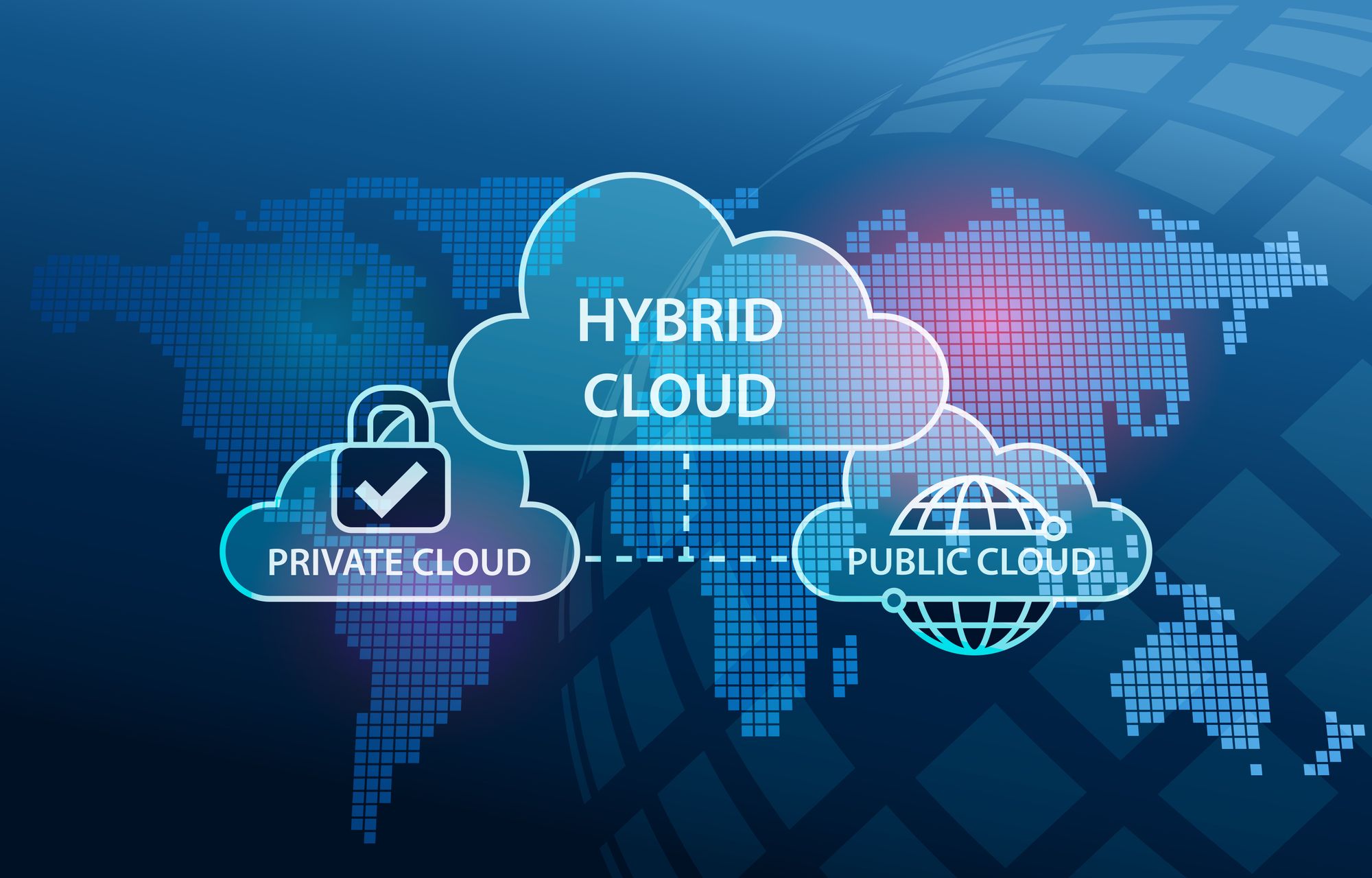
Infrastructure management and access differ between public, private, and hybrid clouds. Public clouds use shared, third-party-owned resources, offering cost savings and scalability; private clouds are dedicated to a single organization for greater security and control; and hybrid clouds combine public and private resources, providing flexibility by leveraging the benefits of both for different workloads.
Private, public, and hybrid clouds are alternative approaches to installing infrastructure and applications in a cloud computing environment. A public cloud is an environment made available via the internet to which anybody can subscribe and then access. A private cloud, as the name implies, is an infrastructure used by a single entity. A hybrid cloud combines the two other categories.
All three offer a similar set of benefits over traditional on-premises IT environments: low cost, dependability, on-demand scaling, and consistent high performance. A variety of factors influence the implementation decision, including the type of workload, security requirements, budgetary constraints, and the level of in-house IT experience. The three cloud kinds are not mutually exclusive. In fact, a rising number of businesses are currently using all three.
What is the Public Cloud?
Public clouds are the most widely used and well-known cloud computing model. The third-party supplier owns and manages all of the resources required to run the infrastructure, including servers, storage, networking components, and supporting software, which your users access via the Internet via a web browser. Public clouds include Amazon Web Services, Microsoft Azure, and Google Cloud Platform.
Public clouds are multi-tenant, which means you share infrastructure with other enterprises while keeping your data and workloads separate in a safe and secure virtual area. Instead of owning and operating the hardware, you rent it on a subscription basis, paying only for the services you use.
The defining features of a public cloud solution include:
- High elasticity and scalability
- A low-cost subscription-based pricing tier
- Fast operationalization
- Most current technologies
- Reliability
Services on the public cloud may be free, freemium, or subscription-based, wherein you’re charged based on the computing resources you consume.
The computing functionality may range from common services—email, apps, and storage—to the enterprise-grade OS platform or infrastructure environments used for software development and testing.
The cloud vendor is responsible for developing, managing, and maintaining the pool of computing resources shared between multiple tenants from across the network.
Pros of Public Clouds
Public clouds offer a number of advantages:
- Lower costs
A public cloud effectively shifts your IT spend from a capital expenses (CAPEX) framework to an operating expenses (OPEX) model: instead of making a large upfront investment to purchase and install hardware and software, you just pay for what you use. The overall required IT budget – known as the total cost of ownership (TCO) — is generally much lower than for traditional on-premises infrastructure. - Freedom from maintenance
The service provider handles all of this, meaning you don’t need to employ a large in-house team of IT professionals to run, manage, and optimize the environment. - On-demand scalability
Providers possess immense resources that you can scale up whenever needed to meet periods of peak demand and then scale down again afterward. - High reliability
Cloud providers maintain large, geographically distributed networks of servers, together with sophisticated redundancy and failover strategies, to ensure customers against outages and downtime. - Reduced complexity
With traditional on-premises systems, as much as 80% of IT time and resources are consumed by merely “keeping the lights on.” The public cloud eliminates most of this expense and complexity. This lets you maintain a much smaller cadre of IT experts in-house, focused on building and delivering high-value products and services. - Flexible pricing options
Cloud providers offer different tiers of service, known as service level agreements (SLAs). Higher guaranteed levels of speed, availability, and resource provisioning come at a premium; you can choose these for mission-critical workloads and pay a lower rate for less vital and lower-use applications. You can also shop around for the best combination of price and performance in today’s highly competitive public cloud marketplace.
Cons of Public Clouds
Despite its many advantages, the public cloud does come with limitations:
- Lack of cost control. The total cost of ownership (TCO) can rise exponentially for large-scale usage, specifically for midsize to large enterprises.
- Lack of security. The public cloud is the least secure, so it isn’t best for sensitive mission-critical IT workloads.
- Minimal technical control. Low visibility and control of the infrastructure may not meet your compliance needs.
- Escalating costs. At a certain point, adding services, using more storage, and adding seats is no longer cost-effective.
- Vendor dependency. Should you want to change providers, migrating services and data is complex and costly.
When to use the public cloud
The public cloud is most suitable for these types of environments:
- Predictable computing needs, such as communication services for a specific number of users.
- Apps and services necessary to perform IT and business operations.
- Additional resource requirements to address varying peak demands.
- Software development and test environments.
What is the Private Cloud?
A private cloud is a computing infrastructure reserved for usage by a single enterprise. It can be housed in your own data center or with a third-party service provider. The defining feature is that the IT resources are run and maintained on a private network for your exclusive usage.
Unlike public clouds, private clouds are not shared with others. This simplifies customization and regulatory compliance, which is why private clouds are frequently used by financial institutions, government agencies, and heavily regulated businesses that require tight control over their workloads.
The defining features of a private cloud solution include many of the features of the public cloud, but also:
- Higher security
- Scalability
- Customization and control
- Greater visibility into every aspect of your cloud
- Compliance with cybersecurity frameworks you choose
Pros of Private Clouds
Private cloud advantages include:
- Stringent security
An environment dedicated to a single customer affords maximum levels of protection against unauthorized data access and theft. - Regulatory compliance
Private cloud infrastructure can be tailored to conform to strict, mandatory privacy and governance rules for sensitive and confidential workloads and data. - Scalability
Private clouds are scalable from a technical standpoint, though it can be costly and inefficient to provision dedicated resources that will remain idle much of the time. - High performance
You can easily equip a private cloud to meet your specific standards for availability and throughput. - Flexibility to respond to changing needs
Because the environment is for your use alone, you can transform it to respond to evolving technology, markets, and opportunities.
Cons of Private Cloud
The private cloud has drawbacks. It may not be an ideal fit for your organization because of these issues:
- Higher costs. The private cloud is an expensive solution with a relatively high TCO compared to public cloud alternatives, especially for short-term use cases.
- Difficult remote use. Considering the high-security measures in place, offsite users may have limited access to the private cloud.
- Scalability depends. The infrastructure may not offer high scalability to meet unpredictable demands if the cloud data center is limited to on-premise computing resources.
- Complex management. You’ll need considerable in-house tech expertise to run your private cloud.
- Potential inefficiencies. You may not fully use your resources, wasting costly infrastructure.
When to use the private cloud
The private cloud is best suited for:
- Highly regulated industries and government agencies.
- Sensitive data.
- Companies that require strong control and security over their IT workloads and the underlying infrastructure.
- Large enterprises that require advanced data center technologies to operate efficiently and cost-effectively.
- Organizations that can afford to invest in high-performance and availability technologies.
What is Hybrid Cloud?
Hybrid clouds mix public and private cloud resources to maximize the benefits of both. High levels of integration and orchestration are required to ensure the seamless movement of data and applications between the two types as requirements change. Confidential operations, such as financial reporting, can be run in a private cloud.
Read Also: Cloud vs On-Premise: Which Is Right for Your Business?
A public cloud can handle high-volume, less sensitive workloads like web-based email, as well as transient workloads like development and testing. Furthermore, public cloud resources can be used to address short-term demand spikes for private-cloud applications (a process known as “cloud bursting”). This avoids the costly CAPEX of purchasing and provisioning additional capacity that will be used only occasionally.
The key motivation is twofold: getting the flexibility to select the best cloud for each application, as well as the ability to freely migrate workloads between clouds as circumstances change. A hybrid cloud strategy helps the organization to achieve its technical and business goals at a lower cost and more effectively than a public or private cloud alone.
This is a common hybrid cloud scenario: organizations can employ private cloud environments for their IT workloads while supplementing the infrastructure with public cloud resources to handle rare spikes in network traffic.
Alternatively, you might use the public cloud for non-critical tasks and data to save money while using the private cloud for sensitive data.
As a result, access to additional computing capacity does not necessitate the expensive CapEx of a private cloud environment, but is provided as a short-term IT service via public cloud solutions. The ecosystem is seamlessly integrated to enable optimal performance and adaptability to changing business requirements.
When pursuing a hybrid cloud, you may need to decide whether your cloud should be homogenous or heterogeneous. That is, do you use cloud services from one vendor or multiple vendors?
Pros of Hybrid Clouds
Running a hybrid cloud offers a number of benefits:
- Compliance and security
Confidential applications can be operated privately while less sensitive workloads can be deployed to a public cloud. - High flexibility
You can respond immediately and effectively to unpredictable demand surges with public cloud infrastructure, and scale back down when the spike subsides, with no impact on other workloads running in your private cloud. - Resource optimization
Flexibly deploy applications to maximize utilization of both on-premises resources and cost-saving public cloud infrastructure. - Ease and agility
Alter your blend of public and private deployments in response to changing needs and opportunities. A hybrid cloud also lets you modernize legacy applications on a gradual basis, rebuilding and migrating them to cost-efficient public cloud infrastructure comfortably over time. - High reliability
Applications and data can be distributed across multiple data centers for highly effective redundancy, failover, and disaster recovery.
Cons of Hybrid Clouds
While the promise of the best of both worlds in going hybrid vs public cloud vs private cloud sounds good, you may encounter some drawbacks:
- Complicated cost management. Toggling between public and private can be hard to track, resulting in wasteful spending.
- Integration issues. Strong compatibility and integration is required between cloud infrastructure spanning different locations and categories. This is a limitation with public cloud deployments, for which organizations lack direct control over the infrastructure.
- Added complexity. Additional infrastructure complexity is introduced as organizations operate and manage an evolving mix of private and public cloud architecture.
- Security risks. Transferring data between clouds introduces vulnerabilities.
When to use the hybrid cloud
Here’s who the hybrid cloud might suit best:
- Organizations serving multiple verticals facing different IT security, regulatory, and performance requirements.
- Optimizing cloud investments without compromising on the value that public or private cloud technologies can deliver.
- Improving security on existing cloud solutions, such as SaaS offerings that must be delivered via secure private networks.
- Strategically approaching cloud investments to continuously switch and trade-off between the best cloud service delivery model available in the market.
A hybrid cloud is a combination of the two cloud kinds, private and public – in its most basic form, an environment that contains one of each.
Until recently, the word “multicloud” referred to architectures made entirely of public clouds: at least two, but usually more, and provided by more than one cloud service vendor.
The method known as hybrid multicloud has made considerable advances in recent years, with “hybrid” referring to the inclusion of a private cloud in the mix and “multicloud” implying more than one public cloud from multiple service providers. As corporations progressively go in this direction, the hybrid multicloud (also known as hybrid cloud) appears to be the dominating IT environment, at least for bigger organizations.
| Factors | Public Cloud | Private Cloud | Hybrid Cloud |
|---|---|---|---|
| Resources | Resources are shared among multiple customers | Resources are shared with a single organization | It is a combination of public and private clouds. based on the requirement. |
| Tenancy | Data of multiple organizations is stored in the public cloud | Data of a single organization is stored in a clouds the public cloud | Data is stored in the public cloud, and provide security in the public cloud. |
| Pay Model | Pay what you used | Have a variety of pricing models | It can include a mix of public cloud pay-as-you-go pricing, and private cloud fixed pricing. It has other pricing models such as consumption-based, subscription-based, etc. |
| Operated by | Third-party service provider | Specific organization | Can be a combination of both |
| Scalability and Flexibility | It has more scalability and flexibility, | It has predictability and consistency | It has scalability and flexibility by allowing organizations to use a combination of public and private cloud services. |
| Expensive | less expensive | More expensive | Can be more expensive, but it can also be less expensive , depending on the specific needs and requirements of the organization. |
| Availability | The general public (over the internet) | Restricted to a specific organization | Can be a combination of both. |
Deciding Between Public, Private and Hybrid Cloud Computing
The decision between public, private, and hybrid cloud solutions is based on your business needs, budget, IT capabilities, and growth aspirations. It’s rarely an either/or situation, since you may discover methods to get the benefits of both while avoiding the drawbacks.
When designing your strategy to cloud computing, balance is the primary consideration. And balancing is a continual requirement. What works for your organization now may not work in the future.
The key to balancing your options is to devise an intentional cloud strategy that maximizes your use of each cloud environment. Begin by outlining the requirements of your various workloads, and then prioritize them based on the advantages and downsides of each model.
While smaller enterprises in deregulated industries prefer the cost savings of public cloud, larger organizations usually run multiple types. Each type of cloud has its own time and place. It all depends on your resources and usage scenarios.
The public cloud is most suitable for situations like these:
- Predictable computing needs, such as communications services for a mostly fixed number of users
- Applications and services critical for IT and business operations
- Reserve resources provisioned to meet peak usage situations on demand
- Software development and test environments
A private cloud is often used by:
- Highly-regulated industries and government agencies
- Technology companies that require strong control and security over their IT workloads and underlying infrastructure
- Organizations with the resources and requirements to invest in advanced technologies delivering the highest performance and availability
A hybrid cloud model is most appropriate for:
- Enterprises serving multiple vertical markets with different IT security, regulatory, and performance requirements
- Optimizing the overall cloud investment while leveraging the advantages of both public and private cloud models
- Providing enhanced security for solutions such as SaaS workloads that need to be delivered via secure private networks
- An agile cloud strategy dictating frequent alternation among providers and clouds to obtain the best combination of price and performance for various workloads
There is no single ‘optimal’ cloud model; the optimum option is totally dependent on an organization’s unique needs, priorities, and circumstances. Making the appropriate selection needs careful evaluation of a number of factors:
- Security and Compliance Needs: If you handle highly sensitive data or operate under strict regulations (like government or healthcare), the control and isolation of a private or hybrid cloud might be necessary. Public clouds are secure, but the shared nature and data location might not meet all compliance mandates.
- Budget and Cost Model Preference: Startups or businesses wanting to avoid large capital expenditures often favor the public cloud’s pay-as-you-go model. Organizations with significant capital budgets and predictable workloads might find a private cloud cost-effective in the long run. Hybrid allows balancing these approaches.
- Scalability and Performance Requirements: Businesses with fluctuating demand or needing rapid scaling benefit greatly from the public cloud’s elasticity. If performance needs are constant and predictable, a private cloud might suffice. Hybrid offers flexibility for variable needs combined with stable baselines.
- Technical Expertise and Resources: Managing a private or hybrid cloud requires significant in-house IT expertise. If your organization lacks these resources, the fully managed nature of the public cloud might be more suitable.
- Existing Infrastructure: If you have substantial investments in existing on-premises data centers, a hybrid approach might allow you to leverage that investment while gradually moving workloads to the cloud.
Thinking on what is best for your business entails carefully weighing these aspects. Often, the answer isn’t either/or, causing many firms to adopt hybrid or even multi-cloud strategies.
Finally
Public, private, and hybrid clouds all use diverse approaches to delivering computing resources. Each has a unique set of strengths and shortcomings. The public cloud provides exceptional scalability and economic effectiveness, with minimal management overhead. The private cloud offers maximum control, security, and customisation, but at a higher cost and complexity. The hybrid cloud seeks to bridge the divide by incorporating the greatest features of both, but it also creates new management issues. As technology advances, the distinctions between these models may blur, with options such as Virtual Private Clouds (VPCs) in public environments or managed private cloud services.
Understanding these fundamental principles is an important first step toward exploring the possibilities accessible in the larger world of modern cloud solutions. The trend is toward greater flexibility, which enables enterprises to create infrastructure solutions that closely meet their specific operational, financial, and security requirements.







Comments