
 By

According to the “4% rule,” achieving financial independence often entails building a portfolio worth 25 times your annual costs. This method allows for a sustainable annual withdrawal to satisfy living expenditures, such as requiring $1 million for a $40,000 annual budget. Expense reduction, investment maximization, and determining your unique “number” are all important considerations.
The Rule of 25 and 4% Rule
- Application: The 4% rule suggests you can safely withdraw 4% of your total portfolio in the first year of retirement, then adjust for inflation annually to avoid running out of money.
Key Factors Determining Your Number
- Annual Expenses: The total cost of your desired lifestyle, including housing, taxes, and healthcare.
- Passive Income: Any income from rental properties, dividends, or businesses can reduce the total savings required.
- Inflation & Market Risk: The calculation must account for rising costs over time.
Steps to Achieve Financial Independence
- Calculate Your Number: Determine your total annual expenses and multiply by 25.
- Increase Savings Rate: Aim to save a high percentage of your income to accelerate growth.
- Invest Wisely: Shift from saving to investing in income-generating assets.
- Reduce Debt: Minimize high-interest debt to lower expenses.
Alternative Approaches
- Lean FIRE: Living on a stricter, lower budget for a faster, smaller FI number.
- Fat FIRE: Accumulating a higher amount to support a more luxurious lifestyle.
The total amount is not one-size-fits-all and depends heavily on personal expenses and goals.
Financial independence occurs when your savings or other sources of passive income are sufficient to pay your living expenditures without the need for a wage. Some people want to retire early, while others want to be able to work less and travel the world. In summary, financial independence means different things to different people, and your definition determines how much you require.
The 25x rule: A Starting Point for Financial Freedom in Retirement
If your goal is retirement at 65 or beyond, the 25x rule is a useful starting point for planning financial freedom. This rule suggests you need around 25 times your annual spending saved to maintain your lifestyle for 25 years.
However, this is only an estimate based on your current spending, so you’ll need to make adjustments if your spending habits shift over time. For example, outgoings such as travel costs might decrease as you get older and you spend more time at home, however utility costs may increase as a result. Alternatively, you might want to travel and take more holidays as you get older, meaning your savings pot may need to be larger.
Additionally, if you plan to retire early, you will also need to save more to ensure your pot lasts for a longer time period. You may also want to plan for the possibility that you could outlive your savings. Investing, maintaining disciplined savings habits, and contributing to a pension are practical ways to grow your retirement pot and work towards long-term financial independence.
If you’re unsure about the best strategy for your goals and current financial situation, it’s always a good idea to speak with a financial advisor who can help you create a plan tailored to your needs.
What Would 25 Years of Financial Independence in Retirement Cost?
Achieving long-term financial independence requires more than simply covering your day-to-day expenses. It can involve addressing debts, preparing for unexpected costs, and ensuring there’s enough saved to comfortably maintain your lifestyle well into the future.
So, how much would UK households actually need to make the dream of a financially independent retirement a reality? To find out, we analysed average household spending, typical levels of debt, and what’s needed for a rainy day fund. We then applied the 25x rule to household spending, a guideline that suggests you need 25 times your annual spending to achieve long-term financial security.
We also considered two key factors within our calculation in order to arrive at a realistic target for lasting financial freedom in retirement:
- Inflation – We calculated this at a rate of 2.88% each year, an average based on historical inflation in the UK.
- Interest or investment returns – We assumed a 5% annual return on savings or investments to estimate how much households would need today to fund 25 years of spending, withdrawing only what’s needed each year.
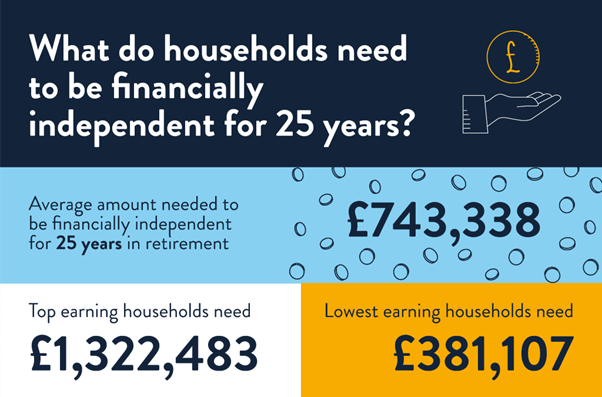
Using this methodology, we’ve calculated that in order to achieve financial independence for 25 years, the average household would need approximately £743,338 saved by the end of 2025. This figure covers 25 years of future living expenses, clears existing household debt, and includes a rainy day fund for emergencies.
Here’s how that looks broken down:
- The average UK household spends £31,653 a year on essentials like utilities, food, transport, and leisure. With prices rising at 2.88% a year (based on historical inflation), that adds up to £1,168,765 million over 25 years. However, if your savings benefited from 5% annual interest, either in a savings account or investment, you’d only need around £613,605 saved today. This assumes starting withdrawals of £32,565 in 2026, increasing with inflation each year.
- But sustaining a financially independent lifestyle also means addressing liabilities. Currently, the average UK household carries £121,525 in debt (including remaining mortgage debt).
- On top of this, emergency funds are recommended to help cover six months of essential expenses, which would currently be around £8,207 on average. It’s important to note that this is an estimation and is based on 2025 spending. If you have an emergency fund, you should regularly assess this figure if your expenses change and prices rise.
Added together (25 years of living expenses, paying off all existing debts upfront, and setting aside a rainy day fund) the total cost over time comes to £1,298,498, but thanks to the power of compound interest (following an average of 5% interest), you’d need to save £743,338 to cover it all for 25 years.
How your Personal Circumstances Affect the Cost of Financial Freedom in Retirement
The path to financial independence will depend heavily on your spending habits and the lifestyle you’re accustomed to. As a result, this will impact the amount needed to cover expenses for 25 years of retirement.
Read Also: The Difference Between Financial Independence and Early Retirement
According to household spending by income level, the lowest 10% of earners will need approximately £381,107 saved for 25 years of retirement after adjusting for savings interest and inflation.
On the other hand, households with higher-than average expenditure will face a steeper target. A household in the top 10% of earners will need as much as £1,322,483 to achieve financial freedom for 25 years of retirement, with interest and inflation applied. And for households somewhere in the middle, an average of £706,167 is estimated as the total amount needed.
This range highlights just how personal the journey to financial independence can be depending on your circumstances. Achieving it requires a clear understanding of your own lifestyle, financial obligations, and long-term aspirations, and aligning your savings or investing goals accordingly.
If you’re looking to achieve financial independence, it’s always best to speak with a financial adviser first. They can help you create a plan that is tailored to your own circumstances.
Final Words
Shepherds Friendly calculated the total cost of financial freedom per household expenditure, and age group based on the following:
- Average household expenditure – Since the most recent data for this was from 2023, average inflation rates for 2024 and 2025 (so far) were applied to find the estimated household expenditure in 2025.
- Household debt per income type – Once again, this has been adjusted for inflation as the most recent data available is from 2022.
- Household debt per age range – Since the most recent data available is from 2020, inflation has been applied.
- 6 month emergency fund – This was calculated as half the annual spend on necessities: food & non-alcoholic drinks, clothing & footwear, housing, fuel & power, health and communication. Please note that this is reflective of 2025 prices and will need to be adjusted accordingly year on year, depending on inflation.
To calculate the cost for 25 years of financial freedom, the 25X rule was applied – estimating the lump sum needed to generate enough passive income to cover annual spending without running out of money for 25 years, including paying off debt and having an emergency fund.
For the average amount needed for middle income households, an average was taken for fifth and sixth percentile income households.
To calculate the cost of financial freedom until the age of 90, the median age of each group was taken and from this, the number of years until reaching 90 years old. Household expenditure was then multiplied by the number of years remaining until they reach 90, before household debt and emergency funds were added.
An assumed inflation rate of 2.88% (the average annual inflation rate since 1989) was applied each year to annual expenditure to account for the national inflation over this time.
An assumed interest rate of 5% (the average nominal interest rate) was applied to the initial investment amount, accounting for annual withdrawals for expenditure costs.











Comments