
 By
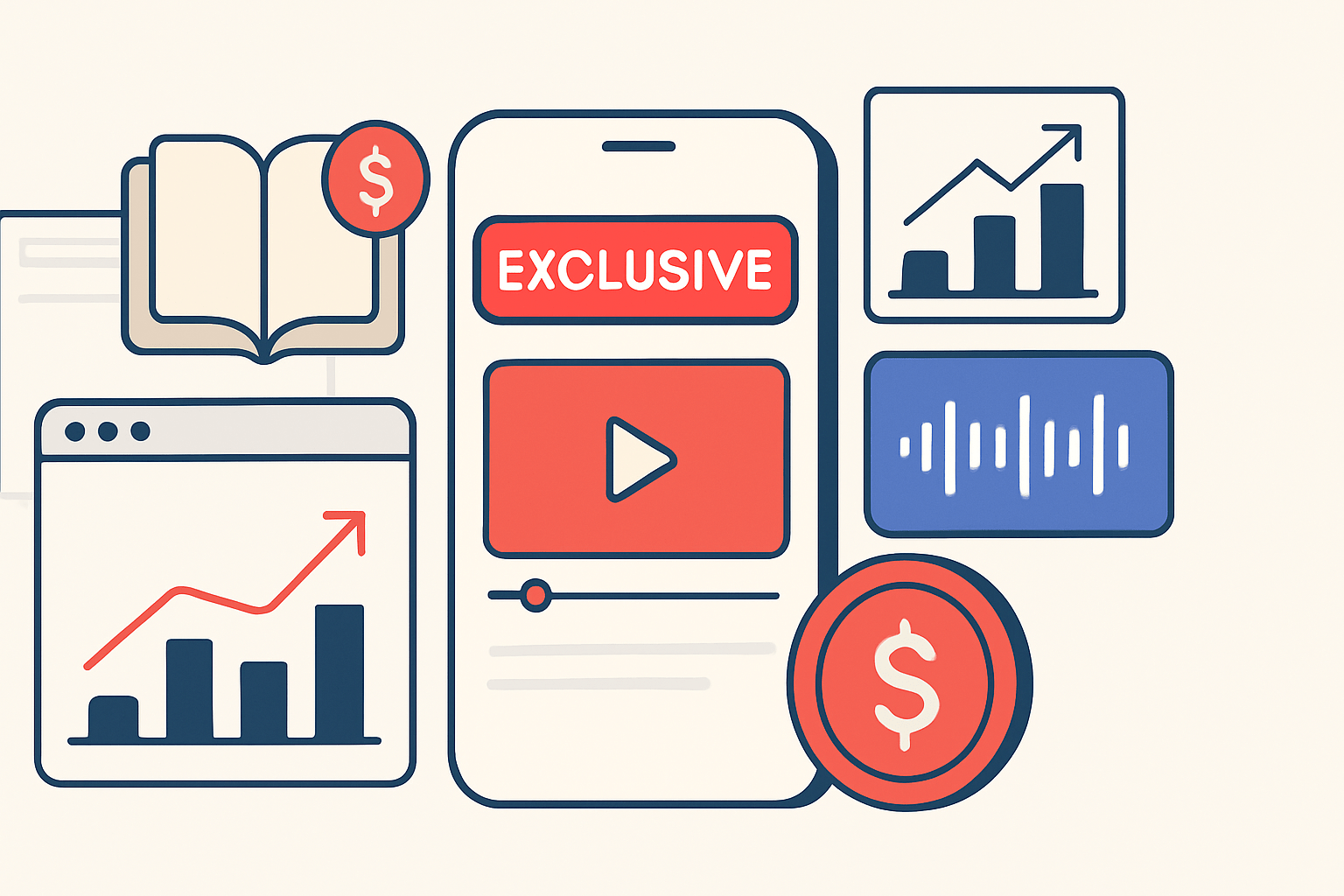
The subscription model, a potent engine for long-term growth, is at the core of the burgeoning creative economy. Creators, entrepreneurs, and educators are now creating successful enterprises with steady, recurring income, going beyond one-time transactions. Deeper community involvement, steady revenue, and the ability to concentrate on adding value rather than pursuing the next sale are all made possible by this tactical change.
This tutorial examines seven different examples of subscription business models and dissects the tactics that contribute to their success. We’ll demonstrate how to use paid communities, membership platforms, and online courses to create your own subscription empire. You will get a thorough analysis, screenshots, and direct links to view the model in action for each case.
What is a Subscription Business Model?
A company uses a subscription model when it charges a regular price for its goods and services. Monthly or annual recurring charges are both possible.
Subscriptions are not a novel idea. From coffee subscriptions to your neighborhood library to the current “Kindle Unlimited,” the subscription business model has become ingrained in our daily lives.
However, why is the subscription business model so well-liked by both consumers and companies? For businesses, it’s the dependability and sustainability, and for consumers, it’s the ease and customization it provides.
Advantages of the Subscription Business Model
Predictable revenue
The subscription model creates a predictable future revenue stream. This recurring revenue can ensure the viability of your business in times of turbulence and financial fluctuations. It also helps in keeping your business operations up and running.
Better customer relationships
Subscription products can scale as the customer grows. Customers often opt for subscriptions because of the convenience factor coupled with options to personalize the product. Check out how UnboxBoardom gives their subscribers an option to customize the plan as well as the product.
Moreover, if they want it, customers can pay for additional value by choosing an upgrade or a higher plan. This flexibility helps develop customer loyalty.
Lower retention spends
Since subscribers automatically buy from you on a regular basis, you don’t have to shell out extra marketing dollars to target them. Also, subscribers, who pay periodically and committed to a long-term association with you, are usually less likely to churn. You do not have to spend more on customer retention.
Revenue expansion opportunities
Once you have a customer locked in for a basic plan, your product(s) has an opportunity to prove its worth to the customers and make them want more. That way, you can get customers to upgrade to a higher plan for no extra cost. There are also avenues of revenue expansion, such as up-selling and cross-selling new features and additional non-core products. It means that you get additional revenue from the same customer without additional acquisition costs.
Better forecasting
The subscription business model allows you to predict future revenue accurately. For eCommerce businesses that face high demand fluctuations, subscriptions can help demand forecasting and efficient inventory management.
Popular Subscription Business Models
There are clear benefits to choosing the subscription business model. Across industries, there are various examples of subscription models. Some new, some old, some reinvented. If we are to classify it broadly, subscription businesses can be classified into B2B and B2C depending on who they serve.
Here are some popular subscription business models:
SaaS
Where oh where should I get started about SaaS?! SaaS, or Subscription as a Service, is one of the most popular subscription business model applications. SaaS is a software delivery model where software is centrally hosted on the cloud and licensed on a subscription basis. Using cloud infrastructure has many advantages as it enables self-service, and you don’t have to worry about on-site maintenance one of the many reasons why businesses love SaaS.
There are many, many examples of SaaS companies across verticals. Adobe, Salesforce, Slack, Dropbox, Freshworks, and Calendly are all SaaS companies, to name a few.
Subscription Boxes
Subscription boxes deliver curated products and physical goods on a recurring basis with monthly/annual charges. Subscription boxes span various products from essentials, hobby supplies, luxury goods, and meal kits, to even collector’s items. E.g., Birchbox’s curated beauty subscription box.
Publications & Newsletters
Mailerlite’s email marketing research says that people still prefer to consume information via email. According to their research, the number of monthly subscriptions to newsletters has grown by 40% since February 2020. That’s great news for paid newsletters!
There are tonnes of good ones out there. For example, the ‘Cleaning the Glass‘ newsletter is all about basketball, game statistics, and predictions. Another example, exclusively for techies, is Stratechery. Their newsletter and subscription provide exclusive access to content about technology and media’s strategy and business side and has subscribers from over 85 different countries, including tech leaders and investors.
Digital publications, too, found their silver lining during the pandemic. In September 2020, The New York Times’ digital revenue was higher than print subscribers and helped make up for the 30% drop in advertising revenue. Increasing reader revenue through subscriptions is definitely the way forward for these traditional publications to expand their digital footprint as well as digital publishers.
Media Subscriptions: Video & Music Streaming Services
Did anyone say Netflix and chill?
We are no strangers to this subscription model. Subscription Video/Audio on Demand, charges a recurring subscription fee in return for video and audio streaming. For the last five years, every area of the home entertainment industry has seen a decline except one. You guessed it. The OTT industry has been booming. The Subscription Video on Demand (SVOD) revenue for 138 countries is estimated to hit $100 billion by 2025, doubling from the $50 billion of 2019.
Read Also: Creating and Selling Digital Products: E-books, Printables and Online Courses
Audio subscriptions are not different as well. Spotify and Amazon Music are well-known examples. Thanks to their growing subscriber base, ad revenue for top audio streaming services saw a YoY jump of 31% during 2020.
What Is a Paywall?
A paywall is a digital barrier that restricts access to certain content on a website. Only users who have a paid subscription or a paid membership are able to view the content behind the paywall. Paywalls are typically used by online publishers, newsletters, podcasts, and other online businesses that produce high-quality content.
Think of a paywall as a gate restricting access to content. Just as a gate unlocks and gives people access to a building, a content gate or paywall lets people access parts of your digital content (which is known as gated content or paywalled content).
The goal is to generate revenue for the website or publication by charging users for access to the content. This approach allows content creators to monetize their work without relying on algorithms or advertising revenue.
Why Use a Paywall?
Implementing a paywall can be an effective way to monetize a website, especially for content-rich sites such as independent publications, podcasts, newsletters, or courses.
Here are a few benefits of using a paywall:
- Revenue generation: Generate recurring revenue and a direct stream of income.
- Reduce reliance on ads: Become less reliant on advertising revenue which, in turn, creates a better user experience.
- Build a dedicated audience: Bring in a more engaged and loyal audience by understanding their preferences and tailoring content to their interests. It also becomes easier to foster a sense of community by actively engaging with your audience and asking for feedback.
- Value perception: If users are willing to pay for your content, it implies it is valuable. Typical paywalled content includes in-depth conversations, expert insights, exclusive interviews, or premium resources.
- Better data and analytics: Receive more data about your users to better tailor your offerings. Regularly analyze user behavior, subscription patterns, and churn rates to refine your strategy for maximum effectiveness.
How to Create a Paywall Website (Step-by-Step)
Setting up your paywall website is the beginning of building a sustainable revenue channel for your business. Follow these steps to move from concept to launch.
1. Pick a paywall model
Before you create anything, decide how your paywall will actually work for your audience. A hard paywall suits publishers with a highly loyal, established readership who already understand the value. A metered model works well when you depend on search traffic and social sharing to acquire new readers, since it lets newcomers sample before committing. Freemium is a good fit when your free content serves a marketing function and your paid content is clearly differentiated in depth or format.
2. Choose your platform
Membership platforms like Memberful integrate with an existing site and handle subscriptions, access control, and payments with minimal setup. Membership platforms are the fastest path to launch and work especially well if you already have a WordPress or Webflow site you don’t want to rebuild.
3. Set up domain, hosting, and SSL
If you’re starting fresh or moving to a new platform, get your infrastructure right before building anything else. Register a domain that matches your brand and points cleanly to your hosting environment. It’s also worth it to choose hosting that can handle traffic spikes. A subscription launch or a viral post shouldn’t take your site down. SSL is also non-negotiable. Browsers flag non-HTTPS sites as insecure, which kills conversions on a checkout page. Most modern hosting providers include SSL automatically.
4. Create your content structure
How you organize your content affects user experience and how easily subscribers find value after signing up. Before importing or creating content, map out your structure. This includes what categories or topics you’ll cover, how premium content will be labeled or separated from free content, and how subscribers will browse or search your archive.
A clean system makes the difference between a library subscribers return to and a pile of posts they stop exploring after the first week. If your paywall model involves unlocking an archive at signup, that archive needs to be navigable.
5. Set up memberships
Next, define your tiers. Most publishers and creators can start with a simple structure of one or two clearly defined paid tiers. A monthly and annual option for the same tier is usually enough to launch with.
When it comes to pricing, research what comparable publications charge and think about the value your content delivers. Most subscription platforms let you offer free trials, introductory pricing, and coupon codes to help subscribers test the waters before committing. Trials can reduce signup friction and lift conversion rates meaningfully, but it’s always a good idea to review whether your trial-to-paid conversion is healthy.
6. Connect payments
Stripe and PayPal are the primary payment processing options. Stripe is well-documented, widely supported by membership platforms, and handles subscriptions, trials, and failed payment recovery cleanly. PayPal is worth adding as a secondary option as it has widespread familiarity with consumers.
No matter which payment processor you choose, be sure to test your payment flow before going live. Make sure receipts are sent correctly, failed cards trigger the right retry logic, and cancellations process immediately.
7. Configure access rules
Access rules are the logic that connects a subscriber’s account to the content they’re allowed to see. This is where your paywall model becomes concrete: which posts, pages, categories, or sections are locked, which are free, and which tier unlocks what.
Be precise and test every rule explicitly. Common failure modes include:
- Content that should be locked being accidentally left public
- Premium subscribers being blocked from content they should have access to
- Free previews cutting off at confusing or awkward points
8. Build key pages
Whether you’re building your paywall on a dedicated membership platform or adding on to an existing website, you’ll need to set up a few key pages.
- Pricing page: This is your primary conversion tool. It should clearly explain what subscribers get, at what price, and why it’s worth it, without burying the offer in marketing language.
- Signup and login pages: These should be fast, simple, and mobile-friendly. Every extra field or loading second costs you conversions.
- Account page: This page gives subscribers control over their subscription, from plan changes to billing updates to cancellation. Doing this well reduces support requests and involuntary churn.
- Thank you page: This is an underused page by most publishers. It should be treated as an onboarding moment, not a receipt. Tell new subscribers exactly what to do next, whether it’s exploring their new subscriber benefits or consuming your top content.
9. Test the full flow
Before launch, run every user journey end-to-end on multiple devices and browsers. Sign up with a test card, hit a paywalled page as a logged-out visitor, upgrade a plan, and attempt to pay with an expired card.
Pay particular attention to the cancel-and-lose-access sequence. It’s legally and reputationally important that it works exactly as your terms describe.
10. Launch with a clear value proposition
Your launch moment sets the tone for every subscriber you’ll ever have. In your launch communications, lead with specificity. You should be able to answer, in one or two sentences, exactly what members get and why it’s worth paying for. Name the content, the frequency, the price, and the benefit.
For example, “Access to three in-depth or behind-the-scenes episodes a week, plus a searchable archive of 200 past episodes” is a clear value proposition for a private podcast. “Exclusive premium content for serious listeners” is not.







Comments