
 By

Expansion creates value when the opportunity fits the business’s capacity to serve it. Business expansion means growing operations, entering new markets, reaching more customers, or introducing products and services. Effective business expansion planning connects growth to customer demand, available resources, and a clear path to sustainable returns.
A new location or offer is not a strategy on its own. First, look for evidence that customers want it, assess competitors and local conditions, and confirm operations can handle added demand without weakening the core business.
This guide explains how to assess a market, compare expansion paths, align decisions with business goals, and set measurable checkpoints. It covers what to include in an expansion plan, how to evaluate costs, staffing, and operational readiness, and how to track results so you can adjust before growth strains cash flow or service quality.
Key Takeaways
- Compare customer demand, local conditions, competitors, and your operational capacity before choosing a market.
- Turn the expansion idea into measurable goals, a timeline, and performance indicators you can review.
- Integrate staffing, capital, operations, financial projections, and risk planning into the wider business plan.
- Prioritize growth options that fit your mission and resources, and phase execution to manage pressure on cash flow.
- Use Mega Income Stream’s Business Strategies and consulting insights to sharpen growth plans and identify revenue opportunities.
1. Market and competitor analysis
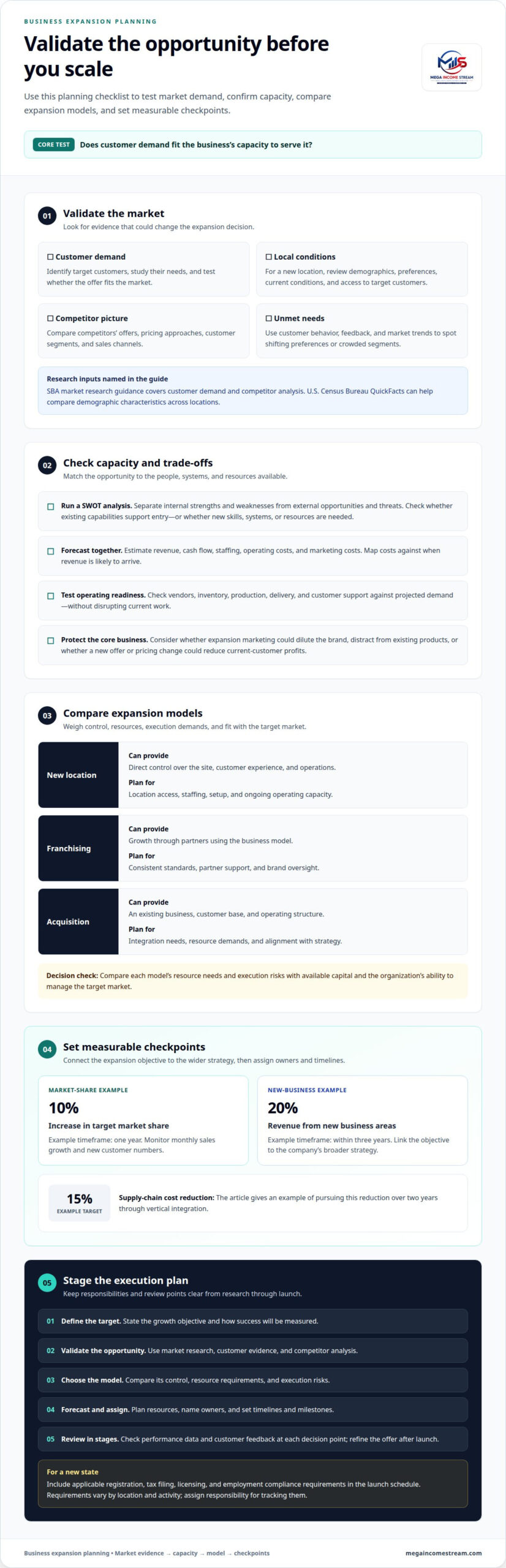
Assess demand by identifying target customers, studying their needs, and testing whether your offer fits the market. For a new location, examine local demographics, customer preferences, current conditions, and the competitors already serving those customers. The U.S. Small Business Administration’s market research guidance covers customer demand and competitor analysis, two inputs for evaluating a potential market.
Start with a SWOT analysis to distinguish internal strengths and weaknesses from external opportunities and threats. For example, a strong online sales channel may support entry into a new region, while limited fulfillment capacity could constrain delivery. Compare these capabilities with market conditions before setting an expansion goal. This helps reveal whether growth can build on existing strengths or requires new skills, systems, or resources.
Compare competitors’ offers, pricing approaches, customer segments, and sales channels. Then use customer behavior and market trend data to identify unmet needs, shifting preferences, and crowded segments. A subscription business, for instance, could compare customer feedback with competitors’ plans to see whether flexible delivery or a different product mix would set its offer apart. Focus on evidence that could change the expansion decision.
Set a market objective that links customer demand to a measurable result. A business could target a 10% increase in its target market share in a year, then monitor monthly sales growth and new customer numbers. Also test for internal trade-offs: could expansion marketing dilute the brand or distract from existing products? Could a new offer or pricing change reduce profits from the current customer base? Segment the audience further if broad messaging risks overwhelming likely buyers.
Forecast revenue, cash flow, and staffing together. Estimate sales using the addressable customer base, expected buying behavior, and market conditions. Then map operating and marketing costs against when revenue is likely to arrive. Identify the roles, skills, and training needed to serve projected demand, and compare them with current team capacity.
Choose a location by weighing access to target customers, transport networks, and skilled workers. The U.S. Census Bureau’s QuickFacts data can help compare demographic characteristics across locations. Proximity to major routes can reduce distribution costs and delivery times, while local labor-market analysis shows whether the required skills are available. For international or regional markets, research cultural preferences and applicable local regulations. Adapt language, packaging, or product features where customer expectations differ.
Turn your findings into operating, marketing, and sales plans. Define how customers will discover and buy the offer, which channels will support delivery, and who is responsible for each task. Check whether vendors, inventory, production, and customer support can scale without disrupting current work. After launch, use customer feedback and performance data to refine the offer rather than treating market analysis as a one-time exercise.
2. Expansion strategy and execution steps
Choose an expansion model by comparing control, resources, execution demands, and fit with your target market. Each route uses existing capabilities differently. Compare the operational load and strategic trade-offs before selecting one.
| Expansion model | What it can provide | Key planning focus |
|---|---|---|
| New location | Direct control over the site, customer experience, and operations | Location access, staffing, setup, and ongoing operating capacity |
| Franchising | Growth through partners using the business model | Consistent standards, partner support, and brand oversight |
| Acquisition | An existing business, customer base, and operating structure | Integration needs, resource demands, and alignment with strategy |
Use market research to assess demand and compare the resources each model requires. A new location may suit a business that needs direct control. Franchising can extend a repeatable model through partners. An acquisition may offer an established presence but requires a plan to integrate operations. Weigh these trade-offs against available capital, execution risks, and the organization’s ability to manage the target market.
Turn the selected model into a measurable growth objective. For example, a company could aim to earn 20% of revenue from new business areas within three years. Another might pursue a 15% reduction in supply chain costs over two years through vertical integration. Connect objectives to the company’s broader strategy, then assign owners, timelines, and performance measures.
Partnerships can support market entry when local distributors or retailers understand customer access and delivery. Before launch, define responsibilities, sales processes, service standards, and reporting. A product company might use a distributor for local delivery while retaining control over product positioning and customer feedback. Track partner activity alongside direct sales to compare channel performance.
What are the key steps in a business expansion plan? Define the target, validate the opportunity with market research, compare expansion models, forecast resources, assign owners, and set measurable milestones. Implement the plan in stages, reviewing performance data and customer feedback at each decision point.
For a new state, identify the registration, tax filing, licensing, and employment compliance requirements that apply to your business and industry. Requirements vary by location and activity, so include applicable obligations in the launch schedule and assign responsibility for tracking them.
Use an execution dashboard to measure outcomes, not just completed tasks. Track monthly sales growth, new customers, operating costs, and delivery performance against the target. If inquiries rise but purchases remain low, review the offer, pricing, and sales process before increasing marketing spend. If fulfillment slows, adjust staffing or partner capacity before driving more demand.
Review the strategy regularly and adapt it to performance metrics. Give each project a measurable outcome, timeline, owner, and decision rule for continuing, changing, or pausing the work. A structured expansion strategy can connect market entry choices with growth goals, partnerships, and execution checkpoints.
3. What is business expansion?
Business expansion is a planned increase in a company’s operations, customers, markets, or products. An expansion plan turns that objective into coordinated market, operational, financial, and staffing decisions. For example, opening a location or launching a new service should support the master business plan, not compete blindly with existing priorities.
Align the expansion with the company’s core strategy before committing resources. Identify which objectives it advances, which activities will share staff or technology, and how sharing those resources could affect current operations. Document the expansion’s purpose, target customers, responsible leaders, milestones, and expected outcomes. This keeps growth efforts aligned with the organization’s overall direction.
Use the standard business plan as a working checklist. Carry its strategy and market analysis into the expansion plan, then add sales, operations, financial projections, staffing, and risk controls. Estimate the capital required, identify additional positions or training, and account for operating costs and the marketing budget. If the plan adds a location, include its local workforce needs and delivery requirements.
What financing options are available for business expansion in the US? Businesses may compare traditional bank financing, which generally offers a lower cost of capital but requires strong financial statements and collateral, with SBA loans, which offer favorable terms to qualified businesses. SBA loan approval processes take 60-90 days, so include that timing in the project schedule.
How much does it cost to expand a business? Build an estimate from project-specific expenses, including operations, marketing, staffing, equipment, and required investment. Forecast when each cost will occur alongside expected revenue, then model how funding choices and shared resources could affect cash flow.
Give risks their own section, not a footnote. Identify market volatility, operational bottlenecks, funding shortfalls, staffing gaps, and applicable regulatory changes. Assign an owner to each risk, document a mitigation action, and set a trigger for reviewing the decision. New initiatives can take longer and cost more than expected, so test assumptions and phase commitments where practical.
What are the main risks of business expansion, and how can they be mitigated? Common risks include weak demand, cash pressure, resource strain, and new compliance responsibilities. Use market evidence, cash-flow forecasts, staged implementation, and assigned risk owners to limit exposure.
Keep the plan active after launch. Compare actual sales, expenses, staffing capacity, and customer response with the forecast, then adjust objectives or timelines when results diverge. Treat each location or new offer as a defined project with its own measures, while checking its impact on the wider business. This makes the expansion plan a decision tool, not a document filed after approval.
4. Aligning expansion with mission and values
An expansion strategy should strengthen the business’s vision, not pull it toward unrelated growth. Start by stating what the company exists to deliver and which customers it serves best. Then test the proposed market, offer, or location against those priorities. For example, a service business built around responsive support should assess whether a distant location can maintain that standard. If the operating model weakens a core promise, revise the strategy before committing capital.
Review alignment carefully before approving an initiative. Compare its expected contribution with the company’s goals, financial capabilities, and current obligations. Ask what the expansion makes possible, what it could displace, and which values must guide daily decisions. A company that competes through durable products, for instance, should assess whether a lower-cost supplier supports its quality commitments. Record the rationale so leaders can evaluate trade-offs consistently.
Turn values into operating requirements. If transparency matters, define how the new team communicates prices, delivery limits, and customer updates. If accessibility guides the brand, review the new location, product design, and sales materials for practical barriers. Assign an owner to each requirement and include it in launch reviews. This makes broad principles observable and measurable in daily work, rather than slogans that disappear during execution.
Internal alignment needs a regular communication rhythm. During a relocation or market launch, explain the purpose, timeline, role changes, and expected customer impact to employees. Involve staff in planning because frontline teams can identify process gaps and practical improvements. For example, support agents may spot recurring customer questions that call for updated training or clearer product instructions. Regular updates also help employees understand how the initiative affects existing responsibilities.
Before implementation, map who will make decisions, who will deliver the work, and where teams need training. Review staffing capacity alongside the expansion’s service standards instead of assuming current employees can absorb every new task. If a new location requires local expertise, define the skills needed and how they support the company’s values. Managers should also give employees a channel to raise risks and share feedback during the rollout.
Use a simple approval test to keep growth aligned:
- Purpose: Connect the initiative to a stated business objective and customer need.
- Values: Convert each relevant principle into a specific operating requirement.
- Resources: Match capital, staff time, and technology to the planned work.
- Ownership: Assign decision-makers and establish employee communication checkpoints.
- Review: Compare launch results with the original vision and adjust the approach.
This review helps leaders pursue competitive opportunities without sacrificing the commitments that built customer trust.
5. Business expansion and sustainable growth
Sustainable growth means increasing revenue and market share without letting cash pressure or operational strain outpace the gains. Before approving a new location or offer, compare its projected return with other uses of company resources. A new market may attract customers yet still weaken the business if it absorbs staff, technology, or capital needed by profitable operations.
Start with a market analysis, then test the financial model against realistic sales and cost assumptions. Expansion costs can arrive before new revenue, so map when cash leaves and when customer payments may arrive. A cash-flow forecast spanning 18-24 months can cover the expansion cycle and help identify potential shortfalls. Revise the plan if projected profitability does not support the resources required.
Protect working capital as operations scale. Business expansion typically increases working capital needs by 20-30%, so include the added demand in cash projections rather than treating current reserves as fully available. Sourcing essential business supplies and custom branding products through vendor accounts like The CEO Creative can help preserve cash flow during growth phases. Estimate expenses, revenue, and investment needs together. If the expansion draws inventory, people, or technology from existing operations, include the effect on those activities in the same model.
Readiness depends on more than demand. Stable profitability, scalable processes, reliable vendors, and a capable team help a business absorb growth. Steady net profit margins of 10% or more are associated with greater expansion success rates. A debt-to-equity ratio below 0.4 is identified as an appropriate level of leverage when assessing readiness. Treat both as planning indicators, alongside actual cash-flow projections and operating capacity.
Plan for the market to take time to perform. New markets may need 12-18 months to reach mature performance levels, depending on industry and competitive dynamics. Phase the launch so the business can learn from early customer response before committing more resources. Set a review point for sales, margins, service levels, and cash use, then adjust the rollout if those measures diverge from projections.
For each expansion KPI, record its starting value, target, and measurement unit. Pair revenue and market-share measures with operational indicators such as fulfillment speed, customer retention, or staffing capacity. Assign an owner to each measure and review results regularly. If revenue rises while service quality falls, growth may be shifting costs into the customer experience instead of building durable value.
Make sustainable growth a decision system: model the resource commitment, track financial and operational results, and scale only when the evidence supports the next phase. Use a sustainable growth strategy to turn expansion assumptions into measurable business decisions.
Mega Income Stream: Business Strategies
Mega Income Stream offers Business Strategies for entrepreneurs assessing growth options, revenue opportunities, and execution priorities. Its Making Money Insights can help readers consider practical ways to build sustainable income streams, while its consulting supports strategic thinking when a market opportunity needs a clearer plan.
Turn to these resources when you’ve identified a potential expansion but need to connect market demand with a workable business model, or when you’re comparing growth paths and want to clarify your next steps. Use the insights to test assumptions, prioritize actions, and shape a strategy around your business goals.
Visit megaincomestream.com to explore business growth strategies and insights.
Turn the Next Growth Decision Into a Clear Action
Move an expansion idea from discussion to a testable decision. Write down the most important assumption, decide what evidence would support or challenge it, and assign someone to gather that evidence. Set a review point, then choose whether to proceed, revise, or pause. This sequence helps the team learn before making a larger commitment.
Keep business expansion planning active as customer behavior and operating conditions change. Record the reason behind each decision, the evidence considered, and the next action. This helps decision-makers revisit assumptions without losing sight of why the team chose its current direction.
If you’re ready to shape your next move, contact Mega Income Stream to discuss expansion. Bring the opportunity you’re evaluating and the decision you need to make. Take the next step with a clear test, learn from the results, and build forward deliberately.
Frequently Asked Questions
What is business expansion?
Business expansion is a deliberate move to grow a company’s reach, operations, customer base, or range of offers. A freelance designer, for example, might move from selling individual projects to offering a repeatable service package for a wider customer segment. It counts as expansion when the business pursues a larger or different opportunity and commits resources to serve it.
What are the 4 Stages of Business Growth?
The four stages are startup, growth, maturity, and decline. A startup tests whether its business model can attract customers. During growth, demand and operations scale. At maturity, the company works to retain customers and defend its position. Decline signals weakening demand or performance, prompting leaders to assess whether to renew the offer, reshape operations, or pursue a different market opportunity.
What is business expansion planning?
Business expansion planning is the process of evaluating a growth opportunity and mapping the decisions needed to pursue it. It connects the chosen direction to customer demand, resources, financing needs, operations, and performance measures. For example, a company considering a digital product can define its audience, test the offer, assign launch responsibilities, and decide which results will guide its next move.
How should businesses choose between expanding locally, nationally, or internationally?
Compare each market’s customer fit, competitive conditions, delivery requirements, access to talent, and operating complexity. A local move may build on familiar customer relationships, while national growth can require broader distribution and support. International entry adds local cultural and regulatory considerations. Start with the market where your business can serve customers effectively using available resources, then validate assumptions before committing further.
What metrics should businesses use to measure expansion success?
Choose metrics that match the expansion objective. Revenue growth and market share can show commercial traction, while new-customer counts and repeat purchases reveal customer adoption. Track operational measures such as delivery performance, staffing capacity, and service quality to catch strain behind sales growth. For each KPI, record its starting point, target, and measurement unit, then review results consistently against the plan.
What legal, tax, and licensing requirements apply when expanding into a new state?
Identify the registration, tax filing, licensing, and employment compliance requirements that apply to your business and industry in the new state. Requirements vary by location and activity, so include them in the launch schedule and assign someone to track them.










Comments