
 By

If everyone can generate an article, a voiceover, or a chatbot, why would a client pay you to do it?
That question separates useful AI side hustle ideas from tool demonstrations. AI has lowered the barrier to producing work, but it has also made generic output easier to copy. Clients still need someone who understands their business, checks the result, and takes responsibility for delivery.
The distinction matters financially. Upwork's Future Workforce Index 2026 reported that generative-AI and creative-production contract starts rose 90% year over year while earnings per contract fell 13%. Those marketplace findings don't predict your earnings, but they explain why selling more AI-generated material isn't necessarily a stronger business.
Sell the finished result and the judgment behind it, not access to a tool your client can subscribe to themselves.
The practical opportunities range from writing and audio production to workflow automation and specialized support bots. Some suit an evening schedule because you can deliver asynchronously. Others require ongoing monitoring, access to business systems, and availability when something breaks.
Startup costs also differ. A writing service can begin with an existing laptop and a modest software setup, while a hosted bot creates continuing expenses for model usage, storage, integrations, and support. A product business avoids some client meetings but leaves you responsible for finding buyers.
The ideas below assess the same working realities: daily tasks, startup expenses, client objections, and the income model that fits. None comes with guaranteed earnings. Choose the one closest to a skill you can already demonstrate, then build a small offer a buyer can understand without needing an explanation of AI.
Table of Contents
- 1. AI-Assisted Content Writing and Blog Ghostwriting
- 2. AI Voiceover and Audio Production Services
- 3. AI-Generated Print-on-Demand Design Business
- 4. Faceless AI Video Channels and Short-Form Content Creation
- 5. AI Chatbot Setup and Management for Small Businesses
- 6. No-Code AI Workflow Automation Consulting
- 7. Licensing and White-Label AI Business Support Bots
- 8. AI Virtual Assistant and Agent Setup Services
- 9. AI-Assisted Digital Products and Templates
- 10. AI-Powered Social Media Management and Content Repurposing
- 10 AI Side Hustles Compared
- Choosing Your AI Side Hustle and Getting Started
1. AI-Assisted Content Writing and Blog Ghostwriting
A useful writing offer isn't just generating blog posts. It's turning a client's expertise, product information, and customer questions into accurate material people want to read.

Day to day, you'll develop briefs, organize source material, draft sections with a language model, and rewrite anything generic or unsupported. You'll also chase missing information, resolve comments, and prepare copy for the client's publishing system. Editing judgment matters more than prompting speed.
Build an Editorial Service
Say an e-commerce store sells specialist gardening equipment. You could turn product specifications and staff interviews into buying guides, maintenance articles, and customer newsletters, checking every recommendation against the actual products.
- Tools and startup costs: Start with a language model, Google Docs, and the client's existing publishing tools. Add paid SEO software only when keyword research is part of a signed scope.
- Quality control: Check factual claims against primary sources, inspect links, remove invented examples, and compare the draft with approved brand samples.
- Natural income model: Sell defined article packages or an editorial retainer, with research, interviews, uploads, and revisions clearly separated.
Clients will push back when they believe AI has eliminated the work. Show the brief, source notes, and editorial decisions rather than defending how long drafting took.
Specialization helps, but don't confuse familiarity with professional competence. Health and financial content require careful boundaries and qualified review where appropriate. A narrower commercial niche you understand is a better starting point than a sensitive subject you can only summarize.
Your first portfolio sample should show a finished article alongside a short explanation of the reader problem it solves.
2. AI Voiceover and Audio Production Services
Synthetic narration is easy to generate. Audio that sounds consistent, pronounces technical terms correctly, and fits a finished video takes production work.
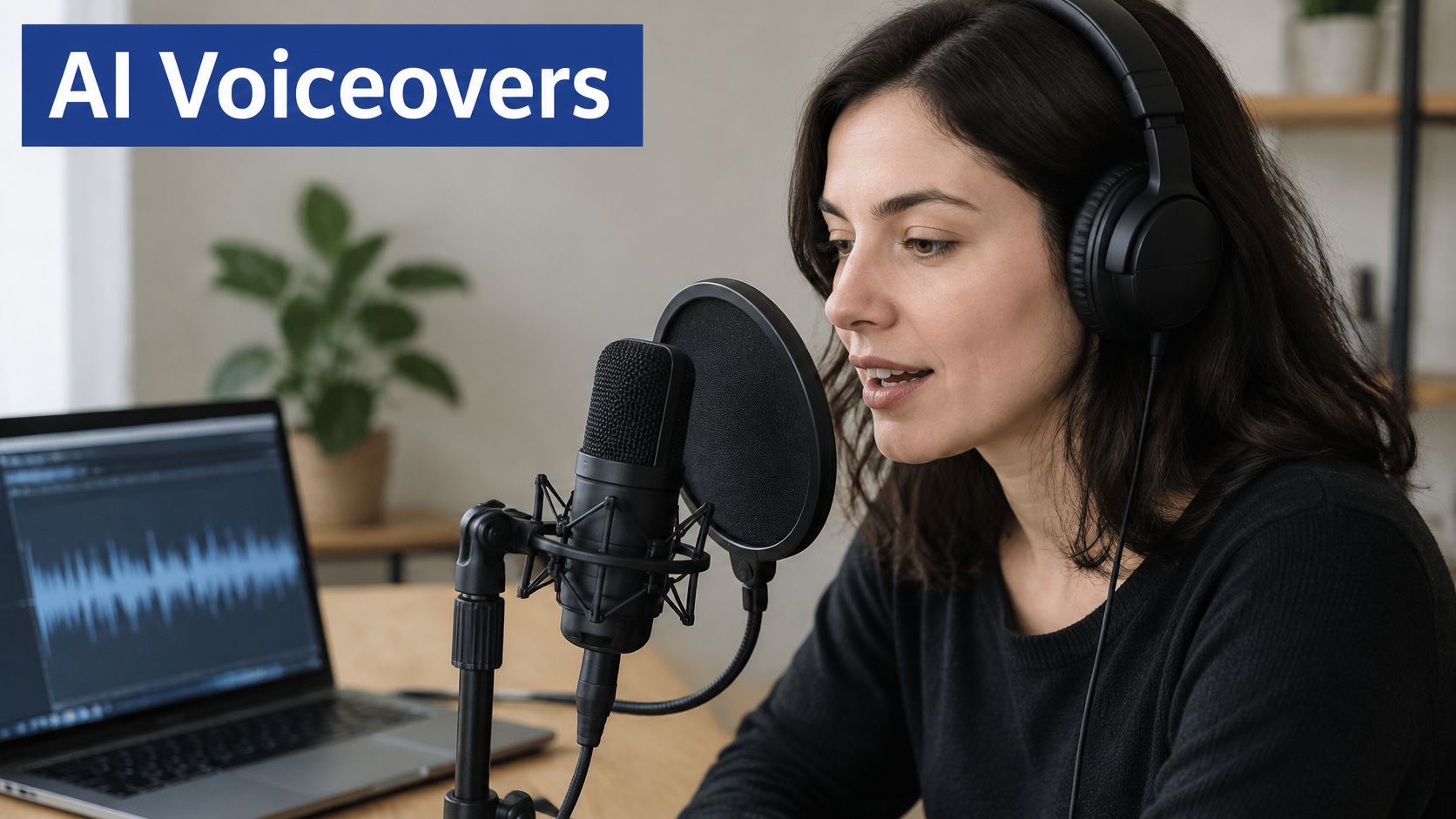
A typical assignment might involve narration for an employee-training course. You'd clean up the script, establish pronunciation rules, generate speech, correct awkward passages, and deliver named files that match the course modules.
Your routine also includes listening. Automated cleanup can introduce metallic artifacts, clipped consonants, or unnatural pauses that aren't obvious from a waveform.
Charge for Production, Not Generation
Tools such as ElevenLabs or Murf can supply narration, while Descript, Audacity, or a digital audio workstation handles editing. Startup expenses include the appropriate commercial subscription and reliable headphones; a microphone becomes relevant if you also record original speech.
Before accepting work, check the specific voice's commercial permissions and the tool's current terms. Obtain written consent before cloning a real person's voice, including agreement about permitted uses and access to the resulting model.
Production boundary: Approve the script and voice sample before generating the complete narration. Script changes after production are new work, not audio corrections.
Project pricing suits course narration and video packages. A recurring production agreement fits podcasts or regularly published lessons, while hourly billing works better for badly recorded audio whose repair effort is uncertain.
Client objections usually concern emotional delivery, pronunciation, and whether synthetic speech suits the audience. Offer a relevant sample rather than promising that every voice will sound human.
Our guide to getting into the voice-over business explains the broader service model. Bundle narration with cleanup, transcripts, or captions only when you can quality-check each deliverable.
3. AI-Generated Print-on-Demand Design Business
The printing partner handles production, but you still run a retail business. You're responsible for choosing products, attracting buyers, answering messages, and resolving problems when the physical item disappoints.

AI image generators can help explore artwork, but print-ready design requires cleanup. Inspect edges, remove accidental artifacts, rebuild lettering manually, and export to the printing provider's required dimensions and color settings.
A focused collection for birdwatchers, for example, needs more than bird illustrations. Buyers may respond to recognizable species, relevant humor, attractive typography, and products suited to gifts.
Calculate the Margin Before Publishing
Your product margin starts with the selling price and shrinks after production, marketplace charges, payment processing, shipping contributions, advertising, and replacements. Don't treat the difference between the displayed base cost and retail price as take-home profit.
- Startup expenses: Budget for design tools, store or listing charges, and physical samples. Avoid paying for a large software stack before testing buyer interest.
- Buyer pushback: Customers judge print quality, fit, delivery, and originality. Accurate mockups and clear product descriptions reduce avoidable disappointment.
- Income model: This is a product business, not an hourly service. Revenue depends on successful listings and distribution, while support continues after the sale.
Check trademark databases, avoid protected characters and brand references, and review each marketplace's AI-content rules. A tool's commercial-use permission doesn't resolve every possible intellectual-property issue.
Order samples before expanding a collection. Artwork that looks sharp on a screen can print poorly on fabric or disappear against a product's background.
If you prefer selling design services rather than merchandise, our guide to charging for a shirt design helps distinguish the design fee from the retailer's product margin.
4. Faceless AI Video Channels and Short-Form Content Creation
There are different businesses hiding under the faceless-video label: building your own audience and producing videos for someone who already has one. The second gives you a clearer deliverable to sell; the first leaves you carrying the audience-growth risk.

For a client service, you might turn a software company's webinar into short tutorials. AI transcription and clipping tools identify candidate moments, but you choose passages that make sense without the original presentation.
Daily work includes checking scripts, sourcing licensed visuals, correcting captions, editing pacing, and reviewing exports. CapCut, Descript, or DaVinci Resolve can support production, depending on the format.
Choose Your Revenue Path
Client production naturally supports project packages or a recurring editing retainer. Define source-footage limits, output formats, revisions, and whether thumbnails or publishing are included.
An owned channel may eventually earn through advertising, affiliates, sponsorships, or products, but those routes depend on audience response and platform eligibility. Use resources that help you find revenue-generating YouTube niches as idea prompts, not earnings forecasts.
Startup costs include editing software, storage, licensed media, and narration where needed. Avoid subscribing to overlapping video generators before you know which production step slows you down.
Clients push back on repetitive visuals, weak hooks, and clips that distort the speaker's meaning. Original commentary and careful selection are more defensible than assembling interchangeable stock footage.
Review current platform rules on monetization, synthetic-media disclosure, and repetitive content before scaling. Our guide to earning money with video editing provides context for selling production skills rather than relying entirely on channel income.
5. AI Chatbot Setup and Management for Small Businesses
A small-business chatbot should have a narrow job. Answering delivery questions or routing appointment requests is a manageable starting point; handling every possible customer problem isn't.
There's a plausible customer base, but adoption alone doesn't prove demand for your service. In Thryv's survey of small-business decision-makers, 55% of surveyed small businesses reported using AI in 2025. Your sales conversation still needs to identify a specific support problem worth fixing.
Build Around Approved Information
Say a bicycle repair shop receives repeated questions about opening hours, service categories, and booking. A bot can answer from approved documents and pass uncertain questions to staff without inventing repair quotes.
Using Voiceflow or Botpress, you'd organize the knowledge base, configure retrieval, connect approved systems, and test realistic customer questions. Ongoing work includes reviewing failed conversations and updating business information.
- Startup costs: Expect platform subscriptions, model usage, and possibly integration expenses. Keep production accounts client-owned where practical, with billing responsibilities documented.
- Client pushback: Owners worry about wrong answers and frustrated customers. Demonstrate unknown-question handling and human escalation, not just successful responses.
- Income model: Use a fixed setup scope plus a maintenance plan tied to defined monitoring and update work.
Test ambiguous questions, outdated information, attempts to override instructions, and requests outside the bot's remit. Collect only the information the workflow needs and document retention and access arrangements.
A retainer shouldn't disguise an unfinished build. Agree on acceptance tests before launch, then distinguish defect correction from new features, added channels, and expanded integrations.
The strongest sales demonstration shows both what the bot can answer and what it safely refuses to answer.
6. No-Code AI Workflow Automation Consulting
Start by watching how information moves through a business. Automating a poorly understood process usually produces faster mistakes.
A practical lead-intake workflow might receive a website enquiry, extract relevant details, suggest a category, create a CRM record, and notify the appropriate employee. Use ordinary rules for predictable decisions and AI only where interpreting messy text adds value.
The implementation gap is real: McKinsey's global survey found that 78% of organizations used AI in at least one business function, across respondents in 101 countries. That broad organizational finding supports investigating workflow needs, not assuming every local business wants automation.
Make Failures Visible
Learn Make, Zapier, or n8n well enough to troubleshoot authentication, webhooks, field mappings, and execution histories. Daily work involves process interviews, building connections, testing exceptions, and tracing failures across systems.
- Document the workflow: Record inputs, permissions, model calls, structured outputs, approval points, and the person responsible when execution fails.
- Protect against duplication: Use unique record identifiers and check whether a transaction already completed before retrying it.
- Measure useful outcomes: Compare task completion time, correction work, and operating cost before and after implementation.
Startup costs include your development environment and test usage; production subscriptions should be visible in the proposal. Sell discovery and implementation as defined projects, then charge separately for monitoring and maintenance.
Clients often ask why a simple-looking connection costs more than the automation subscription. Explain the exception handling, testing, documentation, and recovery work they're buying.
Use the demonstration below to examine how an automation is assembled, then practice documenting its failure paths.
7. Licensing and White-Label AI Business Support Bots
Licensing a specialized bot looks attractive because you can reuse the underlying system. The difficulty is keeping customer-specific requirements from turning every subscription into a custom development contract.
Consider an internal onboarding assistant for property-management firms. The shared product could handle document retrieval and employee questions, while each firm supplies its own approved procedures and permissions.
Unlike a custom chatbot project, this model requires product decisions. You decide which integrations to support, how updates work, and when a request falls outside the standard offering.
Standardize Before You Scale
Daily responsibilities include onboarding customers, checking retrieval failures, managing document updates, and answering support requests. You also need to monitor usage and isolate each customer's content, credentials, and conversation records.
A reusable bot becomes a product only when you can onboard another customer without rebuilding the service around them.
Startup costs are higher than a simple freelance demonstration. Hosting, model calls, storage, authentication, backups, monitoring, and support all continue whether a customer uses the bot heavily or barely opens it.
Subscriptions or licensing agreements fit naturally, with clearly defined usage allowances and separately scoped customization. Avoid unlimited promises before you understand actual operating costs.
Buyers will ask why they shouldn't use a general-purpose assistant. Your answer needs to involve approved knowledge, appropriate permissions, repeatable workflows, and dependable support, not merely a branded chat window.
Pilot with a small customer group before promoting a standard package. Watch where setup requires manual intervention and whether employees return after the initial demonstration.
For legal, medical, or other sensitive applications, limit the assistant's role and route consequential questions to qualified people. A disclaimer doesn't compensate for unsafe behavior or weak access controls.
8. AI Virtual Assistant and Agent Setup Services
An inbox assistant doesn't need permission to send messages to be useful. It can categorize incoming mail, prepare response drafts, and present an action list for review.
That's a stronger starting point than promising an autonomous agent that manages someone's working life. Administrative tasks involve relationships, implied commitments, and exceptions that a model may misunderstand.
Workplace tool governance creates a related opportunity. The Microsoft and LinkedIn Work Trend Index reported that 78% of AI users in its surveyed knowledge-worker population brought their own AI tools to work, supporting services that establish approved workflows rather than adding more unmanaged software.
Separate Preparation From Permission
A useful service for a consultant might combine meeting summaries, draft follow-ups, and proposed CRM updates. You review names, commitments, and deadlines before the client approves anything consequential.
- Access boundaries: Use delegated access and the minimum permissions needed. Don't request an owner's main password when a controlled integration is available.
- Approval boundaries: Require confirmation before sending messages, deleting records, moving money, or making external commitments.
- Operating instructions: Document exceptions, escalation contacts, and what happens when the AI can't interpret a request confidently.
Startup expenses may include an approved business AI environment, scheduling software, and automation tools. Check data-handling settings before connecting client mail or documents.
A setup project suits clients who want to operate the system themselves. Hourly assistance works during discovery, while a retainer fits ongoing supervised administration with defined availability.
Clients push back on privacy, missed nuance, and the fear of losing control. Demonstrate the approval queue and audit trail before showing advanced features.
This isn't passive work. If your service includes daily oversight, sell it as an operating responsibility and price the attention accordingly.
9. AI-Assisted Digital Products and Templates
A template sells when it removes a task buyers dislike or helps them avoid a mistake. A large collection of generic prompts doesn't automatically do either.
Say you understand freelance project management. You could create a client-onboarding kit with a scope worksheet, project tracker, handover template, and worked example showing how the pieces connect.
AI can help draft instructions, suggest spreadsheet formulas, and generate test scenarios. You still need to verify calculations, simplify the setup, and remove features that make the product harder to use.
Validate the Problem Before Polishing
Show potential buyers a working preview and ask them to complete the intended task. Observe where they hesitate rather than asking only whether they like the design.
Tools might include Google Sheets, Excel, Notion, Canva, and a storefront such as Gumroad. Startup costs can stay limited, but transaction charges, customer support, refunds, and software changes remain part of the business.
- Differentiate with expertise: Include realistic examples, decision rules, and explanations of common mistakes.
- Define compatibility: State which software the product uses and whether buyers need additional accounts or paid features.
- Set support boundaries: Explain what help is included and when customization becomes a separate service.
The natural model is a product sale, optionally paired with paid implementation. A subscription makes sense only when you deliver continuing value, such as substantive updates or maintained resources.
Buyers will compare your product with free alternatives. A useful demonstration of the task completed is more persuasive than a long feature list.
Review marketplace disclosure requirements and describe AI involvement clearly where required or relevant. Don't include fabricated case studies, untested formulas, or claims that suggest the template replaces professional advice.
After launch, customer questions should guide revisions. Repeated confusion usually means the product or instructions need work.
10. AI-Powered Social Media Management and Content Repurposing
The difficult part of social media management isn't generating captions. It's obtaining usable source material, coordinating approvals, protecting the client's reputation, and deciding what deserves publication.
For a local fitness studio, you might turn approved instructor interviews into educational posts, class introductions, and short clips. You'd check claims, confirm schedules, and preserve each instructor's meaning before scheduling anything.
AI can help organize transcripts, suggest angles, and adapt drafts to different formats. Canva, Descript, Buffer, or Metricool can support production and publishing, but someone still needs editorial control.
Sell a Manageable Publishing Operation
Daily work includes collecting assets, editing posts, chasing approvals, scheduling content, and handling agreed engagement tasks. Reporting should distinguish publishing activity from enquiries, bookings, or other outcomes the client values.
Startup costs include creative and scheduling tools, storage, and possibly transcription. Use client-owned account permissions rather than sharing passwords, and agree on who pays for additional software.
Scope safeguard: Content production, community management, paid advertising, and customer service are separate responsibilities. Don't let a posting retainer quietly absorb them all.
A monthly retainer suits this service because planning and publishing recur. Specify supported channels, content formats, approval responsibilities, revision boundaries, and response expectations.
Clients often expect growth you can't control or unlimited access to your time. Explain which outcomes you can influence and which depend on their offer, audience, sales process, or advertising budget.
The strongest entry offer is usually narrow: repurpose existing material for a defined channel and report what happened. Expand after you know how reliably the client supplies source content and approvals.
If they have nothing useful to repurpose, account for interviews, photography, or original content production separately.
10 AI Side Hustles Compared
| Side Hustle | Startup Cost | Income Model | Best For | Main Challenge |
|---|---|---|---|---|
| AI-Assisted Content Writing and Blog Ghostwriting | Low; typically an AI tool subscription | Per article, project, or monthly retainer | Freelancers and small businesses seeking scalable content services | Maintaining accuracy and originality while meeting price expectations |
| AI Voiceover and Audio Production Services | Low to moderate; subscriptions and basic audio equipment | Fees for narration, editing, dubbing, or bundled services | Course creators, podcasters, YouTubers, and e-learning teams | Licensing and consent requirements, plus competition from low-cost tools |
| AI-Generated Print-on-Demand Design Business | Low; design subscriptions and marketplace fees | Margin on each product sold | Creatives and e-commerce operators testing low-risk product sales | Saturation and intellectual property risks |
| Faceless AI Video Channels and Short-Form Content Creation | Low to moderate; software and optional stock assets | Ad revenue, affiliate links, sponsorships, or editing services | Creators seeking video income without appearing on camera | Slow audience growth and platform restrictions on repetitive content |
| AI Chatbot Setup and Management for Small Businesses | Low to moderate; platform subscriptions and setup time | Setup fees and monthly maintenance retainers | Small businesses seeking customer support automation | Poorly configured bots can frustrate customers; privacy also matters |
| No-Code AI Workflow Automation Consulting | Low; platform subscriptions and learning time | Project fees for builds and monthly maintenance plans | Entrepreneurs and small businesses reducing manual operations | Workflows require client-specific knowledge and ongoing maintenance |
| Licensing and White-Label AI Business Support Bots | Moderate; development, hosting, and support | Recurring subscriptions with usage tiers | Entrepreneurs and developers building industry-specific AI products | Product support needs and liability from incorrect answers |
| AI Virtual Assistant and Agent Setup Services | Low to moderate; tool subscriptions and onboarding time | Recurring service packages or setup fees | Founders, executives, and small teams needing administrative support | Errors, account security, and the need for human oversight |
| AI-Assisted Digital Products and Templates | Low; tool subscriptions and marketing time | Sales of downloads, courses, or subscription access | Creators and educators building scalable digital income | Standing out in crowded markets while maintaining quality |
| AI-Powered Social Media Management and Content Repurposing | Low; scheduling subscriptions and client-management time | Monthly management retainers | Small businesses and creators needing consistent social media | Algorithm changes and difficulty meeting growth expectations |
Choosing Your AI Side Hustle and Getting Started
Which of these side hustles can you perform consistently and at a price that justifies the effort? AI can accelerate certain tasks, but the service still relies on your judgment, quality control, and ability to manage client requests.
Choose a model based on the work you are willing to do each week. Voiceover production includes listening through exports and correcting errors. Automation involves troubleshooting client-specific systems. Social media management requires coordinating content and approvals. Recurring revenue only helps if you are willing to maintain the service.
Match the Offer to Your Schedule
Writing, design, and templates can fit around another job, but allow time for revisions and customer support. Chatbots and operational automations may need faster responses because problems can affect a business's daily work.
A service can provide direct feedback about what buyers value. A product can reduce repeated delivery work, but only makes sense if you understand the customer problem and have a way to reach potential buyers.
- Use an existing skill: Choose work you can assess without relying on the AI to judge its own output.
- Choose a reachable buyer: Focus on people you can contact through professional connections, local businesses, or relevant communities.
- Define an observable result: Promise a specific deliverable or process improvement, not a vague transformation.
Before paying for tools, create a demonstration using public, synthetic, or permissioned material. Explain what the buyer receives, what inputs you need, and what falls outside the scope.
Price the Responsibility You Accept
Estimate the full delivery effort: discovery, quality control, revisions, meetings, software, and support. Faster drafting does not remove those responsibilities. If a supplier charges based on usage, set limits rather than promising unlimited service.
Hourly pricing fits uncertain discovery and open-ended assistance. Fixed fees suit defined projects and deliverables. Retainers work when the client has recurring needs and the monthly scope is clear. Products and licensing reduce repeated production, but shift effort toward distribution, maintenance, and customer support.
Do not add a maintenance plan to a finished asset unless it needs ongoing work. For social publishing, plan your monthly social media content around the source material and approvals available. The same rule applies to other services: organize delivery before increasing volume.
Turn a Demonstration Into a Paid Pilot
Build a sample that resembles the buyer's work, then propose a limited pilot. State the required inputs, how the client will judge acceptance, and who approves the output.
Track your actual time and operating expenses during delivery. Record unclear instructions, corrections that required your expertise, and requests that fell outside the agreed scope. Use those details to refine the next proposal. If the project only pays off when nothing goes wrong, narrow the scope or adjust the price before taking on similar work.
Mega Income Stream's Earn Living Online section includes freelance pricing guidance, The Freelancers Guide to Raising Rates Without Losing Clients, a USD vs. Local Currency Freelance Earnings Estimator, and free best-selling ebooks. These resources can help you think through rates and income planning as you shape an offer.
Pick one idea and set a launch goal. This week, finish a sample, contact a suitable buyer, or test a workflow. A small paid assignment can show whether your offer, delivery process, and pricing work together.
Mega Income Stream publishes guides on freelancing, digital products, business operations, and AI-supported earning methods. Visit Mega Income Stream to explore the Earn Living Online section and consider your offer, pricing approach, and next step.










Comments