
 By

A business bottleneck analysis identifies the process step limiting the performance of the whole system, helping you focus on the constraint. Even when a business has capable people and resources, one activity that cannot keep pace with demand can slow everything down. The Theory of Constraints describes this as a weak link that restricts the output of connected activities.
It’s easy to focus on keeping every team busy, but local efficiency doesn’t always improve the flow of the whole operation. Bottlenecks often show up as a persistent queue, recurring overtime, delayed handoffs, or downstream teams waiting for work to arrive. Eliyahu M. Goldratt’s book The Goal, first published in 1984, helped bring the Theory of Constraints into business discussions.
This article explains what bottleneck analysis is, how to find and investigate constraints, and how improvements can affect productivity, quality, customer service, and costs. It also covers how to monitor performance after a change, so a resolved constraint does not simply return or shift elsewhere in the process.
Key Takeaways
- Define the process scope and business question before collecting data, so the analysis focuses on a constraint that matters.
- Use queues, cycle times, utilization, and recurring delays to identify where work slows down, then investigate the root cause.
- Improve the flow of the whole process rather than keeping every individual resource busy; the constraint sets the system’s pace.
- Choose process changes or automation that address the cause of the delay, and involve the people who do the work in shaping the fix.
- Track lead time, on-time delivery, and work-in-progress after changes, and update procedures to help prevent the bottleneck from returning.
What is bottleneck analysis?
Bottleneck analysis identifies the process constraint that limits the flow of work through a business. Common causes include capacity mismatches, approval delays, equipment breakdowns, unclear handoffs, and inconsistent workflows.
Identifying Process Constraints and Signals
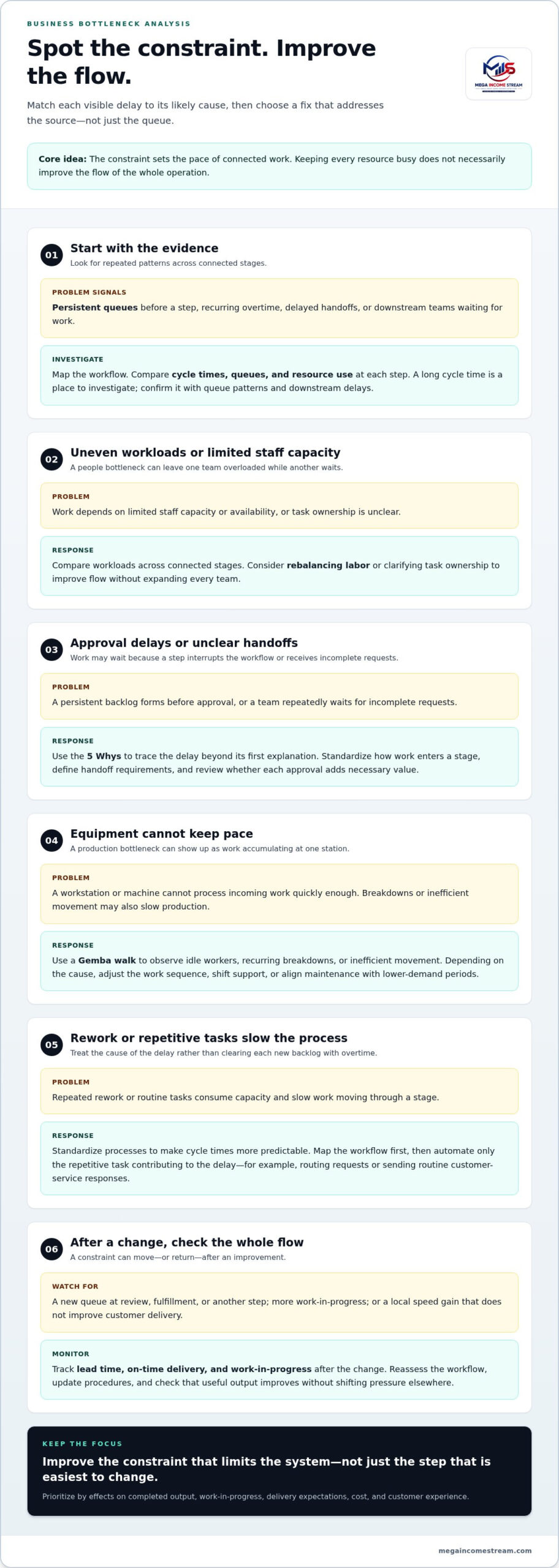
A process constraint is a step with limited capacity that holds back connected activities. To find it, map the workflow and compare cycle times, queues, and resource use at each step. For example, a persistent backlog before an approval point suggests work arrives faster than it can be processed there. These visible delays help focus investigation on the stage affecting overall flow.
The Theory of Constraints views linked processes as a system limited by at least one weak link. Start with the business question, define the process scope, then trace where work waits or slows. The step with the longest cycle time is a useful place to investigate, but confirm the constraint by checking queue patterns and downstream delays. A constraint can move after a process change, so reassess the workflow instead of assuming the first fix resolved every delay.
Process, People, and Production Bottlenecks
A process bottleneck forms when a workflow step creates delays; a people bottleneck occurs when a task depends on limited staff capacity or availability. A production bottleneck arises when a workstation or machine cannot keep pace with incoming work. The distinction matters because a visible queue may point to a process, staffing, or equipment issue. For example, products piling up at one station draw attention to that production step.
On a production floor, a Gemba walk can reveal idle workers, recurring machinery breakdowns, or inefficient movement between tasks. In a service business, reviewing the handoff from intake to approval may expose repeated waiting. Compare workloads across connected stages: if one team is overloaded while another waits, rebalancing labor or clarifying task ownership may improve flow without expanding every team.
Common Causes of Business Bottlenecks
Common causes include uneven workloads, repeated rework, limited equipment capacity, unclear responsibilities, and approval steps that interrupt workflows. These causes matter because treating only the visible queue can leave the underlying constraint intact. Use the 5 Whys method to trace a delay past its first explanation. If a team repeatedly waits for incomplete requests, examine the intake process before adding capacity downstream.
Process changes can prevent constraints from recurring. Standardize how work enters a stage, define handoff requirements, and review whether each approval adds necessary value. In manufacturing, rearranging workstation tools can reduce unnecessary movement, while standardizing processes can make cycle times more predictable. These changes address the workflow itself instead of relying on overtime to clear each new backlog.
Automation can remove repetitive steps that slow a process, such as routing requests or sending routine customer-service responses. First map the workflow and identify the delay, then automate only the repetitive task contributing to it. For example, a chatbot can handle routine service questions while staff address complex cases. Track queues after the change, because automation may shift the constraint to review, fulfillment, or another step.
Productivity, quality, customer service, and cost benefits
Bottleneck improvements matter when they increase useful output without shifting pressure to another stage. Assess the effect across the full path from incoming work to customer delivery. A production change that shortens one task may not improve delivery if inspection, fulfillment, or customer communication becomes the new limiting step. Compare operational outcomes together, so a local efficiency gain does not hide a service or quality problem.
Tools for process analysis include value stream maps, cycle-time records, production rates, queue-length tracking, and direct observation. NIST’s Manufacturing Extension Partnership is a resource for manufacturers exploring operational improvement. Digital twins, virtual models connected to real-time system data, can also help teams simulate production runs and consider proposed changes before applying them.
Prioritize constraints by weighing their effects on cost, delay, and customer experience. Consider which issue restricts completed output, ties up work-in-progress, or causes missed delivery expectations. Then examine whether a proposed fix could increase defects or create extra work elsewhere. A large queue is not automatically the top priority if another constraint has a greater effect on customer commitments.
Capacity, scheduling, and production flow
Manufacturing capacity depends on how production stages interact, not just on the speed of one machine. Products accumulating at a stage may indicate that it cannot process work as quickly as it arrives. Cycle times, production rates, and queue lengths help teams distinguish scheduling losses from equipment or staffing limits.
Scheduling changes can reduce avoidable interruptions at constrained equipment. Teams can also align maintenance with lower-demand periods, adjust the work sequence, or shift support toward a stage with limited capacity. The right option depends on the cause: changing a schedule will not resolve a persistent skills gap, and adding staff will not fix a process that causes repeated rework.
Supply chain and staffing effects
Supply chain delays can interrupt production when materials arrive out of sequence, while staffing constraints can slow work even when equipment is available. Observe how incoming materials, labor, and machine availability align with the actual queue. NIST’s manufacturing resources can help frame operational improvement decisions, while employee input may reveal handoff issues that process records alone do not explain.
Quality, service, and cost outcomes
Steadier work flow can give teams more control over handoffs and customer updates. Track quality alongside speed: rework, incomplete orders, and repeat customer contacts can reveal trade-offs a throughput measure misses. ASQ’s Lean resources describe methods for examining waste in processes. Use that perspective to assess whether a change removes unnecessary effort without weakening checks customers rely on.
Review the operational cost of waiting, rework, and excess work-in-progress alongside customer impact. Connect each proposed improvement to a specific constraint and outcome, then reassess connected stages after implementation. This keeps the focus on end-to-end performance rather than one machine’s utilization. A focused business strategy can also help connect operational constraints with broader growth priorities.
Theory of Constraints
The Theory of Constraints improves overall system output by focusing on its limiting constraint. Unlike Lean, which targets waste across workflows, it concentrates improvement on the constraint shaping total throughput. The two approaches can work together.
Manufacturing and Supply Chain Constraints
A manufacturing or supply chain constraint is a limited-capacity step that restricts the flow of materials or finished work. Excess output upstream can build inventory without increasing customer deliveries. Map each stage from incoming materials to shipment, then trace where production waits. A supplier delay can leave a line without materials, while limited inspection capacity can hold completed products before dispatch.
The Theory of Constraints focuses on the factor currently limiting the whole system, rather than treating every busy machine as equally important. Once identified, protect that resource from avoidable interruptions and align upstream work with its capacity. If the constraint is relieved, reassess the flow: another machine, approval, or supply step may become the new limit.
Short-Term and Long-Term Constraints
A short-term constraint is a temporary limit, such as maintenance, a delayed shipment, or an uneven production schedule. A long-term constraint reflects an ongoing capacity gap, such as a process design that cannot support demand or a persistent shortage of a required skill. Distinguishing between them matters because temporary workarounds can address immediate flow, while lasting constraints call for structural changes.
For a short-term disruption, reschedule work or shift tasks around the affected stage while preserving quality checks. For a persistent constraint, examine capacity planning, process design, and workforce coverage. Track whether the same step continues to restrict output after the temporary disruption ends. This distinction helps teams avoid treating a recurring capacity problem as a one-off delay.
Takt Time and Capacity Constraints
Takt time connects customer demand with available production time. Calculate it by dividing workable production hours by the units required to meet customer demand. Compare the result with the cycle time at each stage. If a step takes longer than the required pace allows, it may restrict capacity and create queues or missed production targets.
This comparison supports practical decisions about line balance, task allocation, and scheduling. A stage operating below the required pace may need a redesigned sequence or additional capacity. A faster stage may have spare capacity, but maximizing its output can simply increase work waiting elsewhere. Measure the whole production flow, then focus improvements on the step that controls system throughput.
Theory of Constraints and Lean Approaches
The Theory of Constraints aims to improve system performance by identifying and managing its most limiting step. Lean approaches focus on removing waste across processes, including excess movement, waiting, and unnecessary work. This distinction matters because improving a local activity may not increase total output if the system constraint remains unchanged.
Use process mapping to see where work flows and waste accumulates, then apply the Theory of Constraints to determine which restriction most affects throughput. Improve that constraint, align other activities with its capacity, and reassess as the flow changes. Lean methods can help remove waste around the constraint, while continuous improvement keeps attention on new limits as they emerge.
Monitoring changes to prevent future bottlenecks
A solution works only if performance monitoring shows that the constraint has eased without creating a new delay. Track the process after each change, then adjust if queues, missed deliveries, or workload patterns shift.
Implementing and Monitoring Solutions
Implement a bottleneck solution as a controlled process change, with a clear owner and defined operating procedure. For example, if inspection delays shipments, cross-train support staff and document how inspection work is assigned. This gives employees a shared method and makes the change easier to assess.
Compare process performance before and after the change using the same measures. If a revised handoff speeds up inspection but increases errors, investigate the cause before expanding the change. Include employees who perform the work in reviews, as they may identify practical issues that dashboards do not show.
Update standard operating procedures when the new method becomes standard practice. Communicate what changed, which tasks it affects, and how teams should handle exceptions. Without this step, employees may return to old workflows, weakening the improvement or recreating the original queue.
Metrics and KPIs for Monitoring
Monitoring metrics show whether a process change improves flow, delivery, and control. Track lead time, on-time delivery rates, and work-in-progress levels together. For example, falling lead time alongside rising work-in-progress may signal that a queue has moved rather than disappeared.
Pair those measures with indicators specific to the process, such as cycle time at the affected step, queue length before it, and production rates. In a service workflow, review how long requests wait for approval and whether completed work reaches customers on schedule. Each measure should relate to the original constraint and intended outcome.
Use a simple review record to compare results over time: note the change, observed performance, and any new delay. Do not rely on a single KPI. A faster machine may increase output while creating excess work for inspection, so review connected stages before deciding whether to streamline further.
Ongoing Monitoring and Prevention
Ongoing monitoring checks whether a constraint returns or shifts to another process step. Review performance after changes in demand, staffing, equipment, or supplier conditions. For example, a production line may run smoothly until a new product mix increases setup work at one machine.
Use the Theory of Constraints cycle as a recurring control: identify the current limit, manage it, improve it, and reassess the system. Once a constraint has been removed, return to the first step. This keeps teams focused on the current constraint instead of assuming an earlier fix remains sufficient.
When a review reveals recurring delays, investigate their causes before adding capacity. Check whether updated procedures are followed, whether work arrives in usable form, and whether the constraint has moved downstream. Communicate procedure changes to affected employees so daily habits support the improvement instead of recreating the original bottleneck.
Definition and origins of bottleneck analysis
Bottleneck analysis examines how a limitation in one activity affects the flow of connected operations. The bottleneck image conveys the idea: a container’s narrow neck limits how quickly its contents can pass through. In a business, the constraint might be a machine, employee, supplier, decision point, or handoff. The practical question is how that limitation shapes the result customers receive.
The approach is closely associated with the Theory of Constraints, which Eliyahu M. Goldratt developed and popularized through The Goal, first published in 1984. The book’s manufacturing setting gives readers a concrete way to consider how a constrained step can affect connected work. Its core lesson extends beyond factories: improving one activity does not necessarily improve the operation’s overall output.
This system-level view changes how managers evaluate performance. Keeping every department busy can appear efficient, but high local activity may create more unfinished work if the next stage cannot keep pace. For example, a team may process requests quickly while a single approval point holds completed work in a queue. The constraint determines how quickly the wider process can deliver.
Consider a service company where staff complete customer requests, but a specialist must review every unusual case. Faster intake may increase the number of cases waiting for review without improving resolution time. Bottleneck analysis follows work across those activities, then examines how the constraint affects delivery, quality, and workload distribution.
This approach also helps distinguish visible busyness from operational importance. An employee waiting for tasks may not be the source of delay; an upstream handoff may release work inconsistently. A machine running below capacity may also have no effect on total output if another stage limits completed orders. Mapping the sequence reveals how each activity connects to the intended result.
The framework is useful as an ongoing management lens, not only as a response to a backlog. Begin by defining what the operation must deliver, such as resolved service cases or completed orders. Then trace the work and evaluate which limitation most affects that outcome. After a change, reassess the workflow, since improving one constraint can expose another.
The key takeaway is to focus improvement on the limitation that governs the whole process, rather than optimizing every task equally. For help connecting operational priorities with growth planning, explore business strategy support.
Mega Income Stream: Business Strategies
Mega Income Stream offers Business Strategies to help entrepreneurs connect operational constraints with practical growth priorities. Once bottleneck analysis shows where work slows, consider how that finding affects revenue workflows, service capacity, and sustainable income. Its Making Money Insights and Consulting Business offerings can help readers think through these broader business decisions.
Use these resources when you need to turn an operational finding into a clear business direction, such as deciding which workflow to streamline or how a capacity constraint affects growth plans. The focus is on actionable strategies and insights, not a promise that one process change will produce a specific result. Visit megaincomestream.com to explore the available guidance.
Turn Process Insight Into Your Next Business Decision
Treat the next improvement as an operating decision, not a one-off project. Before changing a workflow, assign an owner, name the business outcome the change should support, and set a review point to keep the decision visible. This turns analysis into a management habit rather than another document left untouched. The most useful next move is one your team can repeat and act on.
A business bottleneck analysis can inform choices beyond the process itself, including where to focus growth planning and which operational capabilities need attention. Mega Income Stream offers Business Strategies, Making Money Insights, and Consulting Business for entrepreneurs weighing these wider priorities. Use this guidance to connect workflow decisions with a broader revenue direction, without treating one process adjustment as the entire strategy.
For a practical conversation about applying these ideas to your business, contact Mega Income Stream. Keep testing, keep learning, and build your next improvement around evidence from your operations.
Frequently Asked Questions
What are bottlenecks in business?
A business bottleneck is a limited step that caps how quickly an operation can deliver its intended output. For example, a digital agency may have designers ready to work while campaign briefs wait for approval from one account manager. That approval point sets the pace for the whole workflow. Finding the constraint helps distinguish a capacity problem from tasks that are merely busy or inconvenient.
What Are the Goals?
The goals are to increase completed work, protect quality, and make delivery more predictable. A bottleneck review can also show where unfinished work ties up staff time or delays customer value. Set a clear outcome before assessing a process, such as reducing incomplete invoice submissions or improving the flow of client projects. A defined goal helps teams judge proposed changes by business results, not activity alone.
What is business bottleneck analysis?
Business bottleneck analysis is a structured way to examine how work moves through connected activities and determine which limitation most affects the intended result. Unlike a general process review, it prioritizes constraints that restrict overall output. For example, a support team can sort requests quickly, yet resolution may remain slow if a specialist handles every complex case. The constraint, not the fastest task, guides improvement.
How do you identify bottlenecks in a business process?
Choose one process and follow a real case from its starting point to completion. Record when each handoff occurs, note where work pauses, and ask employees what information or decisions they need to continue. Compare a routine case with an exception, such as a customer request missing required details. The contrast can reveal whether delays stem from workload, unclear ownership, incomplete inputs, or unusual approval requirements.
What data and metrics are used for bottleneck analysis?
Useful measures include cycle time, completed output, work-in-progress, resource utilization, rework, and delivery performance. Pair each metric with the process stage it describes. For example, a high completion rate at intake means little if cases later return for missing information. Keep the unit, process scope, and reporting period consistent when comparing results. Employee observations can explain why a metric changes and what operational details it misses.
What are the steps to conduct a business bottleneck analysis?
Keep the review focused on one outcome and one workflow. A practical sequence is:
- Define the business question and process boundaries.
- Trace a representative case through each activity.
- Collect timing, output, rework, and handoff information.
- Identify the limiting step and investigate its causes.
- Choose a change that addresses the cause.
- Review results and revise the process where needed.
Include employees who do the work when interpreting findings and planning changes.
How do you calculate a process bottleneck’s capacity and impact?
Estimate a step’s capacity by dividing its available productive time by the time needed to complete one unit of work. Compare that capacity with demand for the same period and units; the difference indicates potential unmet output. Then assess the impact through delayed orders, additional handling, or missed delivery commitments. Separate measured effects from estimates, and account for product mix, downtime, and rework, as each can change usable capacity.
How can businesses eliminate or reduce bottlenecks?
Match the fix to the cause. If invoice approvals stall because submissions arrive incomplete, clarify required fields at intake and route exceptions separately. If one employee handles a repeatable task, document the procedure and cross-train colleagues where appropriate. If work involves repetitive routing, consider automation. After changing the workflow, compare completion, error, and handoff patterns to ensure faster processing does not create new problems downstream.










Comments