
 By
BaaS (e.g., Firebase, Supabase) has cheap startup costs and a faster time-to-market, making it perfect for MVPs, whereas Custom Backend Development involves a significant upfront investment but provides better long-term cost-efficiency and control for large-scale, sophisticated systems. BaaS fees are dependent on consumption, whereas custom backend expenses are mostly determined by wages and infrastructure management.
Considering the two choices, you may begin asking yourself the following questions: Why are certain software companies pushing BaaS? Is it a passing craze that will be forgotten? Is it easier and less expensive to deliver a viable app with it? Most importantly, does it meet my business objectives better than a custom backend?
While some of these are very easy questions, others appear to be far too complex and context-dependent to be addressed in a single way. But don’t worry; for us, “it depends” is only the start of an informative response. That being said, sit back and enjoy our discussion of the benefits and drawbacks of using one of the two backend systems.
What is Backend as a Service and When to Use it?
BaaS is a solution that facilitates building web and mobile applications by enabling developers to link their digital product to a cloud-stored backend via application programming interfaces (APIs) and software development kits (SDKs). As such, backend as a service can be considered a go-to solution for the two types of projects:
- MVPs, whereby the priority is to shorten the time to market, cut the development costs, and gather the first user feedback as soon as possible;
- apps that won’t require notable upscaling soon;
- non-critical product for which the modification introduced by BaaS provider will not be a deal-breaker.
According to “Backend-as-a-Service: A Global Strategic Business Report”, the global BaaS market is said to reach a value of $31.6 billion by 2020. Global Industry Analysts, Inc., the report’s provider, attributes this state of events to the ever-growing importance of mobile apps in the creation of the worldwide economy. The solution’s popularity is on an increase for a couple of reasons – let me begin by introducing you to three major ones.
Significant reduction of time to market
Software development is not a task that can be completed overnight. While the exact time needed to launch a product is always project-dependent, we can approximate how long the entire process will take by analyzing some real-life cases. One such study has been conducted by Ask Your Target Market, an online market research company, at the request of Progress. As part of their research, AYTM asked 100 developers how long it would take them to build an MVP-quality native application. As it turns out, backend development alone would span 10 weeks.
Bearing this value in mind, it’s safe to say that the increased speed of development is one of the top advantages of using Backend as a Service. If you find a BaaS that lives up to your expectations, there’s no need for setting up a server or programming the boilerplate code first. In fact, once you connect the ready backend to your frontend, the app is ready for launch. Taking into consideration data presented in the above infographics, going for Backend as a Service hat the potential to reduce the app development time by half.
This is a benefit that you’ll appreciate whether you’re a CTO at a large corporation or a freshly minted startup founder. Choosing BaaS as the former, you’ll get to clone an app as many times as you need to find out how it’s perceived by the target audience and what features are worth investing in. As the latter, you’ll find it not only faster but also cheaper to repeat the trial and error process, thus causing your product to generate revenue sooner than later.
Minimized cost and development effort
To build a functional solution, you need not only enough time but also a significant amount of money. While you can reduce the development expenses by outsourcing IT services, you need to remember that a high-quality code comes at a price, even when it’s written by a team for a lower living cost country.
BaaS addresses this issue in two ways. Firstly, it ensures that you’re not making developers reinvent the wheel. At the end of the day, there’s no point in coding elements such as social integration or native notification from scratch if they’re provided by Backend as a Service, is there? Instead, developers can devote their full attention to writing high-quality code accounting for custom modifications.
This brings me to my second argument: if BaaS limits the amount of backend work that needs to be done, it enables you to either downsize the developer team or devote the excess funds to the frontend. Don’t get me wrong: I’m not trying to say that backend is in any way less valuable. However, if you think of it, it’s the frontend code and the design that the users first notice when they start using your app. If your project does not require significant customization on the backend side, maybe it’s worth using a ready solution after all?
Wide range of functionalities
The third major advantage of Backend as a Service is that it frees you from the burden of having to look for ways to integrate your app with third-party services. As some of the most common features offered by BaaS providers we could name user authentication (for increased security), social integration (for easy access to third-party apps such as Facebook or LinkedIn), push notifications, or data storage. However, if you take a glance at any of the major BaaS providers’ offerings, such as CloudKit, Kinvey, or Firebase, you’ll notice that they offer much more in a single bundle.
Custom Backend: Saving the Day When BaaS Fails to Deliver
While Backend as a Service is a cost and time-effective solution, it certainly isn’t an ultimate answer to all business needs. If you’re about to build a web or mobile application that:
- uses a unique set of functionalities that are not offered by a single BaaS provider,
- should be supported for a longer time,
- shows considerable potential to keep attracting more users,
you should consider going for custom backend instead. In the remaining part of this article, I’ll show you how building your product’s backend from the ground up deals with situations in which Backend as a Service wouldn’t do and allows you to meet the most specific business objectives.
No vendor lock-in
One the one hand, Backend as a Service is convenient; as it provides you with ready solutions, it takes the developers’ minds off the task of writing unnecessary lines of code. One the other, however, it leaves you one the mercy of the BaaS provider who, at some point, may just decide to shut their service down. You’ve probably heard about some of such causes célèbres – if not, let me briefly refer to the Parse shutdown.
Parse was a Mobile Backend as a Service that had been launched in 2011. Two years later, it was acquired by Facebook which made the solution gain notoriety in the developer community faster than ever before. It shouldn’t come as a surprise then, that the 2016 announcement of Parse’s shutdown came completely out of the blue. Suddenly, dozens of entrepreneurs and organizations were left in the lurch.
Read Also: Choosing the Right BaaS Provider for Your Startup
This case alone shows that one decision made by the BaaS provider can force you to turn the development strategy upside down, thus having a tremendous impact on your business. In comparison, going for custom backend and building your application on top of a popular, open-source stack such as Python leaves the door open for you to move the development in-house or to an external dev team.
Another argument for custom backend development is that it might be challenging to switch away from a BaaS once it’s in active use, even if the provider allows for data export. At the beginning of your entrepreneurial venture, it’s hard to plan the long-term product development roadmap. As a result, it’s also difficult to select Backend as a Service solution that will work for you in the long run. Once you’re ready to conquer other markets, it might simply turn out that migration from one BaaS to another involves risks such as downtime, errors, lack of support for existing functionalities, or it at best highly time-consuming.
Improved debugging
We’ve already established that with custom backend development, you don’t have to worry about vendor lock-in. In practice, it means that you can not only rest easy but also that, if anything goes wrong, you’ll fix the issue in no time. Being the creator and the owner of the code, you know where to look for the source of the problem and how to fix a given bug. With Backend as a Service, it’s a completely different story: if the API documentation isn’t up-to-date, the only debugging options you’re left with are calling support or attempting a hit-or-miss manual verification.
Customization and flexibility
The aim of Backend as a Service platform is to work for many different web and mobile applications. This means that while companies like Firebase offer a wide range of functionalities, they won’t allow you to build a truly unique solution that will make your product stand out from the digital crowd.
In fact, any app that will go beyond the basic CRUD functions will require customization. Just think about an online store. Initially, it may seem like a simple project with no twisted logic added to it. However, if you wish to supplement, let’s say, a platform with a chatbot, customized in-app payment module with subscriptions and views mixing many types of data, you’ll probably need to go beyond the standard BaaS offering.
Scalability
Greater flexibility of custom backend brings me to another advantage of this solution: scalability. The truth is, BaaS is a competitive market where the pricing models can change suddenly. The cost you have to bear when using Backend as a Service is likely to grow with the increased traffic and there are limited options to negotiate individual pricing with the service’s operator. With custom backend, you’re on the square when it comes to finances – Django t, for instance, is open-sourced and there are no additional fees for using it in your project.
API optimization
When going for Backend as a Service, you are bound to stick to the API scheme introduced by its provider. Because the price of the BaaS option of your choice is usually structured around the volume of API requests or volume of data transferred, so once you reach the quota limits, you can expect a performance drop to happen.
Custom backend, on the other hand, entails no limitations on the number of database operations. Developers can tailor API to your product’s needs, thus eliminating the problem of the increased number of API calls. The result? Improved response time, performance, and… you guessed it right, the greater control over costs you bear.
Backend as a Service (BaaS) vs Traditional Backend Development
What is Backend as a Service (BaaS)?
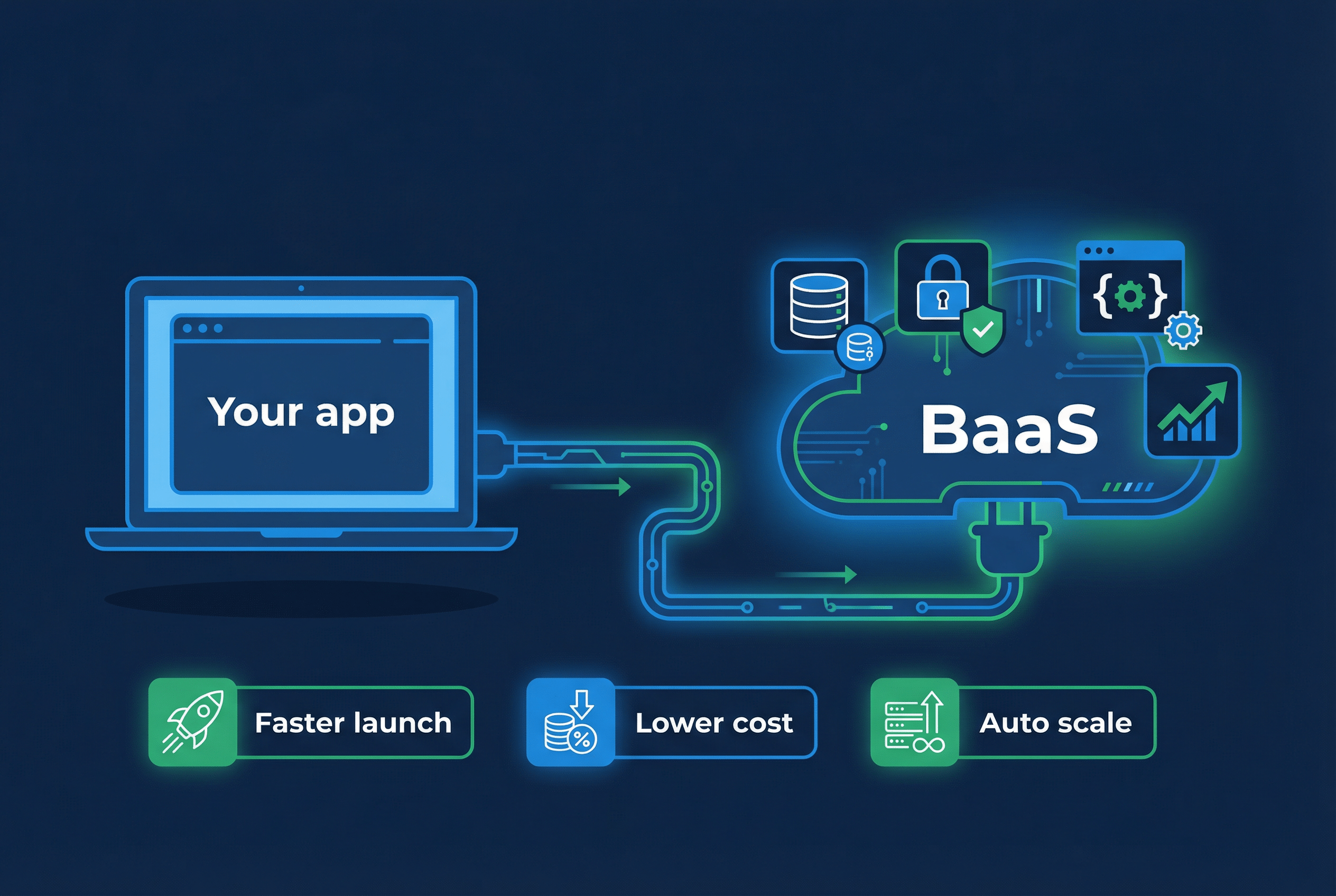
Backend as a Service (BaaS) is a cloud-based service model that enables developers to access backend solutions without having to manage server-side components. It offers critical backend features including databases, file storage, user authentication, and server logic.
By utilizing BaaS, developers may simplify the complexities associated with backend management and focus more on the user interface and the overall user experience. This is especially useful for small teams or startups because it allows them to use resources more effectively and accelerates their development timeframe.
Let’s look at the key advantages of Backend as a Service (BaaS)!
If you are thinking why should you use a Backend as a Service (BaaS)? then BaaS platform offers several benefits, let’s take a look at the main ones.
- Development Speed:- The most noticeable benefit of using Backend as a Service (BaaS) is increasing the development speed. This platform provides useful or reusable codes and helps end-users avoid recreating the wheel.
- Reduce Time to Market:- Increasing the speed of development directly results in getting the product ready for the market as quickly as possible. There are many benefits to startups and enterprises by building a project quickly.
- Performance and Scalability:- The BaaS platform is mainly designed to deploy various systems of applications with diffrent performance requirements. BaaS has all the essential and strong infrastructure needed to launch and manage your application effectively.
- Focus on the core business:- Another benefit of Backend as a Service (BaaS) is that you will be supporting companies focused on core business operations. Those Companies who focus on their core competencies, can concentrate on what they are good at, have more time to manage important things, have more time to motivate employees, etc.
What is Traditional Backend Development?
Traditional backend development refers to the classic approach to building the server side of a web application, focusing on a centralized backend system that manages all data processing, logic, and database interactions through a set of API scripts. The backend is particularly responsible for combining different parts of existing software and services, and also providing support to front-end systems such as databases and servers.
Key Benefits of Traditional Backend Development
Traditional backend development allows full control over performance, scalability, and cost. It has more benefits, so let’s take a look at them.
- Integrate Smoothly:- Backend development streamlines integration between different web technologies. Whether you want to integrate a new payment system, add new functions to your website, or customize the effectiveness and speed of your site, You can do this easily using backend technologies.
- Fulfill Compliance Requirements:- Backend development enables businesses to fulfill their compliance needs. It has now become necessary for many companies to ensure that their data is secure and that customer information is stored safely.
- Customize web experiences:- Backend development helps businesses build customized web experiences for their customers. By understanding the requirements of your target audience, you can create an effective and efficient backend, and satisfied customers with customize web experience.
- In-depth Knowledge Development:- Developers can get a comprehensive understanding of backend systems and technologies by building them from the ground up.
Now it is time to move forward and understand – Backend as a Service (BaaS) vs Traditional Backend Development: Which is Better?
- It is important to consider the specific needs of your project at the time of choosing between Backend as a Service (BOSS) and traditional backend development. Traditional backend development allows full control over performance, scalability, and cost. This approach demands additional time and resources, but it also delivers, scalable solutions tailored to exact business needs.
- BaaS platforms speed up the development process by offering pre-built features and functionalities for tasks such as user management and data storage. Although this can significantly reduce costs and shorten the time to bring a product to market, it may less customization and control over some aspects of the application’s backend infrastructure.
- As BaaS platforms are cost-effective, it is beneficial for those startups or projects that have less budget. Large organizations with complex requirements can go with the traditional backend development because provides more flexibility in functionality and scalability.
- Traditional backend development provides greater flexibility to tailor the backend carefully to your needs, while BaaS may have limitations depending on the provider’s features.
Understanding Backend as a Service (BaaS) in simple language
At the core, imagine building a mobile app that needs user login, data syncing, and analytics, which are quite complex requirements and demand resources. If you go with traditional development practice, you have to hire a team with dedicated expertise in server logic, database management, API writing, and handling the complete deployment part. But a BaaS backend does it for you without requiring the huge budget to hire and employ resources.
So, Backend as a Service, or what we call BaaS, is a platform that runs on the cloud and lets developers utilize prewritten backend functionalities. This includes everything mentioned below and, of course, more than that:
- Authentication
- database management
- file storage
- APIs
- Push notifications
- Analytics
This is like a plug-and-play approach that immediately cuts the cost of development time, where you only have to hire Backend (BAAS) Developers and employ other team members on front-end features.
When you use Backend as a Service BaaS solutions, your development team gets a lot of benefits, with some of the key ones mentioned below.
- Offloading the backend functions like database setup, user authentication, and file storage to a BaaS platform, the teams can save hundreds of manual hours in a project.
- Due to the flexible pay-as-you-go models on cloud-hosted backends, the teams can help their clients to make the project budget efficient because the need to manage physical servers’ cuts.
- Many backend-as-a-service providers give end-to-end encryption, compliance protection, and the best security configuration, which again is something that demands so much time to create manually.
- The job of server maintenance, software patches, and uptime monitoring becomes the responsibility of BaaS, which again frees up developers for some other productive work for the client’s business.
Choosing the Right BaaS Provider
Just like everywhere else, the competition is strong when it comes to picking the right backend as a service provider. Before we talk about the suggestions, be sure to be clear about the requirements of your app, development stack, and future growth plans. Then you are ready to pick from some popular BaaS providers given below:
- Firebase (by Google): ideal for real-time apps with database, hosting, authentication, and analytics (an all-in-one package).
- AWS Amplify: It is a part of Amazon Web Services, which packs really strong backend capabilities if your app is built on React or GraphQL.
- Supabase: for anyone looking for an open-source alternative to the above two, they can go with this SQL-friendly stack.
When Not to Use BaaS?
Although BaaS packs so many benefits, and it might be right for most of the businesses, it might not be ideal for every project. You can avoid BaaS if your project has:
- Complex or custom logic
- Data Privacy Concerns
- Full control and customization requirements
- Avoidance of vendor lock-in (not restricting yourself to a service provider)
Finally
Finally, when it comes to Backend as a Service (BaaS) vs Traditional Backend Development, the decision between the two is entirely dependent on the balance between immediate needs such as budget constraints and long-term goals such as stability and growth potential.
According to the report, Backend as a Service (BaaS) is often preferred over traditional backend development for projects since it includes pre-built backend pieces such as databases, authentication, and APIs, allowing developers to focus on the front-end and essential business logic. On the other hand, if you require complete control over your backend infrastructure and highly customizable features, a traditional method may be preferred.







Comments