
 By

To grow business revenue, improve the return from each sale. Streamline operations, support prices with clear customer value, and remove offers that consume effort without earning a profit. You can also build related income streams. Use financial management practices to connect revenue decisions with costs and cash flow.
More sales alone won’t help if costs rise just as fast or low-margin work drains capacity. Look at what each offer earns and what it takes to deliver. This guide covers ways to increase customer value, improve operations, support premium pricing, and assess new opportunities. Use market research to understand customer needs before changing your offers. The goal is a more resilient revenue model built on deliberate choices, not simply doing more of the same.
Key Takeaways
- Use customer feedback to spot unmet needs and shape new offers around resources you already have.
- Find operational friction by asking employees where work slows down, then simplify or automate tasks that consume time.
- Test how pricing changes could affect demand and revenue before repositioning an offer as premium.
- Assess each product or service by the effort it takes to deliver and the profit it contributes.
- Build complementary revenue streams and partnerships to reduce reliance on a single offer or sales channel.
1. How can I grow my sales and revenue?
Grow sales by increasing the value of existing customer relationships, finding new needs, and tracking the profit each offer generates. For example, set a target to increase revenue by 15% next quarter through relevant upsells. Then review sales and margin performance against that target regularly.
Start with customer feedback. Group comments, support requests, returns, and sales conversations by recurring need. If customers repeatedly ask for an add-on, test whether it fills a genuine gap. Use existing resources and equipment where possible, then offer the solution to interested customers before investing in a wider rollout. Established sales and marketing channels can introduce a new product to current customers or reach a new segment.
Next, segment customers by purchase history, use case, or service needs. A customer relationship management system (CRM) can organize interactions and support tailored offers. For example, a buyer of a core product might receive a relevant accessory offer, while a repeat service customer could see a larger package. Keep cross-sells relevant to the original purchase. Track acceptance, repeat purchases, and returns so a higher order value doesn’t mask a poor customer fit.
Retention can also create expansion revenue. Add-ons, maintenance contracts, or related services can extend a sale and support ongoing customer relationships. For a subscription business, expansion MRR measures the added monthly recurring revenue from existing customers. If MRR rises from $10,000 in June to $12,000 in July, July expansion MRR is $2,000. This isolates growth from the existing base rather than new customer acquisition.
How much does customer acquisition typically cost by industry? There’s no single typical cost across industries. Acquisition costs depend on the channel, sales cycle, audience, and offer. Calculate customer acquisition cost by dividing relevant acquisition spending by the number of new customers gained over the same period. Compare channels consistently.
Before extending credit to a new customer, verify their identity and the legitimacy of their business. Set payment terms that match the transaction’s risk, and monitor invoices for overdue balances. These checks help protect cash flow as the customer base grows.
What are the risks of rapid business growth, and how can they be managed? Fast growth can strain delivery capacity, cash flow, and customer support. Set targets, forecast demand, and review performance against those targets before increasing sales volume or expanding an offer.
Use a repeatable review cycle: collect feedback, prioritize recurring needs, test a relevant offer, and track its sales and profitability. For SaaS businesses, expansion MRR rates of 10% to 30% are common targets. Treat that range as a reference, not a substitute for tracking customer retention and the economics of your own offers.
2. Automating or eliminating inefficient operations
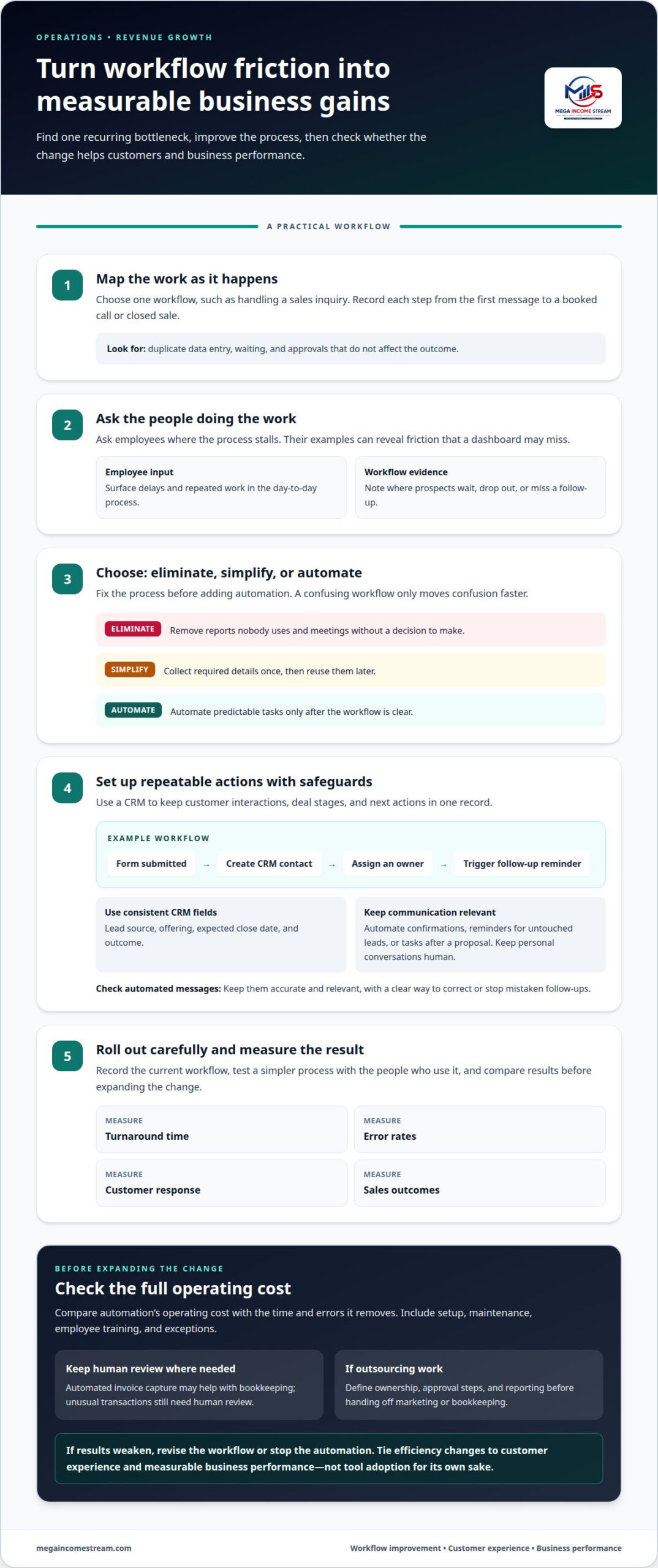
A practical way to think about how to grow business revenue is to recover time and cash before adding new tools or staff. Start with one workflow, such as responding to sales inquiries. Map every step from the first message to a booked call or closed sale. Flag duplicate data entry, waiting, and approvals that don’t affect the outcome. Ask employees who handle the process where work stalls. Their examples can reveal savings that a dashboard might miss.
Separate tasks into three groups: eliminate, simplify, or automate. Remove reports nobody uses and meetings without a decision to make. Simplify paperwork by collecting required details once and reusing them later. Automate predictable tasks only after clarifying the workflow. For example, a form submission can create a CRM contact, assign an owner, and trigger a follow-up reminder. If the process is confusing, automation only moves the confusion faster.
A CRM can keep customer interactions, deal stages, and next actions in one record. Use consistent fields for lead source, offering, expected close date, and outcome. Then compare conversion and sales activity by channel or customer segment. Analytics can show where prospects drop out, such as after a proposal or missed follow-up. Treat the result as a reason to inspect that stage, not proof that a particular tool caused the change.
Sales automation works best for repeatable actions. Set up a workflow to send a confirmation after an inquiry, remind a sales representative about an untouched lead, or create a task after a proposal. Keep personal conversations human. Review automated messages for accuracy and relevance, and provide a clear way to correct or stop mistaken follow-ups. Track completed follow-ups alongside closed deals so activity doesn’t become a substitute for revenue.
When deciding how to grow business revenue, compare automation’s operating cost with the time and errors it removes. Include setup, maintenance, employee training, and exceptions. For instance, a bookkeeping process may benefit from automated invoice capture, while unusual transactions still need human review. Outsourcing marketing or bookkeeping can also free internal capacity, but define ownership, approval steps, and reporting before handing over work.
Use a controlled rollout. Record the current workflow, choose one recurring bottleneck, and test a simpler process with the people who use it. Compare turnaround time, error rates, customer response, and sales outcomes before expanding the change. If results weaken, revise the workflow or stop the automation. This keeps efficiency improvements tied to customer experience and measurable business performance, rather than tool adoption for its own sake.
3. Building brand value to support premium pricing
A premium price needs a clear reason customers can recognize before they buy. Repositioning an offer can support higher prices when the brand communicates distinct value. Start by defining the specific outcome the offer delivers, then align its message, customer experience, and presentation around that outcome. For example, a bookkeeping service could emphasize accurate monthly reporting and clear decision support rather than a generic list of tasks.
Audit each customer touchpoint for consistency. Compare the promise on a landing page with the sales conversation, onboarding, and final delivery. If a premium package claims personalized support, show what that means in practice, such as a named point of contact or tailored recommendations. Remove claims the business cannot consistently deliver. A stronger brand is built on evidence customers can experience, not adjectives alone.
Pricing strategy should reflect both customer value and delivery economics. Map the core offer, its included features, and optional upgrades. Then identify which customer segment values each feature most. A design firm, for instance, might separate a core design deliverable from optional implementation support. Clear tiers help customers compare outcomes and see the added value of each upgrade.
Promotions and discounts can encourage trial, but frequent price cuts may train buyers to wait for a deal. Give each promotion a defined purpose, such as introducing a new package or encouraging a first purchase. Set its start and end conditions, eligible audience, and success measure before launch. Compare the promotion’s sales and profit with the same offer at its regular price. If discounted orders replace full-price purchases, the campaign may shift timing rather than create new demand.
Before changing a price, use forecasting and financial modelling to examine possible effects. Build a baseline from current sales volume, revenue, variable delivery costs, and contribution per sale. Then model alternative prices alongside plausible changes in demand and customer mix. Include promotional costs and additional support requirements. This helps assess whether a higher price could offset lower sales volume or added service demands. Treat assumptions as inputs to test, not guaranteed outcomes.
Use a controlled pricing test where practical. Choose one offer or customer segment, define the comparison period, and record conversion, average order value, refunds, and contribution. Keep other major changes stable so results are easier to interpret. Review customer objections alongside sales data. Repeated questions about value may point to unclear positioning, while objections about a missing feature can guide the next package update.
Make the decision in sequence: clarify the premium promise, align delivery with that promise, model the price change, and measure the response. This links brand strategy to financial performance. The goal is not simply to charge more, but to make the value behind the price clear and consistent while tracking whether the change strengthens revenue and contribution.
4. Identifying and discontinuing unprofitable products or services
Assess each offer by its contribution to profit and the resources it consumes. Revenue alone can make a weak product look successful. Review direct costs, delivery time, support demands, returns, and sales effort for every product or service. A consulting package with frequent revisions may sell well but absorb hours that could serve other clients. Include these hidden workload costs before deciding whether to retain, redesign, or discontinue it.
Use the same method across the portfolio. First, identify each offer’s revenue and direct delivery costs. Next, add the operational work required to sell and support it. Then compare its contribution with the capacity it uses and its role in customer retention. An entry-level product may generate modest profit but introduce buyers to a higher-value service. An offer that repeatedly requires custom work may be a better candidate for repricing or a tighter scope.
Discontinuing an offer doesn’t always mean removing it immediately. Determine whether the problem is weak demand, high fulfillment effort, unclear positioning, or a mismatch between price and scope. For example, a service with regular interest but excessive revisions could be redesigned around defined deliverables. If demand remains low and delivery consumes capacity, phase it out and give existing customers a clear transition path.
Once low-performing offers are clear, consider how stronger products and services can work together. A bundle can pair a core product with related add-ons, while an upsell can offer a larger version to buyers who need more capacity. Product packs can expand from five to ten products. Professional service packages can cover five to ten hours of work. Define what each package includes, then measure its margin and customer response.
Develop a new offer around a specific customer need and a delivery plan. Use customer conversations and sales records to identify a recurring problem. Then assess whether existing equipment, expertise, or sales channels can support a solution. For example, a design studio could test a maintenance service using its current client workflow. A focused pilot can reveal delivery bottlenecks before the studio commits more capacity.
Review the offer portfolio on a consistent schedule. Track sales, contribution, repeat purchases, customer feedback, and team workload for each item. Set targets before making changes, then compare actual results with them. If an offer falls short, document why and choose a response: improve its economics, bundle it with a stronger offer, or discontinue it. This approach helps grow profitable products and services without keeping weak offers out of habit.
5. Diversifying revenue streams and partnerships
Build additional revenue streams around customers, capabilities, and channels the business already understands. Industry research shows that 90% of sales teams use more than one revenue source. That figure signals a common approach, not a guarantee of stronger results. Start by mapping current revenue to its offer, customer segment, and acquisition channel. If sales depend on one offer or channel, identify a complementary source that can reduce that concentration without distracting from profitable core work.
A useful extension solves a related customer problem. A freelance designer, for example, could pair project work with a reusable template or ongoing design support. A software provider might add implementation services alongside subscriptions. Assess the delivery workload, customer demand, and sales path before investing in development. Reuse existing expertise or channels where practical, then test whether customers understand and buy the new offer.
Partnerships can add reach or capability without requiring a fully independent sales pipeline. A consultant might partner with a software implementer whose clients need strategy support. Define each partner’s role, customer handoff, delivery responsibilities, and revenue-sharing method before launch. Agree how referrals will be tracked and customer issues handled. A clear operating process reduces confusion when both businesses serve the same account.
Compare each opportunity with customer acquisition and delivery costs. For a new channel, track the leads it generates, how many become paying customers, and what support those customers need. For partner referrals, record the source and resulting sales in the CRM. Review results over a consistent period, using the same measures across channels. Revenue alone can hide high service demands or low contribution.
Keep experiments bounded. Select one offer and one route to market, such as a referral partnership or an add-on promoted to current buyers. Set a performance target, define a qualified lead, and agree on a review date. If demand appears, check delivery capacity and customer experience before expanding. If the test misses its target, revise the offer, partner process, or audience before adding channels.
Manage concentration as well as growth. A second revenue stream may still rely on the same customer group, platform, or partner, leaving Mega Income Stream exposed to a single disruption. Map these dependencies alongside revenue sources. Then prioritize opportunities that use different routes to customers or meet distinct needs. The practical takeaway: diversify deliberately, measure contribution and customer retention, and scale only the streams that strengthen the overall business model.
Mega Income Stream: Business Strategies
Mega Income Stream’s Business Strategies help entrepreneurs turn revenue goals into practical growth decisions. Use this support when you’ve identified possible changes but need to prioritize pricing, operations, unprofitable offers, or new income streams. Making Money Insights can help frame opportunities, while the Consulting Business supports strategic growth and revenue optimization.
Start by clarifying the decision, the relevant sales or cost data, and the result you want to improve. This creates a focused basis for evaluating options instead of changing several parts of the business at once. Contact Mega Income Stream to discuss your business growth priorities.
Turn your next growth decision into a repeatable system
Revenue growth becomes more manageable when each strategic move has an owner, a measurement, and a clear decision point. Rather than launching several changes at once, select one priority and define what evidence would justify continuing, refining, or stopping it. That discipline makes how to grow business revenue an operating question, not a series of disconnected tactics. A useful decision record captures the intended customer, expected business effect, operational owner, and review signal.
Mega Income Stream offers Business Strategies, Making Money Insights, and a Consulting Business for entrepreneurs weighing growth opportunities and revenue decisions. Use this support when your next move needs clearer priorities or a coordinated plan, rather than another isolated experiment. Before committing resources, distinguish a promising early signal from repeatable performance across customer conversations and delivery demands.
Contact Mega Income Stream to discuss your growth priorities and decide which opportunity deserves focused execution. Your next stage starts with one deliberate decision and a system for learning from it. Keep moving with purpose.
Frequently Asked Questions
How can I grow my sales and revenue?
Grow sales and revenue by improving the path from customer need to completed purchase. Start by identifying where prospects hesitate, such as unclear product details, slow responses, or a difficult checkout. Fix the biggest obstacle first, then compare results with the previous process. For example, a service business could make its proposal easier to understand and track whether more qualified prospects accept it.
What are some common strategies for increasing revenue?
Common strategies include reaching new customer segments, improving product availability, and making repeat purchases easier. A local retailer, for example, could add online ordering for customers who cannot visit during business hours. Before launching a channel, map the additional work, including payment handling, shipping, returns, and customer questions. Choose changes that fit existing capabilities and monitor whether they attract incremental sales.
What is Revenue Expansion?
Revenue expansion is additional revenue earned from customers who already buy from a business. It can come from increased usage, a higher service tier, or a wider product mix. It differs from revenue gained through newly acquired customers. A software company, for example, might earn expansion revenue when an existing account adds more users. Track expansion separately from new-customer sales to see which source drives growth.
What is revenue growth?
Revenue growth is an increase in a business’s sales income between two comparable periods. It measures revenue, not profit: sales can rise while expenses rise faster. To assess the change, compare revenue using the same accounting basis and equivalent periods, then examine which products, customers, or channels contributed. Separate recurring sales from one-time transactions, since their future contribution may differ.
What are the most effective ways to increase business revenue?
The most effective approach depends on the business’s main constraint. If qualified prospects are scarce, strengthen reach and lead qualification. If demand exists but sales stall, address friction in the purchase process. If delivery capacity is constrained, improve the model before increasing demand. Compare proposed changes by customer impact, implementation effort, and revenue contribution, then prioritize one test that addresses the clearest bottleneck.
How can a business increase sales from existing customers?
Make repeat purchasing easier with better onboarding, product education, and timely service reminders. For example, a business that sells equipment could send setup guidance after purchase, then share relevant maintenance information when it becomes useful. Use purchase history to tailor communications, and give customers a simple way to manage preferences. Track repeat orders and customer responses to distinguish useful engagement from messages that create noise.
How can businesses attract new customers and generate more leads?
Choose acquisition channels based on where likely customers look for solutions. A business serving local organizations could publish practical case studies and invite readers to request a focused assessment. Make the next step clear, then record the lead source and whether each inquiry matches the target customer. Review lead quality alongside lead volume; a smaller pipeline of suitable prospects can use sales time more efficiently.
How should businesses price products or services to increase revenue?
Set prices by evaluating customer value, delivery costs, and how buyers compare available options. Separate essential features from optional services, then make package differences easy to understand. Model how a price change could affect sales volume and contribution before applying it broadly. After a change, monitor conversion, customer feedback, and realized revenue, including discounts, to see whether the pricing structure supports sustainable sales.










Comments