
 By
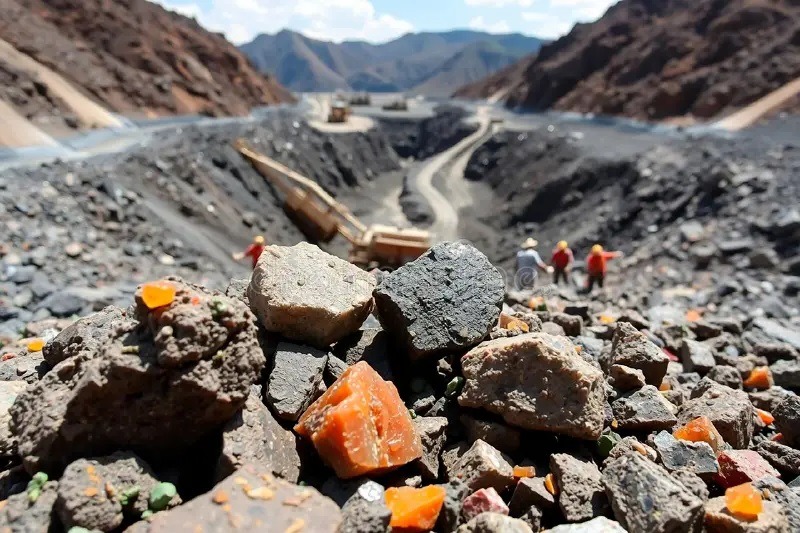
Analysts argue that as global powers compete for crucial minerals, African countries are seeking fresh investment to process more of their own raw materials and meet their people’s needs for economic growth and jobs.
To meet rising demand, the continent must solve power constraints, skills gaps, trade obstacles, and limited industrial capacity.
“This is an unprecedented opportunity for Africa to get on the value-chain bandwagon,” said Hany Besada, senior fellow at the Firoz Lalji Institute for Africa at the London School of Economics and associate professor at the Wits School of Governance.
Africa holds around 30% of the world’s mineral reserves, which include cobalt, lithium, and nickel.
Africa’s Share of Global Critical Mineral Reserves
The International Energy Agency expects lithium demand to grow fivefold by 2040, graphite and nickel demand to double and demand for cobalt and rare earth elements to increase by 50% to 60% by 2040.
Africa needs to “build local value chains that integrate mining with refining and manufacturing and innovation, and this goes hand-in-hand with the green transformation of the continent’s economies,” Besada said.
For example, Zimbabwe, Africa’s top lithium producer, has been nudging mining companies to process the minerals in the country to help lift its economy.
“We are creating new jobs, not only in the mining sector, but in the value addition of our minerals,” Evelyn Ndlovu, minister of environment, climate and wildlife, told Context. “We have got a lot of people coming in to invest in Zimbabwe.”
China’s Zhejiang Huayou Cobalt said in October it would start producing lithium sulphate during the first quarter of 2026 from its new $400 million plant in Zimbabwe.
At the United Nations’ COP30 climate talks in Brazil in November, African countries hope to win support, especially from the Global South, to ensure demand for the minerals fuelling the digital economy and clean energy transition translates into growth, jobs and development.
Africa “wants to be a meaningful participant and beneficiary of the green economy,” said Ibrahima Aidara, deputy Africa director at the National Resource Governance Institute.
“That means an industrial policy that creates jobs, protects rights and enables countries to climb the value chain and not be trapped at the bottom.”
What stands in the Way
Aidara pointed to the Democratic Republic of Congo, which supplies 70% of the world’s cobalt, as an example of a country where mineral wealth has led to child labour, displacement and armed conflict.
Across Africa, barriers to mineral processing – called beneficiation – include a lack of electricity, high tariffs between African countries, infrastructure gaps and cumbersome customs procedures.
“Addressing barriers to trade is critical … If you don’t do that, efforts towards (mineral) beneficiation and industrialisation remain aspirational,” Besada said.
Regional cooperation is also key, including initiatives like the African Continental Free Trade Area (AfCFTA), designed to unify all 1.4 billion people in more than 50 nations into a single market.
Read Also: The Role of Rare-Earth Elements in 5G Infrastructure – Technical Insights
U.S. President Donald Trump’s imposition of tariffs could give momentum to the AfCFTA, which was officially launched in 2021 but has less than half of member states actively trading under the framework.
The African Union’s Green Minerals Strategy, launched this year, and the Lobito Corridor railway, which connects Zambia’s copper belt to Angola’s Atlantic coast, are examples of cooperation that can help make Africa more than a mere supplier.
In West Africa, the minerals boom has sparked a resurgence of resource nationalism, with countries, particularly military regimes like the one in bauxite-rich Guinea, imposing conditions on foreign mining companies to force value addition.
But Aidara said this approach might not ensure lasting benefits to local communities.
“This problem … is bigger than individual countries. We believe at (the) national level we need … well-defined and evidence-based strategies to leverage minerals and create more economic and industrialisation opportunities.”
Listening to Gen Z
The demand for better use of resources is also coming from Africa’s streets. Over the past year, so-called Gen Z protests from Kenya to Madagascar have seen young Africans express their frustration over everything from corruption to power cuts. Demonstrations in Madagascar led to the fall of the president in October.
“Civil society groups and large populations, including the young, hunger for change. With digital proliferation, they see how things have changed in neighbouring countries,” Besada said.
Governments, even dictatorial ones, are mindful that this engaged population may no longer accept that only rich elites, whether they are foreign or local, benefit from national resources.
Growing African middle classes also play a role.
“They pay taxes, they have more of an interest in how economies are shaped and run. They have more to lose if things go badly, and governments understand this,” Besada said.
At COP30, the drive to ensure the energy transition benefits local populations will be on the agenda.
More than 100 civil society groups, including Amnesty International and rights organisations from Brazil to Indonesia, want governments to put transition minerals, and communities affected by mining, at the centre of climate action.
They urged the United Nations and governments to work with Indigenous peoples and civil society, among others, to strengthen governance of the sector.
“Without a drastic shift, the transition will exacerbate and entrench unjust practices and repeat the exploitative patterns of the past,” the groups said in an open letter.




Comments