
 By
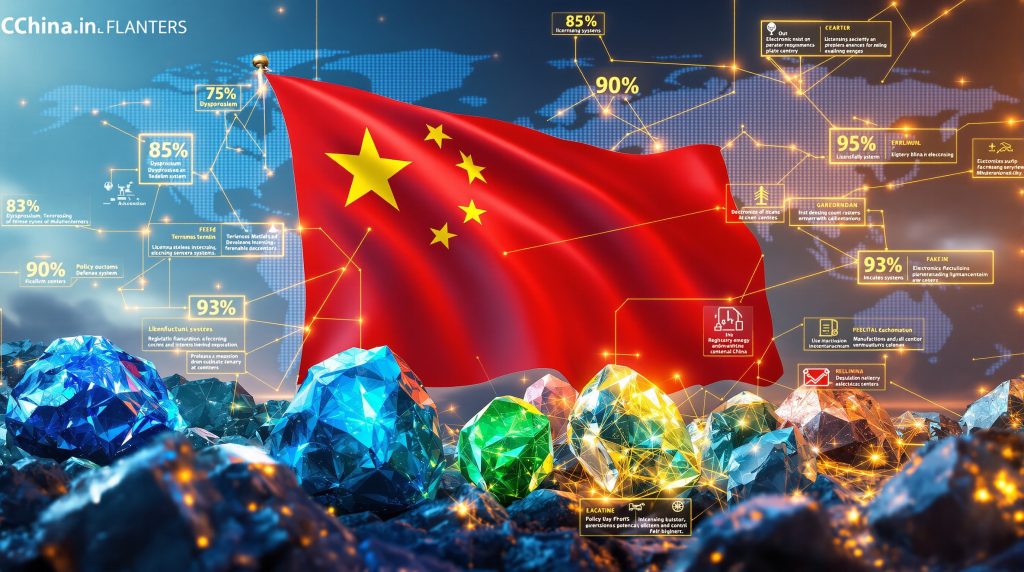
China’s dominance in the rare-earth element (REE) industry, which is defined by almost impenetrable control over the midstream processing and downstream manufacturing phases of the supply chain, continues to be a key component of its geopolitical power in 2026.
Current Market Standing (2026)
- Production & Refining: China accounts for approximately 70% of global mining output but maintains a more critical 85–90% share of global processing and refining capacity.
- Heavy Rare Earths (HREE): Beijing holds a near-monopoly on the separation of high-value HREEs like dysprosium and terbium, controlling an estimated 98–99% of global capacity.
- Industrial Consolidation: The China Rare Earth Group, formed through state-led mergers, controls roughly 70% of domestic production, enabling Beijing to strictly manage global prices and supply through centralized quotas.
Geopolitical Risks
- Strategic Weaponization: China has increasingly treated REEs as “strategic assets” rather than mere commodities. In 2025 and early 2026, it deployed export controls on specific elements and magnet technologies as retaliatory measures in trade disputes with the U.S. and its allies.
- Defense Vulnerability: Western military platforms remain critically dependent; for example, a single F-35 fighter jet requires approximately 410kg of rare earths, making national security architectures vulnerable to supply halts.
- Price Volatility: China’s ability to manipulate supply has led to significant price spikes, creating an unpredictable environment for Western manufacturers of electric vehicles (EVs) and renewable energy technology.
Emerging Opportunities for the West
- Supply Chain Diversification: Countries are aggressively funding “mine-to-magnet” initiatives. Major projects in Australia (Mount Weld), the U.S. (Mountain Pass), and emerging sites in Africa and Vietnam are attempting to break the refining bottleneck.
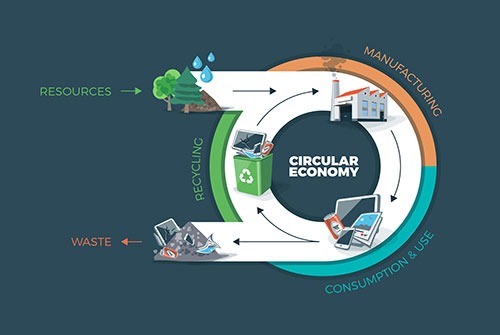
- Urban Mining & Recycling: By 2026, “green chemistry” and bio-leaching technologies are transitioning from pilots to industrial scales, with new regulations in Europe and North America mandating the recovery of REEs from electronic waste.
- Technological Innovation: To bypass dependency, Western firms are investing in REE-free motor designs and hybrid drives that require smaller quantities of permanent magnets.
- Strategic Stockpiling: Nations like India and members of the EU have established critical mineral missions to create emergency buffers against sudden Chinese export restrictions.
Strategic Outlook
Analysts estimate that China will continue to control over 70% of the world’s refining market through 2030 despite significant efforts to decouple because it will take time to construct sophisticated, ecologically responsible processing facilities outside of China. In 2026, the world economy will still function in a “security premium” setting where cost effectiveness is subordinated to supply resilience.
Geographical concentration and deliberate industrial planning coexist in a well designed ecosystem that governs the global rare earth market. One of the biggest supply chain vulnerabilities in contemporary critical materials is China’s supremacy in rare earths, which has an impact on everything from military procurement to the timeliness of electric vehicle production.
Understanding China’s Multi-Layered Dominance Framework
China’s domination in rare earths is demonstrated by several but related control methods that go much beyond straightforward mining activities. The country commands an estimated 85–90% of the world’s processing capacity and produces around 70% of the world’s rare earth oxide output. Global supply chains are impacted by the complex dependency structure created by this division between extraction and value-added production.
Examining heavy rare earth elements makes the processing difference much more noticeable. About 98–99% of the world’s heavy rare earth separation capacity is controlled by China, which creates almost monopolistic conditions for vital elements like terbium and dysprosium. These components are crucial for high-performance applications in defense systems and sophisticated wind turbines, where requirements for magnetic strength and temperature stability surpass conventional limits.
Since their first introduction in 1999, export control methods have undergone substantial change. As a strategic leverage weapon, China’s export quota system was lowered from 65,000 tons per year to about 30,000 tonnes by 2010. Formal quotas were abolished in 2015 as a result of international trade conflicts; instead, licensing controls and regulatory compliance requirements were used to impose tacit restrictions.
Advantages in processing costs result from a variety of structural factors that go beyond labor costs. Chinese facilities gain from:
- Integrated waste management systems built into large-scale operations
- Preferential energy pricing through state-controlled power generation
- Consolidated procurement networks reducing input costs
- Accumulated operational expertise spanning three decades
- Environmental compliance frameworks adapted to local conditions
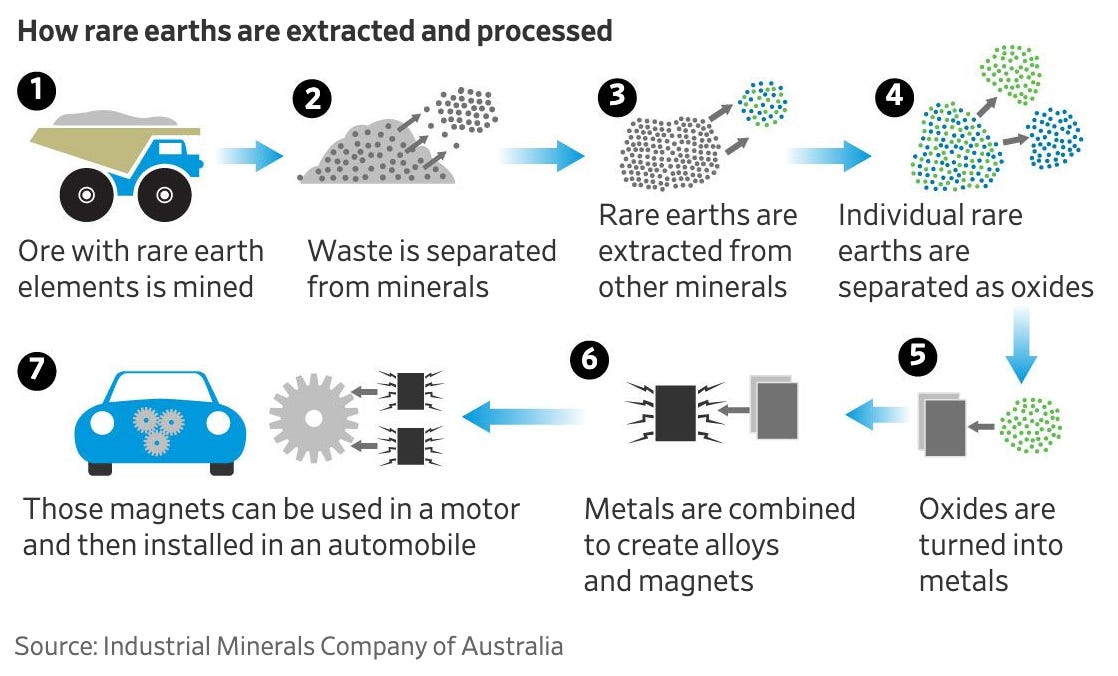
The heavy rare earth processing monopoly represents the most vulnerable aspect of current supply chain architecture. Unlike light rare earth elements, which can be extracted and partially processed at facilities like Mountain Pass in California, heavy rare earths require sophisticated separation techniques using proprietary solvent extraction processes.
Counter-current solvent extraction technology has become the industry standard, with Chinese facilities achieving recovery rates exceeding 95% compared to 80-85% in older Western installations. This technical superiority translates directly into cost advantages and supply reliability, making alternative processing economically challenging.
Light versus heavy rare earth strategic importance creates different vulnerability profiles across sectors:
Light REEs (Neodymium, Praseodymium, Cerium):
- Critical for permanent magnet production in electric vehicles
- Essential for wind turbine generators
- Used in automotive catalysts and glass polishing compounds
Heavy REEs (Dysprosium, Terbium, Europium):
- Required for high-temperature magnetic applications
- Essential in military radar systems and precision-guided munitions
- Critical for specialised electronics and phosphor applications
Heavy rare earths command price premiums 3-5 times higher than light elements due to scarcity and processing complexity. This pricing structure amplifies the economic impact of supply disruptions and creates significant barriers to entry for alternative suppliers.
How Did China Achieve Near-Total Market Control?
The State-Directed Industrial Policy Blueprint
The formation of China Rare-Earths Group in September 2021 represented the culmination of decades-long industrial consolidation strategy. This restructuring combined five major state enterprises into an integrated operational framework controlling approximately 70-75% of domestic rare earth output.
The consolidated entities include China Northern Rare Earth Group, China Southern Rare Earth Group, Baogang Group’s rare earth operations, Jiangxi Copper’s rare earth division, and Shandong Rare Earth Group. This consolidation eliminated internal price competition while creating economies of scale in procurement, technology development, and environmental compliance.
Subsidisation mechanisms operate through multiple channels that create systematic cost advantages:
- Direct government grants for processing facility construction and expansion
- Tax incentives including reduced VAT and corporate income tax waivers
- Preferential access to capital through state-owned banking institutions
- Below-market energy pricing for electricity-intensive separation processes
- Consolidated waste management reducing individual facility compliance costs
These support mechanisms have been estimated to represent $100-200 million annually in direct assistance, supplemented by indirect subsidies through preferential utility pricing that reduces operational costs by 30-40% compared to market rates.
Advanced solvent extraction technology development began during the 1980s through Ministry of Science and Technology innovation programs. Key proprietary advances include internal circulation extraction technology developed in Ganzhou facilities and high-efficiency counter-current extraction methodologies that minimise waste while maximising separation efficiency.
Export restrictions on extraction equipment and technical know-how, formally implemented in 2009 through China’s Catalogue of Technologies Prohibited from Export, created technological barriers for potential competitors while preserving China’s technical advantages.
Resource Consolidation and Reserve Positioning
China’s 44 million metric ton reserve advantage represents approximately 37% of global proven reserves according to U.S. Geological Survey data. These reserves are strategically distributed across Inner Mongolia’s Baotou region (containing roughly 40% of domestic reserves) and southern provinces including Jiangxi, Guangdong, and Fujian (containing 45% of reserves, primarily heavy rare earths).
International acquisition strategies have focused on securing strategic deposits beyond China’s borders. Notable investments include the 2013 acquisition of Tanzania’s Minjingu phosphate deposits through the China-Africa Development Fund, which contain significant rare earth byproducts, and extensive mining operations in Myanmar’s Kachin State.
Myanmar operations exemplify vertical integration strategies where Chinese state enterprises control the entire value chain from extraction through final processing. These operations extract ionic rare earths from weathered mineral deposits, concentrate ore to 30-40% rare earth oxide content, and transport concentrates to processing facilities in Guangdong or Jiangxi provinces.
Furthermore, vertical integration extends from mining through magnet manufacturing, eliminating dependency on external suppliers. Companies like Baogang Group operate mines in Inner Mongolia, own processing facilities for separation and purification, manufacture rare earth metals and alloys, and produce finished permanent magnets for various applications.







Comments