
 By
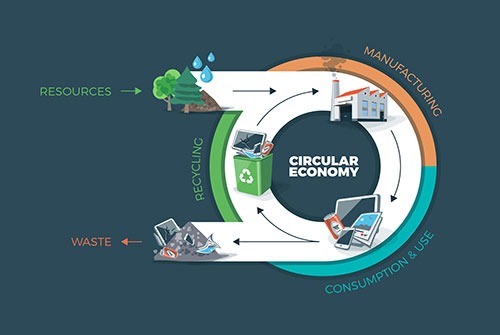
Recycling is becoming an essential, albeit underdeveloped, component of a circular rare-earth element (REE) economy. Driven by rising demand for electric vehicles (EVs) and wind turbines, as well as the need to avoid geopolitical risks from concentrated supply chains, advanced recycling seeks to convert electronic waste (e-waste) into a secondary source of key resources. While only around 1% of REEs are now recycled globally, new technologies are emerging to change that, with the industry expected to reach $1.0 billion by 2030.
Innovations Shaping a Circular Economy
Advanced recycling technologies are turning previously unviable, costly, and inefficient processes into sustainable, high-yield methods:
- Direct Magnet Recycling: Techniques like Hydrogen Processing of Magnet Scrap (HPMS) break down magnet alloys into powder for reuse, saving up to 90% of the energy compared to traditional manufacturing.
- Green Solvents and Hydrometallurgy: The use of ionic liquids and deep eutectic solvents (DES) allows for high-efficiency (~99%) separation of REEs like neodymium and dysprosium with lower toxicity, lower energy consumption, and higher selectivity.
- Bioleaching: Specialized bacteria, such as Gluconobacter, are being used to extract rare metals from waste materials, potentially reducing toxic byproducts.
- AI-Driven Sorting and Robotics: AI-powered systems are enhancing the speed and accuracy of identifying and separating components containing rare earths from complex e-waste streams, with some methods increasing recovery rates by up to 25%.
- Flash Joule Heating (FJH): A rapid electrothermal process that uses electrical pulses to heat materials to nearly 3,000°C within milliseconds, breaking chemical bonds and enabling extraction without extensive chemical processing.
Key Challenges
Despite technological advancements, several hurdles hinder the widespread adoption of REE recycling:
- Low Collection Rates: Currently, less than 1% of REEs are recycled globally. Fragmented e-waste collection systems result in low volumes of feedstock.
- Complexity of E-Waste: Rare earths are often used in small, dispersed quantities within complex devices, making them difficult to locate and separate, often requiring labor-intensive dismantling.
- Economic Viability: The cost of recycling often exceeds the value of recovered materials, making it less competitive than primary extraction, which is favored by many stakeholders.
- Environmental Trade-offs: Some conventional, high-temperature (pyrometallurgical) or chemical-heavy (hydrometallurgical) processes can generate significant waste, although newer methods are addressing this.
- Long Product Lifespans: Larger magnets, particularly in wind turbines, have long lifespans, delaying the availability of material for recycling.
Impact on the Circular Economy
The shift toward a circular REE economy is driven by the need to secure a sustainable supply for electric vehicles, wind turbines, and other green technologies.
- Reduced Environmental Impact: Recycling can reduce environmental impacts (such as toxic waste, water usage, and carbon emissions) by 64–96% compared to primary mining.
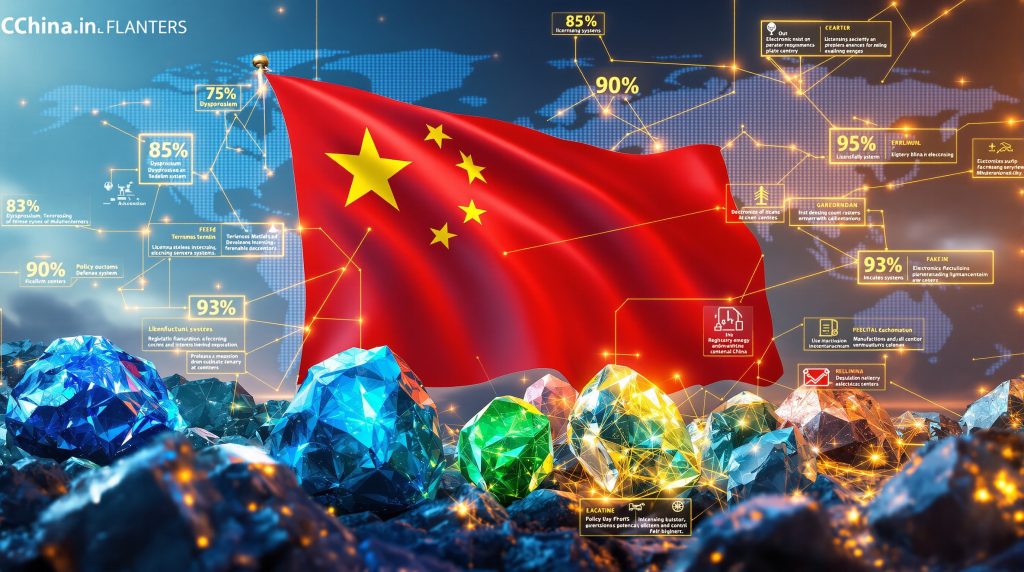
- Supply Chain Resilience: It reduces reliance on volatile foreign markets, particularly China, which controls over 80% of global production.
- Policy Support: Governments (EU, US, Japan) are implementing regulations like Extended Producer Responsibility (EPR) and providing funding for infrastructure to accelerate the transition, aiming for 20% of mineral demand to be met by recycling by 2050.
What Is Rare Earth Recycling Economics?
Rare earth elements (REEs) represent a critical group of 17 metallic elements essential to high-technology and green energy applications. These strategic materials power everything from smartphones and electric vehicles to wind turbines and military equipment, making their sustainable management crucial for global technological progress.
Traditional mining of rare earth elements has significant environmental and economic drawbacks, including massive land disruption, substantial carbon emissions, and geopolitically concentrated supply chains. Recycling emerges as a transformative alternative, offering a pathway to reduce resource scarcity and mitigate geopolitical risks associated with REE procurement.
Importance of REE Recycling
- Reduces dependency on limited geographical sources
- Minimizes environmental degradation from mining operations
- Creates more resilient and decentralized supply chains
- Supports global sustainability objectives
The circular economy is one of the most attractive approaches to decrease reliance on primary mining operations; nevertheless, recycling rare earth elements from end-of-life items poses a complicated web of technological, economic, and strategic obstacles. Despite substantial concentrations of precious elements in discarded electronics, used batteries, and decommissioned renewable energy infrastructure, global recovery rates are now less than one percent. This tremendous inefficiency represents both opportunity and risk for investors, legislators, and supply chain strategists looking for alternatives to traditional extraction methods.
Market dynamics in REE recycling indicate a paradox: technical viability coexists with economic hurdles that preclude broad deployment. To understand these pressures, we must look at both existing processing methods and developing green chemical solutions that have the potential to transform the industry’s cost structure and environmental impact.
Which REE Recycling Methods Are Investment-Ready?
Technology maturity differs substantially amongst recycling approaches, affecting both commercial deployment timescales and investment risk profiles. Understanding Technology Readiness Levels gives critical context for determining whether solutions can actually contribute to supply chain resilience goals within policy-relevant time frames.
Hydrometallurgical Processes – The Proven Commercial Pathway
Acid leaching combined with solvent extraction represents the most mature recycling technology, operating at Technology Readiness Level 8-9 across multiple industrial facilities. This proven pathway involves mechanical pre-treatment, followed by sulfuric or hydrochloric acid dissolution at 50-100°C, then selective solvent extraction using organic extractants such as 2-ethylhexyl phosphoric acid.
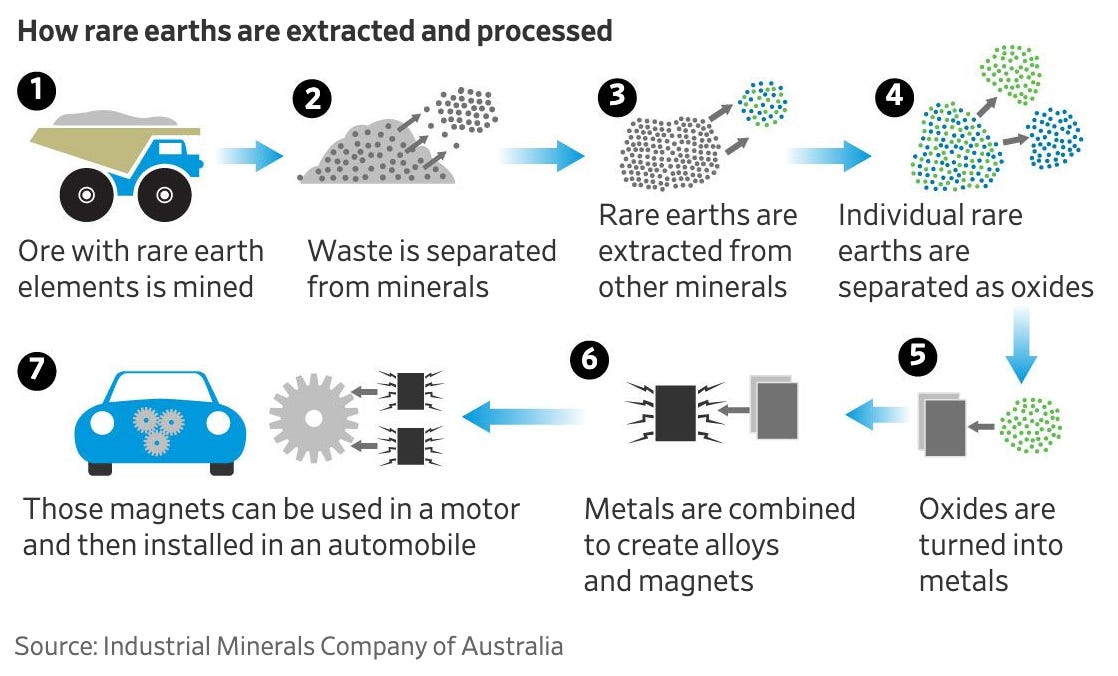
Read Also: From Mine to Magnet: The Full Rare‑Earth Supply Chain Explained – step‑by‑step flow
Industrial-scale facilities currently process 500-5,000 tonnes of pre-concentrated feedstock annually, achieving recovery efficiencies of 90-98% for permanent magnet sources. Purity levels exceed 99.5% for primary-grade oxides or chlorides, meeting specifications for downstream applications. Japanese facilities operated by Shin-Etsu Chemical subsidiaries and European pilot plants demonstrate commercial viability under current market conditions.
Capital expenditure requirements range from $20-50 million for industrial-scale facilities, depending on automation levels and environmental control systems. Operating costs typically fall between $5-15 per kilogram of REE recovered at high utilisation rates, though acid disposal and wastewater treatment add $2-4 per kilogram in environmental compliance costs.
Table: TRL Comparison of REE Recovery Technologies
| Technology | Current TRL | Commercial Readiness | Key Limitations |
|---|---|---|---|
| Acid Leaching | 8-9 | Ready | Environmental concerns, energy intensity |
| DES Systems | 4-6 | 3-5 years | Scale validation needed |
| MOF Separation | 3-5 | 5-10 years | Cost optimisation required |
| Ionic Liquids | 5-7 | 2-5 years | Toxicity assessment incomplete |
| Pyrometallurgy | 7-8 | Near-term ready | High energy consumption |
| Bioleaching | 3-4 | 5-15 years | Process control challenges |
Emerging Green Chemistry Solutions – Deep Eutectic Solvents and MOFs
Deep Eutectic Solvents represent a promising intermediate-term solution, currently at TRL 4-6 with potential for commercial deployment within 3-5 years. These mixtures of Lewis or Brønsted acids and bases exhibit melting points significantly below their individual components, enabling room temperature to 60°C processing compared to traditional high-temperature methods.
Laboratory demonstrations achieve 70-95% REE extraction from permanent magnet waste using choline chloride/urea mixtures, with reduced thermal energy requirements of 30-40% compared to conventional acid leaching. Solvent regeneration through 5-10 cycles appears feasible, though economic optimisation remains incomplete at industrial scales.
Current barriers include cost parity challenges, with DES production costs of $5-10 per litre requiring reduction to under $2 per litre for economic competitiveness. Manufacturing consistency for multi-tonne batches presents scaling challenges, while regulatory approval remains incomplete for some formulations despite generally favourable toxicity profiles.
Metal-Organic Frameworks offer potential for single-stage REE separation without multi-step solvent extraction cascades. These crystalline porous materials demonstrate adsorption capacities of 300-500 mg REE per gram of adsorbent under optimal conditions, with promising selectivity between light and heavy rare earths.
However, MOF technologies remain at TRL 3-5, requiring 5-10 years for commercial readiness. Manufacturing costs currently range from $100-500 per kilogram of MOF material, requiring reduction to under $50 per kilogram for economic viability. Scale-up from gram-level laboratory production to industrial tonne-level manufacturing represents a significant technological leap requiring validation.
Pyrometallurgical vs. Bio-hydrometallurgical Trade-offs
Pyrometallurgical processing operates at TRL 7-8 for specific applications, particularly permanent magnet recycling where high-temperature treatment at 1,000-1,500°C achieves 90-98% recovery rates with minimal impurity carryover. This approach offers the fastest pathway to commercial deployment for magnet waste streams, despite energy costs of $50-100 per kilogram of REE recovered at typical electricity rates.
Environmental considerations include significant energy consumption and emissions, though these may be offset through renewable energy integration or carbon pricing mechanisms. Moreover, the recent development of flash joule heating breakthrough technology offers promising alternatives for energy-efficient processing. Selective application to high-value feedstocks rather than universal deployment appears most economically rational.
Bio-hydrometallurgical approaches remain at early research stages (TRL 3-4) with 5-15 year commercialisation timelines. While these methods promise lower environmental impact through biological extraction mechanisms, challenges include microorganism optimisation, sterility requirements, and process control complexity that limit near-term commercial prospects.
Economic Modelling of REE Recycling Scenarios
A thorough economic analysis of rare earth recycling necessitates the examination of numerous variables across diverse feedstock types, processing sizes, and technological approaches. Market dynamics differ dramatically between permanent magnet recycling, battery processing, and phosphor recovery, with each having unique cost structures and income prospects that influence investment decisions and governmental goals.
Cost-Benefit Analysis by Feedstock Type
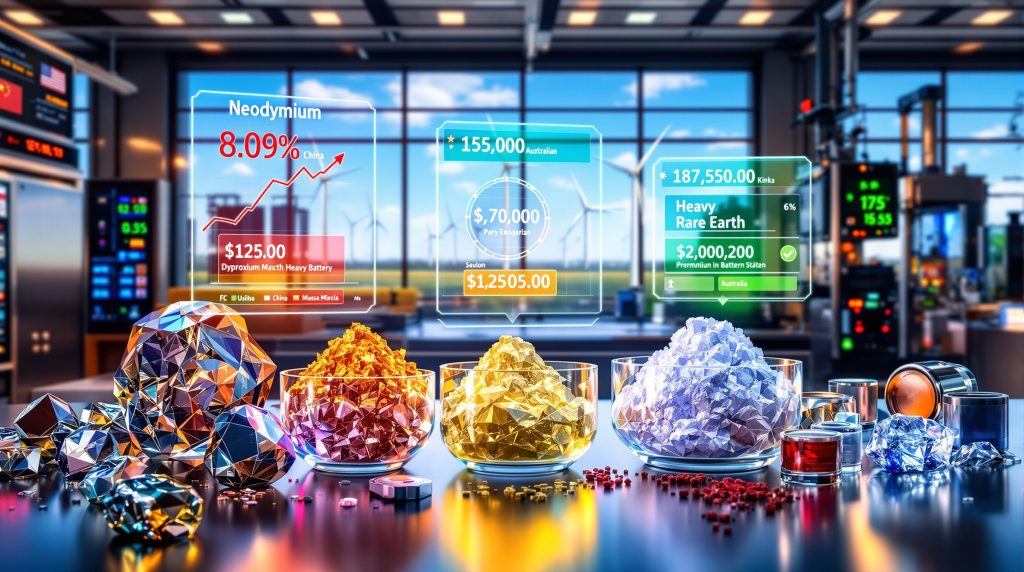
Permanent magnet recycling presents the most favourable economics among current feedstock options. High REE concentrations of 25-35% by weight, combined with established processing techniques, enable recovery costs of $10-20 per kilogram of REE content. Revenue potential depends on product mix, with heavy rare earth elements like dysprosium and terbium commanding premium pricing of $300-800 per kilogram for specification-grade materials.
Economic models for permanent magnet facilities processing 1,000-2,000 tonnes of feedstock annually suggest positive cash flows within 3-5 years at current market prices. Key variables include:
• Feedstock acquisition costs: $0.50-2.00 per kilogram depending on collection infrastructure
• Processing costs: $8-15 per kilogram REE recovered including labour, chemicals, energy, and waste treatment
• Product mix: Heavy REE content significantly impacts revenue per tonne processed
• Market pricing: Rare earth price volatility affects project economics substantially
Table: REE Recovery Potential by Waste Stream
| Source | Annual Volume | REE Content | Recovery Rate | Economic Viability |
|---|---|---|---|---|
| Permanent Magnets | 50,000 tonnes | 25-35% | 90-98% | High |
| NiMH Batteries | 30,000 tonnes | 15-25% | 80-90% | Medium |
| Phosphors | 20,000 tonnes | 5-15% | 70-85% | Low-Medium |
| Electronic Components | 15,000 tonnes | 3-8% | 60-75% | Low |
NiMH battery recycling faces more complex economics due to lower REE concentrations and additional processing requirements for separating rare earths from nickel, cobalt, and other battery materials. Processing costs typically range from $15-25 per kilogram of REE recovered, while revenue potential remains constrained by light rare earth content rather than high-value heavy elements. However, recent developments in battery recycling breakthrough technology may improve these economics significantly.
Phosphor recycling presents the most challenging economics among major waste streams. REE concentrations of 5-15% require higher processing volumes per kilogram of recovered material, while europium and yttrium content varies significantly between fluorescent lamp types and ages. Economic viability often depends on co-processing with higher-value waste streams to achieve scale economics.
Regional Processing Capacity Requirements for 25% Recycling Targets
Achieving 25% recycling rates for rare earth supply would require substantial expansion of processing infrastructure across multiple regions. Current global REE consumption approximates 200,000-250,000 tonnes annually, suggesting 50,000-60,000 tonnes of recycled material needed to meet percentage targets.
Regional capacity requirements vary based on local waste generation and consumption patterns:
• European Union: 15,000-20,000 tonnes annual recycling capacity needed to support regional consumption and achieve policy targets
• North America: 12,000-18,000 tonnes capacity required, concentrated in automotive and electronics recycling
• East Asia (excluding China): 8,000-12,000 tonnes capacity for Japan and South Korea combined
• Other regions: 5,000-10,000 tonnes distributed capacity for remaining global markets
These capacity targets translate to approximately 20-30 industrial-scale recycling facilities globally, each processing 1,500-3,000 tonnes of mixed feedstock annually. Capital requirements range from $15-40 million per facility depending on technology pathway and environmental systems, suggesting total global investment needs of $400-800 million for infrastructure development.
Investment Thresholds for Industrial-Scale Deployment
Commercial-scale REE recycling facilities require minimum throughput levels to achieve cost competitiveness with primary mining operations. Economic modelling suggests threshold capacities of 1,000-1,500 tonnes annual feedstock processing for permanent magnet recycling, with higher thresholds of 2,000-3,000 tonnes for lower-grade sources like electronic waste.
Investment decision frameworks must account for several risk factors:
• Feedstock security: Long-term supply agreements for waste materials at predictable pricing
• Market price volatility: REE price fluctuations can affect project returns significantly over 10-15 year investment periods
• Technology risk: Newer processing technologies may offer advantages but carry execution risk compared to proven methods
• Regulatory changes: Environmental regulations and trade policies can affect both costs and market access
• Competition from primary supply: New mining projects or geopolitical supply changes can impact recycling economics
Venture capital and private equity investment in REE recycling has increased substantially, with funding rounds ranging from $10-50 million for technology development and early commercial deployment. Government co-investment through development banks and strategic investment funds provides additional capital sources, particularly for projects supporting supply chain resilience objectives.
The investment timeline for REE recycling projects typically spans 3-5 years from concept development through commercial operation. Technology selection, permitting, facility construction, and operational ramp-up each require 6-18 months, with additional time needed for feedstock supply chain development and market validation.
Bottomline
Rare earth recycling has great promise. From minimizing supply chain dependencies to resolving environmental concerns, this field combines eco-friendly innovation with future-proofing industries that rely heavily on rare earth metals. While hurdles persist, notably in terms of cost and technological efficiency, recycling’s rapid developments are making it more than just a green alternative, but also a sound economic decision. It’s not only about ‘becoming green’; it’s about long-term profitability and stability.





Comments