
 By
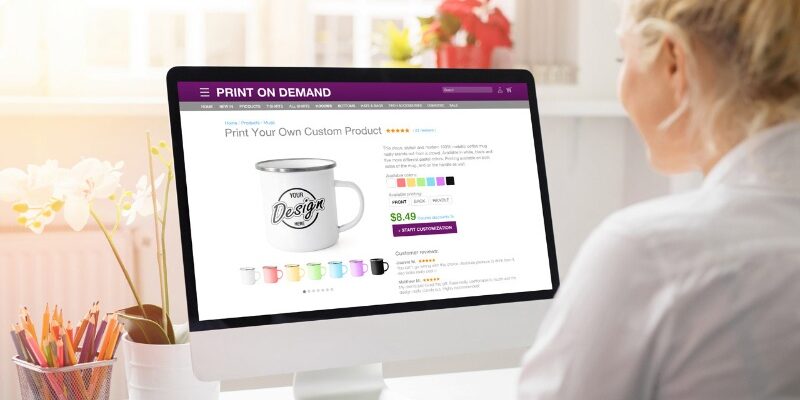
Print-on-demand (POD) is generally the lower-risk option for beginners because products are manufactured only after customers order, eliminating the need to purchase large quantities of stock upfront. Traditional inventory carries greater financial and inventory risk but can offer lower unit costs, faster fulfillment, greater quality control and potentially higher profit margins at sufficient sales volume.
The basic trade-off is:
Print-on-demand = Lower financial risk + Higher unit costs
Traditional inventory = Higher financial risk + Potentially better unit economics
Neither model is universally better.
A new entrepreneur testing 50 T-shirt designs may benefit considerably from POD. An established brand selling 10,000 units of a proven bestseller may benefit from buying or manufacturing inventory in bulk.
The U.S. e-commerce market is large enough to support both models. U.S. Census Bureau data show retail e-commerce sales reached $340.2 billion in Q2 2026, up 12.2% from the same quarter in 2025. E-commerce represented 17.1% of total U.S. retail sales on a seasonally adjusted basis.
Print-on-Demand vs Traditional Inventory
| Factor | Print-on-Demand | Traditional Inventory |
|---|---|---|
| Upfront inventory | Very low/none | Moderate to high |
| Inventory risk | Low | Higher |
| Unit cost | Usually higher | Potentially lower |
| Profit potential | Moderate | Potentially higher |
| Warehousing | Usually unnecessary | Often required |
| Fulfillment | Outsourced | Seller/3PL |
| Product testing | Excellent | More expensive |
| Quality control | Less direct | Greater control |
| Shipping speed | Can be slower | Potentially faster |
| Custom packaging | Limited/provider-dependent | Greater flexibility |
| Unsold stock risk | Minimal | Significant |
| Scaling | Easy operationally | Requires planning |
What Is Print-on-Demand?
Print-on-demand is an e-commerce fulfillment model where an item is produced after a customer buys it. Typical POD products include:
- T-shirts.
- Hoodies.
- Mugs.
- Posters.
- Phone cases.
- Tote bags.
- Books.
- Wall art.
- Personalized gifts.
The process is usually:
Create design → List product → Customer orders → Supplier manufactures → Supplier packs → Supplier ships
Shopify describes POD as a model in which the seller designs products and the supplier produces them once an order arrives. The seller therefore doesn’t need to purchase and manage inventory beforehand.
Printful similarly states:
“Each product is made after it’s bought.”
That one feature dramatically changes the entrepreneur’s financial risk.
What Is Traditional Inventory?
Traditional inventory means purchasing or manufacturing products before customers order them. Suppose you want to sell custom T-shirts. A manufacturer quotes:
500 shirts × $8 = $4,000
You pay $4,000 and receive 500 units.
If you sell them for $30:
500 × $30 = $15,000 potential revenue
But that revenue exists only if customers actually buy all 500 shirts. If only 100 sell, you still own 400.
That’s the defining inventory risk:
Money → Inventory → Hope for sales
With POD, the sequence becomes:
Customer order → Money → Production
That reversal is why POD is so appealing to beginners.
1. Print-on-Demand Has Lower Startup Risk
One of POD’s strongest advantages is the ability to start without buying hundreds of products. Printful currently says it has:
- No setup fees.
- No order minimums.
- No required monthly subscription on its free option.
Merchants pay product, printing, shipping and applicable costs when an order is placed. That makes it possible to test ten designs without manufacturing ten inventories.
Suppose traditional production requires 100 units per design at $10 each. Testing ten designs would potentially require:
10 designs × 100 units × $10 = $10,000
With POD, you could potentially list all ten first and discover which designs customers actually want. That’s a major advantage.
2. Traditional Inventory Can Deliver Better Unit Economics
Low risk has a price. POD products are individually manufactured rather than mass-produced for the retailer. Shopify identifies higher cost per item as one of the disadvantages of print-on-demand because sellers aren’t purchasing inventory in bulk.
Read Also: How to Build a Scalable Print-on-Demand Brand
Consider a hypothetical T-shirt.
POD model
- Selling price: $30
- Production/fulfillment: $15
- Other variable costs: $5
Profit before remaining expenses:
$30 – $15 – $5 = $10
Bulk inventory
- Selling price: $30
- Bulk manufacturing: $7
- Fulfillment/other variable costs: $6
Profit before remaining expenses:
$30 – $7 – $6 = $17
At 1,000 sales:
POD: $10 × 1,000 = $10,000
Inventory: $17 × 1,000 = $17,000
These figures are illustrative rather than typical industry returns, but they demonstrate the economics. Bulk inventory can become extremely attractive when demand is predictable.
3. POD Is Better for Testing Products
Imagine you’ve created these designs:
Design A, B, C, D and E
Which one will sell?
You don’t know. Traditional inventory forces you to make a prediction.
POD allows customers to provide the answer.
Launch all five and measure:
- Click-through rate.
- Conversion rate.
- Sales.
- Returns.
- Customer reviews.
- Repeat purchases.
Suppose the results after three months are:
| Design | Orders |
|---|---|
| A | 12 |
| B | 8 |
| C | 350 |
| D | 4 |
| E | 26 |
Traditional inventory could leave you with boxes of A, B, D and E. POD allows you to identify Design C without making that inventory bet.
4. Traditional Inventory Rewards Accurate Forecasting
Traditional inventory becomes more powerful when demand stops being uncertain. Suppose Design C has sold consistently for 12 months. Now you know:
Customers want it.
Instead of paying POD production costs indefinitely, you could investigate bulk manufacturing. If ordering 5,000 units reduces the product cost by $5 each:
5,000 × $5 = $25,000 potential cost reduction
But only if those products sell. This leads to one of the most important principles in e-commerce:
Inventory creates operating leverage when you’re right and financial pain when you’re wrong.
5. POD Protects Cash Flow
Inventory ties up cash. Suppose your business has $20,000.
You spend:
$15,000 on inventory
Now only $5,000 remains for:
Advertising + Website + Employees + Software + Returns + Packaging + Unexpected expenses
And your $15,000 isn’t necessarily gone—it has been converted into products. But products cannot pay bills until they sell. POD keeps more capital available because manufacturing costs occur as orders arrive.
That can be especially valuable for bootstrapped businesses.
6. Traditional Inventory Provides More Control
POD requires outsourcing a critical part of the customer experience. You may have less control over:
- Production.
- Packaging.
- Shipping.
- Inventory availability.
- Print consistency.
- Product selection.
- Customization.
Shopify specifically lists limited shipping control and customization constraints among POD’s disadvantages. Traditional inventory can give established brands much more freedom.
You can potentially create:
Custom product → Custom box → Branded insert → Premium unboxing experience → Faster fulfillment
That matters when you’re trying to build a recognizable brand rather than simply sell designs.
7. POD Makes International Expansion Easier
Traditional inventory creates another problem:
Where should the stock be stored?
If all your products are in one country, international shipping can become expensive and slow. Large POD networks can manufacture products closer to customers.
Printful, for example, says its international fulfillment network helps merchants sell globally. Most of its orders are currently fulfilled within 2–5 business days before shipping.
That doesn’t mean POD will always deliver faster than stocked inventory. It means outsourced fulfillment can remove some of the operational complexity of international expansion.
8. Traditional Inventory Has the Unsold-Stock Problem
Suppose you buy:
1,000 Christmas sweaters. Christmas ends. You sold 600.
Now you have:
400 unsold sweaters
At a $12 production cost:
400 × $12 = $4,800 tied up in stock
You might need to:
- Discount them.
- Store them.
- Liquidate them.
- Wait until next Christmas.
- Write off part of the loss.
POD largely removes this particular problem because products aren’t manufactured until customers order them. This makes POD especially useful for:
Seasonal designs + Trends + Memes + Experimental products + Niche merchandise
What About Profit Margins?
POD can still be profitable. Printify recommends merchants consider keeping at least a 40% profit margin at the product-pricing stage, although actual net profit after advertising, platform fees, returns, taxes and other expenses can be much lower.
Printify also notes that POD margins are typically thinner than wholesale or bulk-manufacturing models because merchants pay per-unit production costs.
The critical formula for either model is:
Profit = Revenue – Product costs – Shipping – Platform fees – Marketing – Returns – Operating expenses
Don’t confuse a 40% markup or gross product margin with a 40% net business profit.
The Hybrid Strategy: Start With POD, Graduate to Inventory
For many e-commerce businesses, the strongest solution isn’t choosing one model forever. It’s using both.
A practical strategy looks like:
- Step 1: Launch 20 products through POD.
- Step 2: Test designs without buying stock.
- Step 3: Identify the top 20% of products.
- Step 4: Measure stable demand.
- Step 5: Request bulk-manufacturing quotes for winners.
- Step 6: Move proven bestsellers to inventory.
- Step 7: Keep experimental products on POD.
You then get:
POD for experimentation + Inventory for optimization
For example:
| Product | Monthly Sales | Model |
|---|---|---|
| Experimental design | 5 | POD |
| New seasonal shirt | 20 | POD |
| Growing design | 75 | POD/test bulk |
| Established bestseller | 500 | Bulk inventory |
| Flagship product | 2,000 | Bulk inventory |
This approach uses POD to discover demand and inventory to capture economies of scale.
Conclusion
Print-on-demand and traditional inventory represent two different approaches to risk.
POD says:
“I’ll sacrifice some unit economics to avoid buying products before customers want them.”
Traditional inventory says:
“I’ll risk capital upfront to potentially lower costs and gain greater control.”
Neither strategy is automatically superior. The decision depends on one question:
How certain are you that the product will sell? When demand is uncertain, POD can be extremely useful.
Idea → POD → Test → Collect data
Once demand becomes predictable, traditional inventory deserves another look.
Proven demand → Bulk purchasing → Lower unit cost → Greater control → Potentially stronger margins
The latest U.S. Census Bureau figures show the broader opportunity remains substantial: seasonally adjusted U.S. e-commerce sales reached $340.2 billion in Q2 2026, representing 17.1% of total retail sales and increasing 12.2% year over year.
The smarter question therefore isn’t simply:
“Should I use POD or inventory?”
It’s:
“At what point does the evidence justify taking inventory risk?”
For many growing e-commerce businesses, the answer is a hybrid strategy:
Use print-on-demand to discover what sells. Use inventory to optimize products that have already proven they can sell.
That allows you to protect capital when uncertainty is high while pursuing better economics when customer demand becomes measurable.
FAQ
Is print-on-demand better than keeping inventory?
POD is generally better for minimizing upfront inventory risk, while traditional inventory can become financially attractive when demand is established and bulk purchasing meaningfully reduces unit costs.
Can you make a profit with print-on-demand?
Yes, but profit isn’t guaranteed. Pricing must cover production, shipping, marketplace/payment fees, marketing, returns and operating expenses. Printify’s guidance explicitly calculates store profit by subtracting production, shipping and other expenses from sales.
What is the biggest disadvantage of print-on-demand?
Higher per-unit costs and reduced control over fulfillment are major disadvantages. Shopify notes that POD products generally cost more per item because sellers aren’t buying them in bulk.
What is the biggest risk with traditional inventory?
Unsold stock. Capital is committed before customer demand is fully known. Incorrect forecasting can therefore produce excess inventory, storage costs and discounting.
Should beginners start with print-on-demand?
For entrepreneurs selling customizable products, POD can be useful for testing demand without a large inventory commitment. However, product quality, supplier reliability, shipping times and actual margins should still be tested before scaling.
Source: shopify.com





Comments