
 By
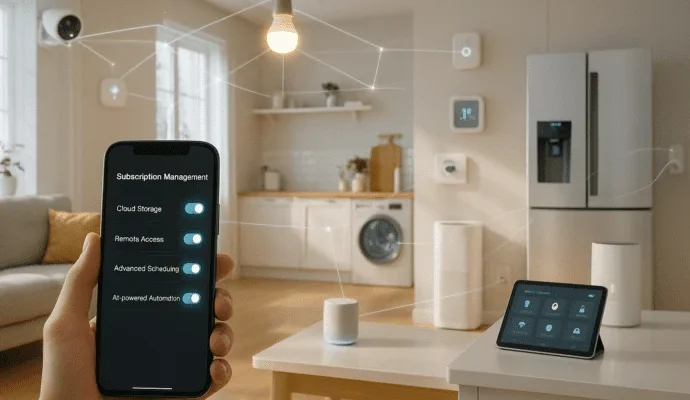
Can your smart home actually earn you money? Yes—but usually not by simply owning smart devices. The most realistic financial benefits come from reducing energy bills, earning utility demand-response incentives, participating in virtual power plants, optimizing home batteries and solar systems, and—where appropriate—voluntarily contributing data to research or commercial programs.
The financial model is better understood as:
Smart devices → Data + Automation → Lower costs or grid participation → Financial benefit
In many cases, therefore, your smart home saves money rather than generates conventional income.
For example, ENERGY STAR says an average certified smart thermostat saves households approximately 8% on heating and cooling bills, or around $50 annually. Homes with high heating and cooling costs can potentially save about $100 annually.
The bigger opportunity is emerging as millions of connected thermostats, batteries, electric vehicles and other Internet of Things (IoT) devices become capable of coordinating with electricity grids.
How Can a Smart Home Make or Save Money?
| IoT Strategy | How It Creates Value | Income Type |
|---|---|---|
| Smart thermostat | Reduces energy consumption | Savings |
| Demand response | Reduces consumption during peak periods | Rewards/credits |
| Virtual power plant | Makes flexible energy capacity available | Incentives |
| Home battery | Stores/shifts electricity | Savings + possible incentives |
| Solar + smart energy management | Reduces grid electricity purchases | Savings |
| Smart EV charging | Moves charging to cheaper periods | Savings/incentives |
| IoT data programs | Voluntary data contribution | Rewards |
| Smart security/monitoring | May reduce losses/costs | Indirect savings |
1. Smart Thermostats Can Turn Automation Into Savings
The easiest form of IoT monetization is energy efficiency. Heating and cooling represent almost half of the average American household’s annual energy bill—more than $900 annually, according to ENERGY STAR.
Smart thermostats can learn or schedule temperature settings, reduce unnecessary HVAC use and allow homeowners to manage systems remotely.
ENERGY STAR says:
“On average, savings are approximately 8% of heating and cooling bills.”
That works out to roughly $50 annually for an average household, although savings depend on climate, occupancy, equipment and individual preferences.
If a household saved $50 annually for 10 years:
$50 × 10 = $500
That’s not income in the traditional sense.
But financially:
$1 saved = $1 that doesn’t leave your household budget.
2. Get Paid to Reduce Electricity During Peak Demand
Things become more interesting when smart homes connect to demand-response programs. Electricity demand isn’t constant. During particularly hot afternoons, for example, millions of air conditioners can run simultaneously, placing enormous pressure on the electricity grid.
Utilities may therefore incentivize customers to temporarily reduce consumption. A connected thermostat could allow the temperature to be adjusted slightly during a peak-demand event.
In exchange, participating households may receive:
- Bill credits.
- Rebates.
- Cash incentives.
- Discounted equipment.
- Other utility rewards.
ENERGY STAR specifically requires certified smart thermostats to have the capability to work with utility programs designed to help prevent brownouts and blackouts while preserving the consumer’s ability to override grid requests.
Your thermostat effectively becomes a tiny grid-management asset.
3. Join a Virtual Power Plant
The more ambitious version of this idea is a virtual power plant (VPP). A VPP coordinates thousands of distributed energy resources, potentially including:
Smart thermostats + Home batteries + Solar panels + EV chargers + Other flexible electrical loads
Individually, each household has limited capacity. Combined, thousands of homes can behave more like a power plant.
The U.S. Department of Energy’s 2025 VPP update provides a striking real-world example.
Arizona Public Service’s Cool Rewards program had enrolled more than 97,500 connected thermostats by November 2024, providing the ability to shed more than 160 megawatts of load during peak-demand events.
That’s the central concept behind monetizing IoT at scale:
One thermostat = Tiny resource
100,000 connected thermostats = Significant grid resource
Utilities and energy aggregators can compensate households for making some of that flexibility available.
4. Monetize a Smart Home Battery
Home batteries can take the concept further. A battery can store electricity when energy is cheaper or plentiful and make it available later when demand and prices are higher.
Depending on your electricity market and utility program, the basic model can look like:
Charge cheaply → Store energy → Use during expensive period
or:
Store energy → Participate in grid event → Receive incentive
Suppose electricity hypothetically costs $0.15 per kWh during one period and $0.35 during another. Moving 10 kWh of consumption could create a gross price difference of:
10 × ($0.35 − $0.15) = $2
Repeat that effectively over many suitable days and the savings can accumulate. Actual economics depend heavily on local tariffs, battery efficiency, equipment costs and utility rules.
Read Also: IoT and Cloud Integration: Smart Devices at Scale
5. Combine Solar Panels With IoT Energy Management
Solar generation becomes more sophisticated when combined with smart-home technology. Instead of simply generating electricity, an energy-management system can potentially determine when to:
- Use solar electricity directly.
- Charge a battery.
- Charge an EV.
- Reduce household demand.
- Draw electricity from the grid.
- Export electricity where local rules permit it.
The objective is:
Produce → Measure → Optimize → Save
This doesn’t mean every smart home with solar becomes profitable. Installation costs, electricity rates, financing, incentives, export compensation and maintenance all affect the economics.
But IoT provides the intelligence required to coordinate the different components.
6. Optimize Electric-Vehicle Charging
An Electric Vehicle can be one of the largest electrical loads in a connected home. Smart charging allows households to schedule charging when electricity prices are lower or grid demand is reduced.
For example, imagine an EV requires 300 kWh monthly.
If smart scheduling hypothetically reduces the average electricity price from $0.30 to $0.20 per kWh:
300 × $0.30 = $90
versus:
300 × $0.20 = $60
Potential monthly difference:
$30
Potential annual difference:
$360
These are illustrative figures rather than typical savings. The underlying strategy is straightforward:
Don’t merely reduce energy consumption—move consumption to economically advantageous periods.
7. Can You Sell Smart-Home Data?
Technically, IoT data can have commercial value. Smart devices can generate information about:
- Energy consumption.
- Temperature.
- Occupancy.
- Appliance usage.
- Environmental conditions.
- Security events.
- Device performance.
Some research, energy or commercial programs may compensate participants or provide incentives for voluntarily sharing specific information. But this is where monetization becomes much more sensitive.
The Federal Trade Commission notes that connected devices can transmit information back to companies and other third parties, while NIST emphasizes that smart-home technology introduces significant privacy and cybersecurity considerations.
Before joining any data-sharing program, ask:
- What data is collected?
- Is it personally identifiable?
- Who receives it?
- Can it be sold onward?
- How long is it stored?
- Can I withdraw consent?
- What am I receiving in exchange?
A $10 reward may not justify surrendering highly sensitive household information.
8. Use Smart Monitoring to Prevent Expensive Problems
Not every financial benefit needs to appear as a payment. Smart-home sensors can potentially detect:
Water leaks + Smoke + Unusual temperatures + Open doors + Equipment failures
Imagine a smart water sensor detects a leak while you’re away. The device doesn’t “pay” you. But if early detection prevents thousands of dollars in water damage, the financial benefit could dwarf the rewards from many direct IoT monetization programs.
This illustrates a broader principle:
Smart-home ROI = Income + Incentives + Energy savings + Avoided losses − Costs
That’s a better measurement than simply asking how much cash a device pays.
Calculate Your Smart-Home ROI
Don’t buy a $500 device merely because the manufacturer says it “saves money.” Calculate the economics.
Use:
ROI = (Financial benefit − Total cost) ÷ Total cost × 100
Suppose a smart-home upgrade costs $600 and produces $150 of annual combined savings and incentives.
Over five years:
$150 × 5 = $750
Net benefit:
$750 − $600 = $150
Five-year ROI:
$150 ÷ $600 × 100 = 25%
That’s only a hypothetical illustration.
Include:
Purchase price + Installation + Subscriptions + Maintenance + Electricity + Replacement costs
when calculating real ROI.
Don’t Ignore Cybersecurity
Turning a home into a network of internet-connected financial assets also increases the number of devices that need protection.
NIST’s 2025 study surveyed 401 U.S. smart-home users across lighting, security devices, sensors, thermostats and voice assistants. Researchers found that security and privacy perceptions differed considerably depending on device category, with voice assistants viewed as particularly problematic.
NIST cautions:
“With the convenience and fun of these tools comes potential security and privacy risks.”
The FTC recommends securing the router connecting IoT devices, changing default administrative credentials, enabling encryption and installing updates. For a monetized smart home, basic security should include:
- Use unique passwords.
- Enable multi-factor authentication where available.
- Keep device firmware updated.
- Secure the Wi-Fi router.
- Remove unsupported IoT devices.
- Review data-sharing permissions.
- Consider separating IoT devices from sensitive computers where appropriate.
- Understand what cloud services each device uses.
Final Thoughts
The future of smart homes isn’t simply:
Lights you can control from your phone.
It’s increasingly:
Connected devices → Automated decisions → Energy flexibility → Economic value
ENERGY STAR says an average certified smart thermostat can save roughly 8% on heating and cooling costs, while the Department of Energy documents utility programs already aggregating tens of thousands of connected thermostats into substantial grid resources.
That points toward a larger transformation.
A future smart home could combine:
Solar + Battery + EV + Thermostat + Smart appliances + Energy-management software
The system could continuously determine when to consume, conserve, store or potentially provide flexibility to the grid.
But monetization shouldn’t come at the expense of security or privacy. NIST’s research emphasizes that connected homes introduce real cybersecurity and data-protection challenges.
The most realistic strategy today is therefore not:
“Buy IoT gadgets and get rich.”
It’s:
Automate consumption → Reduce waste → Join legitimate incentive programs → Protect your data → Measure your ROI
Your smart home may not become your next full-time income stream. But increasingly, it can become an asset that actively manages costs and potentially earns rewards instead of merely consuming electricity.
FAQ
Can a smart home generate passive income?
Potentially, but usually in modest amounts. Utility demand-response programs, VPPs and other programs can provide incentives. Energy savings are currently a more common financial benefit.
Can smart thermostats make money?
They primarily save money, although compatible thermostats may also participate in utility incentive programs. ENERGY STAR estimates average savings of about 8% on heating and cooling bills, or approximately $50 annually.
What is a virtual power plant?
A VPP coordinates many distributed devices—such as batteries and smart thermostats—so they can collectively provide useful capacity or flexibility to the electricity grid.
Can I sell data from IoT devices?
Certain voluntary programs may compensate participants for specific data, but availability varies. Read the privacy policy carefully because smart-home data can reveal sensitive household information.
Is smart-home monetization worth it?
It depends on equipment costs, electricity prices, incentives and how frequently automation creates savings. Calculate total ROI rather than focusing solely on advertised rewards.
Source: freeway.com




Comments